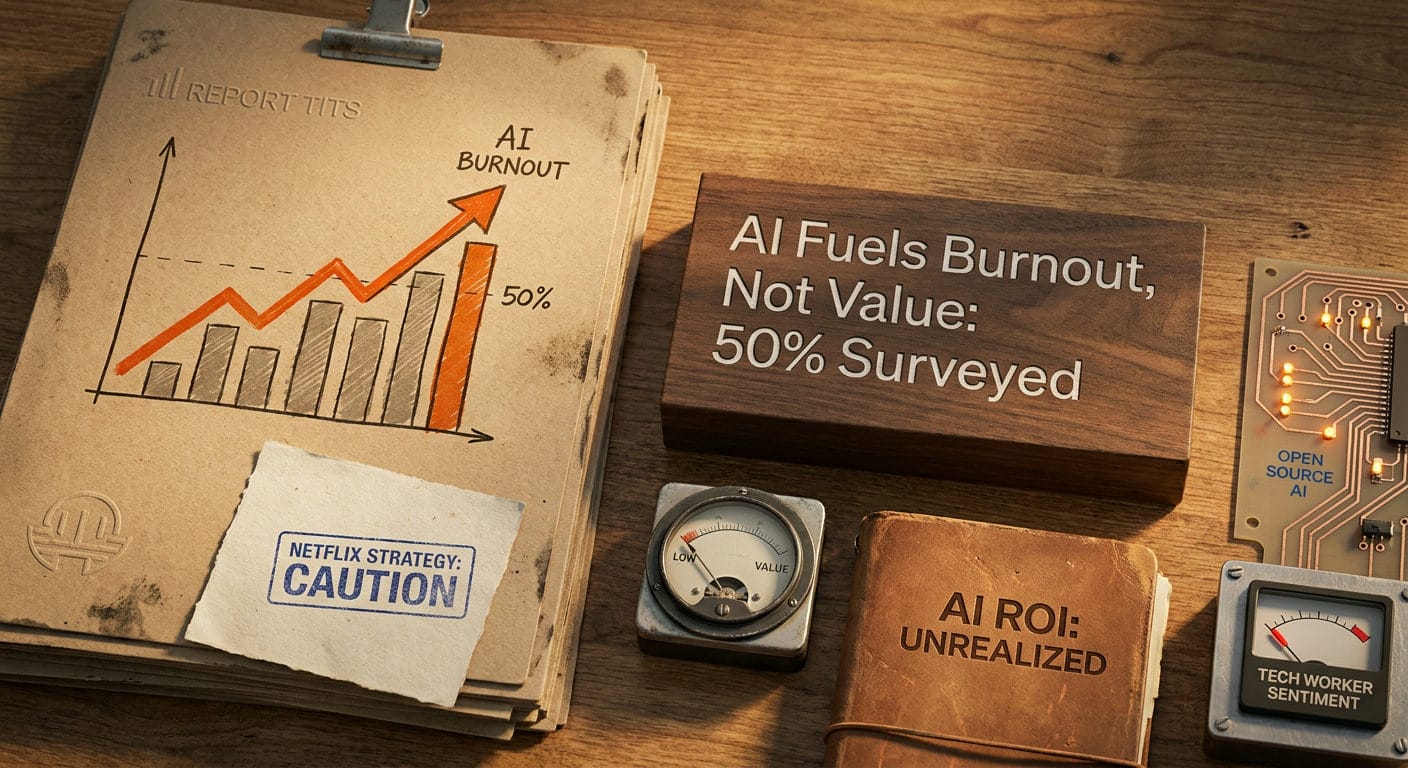
This week, the tech industry confronts a paradox: while AI offers immense potential, it's simultaneously fueling unprecedented burnout, job insecurity, and a chilling "cognitive rot" among workers.
The Intake
📊 11 episodes across 8 podcasts
⏱ 688 minutes of intelligence analyzed
🎙 Featuring: Lenny Rachitsky (Lenny's Podcast: Product | Career | Growth), Noam Segal (Community Research Lead), Lenny (Host)
|

The Big Shift
The tech industry is grappling with a profound sense of ambivalence toward AI, as evidenced by a new Tech Worker Sentiment Survey. While "AI is a tailwind for authenticity" (Adam Mosseri, Head of Instagram on Lenny's Podcast) and empowering creators, its rapid deployment is creating a bifurcated workforce. Half feel amplified, but the other half feel destabilized by "cognitive rot" and surging burnout.
"So burnout is surging. More than half of our sample are feeling significantly burnt out at this point. And at the same time, optimism around the future of our roles and our careers is falling from 54.8% in 2025 to 48.7% in 2026. Bad news for the tech community."
— Noam Segal, Research Leader (former Airbnb, Meta, Twitter, Zapier, Intercom, Figma) on Lenny's Podcast: Product | Career | Growth
The core issue isn't just job displacement by AI, but the "expectation to do more for the same pay and the unsustainable pace of work and technological change" (Lenny, Host on Lenny's Podcast: Product | Career | Growth). This dynamic is driving burnout up by 11 points in a single year and discouraging even founders from recommending their roles to newcomers. The shift away from human judgment and creativity towards mere speed and volume is leaving professionals feeling like their "brain is rotting" and their "work feels worse," even if they are technically "producing more." This tension between AI's promise and its human cost is becoming the dominant narrative, creating a fragile foundation for future innovation.
The Rundown
① AI is not a database; it is a creative tool.
Wix CEO Avishai Abrahami clarified Wall Street's misunderstanding of AI as merely a database, asserting that if SaaS becomes solely a commodity piping provider for AI agents, it risks becoming valueless. (Avishai Abrahami on The Twenty Minute VC (20VC))
→ The signal: This reframes the AI value chain; the true value is in AI's capacity for creative generation, not just information retrieval, and current SaaS models must adapt to this.
② Creative monopolies are built on long-term planning, not hyper-growth.
Peter Thiel’s 'Zero to One' principles advocate for rejecting competition to focus on unique value creation through "creative monopolies," built by "long term planning" and asking "Will this business still be around a decade from now?" (David Senra on Founders)
→ What to watch: This contrarian view suggests that focusing solely on near-term growth metrics, a common venture trap, often blinds founders to building truly durable businesses.
③ Open-source AI is crucial for physical autonomy.
Hugging Face CEO Clem Delangue argues that open-source AI is inherently less dangerous due to transparency, and more critical for applications like robotics to foster trust and enable choice, especially as Chinese models gain dominance. (Clem Delangue on Equity)
→ Why it matters: This highlights a growing geopolitical concern about transparency and control in AI, especially in sensitive areas like physical robots working in private environments.
④ Netflix is chasing YouTube to capture daytime eyeballs and ad revenue.
Netflix is strategically entering the short-form video and podcast market, directly competing with YouTube to boost engagement and diversify its ad revenue model. (Kara Swisher on Pivot)
→ The signal: This pivot reflects investor pressure for growth and signals an end to Netflix's pure subscription model dominance, indicating a broader media battle for user attention.
⑤ OpenAI’s monetization strategy focuses on transaction cuts, not just ads or subscriptions.
OpenAI can control compute allocation, allowing for service degradation for free users, and "monetize through agents taking cuts from transactions rather than direct ads" (Dylan Patel, Founder of SemiAnalysis on The a16z Show). (Dylan Patel on The a16z Show)
→ What to watch: This implies a future where AI models become embedded in commerce, extracting value from every transaction, which could generate significantly higher revenue streams.
Signal Board
🔥 Heating Up
• Custom Silicon: Hyperscalers are increasingly prioritizing custom silicon as a major threat to NVIDIA's dominance in the AI hardware race. (Dylan Patel on The a16z Show)
• Humanoid Robots: Rapid advancements in humanoid robots' ability to learn from human demonstrations and online videos are making the form factor increasingly viable. (Gavin Baker on The a16z Show)
• Agentic Marketing Workflows: Higgsfield's viral growth from focusing on agentic marketing workflows for social media highlights a massive opportunity in AI tools for repetitive marketing tasks. (Alex Mashrabov on The Official SaaStr Podcast)
👀 On Watch
• Instagram Algorithm's Semantic Understanding: Instagram is starting to leverage LLMs and embeddings for more precise recommendations, moving beyond simple engagement metrics. (Adam Mosseri on Lenny's Podcast: Product | Career | Growth)
• Startup Employee Liquidity: Founders are less sensitive to dilution in early rounds, and NVIDIA is offering 'compute now, pay later' models, suggesting a shift towards more flexible financing and reward structures in tech. (Harry Stebbings on The Twenty Minute VC (20VC))
• SaaS Gross Margins in AI: Successful AI-native companies will inherently face lower gross margins, pressing investors to shift their performance expectations from traditional SaaS. (Gavin Baker on The a16z Show)
🧊 Cooling Off
• Traditional Venture Capital Dilution Fears: Founders today are "less sensitivity to dilution" due to the belief that the outcomes can be massive in the AI space. (Jason Lemkin on The Twenty Minute VC (20VC))
• AI Data Center Cost as Primary Constraint: The biggest constraint for AI data center build-outs in the United States is power infrastructure and labor, not the cost of power itself. (Dylan Patel on The a16z Show)
• AI Replacing Human Judgment Immediately: While AI can do more faster, "the output isn't of higher quality," leading to concerns about "cognitive rot" rather than full automation or creative replacement. (Lenny on Lenny's Podcast: Product | Career | Growth)
The Debate
The industry is split on whether the current AI investment frenzy constitutes an unsustainable bubble or a rational, high-ROI buildout.
🐂 The bull case: Gavin Baker, Managing Partner and CIO of Atreides Management, argues forcefully that "I do not believe we're in an AI bubble today... At the peak of the [year 2000] bubble, 97% of the fiber that had been laid in America was dark. Contrast that with today. There are no dark GPUs." He emphasizes that the ROI on current AI spending is highly positive, making the investments rational. (Gavin Baker on The a16z Show)
🐻 The bear case: While not explicitly called a bubble, Alex Karp (Palantir CEO) "sounds the alarm" on enterprises' skepticism towards frontier AI models, citing concerns over data privacy, questionable ROI, and the threat of training competitors' models. This suggests a significant disconnect between current capital flows and enterprise adoption realities. (Harry Stebbings on The Twenty Minute VC (20VC))
Our read: While hardware and infrastructure have clear, immediate returns due to overwhelming demand for compute, the application layer faces scrutiny on ROI and data privacy, suggesting a potential future correction if enterprise adoption doesn't match infrastructure investment.
The Bottom Line
The AI revolution is here, but its true costs—worker burnout, cognitive erosion, and a reckoning with actual ROI—are quickly becoming as central as its promised benefits.
📖 Want the full episode breakdowns, guest details, and listen links?
Episode Guide (Web Version)
1. Lenny's Podcast: Product | Career | Growth — "How tech workers actually feel about AI in 2026 | Annual AI sentiment survey (Noam Segal)"
Runtime: 96 min | Host: Lenny Rachitsky | Guest: Noam Segal (Research Leader (former Airbnb, Meta, Twitter, Zapier, Intercom, Figma) and AI Builder), Lenny (Host)
For the Stretched CEO: This episode is essential for understanding the rapidly eroding morale and trust within your tech workforce due to AI's impact and job insecurity.
A new survey reveals surging burnout (over 50%) and declining optimism among tech workers, with 72% fearing layoffs. Despite AI increasing productivity, many feel their cognitive abilities are diminishing, and no one, including founders, would recommend their roles to newcomers, signaling a deep underlying crisis in tech employment.
"What you're seeing here is that no one is a promoter of their role in tech right now. Not even founders who are by far the happiest, happy go lucky people in tech right now. Founders would not recommend their roles."
— Noam Segal, Research Leader (former Airbnb, Meta, Twitter, Zapier, Intercom, Figma) and AI Builder on Lenny's Podcast: Product | Career | Growth
2. My First Million — "Brainstorming business ideas with a billion-dollar founder"
Runtime: 87 min | Host: Sam Parr, Shaan Puri | Guest: Mark Pincus (Founder, Workplay Ventures)
For the Founder Seeking Scale: Dive into the mindset of a billion-dollar founder on identifying monumental opportunities and navigating platform shifts, particularly in AI.
Mark Pincus, an early Facebook investor, shares his strategy for spotting "lightning in a bottle"—vastly underestimated platform shifts like AI, which he believes will create companies valued in the trillions. He advocates for blurring work and play and using a "proven, better, new" framework for product ideation, focusing on massive, underserved markets.
"If you pick the right body of water, you don't have to pick the right boat, but if you pick the wrong body of water, the best boat isn't going to help you."
— Mark Pincus, Founder, Workplay Ventures on My First Million
3. Pivot — "Netflix Chases YouTube, Meta's AI Photo Grab, and Disney Fights the FCC"
Runtime: 70 min | Host: Kara Swisher | Guest: Matt Belloni (Founding Partner and Host of The Town podcast, Puck)
For the Media Executive: Understand the strategic shifts in content, M&A battles, and the growing influence of AI on traditional media giants.
This episode unpacks Netflix's push into short-form content to rival YouTube, Meta's controversial AI image generation from user photos, and Disney's aggressive stance against FCC challenges. It also delves into a potential antitrust lawsuit for the Paramount-Warner Bros. Discovery merger and Amazon's cancellation of a Sam Altman biopic due to OpenAI ties, highlighting AI's increasing impact on media decisions.
"I wish Netflix would be Netflix and not try to be YouTube, but I understand why they're doing it."
— Kara, Host on Pivot
▶ Listen · Apple Podcasts
4. The a16z Show — "Can Anyone Catch NVIDIA? | The Future of Chips and Infrastructure"
Runtime: 65 min | Host: Erik Torenberg | Guest: Dylan Patel (Founder, SemiAnalysis), Erin Price-Wright, Guido Appenzeller
For the Infrastructure Investor: Gain clarity on NVIDIA's competitive moats, the rise of custom silicon, and the surprising constraints on AI data center build-outs.
Dylan Patel argues that NVIDIA's biggest threat isn't AMD but custom silicon from hyperscalers like Google. The discussion reveals OpenAI's new cost-optimization strategies via GPT-5's router functionality and the shift to usage-based pricing. Unexpectedly, power infrastructure and labor, not power cost, are the primary constraints for US AI data center expansion.
"I think the biggest threat to Nvidia is custom silicon, right: The hyperscalers still can grow CAPEX 20, 30% next year. If AI is concentrated, then custom silicon will do better."
— Dylan Patel, Founder of SemiAnalysis on The a16z Show
5. The Twenty Minute VC (20VC): Venture Capital | Startup Funding | The Pitch — "20VC: Sam Altman Offers Trump 5% of OpenAI: Fool or Genius? | Alex Karp Sounds the Alarm: Enterprises Fear Frontier Models & Questionable ROI of AI | The Rise of Chinese Open Source: Deepseek Building Own Chips"
Runtime: 84 min | Host: Harry Stebbings | Guest: Rory O'Driscoll (Partner, Scale Venture Partners), Jason Lemkin (Founder and CEO, SaaStr Fund)
For the GP/LP: This episode offers a critical look at government influence in AI, evolving founder priorities post-dilution, and enterprise skepticism around expensive frontier models.
Sam Altman's controversial offer of a 5% stake in OpenAI to the US government triggers a debate on increased oversight. Rory O'Driscoll and Jason Lemkin discuss founders' reduced fear of dilution in the AI era and Alex Karp's warnings about enterprise ROI from frontier models. The rise of Chinese open-source AI is also highlighted, challenging Western dominance.
"No one's worried about making their last round high priced investors money anymore. Literally no one is. Because I believe investors have Learned to accept 1x when it doesn't work out without drama, without blocking, without threats."
— Harry Stebbings, Host of The Twenty Minute VC (20VC)
▶ Listen · Apple Podcasts
6. The Twenty Minute VC (20VC): Venture Capital | Startup Funding | The Pitch — "20VC: Wix's Founder on What Wall St Gets Wrong About AI and Wix | Will Base44 Win the Vibe Coding Wars | The Truth About the Economics of Vibe-Coding | The Buyback Disaster: Lessons Learned with Avishai Abrahami"
Runtime: 57 min | Host: Harry Stebbings | Guest: Avishai Abrahami (Co-Founder and CEO, Wix)
For the Enterprise SaaS CEO: Gain an insider's perspective on AI's actual impact on SaaS valuations and the strategic imperative of proprietary AI development.
Wix CEO Avishai Abrahami challenges Wall Street's undervaluing of Wix's AI-powered "vibe coding" product, Base44, arguing that the market wrongly fears AI's impact on SaaS. He reveals that Wix's proprietary AI models are only marginally cheaper than frontier models and stresses execution over financial challenges, while advocating for balanced stock-based compensation and buybacks.
"I think the concept that companies, you know, always issue more and more, decrease their delusion by issuing more shares to employees and for other things is something that should be balanced with buyback when the company can. I'm really in favor of that."
— Avishai Abrahami, CEO at Wix | Base44 on The Twenty Minute VC (20VC)
7. Lenny's Podcast: Product | Career | Growth — "Adam Mosseri: AI is a tailwind for authenticity"
Runtime: 68 min | Host: Lenny (Host, Lenny's Podcast) | Guest: Adam Mosseri (Head of Instagram, Instagram)
For the Product Leader: Essential insights on how AI is reshaping product teams, leadership roles, and user engagement strategies at a major social platform.
Instagram Head Adam Mosseri discusses the shift from large specialist product teams to small, generalist 'pods,' emphasizing that human brains remain crucial for vision and strategy despite AI's growing capabilities. He believes "AI content will be a tailwind" for authenticity, and that despite anxieties, designers' "taste" is hard to automate. Mosseri also highlights Instagram's use of LLMs for algorithmic transparency.
"I'm actually pretty long on design or designers because they tend to have taste. And I think that is something that is much more difficult to imagine being automated away."
— Adam Mosseri, Head of Instagram on Lenny's Podcast: Product | Career | Growth
8. The a16z Show — "Is AI a Bubble? | Gavin Baker on Data Centers, GPUs, and the AI Economy"
Runtime: 32 min | Host: David George | Guest: Gavin Baker (Managing Partner and CIO, Atreides Management)
For the LP Allocator: Get a clear-eyed assessment of whether current AI investments are rational or indicative of a bubble, with comparison to historical tech cycles.
Gavin Baker argues forcefully that the current AI buildout is not a bubble, contrasting it with the 2000 dot-com bust by noting "no dark GPUs" and strong ROI in infrastructure. He identifies Google's TPUs as NVIDIA's primary competitor and predicts lower gross margins for successful AI-native companies, challenging traditional SaaS valuation models.
"I do not believe we're in an AI bubble today. ... At the peak of the [year 2000] bubble, 97% of the fiber that had been laid in America was dark. Contrast that with today. There are no dark GPUs."
— Gavin Baker, Managing Partner and CIO of Atreides Management on The a16z Show
9. Founders — "#424 Peter Thiel on How to Build a Creative Monopoly"
Runtime: 54 min | Host: David Senra | Guest: Peter Thiel (Author, Zero to One)
For the Early-Stage Founder: Learn Peter Thiel's counter-intuitive strategies for building defensible, long-term businesses by avoiding competition and focusing on "secrets."
David Senra explores Peter Thiel's 'Zero to One' concepts of creative monopolies, emphasizing long-term planning over short-term growth and rejecting competition. Thiel's framework for building durable companies—proprietary technology, network effects, economies of scale, and branding—is dissected, along with the critical role of "secrets" and definitive optimism in innovation.
"Long term planning is often undervalued by our indefinite short term world."
— David Senra, Host of Founders Podcast on Founders
10. The Official SaaStr Podcast: SaaS | Founders | Investors — "SaaStr 867: $0 to $500M ARR in 13 Months. Inside Higgsfield's Viral AI Growth with Alex Mashrabov, co-founder and CEO"
Runtime: 37 min | Host: Jason Lemkin | Guest: Alex Mashrabov (Co-founder and CEO, Higgsfield)
For the Growth-Stage CEO: Discover the playbook for hyper-growth in AI-native SaaS, including strategic product bets and controversial ARR definitions.
Higgsfield co-founder Alex Mashrabov details the company's explosive growth to $300M ARR in 11 months, driven by AI-native video creation for social media. He reveals that 70% of their revenue comes from agencies, disrupting traditional models. Mashrabov also clarifies Higgsfield's ARR calculation amid debates, stressing their rapid "time to value" and aggressive ACV expansion.
"We were the first to maybe introduce camera controls and camera controls are extremely important for professional creative directors. We were really surprised that it took off so quickly and within just in like maybe five, six weeks we got to 10 million ARR."
— Alex Mashrabov, Co-founder and CEO of Higgsfield on The Official SaaStr Podcast: SaaS | Founders | Investors
▶ Listen · Apple Podcasts
11. Equity — "Open source AI matters more than ever, according to Hugging Face's Clem Delangue"
Runtime: 38 min | Host: Rebecca Bellan | Guest: Clem Delangue (Co-founder and CEO, Hugging Face)
For the AI Strategy Lead: Understand the rising importance of open-source AI, the geopolitical dynamics of model development, and Hugging Face's capital-efficient approach.
Hugging Face CEO Clem Delangue explains why companies shift from expensive frontier APIs to open-source models as they scale. He highlights "China's growing dominance in open-source AI models" and the risk of power concentration if a few companies control AI. Delangue also reveals Hugging Face's capital-efficient strategy, including turning down NVIDIA investment, and identifies robotics as a key underinvested AI domain.
"In my opinion, the biggest risk in AI is concentration of power. We mentioned some of the AI companies becoming the most valuable companies in the world very soon. In my opinion, they're also becoming the most powerful companies in the world."
— Clem Delangue, Co-founder and CEO of Hugging Face on Equity