
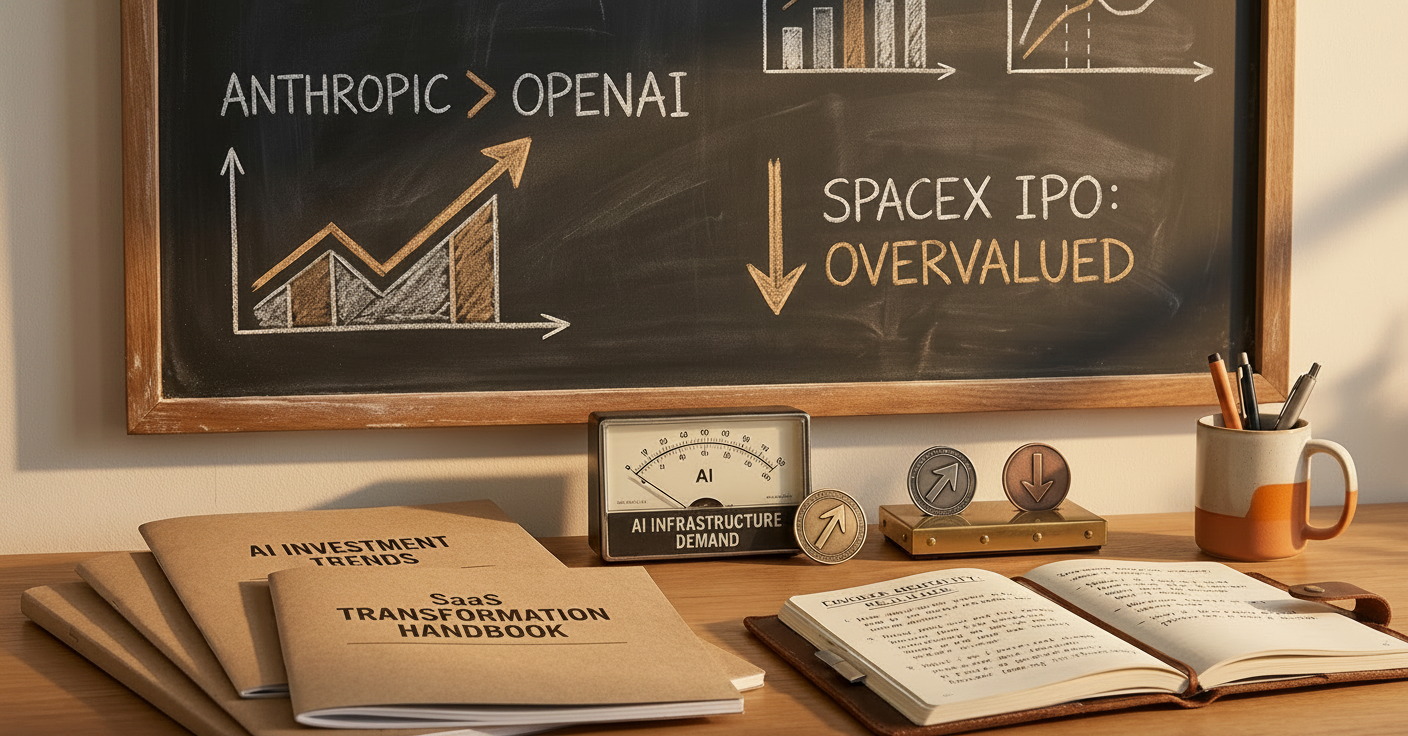
The 'SaaSpocalypse' is dead, replaced by an even hungrier AI market demanding capital, not cash flow.
The Intake
📊 11 episodes across 10 podcasts
⏱ 795 minutes of intelligence analyzed
🎙 Featuring: Eric Ries, Garry, Eric, Jack Farley, Max Wiethe, Ara Kharazian, Dan Shipper, Lenny Rachitsky, Harry Stebbings, Rory O'Driscoll, Jason Lemkin, Andrew Bielecki, Kara Swisher, Scott Galloway, Kirsten Korosec, Anthony Ha, Sean O'Kane, Mike Gelb, Tony Conrad, Mohnish Pabrai, Shaan Puri, Jason Calacanis, Alex, Immad Akhund, Avi Patel, Kyle Norton, SaaStr
|

The Big Shift
The "SaaSpocalypse" narrative is over, but this isn't a return to business as usual. A new, more efficient, and capital-intensive era for software and AI is dawning. Instead of dying, traditional SaaS models are being amplified by AI. Capital markets, meanwhile, are fixated on AI infrastructure with an insatiable appetite for growth over profitability.
The Signal: Ramp's business spending data shows traditional SaaS models like seat-based pricing and platform fees are still dominant. Token-based AI spend is growing but remains a tiny fraction, refuting any notion of a SaaS collapse. As Ara Kharazian, Lead Economist at Ramp, noted on The a16z Show, "My main take is that SaaSpocalypse as a pronouncement has come way too soon and is typically not informed by actual business behavior." Ironically, AI is actually driving *more* SaaS usage and improving margins. "I would buy SaaS stocks right now," said Dan Shipper, CEO and Founder of Every, on Lenny's Podcast: Product | Career | Growth, because users are bringing their own AI tokens to apps, boosting demand at no direct cost to SaaS providers.
The Twist: AI is still disruptive—just not where everyone was looking. Capital markets are underwriting enormous bets on AI infrastructure and foundational models, highlighted by Anthropic's staggering valuation and Salesforce's heavy spending on its tokens. AI is also spawning entirely new software categories like Answer Engine Optimization (AEO) that legacy players can't touch. The money isn't displacing SaaS; it's flooding into foundational AI and the next generation of applications. Companies like Owner.com prove how aggressive, centralized AI strategies can lead to 4x the ARR per rep, carving a path to hyper-efficiency for traditional SaaS.
Why it matters: Founders and investors should follow the money, not the narratives. The 'SaaSpocalypse' was a red herring. The real story is the rise of AI-augmented SaaS and massive infrastructure bets. Strong SaaS businesses with a clear AI strategy are still attractive, but pure-play AI models command astronomical valuations (and CapEx). Investors are chasing the next layer of the tech stack. As Rory O'Driscoll noted on 20VC, "If ARR multiples are the proxy for value, then this is the best value in the venture universe." This has created a market where AI infrastructure and novel AI-native GTM strategies fetch high multiples, while traditional SaaS must show clear AI integration to keep growing.
The move: Prioritize AI solutions that enhance existing SaaS workflows, don't just try to replace them. Founders should use AI to create structural efficiencies in their GTM, like Owner.com. Investors should keep watch on the deeply capitalized AI infrastructure plays, but with a sober understanding of the massive CapEx and speculative risk.
The Rundown
① The Rise of "Purposeful Incorporation" to Defend Against Shareholder Primacy.
Founders should adopt governance models that protect their mission from short-term financial pressure. That means considering "purposeful incorporation" through structures like a Public Benefit Corporation (PBC) from day one. (Eric Ries on Y Combinator Startup Podcast)
→ Why it matters: Shareholder primacy, a fairly new academic idea, can destroy long-term value and get founders ousted. As The Lean Startup author Eric Ries put it, "If you are a Delaware C corp, the thing you make is not a beautiful living thing that creates products and delights customers... No, it's just a financial instrument for investment returns."
② Venture Capital Now Disrupting the Defense Industrial Complex.
The slow, non-competitive defense industry is being disrupted by startups like Divergent Technologies, which use venture-style models to build military hardware faster and cheaper. (Lukas Czinger on This Week in Startups)
→ The signal: This shift injects competition into a critical sector. Advanced manufacturing techniques like AI-driven 3D printing are proving transferable from hypercars to cruise missiles. "It's amazing how this military... has been infected by entrepreneurship and also by the venture capital industrial complex," observed Jason Calacanis, Host of This Week in Startups.
③ AI Demands More Humans, Not Fewer: The "Automation is a Lie" Paradox.
Despite rising automation, companies are finding they need *more* people to manage agents, review output, and direct AI systems. (Dan Shipper on Lenny's Podcast: Product | Career | Growth)
→ What to watch: AI is commoditizing "yesterday's human competence," but it creates new work in leveraging that competence. Human roles are shifting to oversight, quality control, and strategic direction for AI agents. Dan Shipper, CEO and Founder of Every, put it bluntly: "Automation is a lie. Every agent needs a human."
④ SpaceX Valuation Under Scrutiny Despite Starlink's Profitability.
Analysts are calling **SpaceX's** ambitious $1.75 trillion IPO valuation "overvalued." The concerns center on a huge Total Addressable Market (TAM) untethered from real numbers and rising costs in divisions outside the profitable Starlink. (Kirsten Korosec on Equity)
→ Why it matters: This signals skepticism about how public markets will treat speculative mega-IPOs. Starlink may be a success, but stapling on money-losing ventures like XAI makes the overall valuation precarious. As Scott Galloway, Host at New York Magazine, lamented, "If this [Starlink] were the whole company, it would be one of the great businesses of our era. But the problem is it's not. Stapled to this rocket ship is XAI a business that is, clinically speaking, a money furnace."
⑤ Founder Mentality as a Key Differentiator in Investment Decisions.
For early-stage investing, finding the "right founder" with traits like curiosity, thoughtful questions, and strong storytelling is more critical than market or execution—especially with today's inflated seed valuations. (Tony Conrad on Consumer VC: Venture Capital I B2C Startups I Commerce | Early-Stage Investing I Brands | Technology)
→ The signal: In a market ripe for correction, conviction in a founder’s psychology—their ability to create something from nothing and their long-term vision—is what matters most. Tony Conrad, Partner at True Ventures, stressed, "On the fund level, there needs to be a path. Got to really believe on every investment you make that if things went right... you could return the entire fund."
Signal Board
🔥 HEATING UP
• Anthropic: Surpassed OpenAI as the most popular AI model for businesses, per Ramp data, signaling a shift in enterprise adoption. (Ara Kharazian on The a16z Show)
• Founder-led software companies using AI for growth: Showing accelerated growth by integrating AI tools for operational efficiency and GTM. (Jason Lemkin on 20VC)
• Mercury Bank: Nearing $1 billion in revenue and pursuing a bank charter, signaling strong growth and expansion in fintech. (Immad Akhund on This Week in Startups)
👀 ON WATCH
• Tony Conrad 🆕: A seasoned VC emphasizing founder psychology and historical market parallels for navigating the current AI landscape. (Tony Conrad on Consumer VC: Venture Capital I B2C Startups I Commerce | Early-Stage Investing I Brands | Technology)
• Avi Patel 🆕: CEO of Kled, publicly calling out a Y Combinator startup and General Catalyst for alleged copying and potential ethical breaches. (Avi Patel on This Week in Startups)
• True Ventures 🆕: Its partner-as-founder model gives it deep entrepreneurial insight into investments. (Tony Conrad on Consumer VC: Venture Capital I B2C Startups I Commerce | Early-Stage Investing I Brands | Technology)
• AI-native GTM strategies: Companies like Owner.com are hitting 4x ARR per rep by aggressively embedding AI into their go-to-market motions. (Kyle Norton on The Official SaaStr Podcast: SaaS | Founders | Investors)
❄️ COOLING OFF
• Wix and Squarespace: Losing ground to Shopify in merchant services and the relative ease of building custom-coded websites. (Rory on 20VC)
• Chemical imbalance theory of depression: Debunked as a marketing ploy that lacks scientific evidence, leading to misdiagnosis and over-prescription. (Mark Horowitz on This Week in Startups)
• Shareholder Primacy: Increasingly seen as a threat to long-term company value, driving founders toward alternative governance models. (Eric Ries on Y Combinator Startup Podcast)
The Debate
Topic: The Valuation of Early-Stage AI Startups and Big Tech's AI Bets
🐂 The bull case: High valuations and massive capital deployment are justified by the sheer demand for AI infrastructure. Anthropic’s valuation and major acquisitions signal a deep belief in AI’s transformative power, making these investments look like a bargain for what’s next. As Rory O'Driscoll, Guest on 20VC, argued, "If ARR multiples are the proxy for value, then this is the best value in the venture universe."
🐻 The bear case: The AI market, especially for companies with huge CapEx like **SpaceX's** AI division, looks a lot like the dot-com bubble’s unsustainable spending. Sky-high valuations could lead to a crash if revenue or demand doesn't materialize. Scott Galloway, Host at New York Magazine, bluntly called **SpaceX's** XAI "clinically speaking, a money furnace," casting doubt on the entire $1.75 trillion valuation.
Our read: The AI market is undeniably speculative. Valuations are based on promise, not profit. The key for investors will be to separate the truly foundational technology from the hype.
The Bottom Line
The AI gold rush is shifting from a 'SaaSpocalypse' narrative to a high-stakes CapEx gamble, rewarding AI-augmented efficiency and mission-driven governance while inflating the valuations of anything foundational.
📖 Want the full episode breakdowns, guest details, and listen links?
Episode Guide (Web Version)
1. Y Combinator Startup Podcast — "How The Best Companies Defend Against Mediocrity And Rot"
Runtime: 50 min | Guests: Eric Ries (Author, The Lean Startup, Incorruptible), Garry (Host, Y Combinator), Eric (Advisor (implied), Anthropic)
For the Strategic Founder: This episode is a must-listen for founders thinking about long-term governance and how to protect their mission from shareholder primacy. It digs into the history and consequences of the concept, offering concrete alternatives.
Eric Ries, author of "The Lean Startup," discusses choosing governance models like Public Benefit Corporations (PBCs) to prioritize mission over profit. He argues that many corporate "best practices" actually destroy value and that shareholder primacy is a modern academic consensus, not a legal mandate.
"If you are a Delaware C corp, the thing you make is not a beautiful living thing that creates products and delights customers... No, it's just a financial instrument for investment returns."
— Eric Ries, Author of The Lean Startup on Y Combinator Startup Podcast
2. This Week in Startups — "From hypercars to cruise missiles: Lukas Czinger on the future of US defense | E2292"
Runtime: 107 min | Guests: Jason Calacanis (Host, This Week in Startups), Lukas Czinger (CEO and Co-founder, Divergent Technologies), Lon Harris (Guest), Mark Horowitz (Co-founder, Outro Health) , Brandon Good (Co-founder, Outro Health)
For the Innovation-Driven Investor: This episode covers the surprising startup disruption of the defense industry, along with a deep dive into the real science of antidepressant withdrawal.
Lukas Czinger discusses **Divergent Technologies'** move from hypercars to 3D printing lightweight military components with its AI-driven manufacturing platform. The conversation also debunks the "chemical imbalance" theory for antidepressants as a marketing story and introduces hyperbolic tapering for safer medication reduction.
"Divergent had really a industry agnostic and product agnostic brief from the very start. So we started in auto and then we got involved in the defense line of work using that same engineering practice, AI driven engineering practice."
— Lukas Czinger, CEO and Co-founder of Divergent Technologies on This Week in Startups
3. The a16z Show — "Why AI Isn’t Killing SaaS Yet"
Runtime: 40 min | Guests: Jack Farley (Host, The a16z Show), Max Wiethe (Host, The a16z Show), Ara Kharazian (Lead Economist, Ramp)
For the SaaS CEO: This data-driven episode debunks the "SaaSpocalypse" narrative, showing how traditional SaaS models are holding strong while AI creates new competitive fronts and entirely new product categories.
Using Ramp's business spending data, Ara Kharazian shows that traditional SaaS is flourishing. The analysis also reveals **Anthropic** has surpassed **OpenAI** in business adoption and highlights the emergence of new AI-native software categories like AEO.
"My main take is that SaaSpocalypse as a pronouncement has come way too soon and is typically not informed by actual business behavior."
— Ara Kharazian, Lead Economist at Ramp on The a16z Show
4. Lenny's Podcast: Product | Career | Growth — "The AI paradox: More automation, more humans, more work | Dan Shipper"
Runtime: 94 min | Guests: Dan Shipper (CEO and Founder, Every), Lenny Rachitsky (Host)
For the Forward-Thinking Leader: A contrarian take on AI's impact on work, this episode argues that more automation will require more, not less, human oversight and interaction, challenging the "SaaS apocalypse" narrative.
Dan Shipper argues that automation will create more human work in managing AI agents. He makes a bullish case for SaaS stocks, predicting user-supplied AI tokens will increase usage and margins for existing platforms. He also boldly declares the CLI is dead.
"Automation is a lie. Every agent needs a human."
— Dan Shipper, CEO and Founder of Every on Lenny's Podcast: Product | Career | Growth
5. The Twenty Minute VC (20VC): Venture Capital | Startup Funding | The Pitch — "20VC: Andrej Karpathy Joins Anthropic & Anthropic Raises $30BN at $900BN Price | SpaceX Files S1: How Does it Trade | Cerebras Smashes Day 1: What it Means for IPOs | Why Mass Layoffs Are More Worrying Than Anyone Sees"
Runtime: 82 min | Guests: Harry Stebbings (Host, The Twenty Minute VC (20VC)), Rory O'Driscoll (Guest), Jason Lemkin (Guest), Andrew Bielecki (Co-founder and CEO, Klaviyo), Rory (Guest Analyst), Jason (Guest Analyst)
For the VC Strategist: A sharp dissection of key movements in AI and public markets, including **Anthropic's** valuation, **SpaceX's** IPO prospects, and the re-acceleration of public tech stocks. A must-listen for understanding the strategic implications of market dynamics.
Harry Stebbings and his guests discuss **Anthropic's** massive valuation and AI's growing role in enterprise ops. They also analyze **Cerebras's** successful IPO in the AI inference space and debate the sustainability of compute-hungry businesses, warning of a potential data center glut.
"If ARR multiples are the proxy for value, then this is the best value in the venture universe."
— Rory O'Driscoll, Guest on The Twenty Minute VC (20VC): Venture Capital | Startup Funding | The Pitch
6. Pivot — "James Murdoch & Vox Media, SpaceX IPO Predictions, and Bezos Gets Defensive"
Runtime: 67 min | Guests: Kara Swisher (Host, New York Magazine), Scott Galloway (Host, New York Magazine)
For the Media and Tech Investor: A critical look at digital media M&A, a skeptical take on the **SpaceX** IPO, and sharp parallels between today’s tech market and past bubbles, with pointed commentary on leadership and philanthropy.
Kara Swisher and Scott Galloway discuss James Murdoch's acquisition of Vox Media and express deep skepticism about **SpaceX's** IPO valuation, particularly with its money-losing side ventures. They draw direct parallels to the 1999 dot-com boom, slamming unsustainable CapEx in AI and questioning **OpenAI's** aggressive valuation targets.
"The business model for tech has been to consolidate the market and then start sucking the oxygen out of the entire ecosystem."
— Scott Galloway, Host at New York Magazine on Pivot