
The biggest bottleneck for AI isn't chips or algorithms, but the physical power infrastructure—and for investors, its cost, sustainability, and geopolitical implications are the new frontier.
📊 12 episodes across 10 podcasts
⏱ 548 minutes of intelligence analyzed
🎙 Featuring: Rachel Warren, Hannan Happi, Hanan
|

The Big Shift
The AI race has fundamentally shifted from a chip and algorithm contest to a brute-force infrastructure build-out, with energy grid capacity emerging as the unexpected choke point. This pivot means the next wave of AI winners will be defined by their ability to secure and manage power, not just process data.
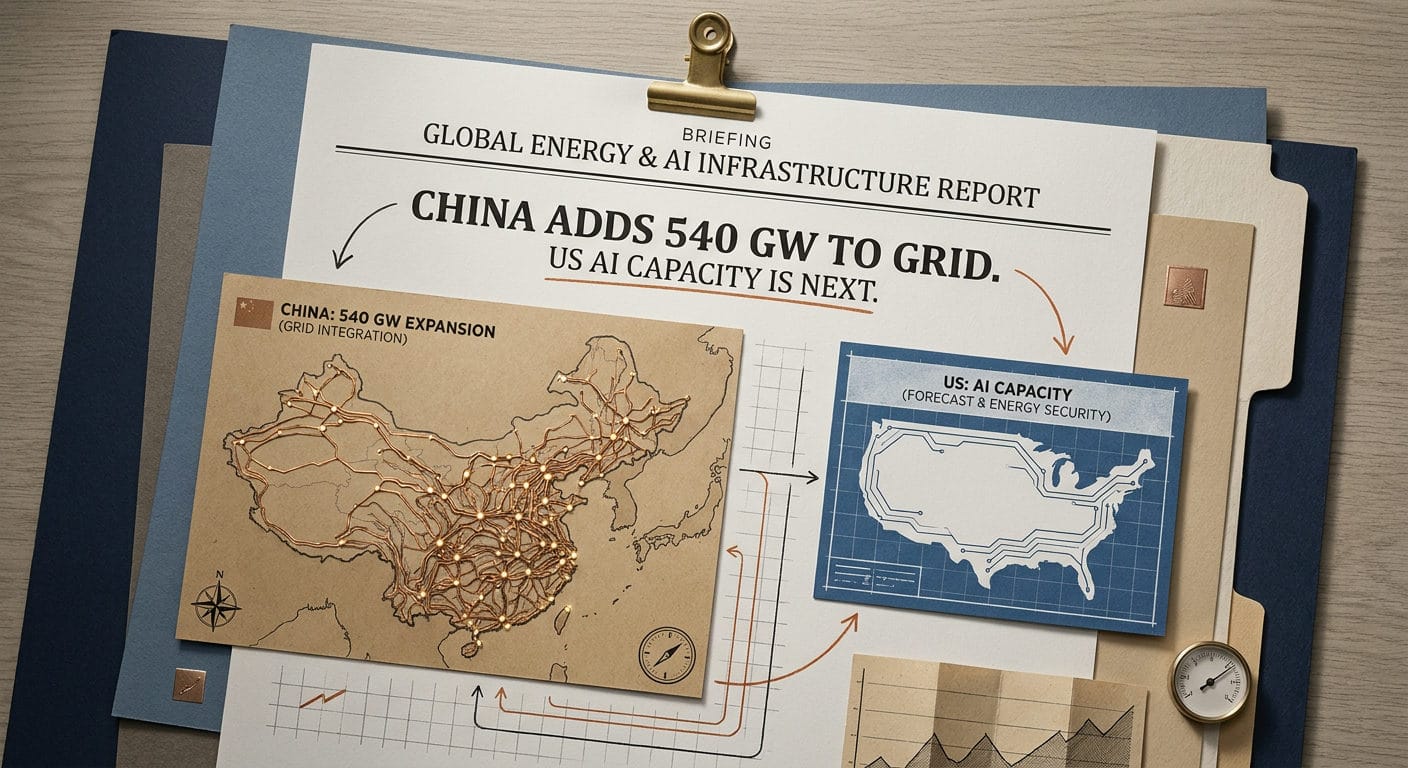
Why it's happening: The insatiable demand for AI compute capacity translates directly into a massive need for power. According to Hannan Happi, Co-founder and CEO of Exowatt, during a discussion on Motley Fool Money, China is adding 540 gigawatts of power to its grid annually, "more than 10 times our capacity" in the US. This disparity creates a significant challenge for American AI ambitions. This structural disadvantage is forcing companies to re-evaluate how and where they build data centers.
The new playbook: To circumvent utility grid delays and community opposition (NIMBYism), the strategy is shifting towards building data centers on "frontier land" with dedicated, on-site renewable energy solutions. Hannan Happi highlighted that "A year delay, if you just take that as a number, is about $12 billion of missed revenue opportun" for a hyperscaler, emphasizing the urgency.
"The next generation of AI winners will be defined less by their breakthrough technology and more by their ability to build out."
— Hannan Happi, Co-founder and CEO of Exowatt on Motley Fool Money
The critical implication: This isn't just about electricity; it's about the financial viability and long-term sustainability of AI investments. Investors and operators need to look beyond traditional CapEx returns. As Hanan, CEO of Exawatt, noted on Motley Fool Money, assessing "the environmental and political stability of data center locations" is paramount to ensure revenue streams are viable for decades, especially given the potential for "massive penalties" or outright halts for gas-powered facilities.
The level to watch: The capacity and reliability of regional power grids and the regulatory environment for new energy infrastructure. Delays of 12+ months signal significant headwinds for AI-driven growth.
The Rundown
① Treasury's New Liquidity Play Signals Risk-On Ahead.
The US Treasury, through the actions of Scott Bessent, is considering funding bond buybacks via the Treasury General Account (TGA), a move that could inject significant liquidity into the financial system. (Andreas Steno on Real Vision: Finance & Investing)
→ Why it matters: If executed, this TGA liquidity injection would directly benefit risk assets like Bitcoin and gold by enabling hedge funds to increase leverage, potentially extending the current market cycle through 2027.
② Nvidia's Profit Margins Face Internal Threat from Hyperscalers.
While competition from AMD is often cited, Matt Frankel on Motley Fool Money noted that Nvidia's biggest threat to its 75% gross margins isn't just rival chipmakers but hyperscalers developing their own custom AI chips to bypass Nvidia's CUDA moat.
→ Why it matters: CFOs reliant on Nvidia's ecosystem should monitor hyperscaler internal development; success here would signal a significant shift in AI hardware power dynamics and potentially reduce compute costs.
③ Structured Notes Market Thriving Despite ETF Alternatives.
Despite the rise of defined outcome ETFs, the structured note market continues to grow, driven by persistent investor demand for defined outcomes and improved technological access. (Matt Radgowski on Animal Spirits Podcast)
→ Opportunity: Financial advisors and wealth managers should explore AI-powered tools like Halo's Aura for precise portfolio integration of structured notes, as client demand indicates a resilient and growing asset class.
④ Public Equity Investing Now Mimics Venture Capital for Tech.
Nick Colas, Co-founder of DataTrek Research, highlighted on The Compound and Friends that public equity investing, particularly in tech, has evolved to resemble venture capital, with companies reinvesting nearly all cash flow into long-term 'science projects' rather than returning it to shareholders.
→ Implication for Investors: Expect less immediate shareholder return from tech giants as they prioritize speculative, long-term R&D, requiring a re-evaluation of valuation models that traditionally rely on near-term cash flows.
⑤ Domino's Pizza's EPS Growth Hides Revenue Stagnation.
Domino's has achieved impressive 15% EPS growth for two decades despite only 6% revenue growth, primarily through shrewd capital allocation via its asset-light franchise model and debt-funded share buybacks. (Kyle Grieve on The Intrinsic Value Podcast - The Investor’s Podcast Network)
→ CFO Takeaway: This exemplifies how financial engineering and optimized capital structures can drive shareholder value even with moderate top-line growth, but risks include franchisee dissatisfaction and increased debt exposure.
⑥ Gen Z's Ambition-Work Ethic Disconnect Challenges Employers.
Suzy Welch, Professor of Management Practice at NYU, explained on Bloomberg Surveillance that Gen Z exhibits high ambition for competitive jobs but a declining "work centrism," leading to disillusionment with traditional work contracts and confusion about career paths.
→ HR & Management Call: Companies need to rethink traditional career paths and incentives to engage a generation that seeks achievement but values work-life balance and self-knowledge over conventional work-first commitments.
Signal Board
📈 Heating Up
• Energy storage for AI data centers: Identified as a new significant growth engine, addressing the grid stability challenges posed by intermittent AI compute demand spikes. (Manish Karira on We Study Billionaires - The Investor’s Podcast Network)
• Nigeria's agriculture growth: Growing close to 6% annually since 2000, surpassing rates seen in Asian powerhouses like China in the same period. (Joe Studwell on Odd Lots)
• Ethereum's Role in Mass Tokenization & AI Settlement Layers: Projected to be a standout in the next crypto cycle due to its critical role in an AI-powered, agentic economy. (Tom Lee on Bankless)
🆕 On Watch
• Nvidia (NVDA): Its earnings report is seen as an inflection point for the broader market, with a focus on whether its 74% gross margins are sustainable given internal hyperscaler competition. (Jon Quast on Motley Fool Money)
• Treasury General Account (TGA) Buybacks: The potential use of TGA funds for bond buybacks could inject substantial liquidity, making hedge funds marginal Treasury buyers and boosting risk assets. (Andreas Steno on Real Vision: Finance & Investing)
• Gen Z employment challenges: This generation is highly ambitious but increasingly disillusioned with traditional work contracts, impacting talent acquisition and retention. (Suzy Welch on Bloomberg Surveillance)
• Dangote Refinery: IPO in Nigeria signals potential for significant African economic development through large-scale industrialization. (Joe Studwell on Odd Lots)
📉 Cooling Off
• AI Data Center Overbuilding Concerns: Demand for AI compute is scaling faster than hardware is shrinking, suggesting that current buildouts are unlikely to result in overcapacity, defying initial concerns. (Rachel Warren on Motley Fool Money)
• Anthropic's Momentum: Has stalled relative to OpenAI due to compute capacity issues, shifting business momentum perceptions. (Andreas Steno on Real Vision: Finance & Investing)
• CATL's 15.5% profit margin expansion: Identified as a 'cost wedge profitability fluke' that is not sustainable due to contractual obligations and supplier squeeze tactics. (Ralph Summerford on We Study Billionaires - The Investor’s Podcast Network)
The Debate
The sustainability of bond yields amid fiscal deficits versus the impact of Treasury intervention.
🐂 The bull case:Kelsey Berro, Executive Director, Fixed Income at JPMorgan Asset Management, believes that while 30-year Treasury yields reached 5.3% causing intervention, "To really get stabilization in the markets right now, it's not just one factor. You're going to need multiple factors to come together." This implies a potential for stabilization through a combination of market forces beyond just direct Treasury action.
🐻 The bear case:Sarah House, Senior Economist at Wells Fargo, counters this by arguing that bond buying is merely a short-term fix. "This isn't going to bring rates sustainably lower. The underlying issue is really these unsustainable fiscal deficits," she stated on Bloomberg Surveillance, suggesting that the structural fiscal problems will continue to exert upward pressure on yields regardless of interventions.
Our read: While short-term stabilization might be achieved through intervention, the fundamental fiscal imbalances suggest sustained pressure on yields unless underlying deficits are addressed.
The Bottom Line
The AI revolution has moved from the chip factory to the power grid, making energy infrastructure the critical battleground for capital and a key determinant of future winners and losers.
Episode Guide (Web Version)
Motley Fool Money — "America Is 10x Behind China in AI Infrastructure — The CEO Building the Solution"
Runtime: 30 min | Host: Rachel Warren | Guests: Hannan Happi (Co-founder and CEO, Exowatt), Hanan (CEO, Exawatt)
For CEOs & Investors: Essential listening for understanding the strategic challenges and opportunities in AI infrastructure, particularly concerning energy and geopolitical competition.
This episode details how the US lags China in grid capacity for AI, pushing companies like Exowatt to build dedicated, renewable energy solutions for data centers on "frontier land" to avoid costly delays and community backlash. It emphasizes that the next AI winners will be defined by their ability to build out infrastructure, not just technology.
"China adds 540 gigawatts of power to the grid per year, so more than 10 times our capacity."
— Hannan Happi, Co-founder and CEO of Exowatt
We Study Billionaires - The Investor’s Podcast Network — "TIP840: CATL: Powering EVs, Power Grids, and AI w/ Stig Brodersen, Manish Karira & Ralph Summerford"
Runtime: 79 min | Host: Stig Brodersen | Guests: Manish Karira (Guest, We Study Billionaires - The Investor’s Podcast Network), Ralph Summerford (Forensic Accountant, We Study Billionaires - The Investor’s Podcast Network)
For Supply Chain & Energy Investors: Provides a deep dive into CATL's market dominance and its crucial role in the global energy transition, from EVs to AI data center power infrastructure.
The episode analyzes CATL, the world's largest battery maker, exploring its competitive advantages, R&D, and strategic moves like its LRS model, while also dissecting risks such as price deflation, geopolitical tensions, and the sustainability of its profit margins.
"My main thesis on CATL is that this company is more than a battery company. I think it is fast becoming the backbone of of the energy infrastructure."
— Manish Karira, Guest at We Study Billionaires - The Investor’s Podcast Network
The Intrinsic Value Podcast - The Investor’s Podcast Network — "TIVP092 (Video): Domino's Pizza (DPZ): Is the Royalty Engine Still Running? w/ Kyle Grieve & Shawn O'Malley"
Runtime: 76 min | Host: The Investor's Podcast Network | Guests: Kyle Grieve (Guest Analyst, The Investor's Podcast Network), Shawn O'Malley (Guest Analyst, The Investor's Podcast Network)
For Private Equity & Franchise Operators: Offers a detailed analysis of Domino's asset-light franchise model, capital allocation, and the nuanced risks of managing franchisee relationships.
This discussion dissects Domino's Pizza's unique royalty-driven model, showcasing how it achieves 15% EPS growth with only 6% revenue growth through strategic capital allocation and supply chain management, while also highlighting the critical importance of franchisee relations.
"I mean, how else really can you describe their ability to increase their earnings per share by 15% over that exact same time period when they were just delivering 6% revenue growth?"
— Kyle Grieve, Guest Analyst at The Investor’s Podcast Network
Animal Spirits Podcast — "Talk Your Book: The Alternative to Alternatives"
Runtime: 31 min | Host: Michael Batnick | Guests: Ben Carlson (Host, The Compound), Matt Radgowski (CEO, Halo), Matt (Guest, Halo Investing)
For Financial Advisors & Wealth Managers: Explores the growing structured notes market, how AI is simplifying analysis, and advanced strategies for managing concentrated wealth.
The hosts and Matt Radgowski from Halo discuss how AI is transforming structured note analysis for financial advisors, noting the resilient growth of structured notes despite the rise of defined outcome ETFs due to investor demand for defined outcomes and technological access.
"AI is perfect for this, for helping understand. What the att, how does this change things? They're obviously taking a big part in this too."
— Michael Batnick, Host at The Compound
Bloomberg Surveillance — "Bloomberg Surveillance TV: August 24th, 2026"
Runtime: 23 min | Host: Bloomberg | Guests: Anne Walsh (CIO, Guggenheim Partners Investment Management), Brian Gardner (Chief Washington Policy Strategist, Stifel), Troy Gayeski (Chief Market Strategist, Future Standard)
For CFOs & Portfolio Managers: Provides insights into credit market dynamics, concentration risk in private AI markets, and the impact of political policies on trade and investment.
This episode features discussions on increased investor nervousness due to market fragmentation, the risks of significant debt issuance in the AI sector, and the concentration of capital in private AI markets, alongside analysis of US trade policy and private debt credit quality.
"My concern about the data center build out and the cost of that is the obsolescence risk in the long term."
— Anne Walsh, CIO of Guggenheim Partners Investment Management
Motley Fool Money — "1 Earnings Report That Could Move the Market"
Runtime: 26 min | Host: Jon Quast | Guests: Matt Frankel (Guest, Motley Fool), Rachel Warren (Guest, Motley Fool)
For Equity Analysts & Tech Investors: Focuses on Nvidia's market dominance, the sustainability of its high margins, and the evolving competitive landscape in AI hardware.
The team discusses Nvidia's upcoming earnings, its 95% market share in data center GPUs, and the implications of its 75% gross margins, exploring potential competitive threats and the 'overbuilding' concern for AI data centers through the lens of Jevons Paradox.
"Nvidia is sitting at 74% gross margin, basically for every hundred dollar a product that they sell. It only costs them $36 to make it in direct costs."
— Jon Quast, Host at Motley Fool
Real Vision: Finance & Investing — "Scott Bessent Just Changed the Liquidity Setup | Macro Mondays: August 24, 2026"
Runtime: 33 min | Host: Andreas Steno | Guests: Mikkel Rosenvold (Host, Real Vision)
For Macro Strategists & Risk Managers: Critical intelligence on potential shifts in market liquidity, the competitive dynamics of AI, and geopolitical risk factors.
This episode unpacks the impact of Scott Bessent's decision to double bond buybacks, potentially funded via the TGA, which could inject significant liquidity and benefit risk assets. It also covers the competitive landscape between Anthropic and OpenAI and escalating geopolitical tensions.
"It is much more likely today than it was two weeks ago that the cycle will run through 2027 as well, in my opinion."
— Andreas Steno, Host at Real Vision
Odd Lots — "The Nigerian Industrial Behemoth That Could Reshape the African Economy"
Runtime: 58 min | Host: Joe Weisenthal | Guests: Tracy Alloway (Host, Bloomberg), Joe Studwell (Senior Visiting Fellow & Author, Africa Urban Lab & ODI Global)
For Frontier Market Investors & Development Professionals: Offers a nuanced perspective on African economic development, industrialization, and the role of large private sector entities.
Joe Studwell discusses the Dangote Refinery IPO in Nigeria, highlighting the role of population density and large companies in African industrialization. He challenges the notion that AI and robotics will preclude manufacturing in Africa, emphasizing low labor costs and intra-African trade as growth drivers.
"If you want to move the needle on productivity, you need big firms."
— Joe Studwell, Senior Visiting Fellow at Africa Urban Lab & ODI Global
The Compound and Friends — "Why Every Trader on Earth is Watching the 10-Year Treasury Now with Nick Colas"
Runtime: 43 min | Host: Josh Brown | Guests: Nick Colas (Co-founder, DataTrek Research)
For Portfolio Managers & Macro Analysts: Explains the drivers behind rising Treasury yields, S&P valuations, and the shift of public equity investing towards a venture capital model.
Josh Brown and Nick Colas explore the rise in long-term Treasury yields driven by real rates and AI-related corporate bond issuance, analyzing S&P 500 valuations and noting how public equity investing is becoming more like venture capital due to tech innovation risks.
"What moves around a ton, meaning a ton, is real rates. What you have left over after inflation expectations, and there are the ones that have broken out."
— Nick Colas, Co-founder of DataTrek Research
Bloomberg Surveillance — "US Bond Yields, Kevin Warsh, and Nvidia Preview"
Runtime: 37 min | Host: Tom Keene | Guests: Paul Sweeney (Host, Bloomberg), Kelsey Berro (Executive Director, Fixed Income, JPMorgan Asset Management), Sarah House (Senior Economist, Wells Fargo), Dan Ives (Partner, Yorkville & Ives), Suzy Welch (Professor of Management Practice, NYU), Susie Welchworth (Professor of Management Practice, NYU)
For Fixed Income Investors & Education Sector Leaders: Provides insights into bond yield stabilization, the Fed's potential focus, and the profound impact of AI on Gen Z careers and higher education.
This episode discusses factors influencing bond yields, the Fed's potential Jackson Hole agenda, and a preview of Nvidia's earnings. It also delves into the significant societal shifts driven by AI, particularly affecting Gen Z's career expectations and the evolving landscape of higher education.
"This isn't going to bring rates sustainably lower. The underlying issue is really these unsustainable fiscal deficits."
— Sarah House, Senior Economist at Wells Fargo
Bankless — "What's Next for Bitmine after 5% of ETH? | Chairman Tom Lee"
Runtime: 68 min | Host: David | Guests: Tom Lee (Chairman of the Board, Bitmine)
For Crypto Investors & Digital Asset Strategists: Explores Bitmine's strategy in the Ethereum ecosystem, the role of tokenization, and macro factors influencing crypto asset performance.
Tom Lee, Chairman of Bitmine, outlines how the company accumulated 5% of the ETH supply without debt and is transitioning into an Ethereum ecosystem company. He argues for Ethereum's potential as a standout in the next crypto cycle, driven by tokenization and its role in an AI-powered economy.
"The AI world and an agentic world and an economy built on machine to machine transactions probably sees a lot less value in traditional financial settlement Rails."
— Tom Lee, Chairman of the Board at Bitmine
CNBC's "Fast Money" — "Semis slump ahead of Nvidia results... And an NFL star’s market playbook 8/24/26"
Runtime: 44 min | Host: Frank Hollanen | Guests: Tim Seymour (Trader (Fast Money panel), CNBC), Steve Grasso (Trader (Fast Money panel), CNBC), Dan Nathan (Trader (Fast Money panel), CNBC), Guy Adami (Trader (Fast Money panel), CNBC), Eamon Jabbers (Reporter, CNBC), Julian Emanuel (Senior Managing Director, Evercore ISI), Logan Ryan (Former NFL Player, CBS Sports), The traders (Fast Money panel) (Host, CNBC), Julia Borstin (Reporter, CNBC), Mike Ozanian (Reporter, CNBC Sports)
For Market Traders & Risk Managers: Discusses market reactions to Nvidia's strategy, geopolitical impacts on bond markets, and insights into financial literacy and M&A deals.
This segment covers Nvidia's stock performance ahead of earnings, debating its strategy of investing in customers. It also touches on new sanctions against Iran and their impact on bond markets, Bitcoin's rebound, and financial lessons from former NFL player Logan Ryan.
"This is what I think is different this time. I can't remember so many announcements coming out of the company that might affect future earnings. Not right now."
— Dan Nathan, Trader (Fast Money panel) at CNBC