
The age of digital authenticity is over, and the market is still figuring out what that means for value.
📊 11 episodes across 8 podcasts
⏱ 618 minutes of intelligence analyzed
🎙 Featuring: Tracy Alloway (Bloomberg), Joe Weisenthal (Bloomberg), Sergey Levine (Physical Intelligence), Patrick O'Shaughnessy (Positive Sum)
The Big Shift
AI's Credibility Crisis is Here, and It's Rewriting Online Economics
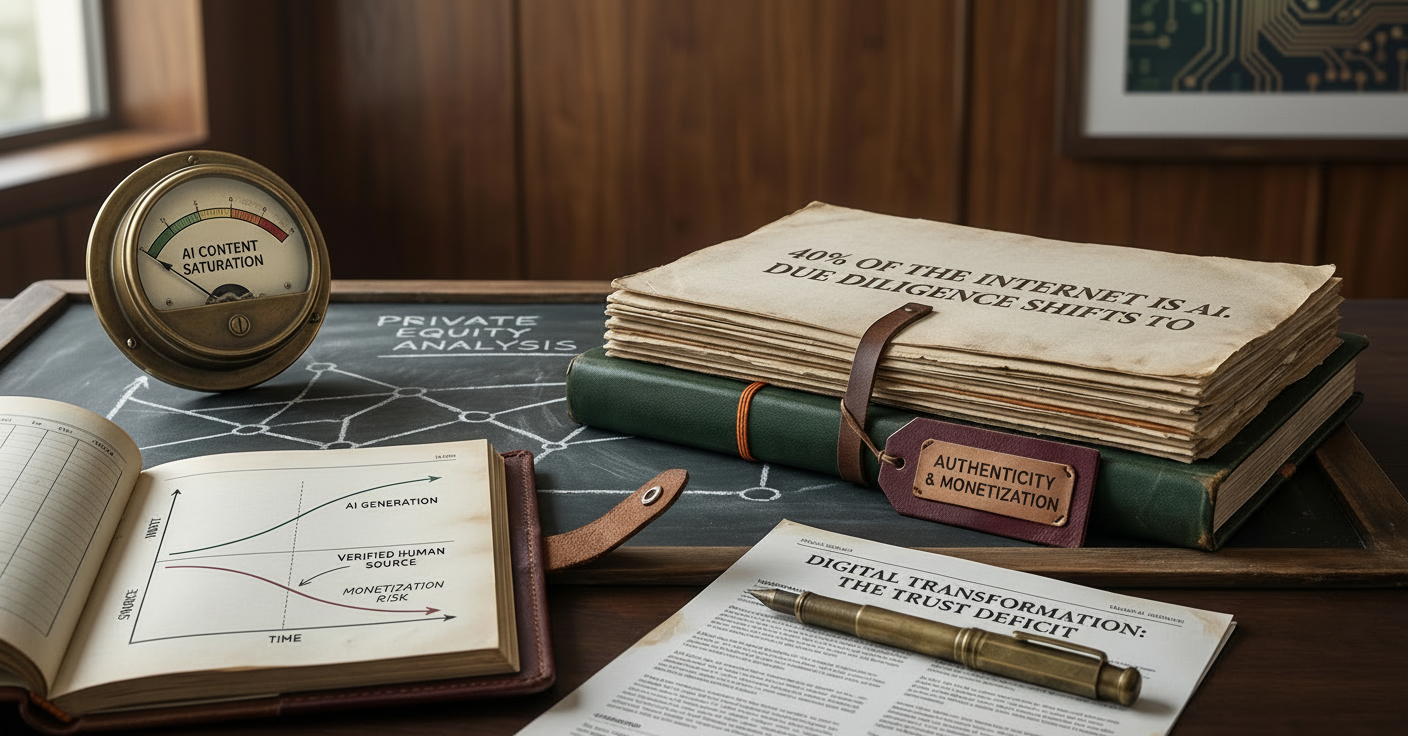
The internet is already 40% AI-generated content, pushing platforms like Google past their breaking point and forcing a re-evaluation of what holds value online. This isn't a future problem; it's today's reality. The sheer volume of AI "slop" is eroding trust at a foundational level, shifting the search for authentic signal from mere content to verifiable data and unique insights. This dynamic is creating unexpected value in places like hyper-local news. (Max Spero on Odd Lots; Matthew Prince on Masters of Scale)
"It's about 40% from an Internet page perspective. About a year and a half ago we looked at medium and found that over 50% of newly written Medium articles were AI generated...Reddit, it was 7% a year ago, I believe a little over 10% today."
— Max Spero, CEO of Pangram Labs on Odd Lots
This deluge of synthetic content means traditional ad-based monetization models are failing. Google, the "hero of the last 30 years of the Internet," is at risk because AI breaks its core model. Instead, value is now accruing to non-substitutable data. Matthew Prince, CEO of Cloudflare, argues that niche, unique information—like local news articles—is suddenly more valuable for AI models than broad, general content. This forces a strategic pivot for content creators and investors: move beyond volume to unique, verifiable context. The question isn't whether AI will improve content, but whether we'll even trust content anymore. It’s creating a whole new diligence area in acquisitions, signaling that AI readiness is now as critical as cyber readiness. (Ryan Milligan on Private Equity Funcast)
The Rundown
① AI Readiness is the New Cyber Diligence. AI's emerging role in dealmaking is critical, with firms now evaluating product defensibility and readiness in sales processes akin to how cybersecurity became standard. (Ryan Milligan on Private Equity Funcast)
→ Why it matters: If you're selling, your diligence checklist now includes specific questions about AI integration and defensibility. If you're buying, this is where you'll find new risk or untapped alpha.
② Robotics is Breaking Moravec's Paradox. Tasks easy for humans, difficult for machines (like picking up a cup), are becoming tractable for robots thanks to machine learning, shifting the bottleneck from low-level execution to mid-level scene interpretation. (Sergey Levine on Invest Like the Best with Patrick O'Shaughnessy)
→ Signal: The "bitter lesson" of AI (more data, more compute wins) is playing out in physical intelligence, suggesting generalist robotic systems will scale faster than niche applications. This changes the investment thesis in automation.
③ The Strait of Hormuz is Creating Global Economic Whiplash. Geopolitical tensions are driving refined product prices (like Singapore diesel at $200/barrel) higher than crude, with Middle East conflicts contributing to global fertilizer and helium supply crises. (Javier Blas on Odd Lots; David Friedberg on All-In with Chamath, Jason, Sacks & Friedberg)
→ Implication: Supply chain risk just got repriced in a major way. Expect continued volatility in commodities not directly tied to crude, and factor this into portfolio company input costs and geopolitical exposure.
④ The Purpose of an IPO Has Shifted. IPOs are less about capital raising and more about providing liquidity and establishing market valuation for mature companies, especially SaaS and AI firms. (Scott Bok on Odd Lots)
→ Market Read: This implies that firms coming to market are often pursuing an exit for early investors and employees, rather than just fresh capital for growth. This is a clear signal of maturity and potentially changing liquidity options for later-stage private investment.
⑤ Activist Investors Overlook Corporate Governance's Negative Correlation. Research shows a negative correlation between "good governance" ratings and company performance since 2008, suggesting traditional best practices might be doing more harm than good to long-term value creation. (Eric Ries on Boardroom Governance with Evan Epstein)
→ Pattern Recognition: If you're advising a board or leading a portfolio company, revisit assumptions about what constitutes "good governance." Sometimes, the unconventional path (or a less-rated one) is the better one.
Signal Board
🔥 Heating Up
• NASA's Chief Economist 🆕: The creation of a dedicated economic role at NASA signals an intensifying focus on private sector engagement, procurement, and commercializing space's economic frontier. (Alexander MacDonald on Odd Lots)
• Niche Content Licensing: Hyper-local content is becoming a valuable asset for AI companies looking to fill knowledge gaps, turning local news into an unexpected data licensor. (Matthew Prince on Masters of Scale)
• General-Purpose Robotic Foundation Models 🆕: Developers are shifting towards creating universal AI models for robotics, aiming for systems that can control any embodied system for any task over specialized solutions. (Sergey Levine on Invest Like the Best with Patrick O'Shaughnessy)
👀 On Watch
• AI-Generated Content Prevalence 🆕: With 40% of the internet and over 50% of new Medium articles being AI-generated, content authenticity and its economic models are fundamentally challenged. (Max Spero on Odd Lots)
• Moon as an Industrial Frontier 🆕: The moon is increasingly seen as a viable location for extracting resources like precious metals and conducting manufacturing, driven by robotics and AI capabilities. (David Friedberg on All-In with Chamath, Jason, Sacks & Friedberg)
• Management Equity Rollovers 🆕: Early and transparent communication about management equity rollovers is highlighted as critical in M&A processes, impacting deal success and team motivation. (Devin Mathews on Private Equity Funcast)
🧊 Cooling Off
• OpenAI Secondary Market Demand 🆕: While Anthropic is seeing strong demand, investor appetite for OpenAI at an $850 billion valuation is showing signs of reluctance. (Jason Calacanis on All-In with Chamath, Jason, Sacks & Friedberg)
• Traditional Brand Loyalty 🆕: In an agentic commerce future, where AI agents prioritize efficiency and verifiable data, traditional brand loyalty may diminish, threatening small businesses that rely on it. (Matthew Prince on Masters of Scale)
• Strategic Buyer Accessibility 🆕: Strategic buyers are increasingly difficult to engage in M&A processes, often requiring a target to be their top acquisition priority just to sign an NDA. (Devin Mathews on Private Equity Funcast)
The Bottom Line
The internet just passed peak humanity, and now every PE playbook needs to account for AI-driven commoditization colliding with a fragmented, geoplitically-charged global economy.
📖 Want the full episode breakdowns, guest details, and listen links?
Episode Guide
Odd Lots — "This Is How to Tell if Writing Was Made by AI"
Runtime: 49 min | Host: Jill Wiesenthal | Guest: Max Spero (CEO, Pangram Labs)
Listen If: You want to understand how AI is changing the internet's content landscape and how detection is evolving.
Delves into the challenges of detecting AI-generated text, revealing that 40% of the internet is already AI-produced. Discusses Pangram Labs' deep learning approach to maintain high accuracy in differentiating human from AI writing, highlighting the cat-and-mouse game of content authenticity.
"It's about 40% from an Internet page perspective. About a year and a half ago we looked at medium and found that over 50% of newly written Medium articles were AI generated...Reddit, it was 7% a year ago, I believe a little over 10% today."
— Max Spero, CEO of Pangram Labs
Connects to: The Big Shift, Signal Board (AI-Generated Content Prevalence)
Masters of Scale — "The internet is breaking. So what’s next? with Cloudflare’s Matthew Prince"
Runtime: 35 min | Host: Bob Safian | Guest: Matthew Prince (CEO and Co-founder, Cloudflare)
Listen If: You're navigating the changing economics of online content and brand in an AI-dominated world.
Matthew Prince explores AI's disruptive impact on the internet, from increased bot traffic to the shift in content monetization. He argues that unique, niche data (like local news) will gain immense value, while traditional brand loyalty may erode in an efficiency-driven, agentic commerce future.
"Over half of Internet traffic is generated by bots. And the business model of the future is unclear."
— Matthew Prince, CEO and Co-founder of Cloudflare
Connects to: The Big Shift, Rundown (Niche Content Licensing), Signal Board (Traditional Brand Loyalty)
Invest Like the Best with Patrick O'Shaughnessy — "Sergey Levine - Building LLMs for the Physical World - [Invest Like the Best, EP.465]"
Runtime: 67 min | Host: Patrick O'Shaughnessy | Guest: Sergey Levine (Co-founder and Researcher, Physical Intelligence)
Listen If: You're investing in AI/robotics and want to understand the path to general physical intelligence.
Sergey Levine details the vision behind Physical Intelligence: to develop universal robotic foundation models. He discusses overcoming Moravec's paradox, the surprising dexterity of current systems, and the shift from specialized robotics to scalable generalist AI, drawing parallels to LLMs.
"The goal at Physical Intelligence is to develop robotic foundation models that can control basically any embodied system to do any task."
— Sergey Levine, Co-founder and Researcher at Physical Intelligence
Connects to: Rundown (Robotics is Breaking Moravec's Paradox), Signal Board (General-Purpose Robotic Foundation Models)
Private Equity Funcast — "When And How To Sell Your Company"
Runtime: 59 min | Host: Devin Mathews | Guest: Ryan Milligan (Guest, Private Equity Funcast)
Listen If: You're planning an exit or engaging in M&A, particularly regarding AI diligence and management.
Devin and Ryan dissect company sales, emphasizing timing, banker engagement, and "sale readiness." They highlight AI defensibility as a new critical diligence factor, equal to cybersecurity, and stress early communication with management regarding equity rollovers.
"The new element right now is AI. AI is the new cyber. So particularly right now, I think product and market merge. You better show up in a sale process with kind of AI readiness, AI defensibility, AI MOEs."
— Ryan Milligan, Guest on Private Equity Funcast
Connects to: Rundown (AI Readiness is the New Cyber Diligence), Signal Board (Management Equity Rollovers)
Boardroom Governance with Evan Epstein — "Eric Ries: Incorruptible, and the Case for Long-Term Governance Reform"
Runtime: 78 min | Host: Evan Epstein | Guest: Eric Ries (Author & Founder, The Lean Startup, Long-Term Stock Exchange)
Listen If: You're rethinking corporate governance and challenging "best practices" for long-term value.
Eric Ries critiques corporate governance's "financial gravity" and short-termism, arguing that 'good governance' often correlates negatively with performance. He champions a reform agenda, including his LTSE principles and a "Director's Oath," for building incorruptible, value-creating organizations.
"One of my favorite stats in the book is this incredible study that shows that companies since 2008, companies that are rated to have bad governance have outperformed those that have good governance. It's like, what are we doing here?"
— Eric Ries, Author of Incorruptible
Connects to: Rundown (Activist Investors Overlook Corporate Governance's Negative Correlation)
Founders — "#416 The Relentless Missionary Creating AGI: Demis Hassabis"
Runtime: 55 min | Host: David Senra | Guest: Demis Hassabis (Co-founder, DeepMind)
Listen If: You want an inside look at the relentless pursuit of AGI and the DeepMind origin story.
Profiles Demis Hassabis, co-founder of DeepMind, and his lifelong mission to create Artificial General Intelligence. Explores his competitive drive, unique fundraising against skepticism, and the role of DeepMind in developing "alien-like" AI strategies, contrasting it with OpenAI's path.
"Intelligence is fundamental. It is the root of all else. It is the mechanism through which humans perceive reality. It's the mind that creates our reality around us."
— Demis Hassabis, Co-founder, DeepMind
Odd Lots — "Why NASA Hired a Chief Economist"
Runtime: 49 min | Host: Tracy Alloway | Guest: Alexander MacDonald (Senior Associate & NASA's first Chief Economist, Aerospace Security Project at CSIS)
Listen If: You're interested in space economics, commercial space stations, or the intersection of government and private innovation.
NASA's first chief economist, Alexander MacDonald, discusses the agency's evolving strategy, driven by a growing private sector pushing the economic frontier of space. Explores the viability of orbital data centers, lunar bases, and the challenges of evaluating new technologies and procurement.
"These days there's such a growth in venture capital and private equity investment in space that actually it's a bit of a booming field."
— Alexander MacDonald, Senior Associate at Aerospace Security Project at CSIS
Connects to: Signal Board (NASA's Chief Economist)
How I Built This with Guy Raz — "Advice Line with Angie & Dan Bastian of Angie's BOOMCHICKAPOP"
Runtime: 50 min | Host: Guy Raz | Guest: Angie Bastian (Co-founder, Angie's BOOMCHICKAPOP)
Listen If: You're an entrepreneur seeking advice on scaling, funding, or authentic marketing for sensitive products.
Angie and Dan Bastian offer advice to founders on securing investment without compromising values, marketing sensitive health products, and scaling specialty brands. Emphasizes leveraging personal stories and focusing on organic domestic growth before international expansion.
"How do we decide whether outside capital accelerates our mission or compromises it? And then on the turn, how do we find investors who strengthen the business without diluting our values?"
— Michelle Pusateri, Founder of Nana Jo's Granola
Odd Lots — "Scott Bok Explains What Investment Bankers Actually Do All Day"
Runtime: 54 min | Host: Joe Weisenthal | Guest: Scott Bok (Former CEO, Greenhill)
Listen If: You want an insider's view on the evolution of investment banking, private equity's role, and AI's impact.
Scott Bok, former CEO of Greenhill, chronicles investment banking's transformation since the 80s, highlighting how private equity became a key client and technology automated many tasks. He notes AI's future impact will shift bankers' roles towards human interaction and psychological insights.
"Private equity really became the biggest client base for the whole industry. The rise of the private equity industry created a client that was kind of permanently in the transaction business."
— Scott Bok, Former CEO of Greenhill
Connects to: Rundown (The Purpose of an IPO Has Shifted)
All-In with Chamath, Jason, Sacks & Friedberg — "SpaceX IPO, Iran War Fallout, Quantum Bitcoin Hack, The Space Opportunity"
Runtime: 81 min | Host: Chamath Palihapitiya | Guest: Jason Calacanis (Host, All-In Podcast, LLC)
Listen If: You're tracking high-stakes IPOs, geopolitical supply chain risks, and emerging tech like quantum computing and space industrialization.
This discussion ranges from the impending SpaceX IPO and speculative AI company valuations (OpenAI vs. Anthropic) to the geopolitical fallout of Middle East conflicts affecting global fertilizer and helium supplies. Also touches on quantum computing threats to crypto security.
"The Moon could end up being kind of the next industrial frontier for humanity... it will cost less to move goods, manufactured goods, processed, or precious metals from the Moon to a specific point on Earth."
— David Friedberg, Host
Connects to: Rundown (The Strait of Hormuz is Creating Global Economic Whiplash), Signal Board (OpenAI Secondary Market Demand), Signal Board (Moon as an Industrial Frontier)
Odd Lots — "Javier Blas on Why Oil Could Go Much, Much Higher"
Runtime: 41 min | Host: Tracy Alloway | Guest: Javier Blas (Energy and Commodities Columnist, Bloomberg)
Listen If: You want to understand the nuanced dynamics pushing energy prices higher beyond just crude oil.
Javier Blas explains the widening gap between financial and physical oil markets, specifically the extreme surge in refined product prices (e.g., Singapore diesel nearing $200/barrel). He details how Strait of Hormuz tensions, lost refining capacity, and limited refined product trade disproportionately impact East Asian economies.
"If you look at the cost of diesel in Singapore, which is a benchmark for the Southeast Asian market, the price there is approaching $200 a barrel, which is something that we have never seen."
— Javier Blas, Energy and Commodities Columnist at Bloomberg
Connects to: Rundown (The Strait of Hormuz is Creating Global Economic Whiplash)