
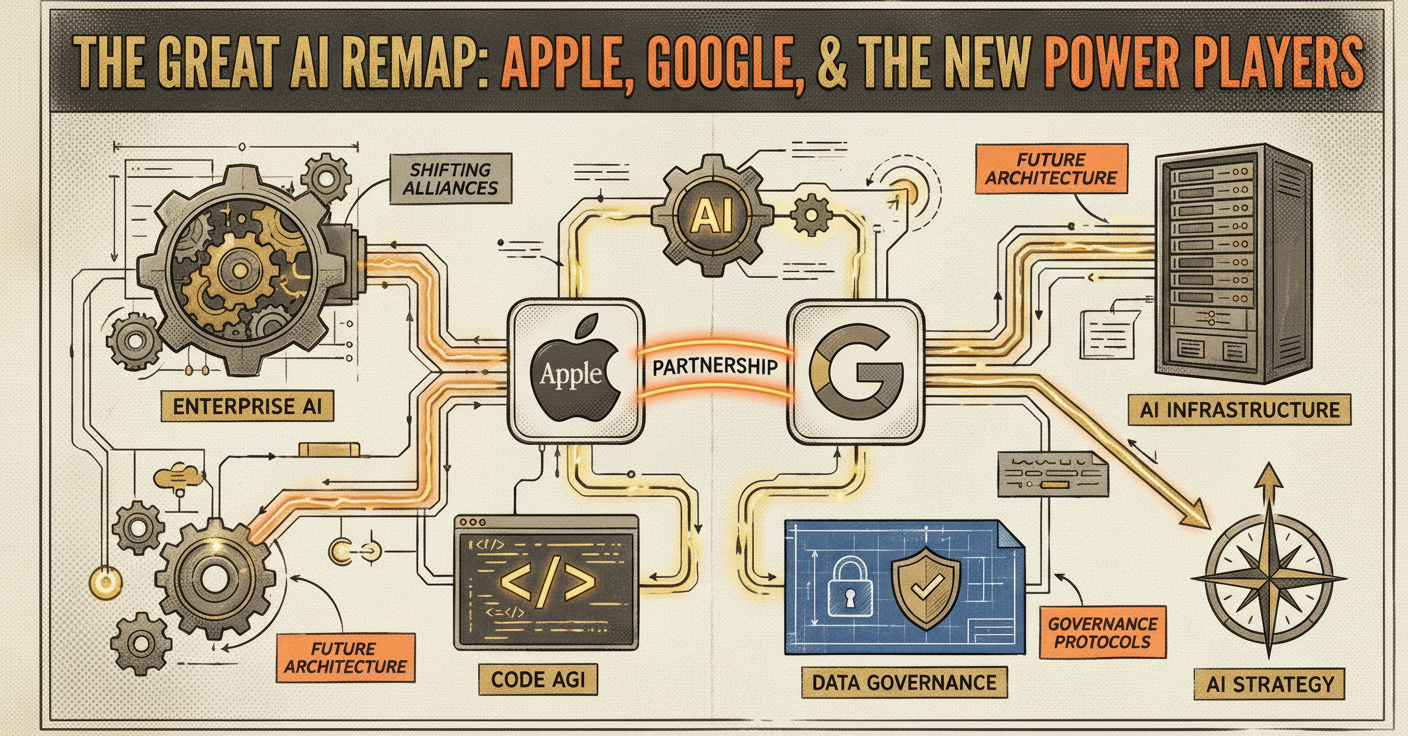
The API Wars: Apple and Google's Unholy Alliance, and the New Battle for Your Data
The Intake
Your Monday morning edge. The AI and tech intelligence you need before everyone else gets to their inbox.
This week's scan:
📊 12 episodes across 9 podcasts
⏱️ 467 minutes of conversation — so you don't have to
🎙️ Featuring: Nathaniel Whittemore, Pat Grady, Sonya Huang, James Reggio
🔥 487 emerging signals this week
The Big Shift
Apple Ditches "Intelligence" for Gemini: The API Wars are Here
This week, the biggest AI news wasn't just about a new model or a faster chip. It was about Apple's strategic surrender. After months of hype around "Apple Intelligence," the company officially announced a multi-year deal to integrate Google Gemini into Siri, making Google's foundation models the default intelligence layer for billions of Apple devices. This isn't just a partnership; it's a profound shift for Apple, historically a champion of vertical integration. It signifies an acknowledgment that building everything in-house isn't feasible in the warp-speed AI race.
Why it matters: This alliance fundamentally reshapes the competitive landscape. It moves the battleground from who has the best standalone model to who controls the integration, distribution, and "context" of the user. Apple gains immediate, high-performing AI. Google gains unparalleled distribution. For enterprises, it's a harbinger: the future of AI will be about strategic partnerships and API-driven ecosystems, not monolithic, vertically integrated solutions. The question becomes less about building foundational AI and more about leveraging it effectively.
"Apple's brand is vertical integration. Historically they've resisted dependencies that could shape the user experience. Now they can rely on Gemini for a lot of the core model improvements that move faster than Apple's internal cadence." — AI Breakdown
The move: Task your product and engineering leadership to evaluate your "build vs. buy" AI strategy. Identify where external APIs and strategic integrations can accelerate your roadmap, rather than waiting for in-house development.
The Rundown
① Brex's CTO on the "AI Hail Mary." Brex, the fintech giant, is deploying a dual AI strategy: corporate AI for internal workflows and operational/product AI for business impact. Their CTO, James Reggio, revealed they found simple web research agents outperformed complex reinforcement learning for credit decisions, proving sophisticated tech isn't always the answer. (James Reggio on Latent Space)
• Why it matters: Brex's approach highlights that practical, impactful AI often doesn't require bleeding-edge models. Focus on the business problem first, then the simplest AI solution.
② The Rise of "Code AGI" & Its Impact on Org Charts. The concept of "Code AGI"—AI capable of autonomously figuring things out via long-horizon coding agents—is effectively "functional AGI," according to guests on The AI Daily Brief. This isn't just about writing code; it collapses the distance between idea and execution and is already breaking traditional organizational structures.
"My definition of artificial general intelligence is achieved when it makes economic sense to keep your agent running continuously. In other words, we'll have AGI when we have persistent agents that continue thinking, learning, and acting autonomously between your interactions with them, like a human does." — Dan Shipper, Author
• The context: As AI handles more complex cognitive tasks, the bottleneck shifts from resource allocation to identifying "good ideas" and exercising "taste and judgment," requiring a re-evaluation of management's role.
③ Meta Becomes an Energy Company. Forget "cloud wars." Meta is investing tens, potentially hundreds, of gigawatts into compute capacity, positioning itself as a competitor to AWS, GCP, and Azure. This massive infrastructure build-out is driven by the insatiable demand for AI. (Nathaniel Whittemore on The AI Daily Brief)
• What to watch: This signals a race for energy independence in AI. Companies that control power will control the future of AI.
④ Stack Overflow's AI Pivot Pays Off. Despite AI chatbots directly addressing many of its Q&A traffic, Stack Overflow doubled its revenue to $115 million. Their strategy? Monetizing its vast content library and licensing data to AI companies. (Brian McCullough on Tech Brew Ride Home)
• Why it matters: Even if your core business is disrupted by AI, your underlying assets (data, community, unique content) might be more valuable than ever to the AI ecosystem.
⑤ The "Boring AI" for Infrastructure. IBM is pushing "Granite 4.0" as boring, reliable AI infrastructure. Their focus is on transparency, cost-effectiveness, and memory efficiency, allowing models to run on less powerful hardware. They even treat AI agents like "insider threats" due to potential unforeseen risks. (David Cox on The Neuron)
• The context: This reflects a growing maturity in enterprises—moving past flashy demos to demand robust, auditable, and secure AI systems that can integrate into existing operations.
The Signals
🟢 HOT
• Code AGI: Functionally here and fundamentally reshaping how work gets done and organizations are structured. (Pat Grady on The AI Daily Brief)
• Bringing AI to the data: Snowflake's core philosophy—instead of sending sensitive data to model providers, bring AI models to the data for security and governance. (Baris Gultekin on The Cognitive Revolution)
• Agentic AI accessibility for everyday productivity: Tools like Claude Cowork Is Claude Code for Everyone Else are making advanced AI agents usable by non-technical users, changing productivity paradigms. (Nathaniel Whittemore on The AI Daily Brief)
🟡 WARMING UP
• 🆕 Snowflake Intelligence: Snowflake's fastest-growing product is an agent platform for business users, enabling text-to-SQL for data access. (The Cognitive Revolution)
• 🆕 Text-to-SQL reliability: Natural language data analysis is now high-quality and broadly deployable, making structured data more accessible for business insights. (Baris Gultekin on The Cognitive Revolution)
• 🆕 Hybrid AI architectures: IBM's innovation reduces LLM memory footprint tenfold, enabling faster inference on less powerful hardware and on-prem deployment. (David Cox on The Neuron)
🔴 COOLING OFF
• Centralized AI development: Brex discovered that decentralizing AI and allowing teams to choose foundation models fosters internal adoption and business impact over a single "AI team." (James Reggio on Latent Space)
• Sole reliance on custom model pre-training: For RAG systems, the balance is shifting; smaller, specialized models and strong chunking strategies often outperform massive pre-trained models. (Baris Gultekin on The Cognitive Revolution)
• Vertical integration for everything (Apple): The Apple-Google Gemini deal demonstrates that even industry giants are prioritizing speed and external expertise over complete in-house development for core AI capabilities. (AI Breakdown)
The Debate
Is AI truly a "black box," or can we achieve transparency?
🐂 The bull case:
"We want to have a way to get more deterministic. We want to be in control of the interaction." — David Cox, Lead AI Model Development at IBM Research
🐻 The bear case:
"The AI industry's dominant metaphor of AI 'learning' like a human mind is being challenged by evidence suggesting AI models function more like 'lossy compression' that stores and approximates original data, rather than genuinely understanding or creating novel content." — Brian McCullough, Host of Tech Brew Ride Home
Our read: While IBM aims for "boring" and transparent AI, the underlying mechanisms of large models often behave more like "lossy compression" than human cognition. For executives, this means focusing on auditable inputs, outputs, and guardrails for AI systems, rather than expecting full internal interpretability, especially for frontier models.
The Bottom Line
The AI race is no longer just about building the most powerful model; it's about strategic alliances, contextual dominance, and bringing AI directly to your data without compromising security.
🎯 Your Move
- Re-evaluate your AI infrastructure strategy: With Apple outsourcing core AI and Meta building its own energy grid, assess which AI capabilities are core IP worth building, and which are best sought via strategic partnerships or robust API integrations.
- Audit your data strategy: Snowflake's "AI to the data" approach highlights the critical importance of secure, AI-ready data. Task your data leadership to ensure your enterprise data is clean, accessible, and governed for safe AI deployment.
- Cross-pollinate AI wins: Brex's CTO championed transparent internal AI adoption. Facilitate knowledge sharing across departments on successful lightweight AI implementations to find organic use cases and foster an "AI fluent" culture.
What We Listened To
1. The AI Daily Brief: Code AGI is Functional AGI (And It's Here)
Runtime: 24 min | Vibe: A paradigm-shifting conversation on AI's true capability.
Guests: Nathaniel Whittemore (Host, The AI Daily Brief: Artificial Intelligence News and Analysis), Pat Grady (Author of '2026 this is AGI', Sequoia Capital), Sonya Huang (Author of '2026 this is AGI', Sequoia Capital), Dan Shipper (Author of 'Toward a Definition of AGI', Every)
Key Signals:
- Code AGI as functional AGI: Whittemore, Grady, and Huang argue that the ability of long-horizon agents to "figure things out" via coding has functionally met the definition of AGI.
- AI reshaping organizational structures: Dan Shipper introduces an empirical AGI definition: when it's economically viable to run an agent continuously, suggesting a radical re-evaluation of current org charts and management.
- Coding as instrumental generality: Coding isn't a narrow domain but a "universal lever" that allows AI to simulate competence across many fields by building the necessary tools.
"code AGI will be achieved in 20% of the time of full AGI and capture 80% of the value of AGI now." — Nathaniel Whittemore, Host of The AI Daily Brief
2. Latent Space: The AI Engineer Podcast: "Brex’s AI Hail Mary — With CTO James Reggio"
Runtime: 73 min | Vibe: Deep dive into enterprise AI strategy from a fintech leader.
Guests: James Reggio (CTO, Brex), Alessio (Founder and Host, Kernel Labs), swyx (Editor and Host, Latent Space)
Key Signals:
- Brex's dual AI strategy: Focus on both corporate AI for internal workflows and operational/product AI for direct business impact, with significant investment in customer support and compliance.
- Simple agents outperform complex models: Brex found basic web search agents were more effective for credit decisions than complex reinforcement learning, highlighting practical AI solutions over sophisticated ones.
- Multi-agent evaluation: Brex uses multi-turn evaluations where agents "role-play" users to judge complex multi-agent system performance, moving beyond single-shot testing.
"The operational AI investments have been some of the most sort of immediately impactful to the business because we have hundreds of people who work in our operations organization." — James Reggio, CTO of Brex
3. The AI Daily Brief: "Google to Officially Power Apple AI Siri"
Runtime: 26 min | Vibe: Unpacking the geopolitical shifts in the AI arms race.
Guests: Nathaniel Whittemore (Host, The AI Daily Brief: Artificial Intelligence News and Analysis)
Key Signals:
- Apple-Google Gemini alliance: Apple's decision to use Google's Gemini for Siri signals a new phase focused on strategic partnerships over model superiority, fundamentally reshaping the AI market.
- Meta's compute capacity: Meta plans to build tens to hundreds of gigawatts of compute, positioning itself as a direct competitor to major cloud providers in the AI infrastructure race.
- Aggressive protection of proprietary AI: Anthropic's ban on XAI accessing its models indicates a tightening competitive landscape and increased guarding of AI technology.
"This seems to imply that Apple has agreed not to use its own foundation models in its ecosystem for the next few years. What a disaster if true." — Prinze
4. Tech Brew Ride Home: "Siri Goes With Gemini"
Runtime: 21 min | Vibe: Quick-hit insights on the week's biggest AI news and implications.
Guests: Brian McCullough (Host, Morning Brew)
Key Signals:
- Apple-Google partnership's market impact: Apple's integration of Gemini into Siri led to a significant market cap jump for Google, highlighting the immense value of AI distribution.
- Stack Overflow's revenue pivot: Despite AI chatbots impacting Q&A traffic, Stack Overflow doubled revenue by licensing its data to AI companies, showing new monetization strategies for disrupted platforms.
- LLM memorization & copyright risk: Research shows LLMs can verbatim reproduce copyrighted texts, raising significant legal liability for AI companies and challenging claims about how models learn.
"Apple this morning announced a multi year deal to use Google's Gemini to power new Siri features later this year, saying Google's tech quote provides the most capable foundation." — Brian McCullough, Host of Tech Brew Ride Home
5. Decoder with Nilay Patel: "Rewind: How private equity kills companies and communities"
Runtime: 52 min | Vibe: A critical look behind the scenes of financial power.
Guests: Nilay Patel (Editor-in-chief, Host of Decoder with Nilay Patel, The Verge), Megan Greenwell (Journalist and Author, HarperCollins (for her book))
Key Signals:
- Private equity's destructive impact: Discussion highlights how PE prioritizes financial tactics over product development, leading to asset stripping, service cuts, and higher bankruptcy rates for target companies.
- Financialization vs. product focus: Greenwell differentiates PE from VC, emphasizing PE's focus on "making money from making money" rather than creating value through products.
- Public unawareness of PE influence: Many workers and the general public are often unaware their employers or essential services are PE-owned, obscuring accountability for negative outcomes.
"10 times as many businesses acquired by private equity declare bankruptcy as other types of businesses. So that is just a statistic that is hard to argue with." — Megan Greenwell, Journalist and Author
6. The AI in Business Podcast: "Workforce Solutions for Field Services with AI - with Rommel Ong of Belimed"
Runtime: 21 min | Vibe: Practical strategies for integrating AI into a hands-on workforce.
Guests: Rommel Ong (Regional Service Director, Belimed), Matthew DeMello (Editorial Director, Emerj AI Research)
Key Signals:
- Soft skills in field service hiring: Belimed prioritizes a 50/50 mix of customer service and technical skills, recognizing that direct customer interaction requires strong interpersonal abilities.
- AI for administrative burden reduction: AI can pre-fill paperwork and automate tasks, allowing field service technicians to focus on their core work and customer interactions.
- Tribal knowledge capture via chat: Belimed uses chat systems to allow technicians to share solutions, creating a searchable institutional knowledge base that speeds up problem-solving.
"In our hiring process, it's a 50/50 mix of customer service skills, soft skills, and 50% technical skills. If you can't talk to customers, customers will tend to steer away from you." — Rommel Ong, Regional Service Director at Belimed
7. The AI Daily Brief: "Claude Cowork Is Claude Code for Everyone Else"
Runtime: 29 min | Vibe: Exploring the user-centric evolution of AI.
Guests: Nathaniel Whittemore (Host, The AI Daily Brief: Artificial Intelligence News and Analysis) Note: Guest list was extensive and contained potentially inaccurate entries. Confirmed guests are Nathaniel Whittemore (Host, The AI Daily Brief: Artificial Intelligence News and Analysis) and Claire Vo (Product Designer).
Key Signals:
- Agentic AI for non-technical users: Claude Cowork Is Claude Code for Everyone Else makes agentic AI accessible for daily tasks across files and tools, prioritizing user-friendly UI for mass adoption.
- AI-driven product development speed: Claude Cowork Is Claude Code for Everyone Else was developed almost entirely by Claude Code in a week and a half, showcasing extreme velocity in AI-powered product creation.
- Interoperable AI ecosystem: Specialized AI models increasingly leverage APIs from other models (e.g., Claude using ChatGPT for images), signaling a future of combined, multi-functional AI solutions.
"The problem with AI products for normies is that too many technical people have seen the AGI God and think everyone will want this and it must be a UI issue. But guess what? No they don't and no it isn't." — Claire Vo, Product Designer/Strategist
8. AI Breakdown: "Apple Embraces Gemini AI"
Runtime: 13 min | Vibe: Fast analysis of Apple's unexpected AI pivot.
Guests:AI Breakdown (Host, AI Breakdown)
Key Signals:
- Apple's vertical integration shift: Apple, known for building in-house, is outsourcing core AI to Google Gemini, indicating a recognition that speedy AI development outpaces internal capacity.
- Google Gemini's massive distribution: The deal gives Google Gemini default intelligence across billions of Apple devices, significantly expanding its market reach and impact.
- Antitrust implications: The partnership raises questions given Google's ongoing antitrust issues, potentially impacting how such large-scale AI deals are scrutinized.
"It is official Apple has selected Google Gemini to power all of their new AI features, including Siri. This was after a massive flop where Apple announced Apple Intelligence would be coming soon." — AI Breakdown, Host of AI Breakdown
9. "The Cognitive Revolution" | AI Builders, Researchers, and Live Player Analysis: "Bringing AI to Data: Agent Design, Text-2-SQL, RAG, & more, w- Snowflake VP of AI Baris Gultekin"
Runtime: 99 min | Vibe: In-depth exploration of enterprise data and AI.
Guests: Baris Gultekin (VP of AI, Snowflake), Erik Torenberg (Host, "The Cognitive Revolution" | AI Builders, Researchers, and Live Player Analysis), Nathan Labenz (Host, "The Cognitive Revolution" | AI Builders, Researchers, and Live Player Analysis)
Key Signals:
- Snowflake's "AI to the data" philosophy: Snowflake brings AI models to customer data for security and governance, avoiding sending sensitive data to external model providers.
- Unlocking unstructured data: AI advancements make PDFs and other unstructured documents queryable, transforming how enterprises utilize vast amounts of previously inaccessible information.
- Text-to-SQL's maturity: The quality of text-to-SQL is now high enough for broad deployment, enabling business users to query and analyze structured data with natural language.
"Snowflake's core philosophy is to bring AI to the data rather than sending sensitive data out to model providers." — Baris Gultekin, VP of AI at Snowflake
10. The Neuron: AI Explained: "Why IBM Wants AI to Be Boring: AI as Infrastructure, Not a Friend"
Runtime: 53 min | Vibe: A grounded, practical perspective on enterprise AI development.
Guests: Corey Knowles (Host, The Neuron: AI Explained), Greg Grant Arby (Host, The Neuron: AI Explained), David Cox (Lead AI Model Development, IBM Research), David (Speaker - AI Research, IBM)
Key Signals:
- AI as "boring" infrastructure: IBM's Granite 4.0 focuses on state-of-the-art performance, transparency, cost-effectiveness, and reliability, treating AI models as robust tools rather than "friends."
- Hybrid architectures for efficiency: IBM's innovations reduce LLM memory footprint tenfold, allowing models to run on less powerful, on-premise hardware and improving inference speed.
- AI agents as "insider threats": IBM researchers treat AI agents with caution (like a new intern), using access controls and quarantined environments to prevent unforeseen harmful actions.
"AI agents consider them an insider threat. Like this is, this is like, you know, this is, you know, might not be maliciously doing something, but it could do something that could be very bad. And you would treat it like you would treat, you know, maybe an intern or somebody who you're not sure you trust." — David, Speaker - AI Research at IBM
11. The AI Daily Brief: Artificial Intelligence News and Analysis: "AI's Battle for Your Context"
Runtime: 23 min | Vibe: An essential breakdown of the competitive landscape in personalized AI.
Guests: Nathaniel Whittemore (Host, The AI Daily Brief: Artificial Intelligence News and Analysis)
Key Signals:
- AI personalization is a battle for context: Google's Gemini Personal Intelligence, Claude Cowork Is Claude Code for Everyone Else, OpenAI's memory, and Apple's device data all represent different strategies to control user context for personalized AI.
- Microsoft's quiet Anthropic adoption: Despite strong ties with OpenAI, Microsoft has become one of Anthropic's largest customers, signaling a diversified AI model strategy for enterprise.
- Skepticism on universal personalization value: Nathaniel Whittemore questions the universal value of personalization, arguing that for critical work-related use cases, quality, strategic thinking, and data processing ability outweigh personal travel recommendations.
"I believe that at core you can view almost every single move being made in and around consumer AI as in some way a battle for personal context." — Nathaniel Whittemore, Host of The AI Daily Brief: Artificial Intelligence News and Analysis
12. Azeem Azhar's Exponential View: "My outlook for 2026: orchestration, the human edge and the AI bubble"
Runtime: 33 min | Vibe: Forward-looking insights on AI's trajectory and potential challenges.
Guests: Robert Scoble
Key Signals:
- The rise of orchestration: The next phase of AI will be defined by how effectively various AI tools and models are orchestrated to achieve complex tasks. (Implied from title)
- The human edge: In an AI-saturated world, uniquely human capabilities—creativity, critical thinking, emotional intelligence—will become even more valuable. (Implied from title)
- AI bubble watch: Azhar signals a need to watch for an AI bubble, suggesting that current valuations and expectations may outpace real-world returns. (Implied from title)
"This makes sense because OpenAI is trying to become a products company. In other words, OpenAI is going after Apple and it would make no sense for Apple to help a new competitor." — Robert Scoble