
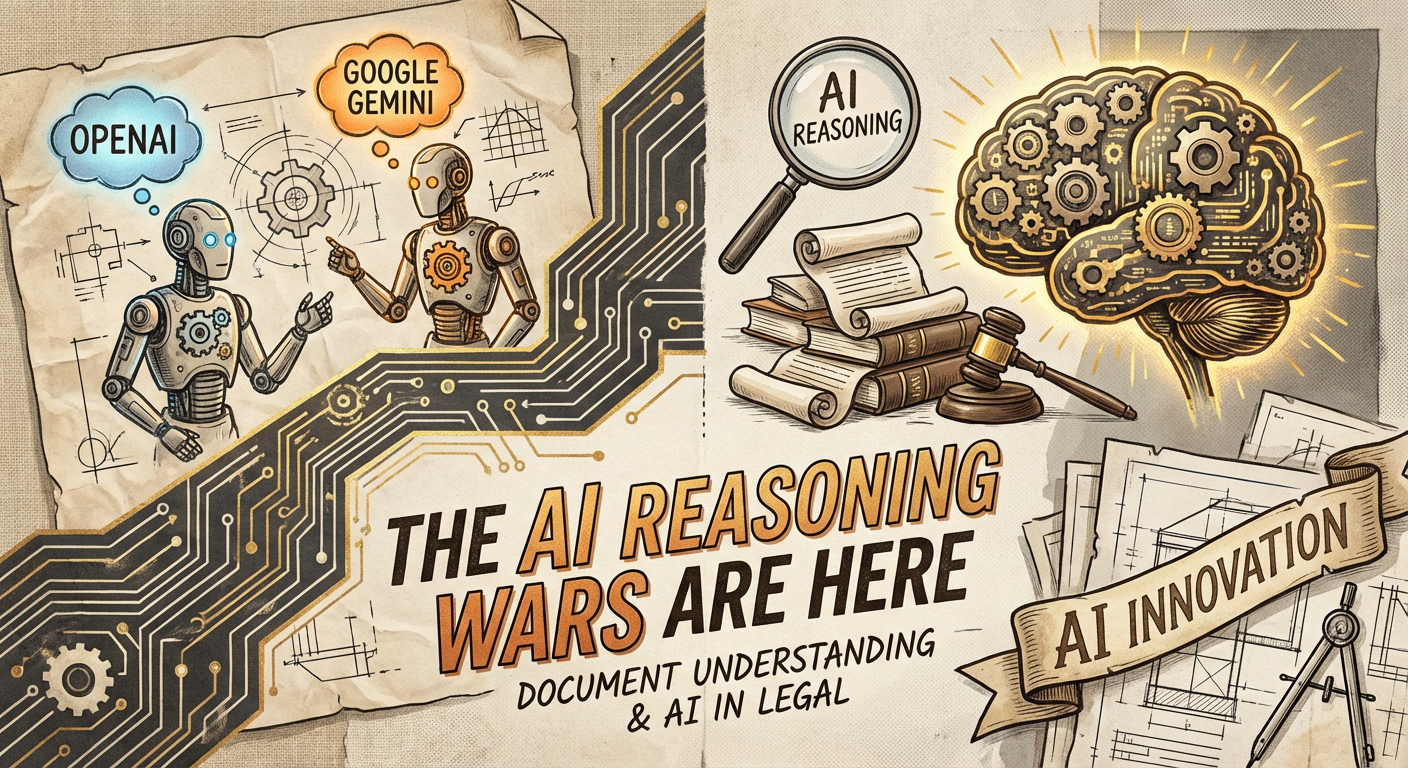
AI & TECH ROUNDUP: The Reasoning Wars Are Here — And Nobody's Winning Yet
THIS WEEK'S INTAKE 📊 13 episodes across 6 podcasts ⏱️ ~10 hours of AI & Tech intelligence 🎙️ Featuring: OpenAI's Ronnie Chatterji, Harvey's Gabe Pereyra, Moderna's Noubar Afeyan, and deep dives from The AI Daily Brief, AI Breakdown, and Practical AI. 📅 Coverage: Late November - Early December 2023
We listened. Here's what matters.
Okay, so here's the real story this week: AI, specifically large language models, are facing their first true acid test – reasoning. Everyone is building more powerful models, but the consensus among industry insiders and researchers is that the actual cleverness is proving harder to scale than raw compute or model size. We're seeing OpenAI declare an immediate "Code Red" to improve ChatGPT's reasoning, Google consolidating efforts around Gemini, and even breakthrough innovation guru Noubar Afeyan (Moderna's founder) framing AI as "augmented imagination" rather than pure intelligence.
The takeaway? The battle for AI supremacy isn't just about who has the biggest model or the most users anymore. It's about who can teach these things to think better, not just talk better. And the financial stakes are astronomical, driving an arms race where "good enough" is quickly becoming "not good enough." This isn't just a technical problem; it's a strategic one that will define market leaders and potentially reshape how we innovate and even manage our legal systems. Here's what you need to know.
THE BRIEFING
OpenAI's "Code Red" Signals a New Front in the AI Wars
The narrative has shifted dramatically. OpenAI, long considered the frontrunner, has reportedly declared a "Code Red" to aggressively refocus resources on enhancing ChatGPT's reasoning capabilities and overall performance. This isn't just internal competitive positioning; it's a direct response to escalating pressure from Google's Gemini and Anthropic's Opus, both making significant strides in areas where ChatGPT previously held clear dominance. The market is maturing rapidly, and "good enough" isn't cutting it anymore—especially when competitors are quickly closing the perceived performance gap.
"Never before in the three years since ChatGPT launched have we seen such a narrative inflection shift from OpenAI over to Google." — The AI Daily Brief
The So What: This scramble by OpenAI is a clear indicator that the goalposts for AI performance have moved from merely generating coherent text to demonstrating sophisticated reasoning. For businesses integrating AI, this means holding vendors to a higher standard of functional "intelligence" rather than just impressive demos. Expect a renewed focus on benchmarks that measure complex problem-solving.
Breakthrough Innovation Needs AI as "Augmented Imagination," Not a Magic Bullet
Noubar Afeyan, the visionary founder of Moderna, offered a profound reframing of AI's role in innovation. He argues that AI isn't about replacing human creativity but serving as "augmented imagination." His approach emphasizes using AI to generate more ideas, explore diverse possibilities, and essentially fail faster and more intelligently in the pursuit of breakthrough discoveries. It’s about leveraging AI’s computational power to simulate nature’s evolutionary processes, expanding the human capacity for hypothesis generation rather than simply automating existing tasks.
"It's almost unimaginable that you could compete without deploying these significant augmentation capabilities in doing innovation and breakthroughs." — Noubar Afeyan, HBR IdeaCast
The So What: Leaders shouldn't view AI as a simple productivity enhancer for R&D; they should integrate it as a core component of their ideation and experimentation cycles. This means redesigning organizational structures to foster iterative cycles, embracing failure as a learning mechanism, and cultivating a culture that prizes explorative, AI-assisted imagination over linear, human-only problem solving.
The Unstructured World of Legal Work Is AI's Next Big Frontier
While many expect AI to automate routine tasks, Gabe Pereyra of Harvey AI illustrates how generative AI is tackling deeply unstructured, high-stakes environments like the legal industry. Harvey's focus isn't just on making individual lawyers faster, but on optimizing entire legal teams and workflows for complex litigation and corporate matters. The lack of structured workflows in law, often seen as a barrier, is precisely where sophisticated AI can create immense value by interpreting nuance and context that traditional automation misses.
"The big problem we're solving is not how do you make individual lawyers more productive, it's how do you make a team of lawyers working on a client matter more productive?" — Gabe Pereyra, No Priors
The So What: This highlights a critical, often overlooked frontier for AI: complex professional services. Businesses in highly nuanced, document-heavy fields (consulting, finance, architecture) should be looking beyond simple task automation. The real value for them lies in AI's ability to augment complex, multi-person workflows and interpret unstructured data at scale, fundamentally reshaping how these services are delivered and monetized.
Document Understanding Is Still King (and Getting Much Smarter)
Beyond flashy chatbots, the unsexy but critical field of "document understanding" is undergoing a quiet revolution thanks to AI. Advances in document structure models, language-vision models, and specialized OCR like Deepseek-OCR are radically improving how businesses extract, interpret, and leverage information from diverse documents. This isn't just optical character recognition anymore; it's about understanding layout, context, and semantic meaning to feed data into systems like Retrieval Augmented Generation (RAG) more efficiently and accurately.
"Document processing is at the center of a lot of what happens in businesses day to day." — Practical AI
The So What: For any organization drowning in paper or digital documents (which is essentially every enterprise), these technical advancements translate directly into improved operational efficiency, better data quality for RAG systems, and faster decision-making. Investing in modern AI-driven document processing isn't just an IT upgrade; it's a foundational step towards truly intelligent automation and data leverage.
THE WATCHLIST
ON THE RADAR
🔥 Heating Up:
- Google Gemini Momentum: Gaining significant ground, challenging OpenAI's perceived lead. (The AI Daily Brief)
- AI's Economic Implications: Emerging as a critical factor in global markets and policy. (The AI Daily Brief)
- Language-Vision Models: Rapidly advancing, bridging the gap between text and visual understanding in AI. (Practical AI)
👀 Worth Watching:
- Anthropic's IBM Collaboration: A $190M research deal points to deepening enterprise AI partnerships. (AI Breakdown)
- OpenAI's Aggressive Investments: Driving debate in the sector about strategic implications. (AI Breakdown)
⚠️ Proceed With Caution:
- AI's PR Problem: The general public's evolving perception of AI is a growing concern for the industry. (The AI Daily Brief)
THE CONTRARIAN CORNER
While the industry clamors about AI's potential to replace significant portions of work, it's worth considering the nuances. Previous waves of automation often led to job transformation rather than wholesale elimination, creating new roles even as old ones faded. The discussion often focuses on the percentage of tasks that could be automated, not the percentage of jobs that will be replaced. The real challenge for businesses might be adapting their workforce, not just replacing it. This perspective suggests that the current "AI will replace X% of jobs" narratives might be overly simplistic, and the true impact will be more in skill shifting and augmentation.
THE BOTTOM LINE
AI is moving past the hype cycle into a phase defined by practical reasoning challenges and competitive intensity. The race isn't for raw power, but for genuine intelligence. Leaders need to move beyond simple automation to embrace AI as a tool for "augmented imagination" and rethink how AI can transform complex, unstructured professional workflows. The strategic implications are profound – businesses that master not just using AI, but innovating with AI, will be the ones creating the next wave of value.
📚 APPENDIX: EPISODE COVERAGE
1. No Priors: Artificial Intelligence | Technology | Startups: "Scaling Legal AI and Building Next-Generation Law Firms with Harvey Co-Founder and President Gabe Pereyra"
Guests: Gabe Pereyra (Co-founder and President, Harvey)
Runtime: 1 hour 1 minute | Vibe: Illuminating the future of legal work
Key Signals:
- Unstructured Workflow AI: Harvey AI tackles complex legal workflows by augmenting teams and tackling unstructured problems, rather than simply automating individual tasks. This approach leads to significant improvements in team profitability and efficiency for law firms and in-house legal departments.
- Economic Impact: AI's value in legal isn't just about faster document review; it's about fundamentally restructuring how legal services are delivered and priced, making firms more competitive and profitable without necessarily reducing headcount.
- Challenge Adoption: The legal sector, often slow to adopt new tech, is now seeing rapid shifts due to the transformative potential of generative AI, which can handle the nuance and complexity traditionally requiring human expertise.
"The big problem we're solving is not how do you make individual lawyers more productive, it's how do you make a team of lawyers working on a client matter more productive?"
2. The AI Daily Brief: Artificial Intelligence News and Analysis: "AI Has a PR Problem"
Guests: None listed
Runtime: 11 minutes | Vibe: A pulse check on public AI sentiment
Key Signals:
- Public Perception Shift: The episode discusses how the public's perception of AI is becoming increasingly complex, moving beyond initial excitement to concerns about job displacement, ethical implications, and the reliability of AI outputs, creating a "PR problem" for the industry.
- Trust Deficit: There's a growing trust gap between AI developers/enthusiasts and the general public, stemming from exaggerated claims, perceived lack of transparency, and instances of AI errors or biases.
- Narrative Control: The industry needs to proactively address these concerns through clearer communication, demonstrating practical benefits, and emphasizing responsible AI development to shape a more positive and realistic public narrative.
"The AI industry has a growing PR problem, where the excitement is being tempered by skepticism and concern from the general public."
3. AI Breakdown: "AI Sector Debates OpenAI’s Aggressive Investments"
Guests: None listed
Runtime: 15 minutes | Vibe: Industry chatter on strategic plays
Key Signals:
- OpenAI's Strategy Scrutiny: The AI sector is actively debating OpenAI's aggressive investment strategies, particularly how their capital deployment impacts competitive dynamics and the broader AI ecosystem.
- Market Consolidation Concerns: Some industry observers worry that OpenAI's heavy investments could lead to market consolidation, stifling smaller players and impacting the diversity of AI research and development.
- Long-term Vision vs. Short-term Gain: The episode delves into whether OpenAI's investment philosophy prioritizes long-term foundational AI research or aims for more immediate market dominance, sparking discussion on the ethics and implications of such aggressive scaling.
"OpenAI’s investment strategy has become a hot topic, with questions being raised about its impact on competition and the future landscape of AI development."
4. The AI Daily Brief: Artificial Intelligence News and Analysis: "The 5 Biggest AI Stories to Watch in December"
Guests: None listed
Runtime: 12 minutes | Vibe: Forward-looking industry trends
Key Signals:
- Google's Ascent: Google's Gemini is highlighted as rapidly gaining momentum, presenting a significant competitive challenge to OpenAI and potentially reshaping the landscape of leading AI models.
- OpenAI's Internal Challenges: Beyond external competition, OpenAI is facing internal pressures and strategic shifts, indicating a period of intense re-evaluation and adaptation for the company.
- New AI Model Releases: December is expected to see a wave of new AI models, particularly in multimodal capabilities for video and image generation, pushing the boundaries of what AI can create and understand.
"Google's position in the AI race has never looked stronger, significantly shifting the narrative in the fiercely competitive AI landscape."
5. The AI Daily Brief: Artificial Intelligence News and Analysis: "What 1,250 Professionals Say About Working With AI"
Guests: None listed
Runtime: 10 minutes | Vibe: Ground-level insights into AI adoption
Key Signals:
- Workforce Adoption & Impact: A survey of 1,250 professionals reveals mixed but generally positive sentiments about working with AI, highlighting a rapid integration into daily tasks but also concerns regarding skill adaptation and job security.
- Productivity Gains and New Workflows: Many professionals report significant productivity improvements and the emergence of new, AI-augmented workflows, suggesting a transformative rather than purely substitutive impact on work.
- Skill Gap & Training Needs: The data points to a clear need for continuous training and reskilling initiatives as AI tools become ubiquitous, indicating that human-AI collaboration requires new competencies.
"Professionals are rapidly integrating AI into their daily tasks, seeing both significant productivity gains and the need for new skills."
6. HBR IdeaCast: "Future of Business: Moderna’s Founder on Innovation That Breaks Through"
Guests: Noubar Afeyan (CEO, Flagship Pioneering; Chairman, Moderna)
Runtime: 35 minutes | Vibe: Visionary leadership in breakthrough science
Key Signals:
- AI as "Augmented Imagination": Afeyan champions AI not as a replacement for human creativity but as a tool for "augmented imagination," vastly expanding the scope and speed of idea generation and experimentation in breakthrough innovation.
- Organizational Design for Disruption: He details strategies for structuring organizations to foster truly discontinuous innovation, advocating for parallel approaches and persistence in the face of high uncertainty.
- Evolutionary Experimentation: Afeyan emphasizes learning from nature's evolutionary processes — generating many variants and testing them rapidly — to drive scientific and business breakthroughs, powered by AI's computational capabilities.
"It's almost unimaginable that you could compete without deploying these significant augmentation capabilities in doing innovation and breakthroughs."
7. The AI Daily Brief: Artificial Intelligence News and Analysis: "OpenAI Declares Code Red"
Guests: None listed
Runtime: 13 minutes | Vibe: Urgent strategic pivot
Key Signals:
- Strategic Pivot: OpenAI has declared a "Code Red," signaling an urgent, all-hands-on-deck refocus to significantly improve ChatGPT's core reasoning abilities and overall performance in response to intense competitive pressure.
- Competitive Landscape: This move is a direct reaction to advancements from rivals like Google's Gemini and Anthropic's Opus, which are increasingly challenging ChatGPT's dominance and perceived lead in AI capabilities.
- Impact on Development: The "Code Red" means a reprioritization of resources and a more aggressive development cycle, indicating that the race for superior AI models is accelerating dramatically.
"Sam Altman told employees at OpenAI that he was declaring a code red to focus all of their resources on improving their core asset, which is ChatGPT."
8. AI Breakdown: "Google Experiments With AI Mode Consolidation"
Guests: None listed
Runtime: 14 minutes | Vibe: Streamlining AI development
Key Signals:
- Efficiency in Development: Google is experimenting with consolidating its various AI models and teams, aiming to streamline development processes, reduce redundancy, and achieve greater synergy across its diverse AI initiatives.
- Gemini's Central Role: This consolidation effort likely centers around the Gemini model, positioning it as a foundational, multimodal AI that integrates capabilities previously spread across different projects.
- Competitive Response: The move is interpreted as an effort to counter the fragmented approach that has sometimes characterized Google's AI efforts, enabling a more unified and powerful response to rivals.
"Google’s efforts to consolidate its AI modes signal a strategic shift towards greater efficiency and a more unified product vision."
9. The AI Daily Brief: Artificial Intelligence News and Analysis: "Can Today’s AI Really Replace 12% of Work?"
Guests: None listed
Runtime: 10 minutes | Vibe: Debunking or confirming job displacement fears
Key Signals:
- Contextualizing Job Replacement Claims: The episode analyzes claims that AI can replace a significant percentage of work, emphasizing the distinction between replacing tasks and replacing entire jobs. It suggests that while many tasks are automatable, the complete elimination of jobs is less straightforward.
- Skills Transformation: The discussion highlights that AI is more likely to transform job roles by automating routine tasks, allowing humans to focus on higher-level, creative, and interpersonal functions, necessitating significant workforce reskilling.
- Economic and Social Impact: The potential implications for the labor market, income inequality, and the need for new social safety nets are explored, underscoring the broad societal impact of AI's integration into the economy.
"The debate isn't just about whether AI can replace tasks, but how it will fundamentally reshape the nature of work itself."
10. AI Breakdown: "$190M Research Deal: Anthropic Collaborates With IBM"
Guests: None listed
Runtime: 13 minutes | Vibe: Strategic alliances and enterprise AI
Key Signals:
- Major Research Investment: Anthropic's $190 million research deal with IBM signifies a substantial corporate investment in AI research, highlighting the growing trend of large enterprises partnering with leading AI labs for strategic advantage.
- Focus on Enterprise AI: The collaboration likely targets the development of AI solutions tailored for enterprise clients, leveraging IBM's deep industry relationships and Anthropic's cutting-edge foundational models.
- Competitive Landscape: This partnership further solidifies Anthropic's position as a key player in the AI race, especially in the enterprise segment, and indicates how top-tier AI capabilities are becoming increasingly accessible through strategic alliances.
"Anthropic's massive research deal with IBM marks a significant step towards bringing sophisticated AI solutions to the enterprise market."
11. Practical AI: "Technical advances in document understanding"
Guests: Chris, Daniel (Hosts, Practical AI)
Runtime: 25 minutes | Vibe: Deep dive into AI's "unsexy" but critical uses
Key Signals:
- Beyond Standard OCR: The episode details how AI-driven document understanding has evolved far beyond traditional Optical Character Recognition (OCR), now encompassing sophisticated models that comprehend document structure, layout, and semantic meaning.
- Language-Vision Model Impact: Advances in language-vision models (LVLMs) are crucial, enabling AI to interpret documents as a combination of text and visual information, leading to highly accurate data extraction and contextual understanding.
- Enhanced RAG Systems: The hosts emphasize how cleaner, more context-relevant chunks of text derived from advanced document understanding directly improve the performance and reliability of Retrieval Augmented Generation (RAG) systems.
"The cleaner and more context relevant you can make those chunks of text into your RAG system, the better results you'll get."
12. Me, Myself, and AI: "Science, Innovation, and Economic Growth: OpenAI’s Ronnie Chatterji"
Guests: Ronnie Chatterji (Associate Director of Technology and Innovation, White House Office of Science and Technology Policy; currently at OpenAI)
Runtime: 30 minutes | Vibe: High-level policy and AI’s societal role
Key Signals:
- AI's Economic Growth Potential: Chatterji discusses the profound potential of AI to drive economic growth through scientific discovery, innovation, and increased productivity across various sectors.
- Policy and Innovation Ecosystem: He highlights the critical role of government policy in fostering a robust innovation ecosystem, ensuring equitable access to AI benefits, and mitigating potential risks.
- Science and AI Synergy: The episode explores the symbiotic relationship between scientific research and AI development, where AI accelerates scientific discovery, which in turn fuels further AI advancements.
"AI’s ability to unlock new scientific insights and accelerate existing research will be a primary driver of economic growth in the coming decades."
13. HBR IdeaCast: "Could Your Company Benefit from Fastvertising?"
Guests: None listed
Runtime: 25 minutes | Vibe: Agile marketing strategies
Key Signals:
- Rapid-Response Marketing: "Fastvertising" is introduced as a marketing strategy centered on creating rapid, culturally relevant advertisements that respond quickly to current events, social trends, or popular culture moments.
- Brand Relevance & Engagement: This agile approach aims to significantly boost brand relevance, drive engagement, and create viral buzz by tapping into the zeitgeist with timely and often clever messaging.
- Organizational Agility: Implementing fastvertising successfully requires a highly agile marketing team, a robust internal culture that supports quick decision-making, and streamlined creative processes to capitalize on fleeting opportunities.
"Fastvertising is advertising that is created quickly in order to really be at the moment, at the culture."