
The Intake
Your Monday morning edge. The AI and tech intelligence you need before everyone else gets to their inbox.
This week's scan:
📊 12 episodes across 9 podcasts
⏱️ 614 minutes of conversation — so you don't have to
🎙️ Featuring: Jaeden Schafer, Peter Steinberger, Richard White, Henrik, Olive Song, Deborah Golden, Taylor Mullen, Martin Casado
The Big Shift
The Autonomy Paradox: Ring's "Crime-Free" Dream vs. OpenClaw's Code-Driven Reality
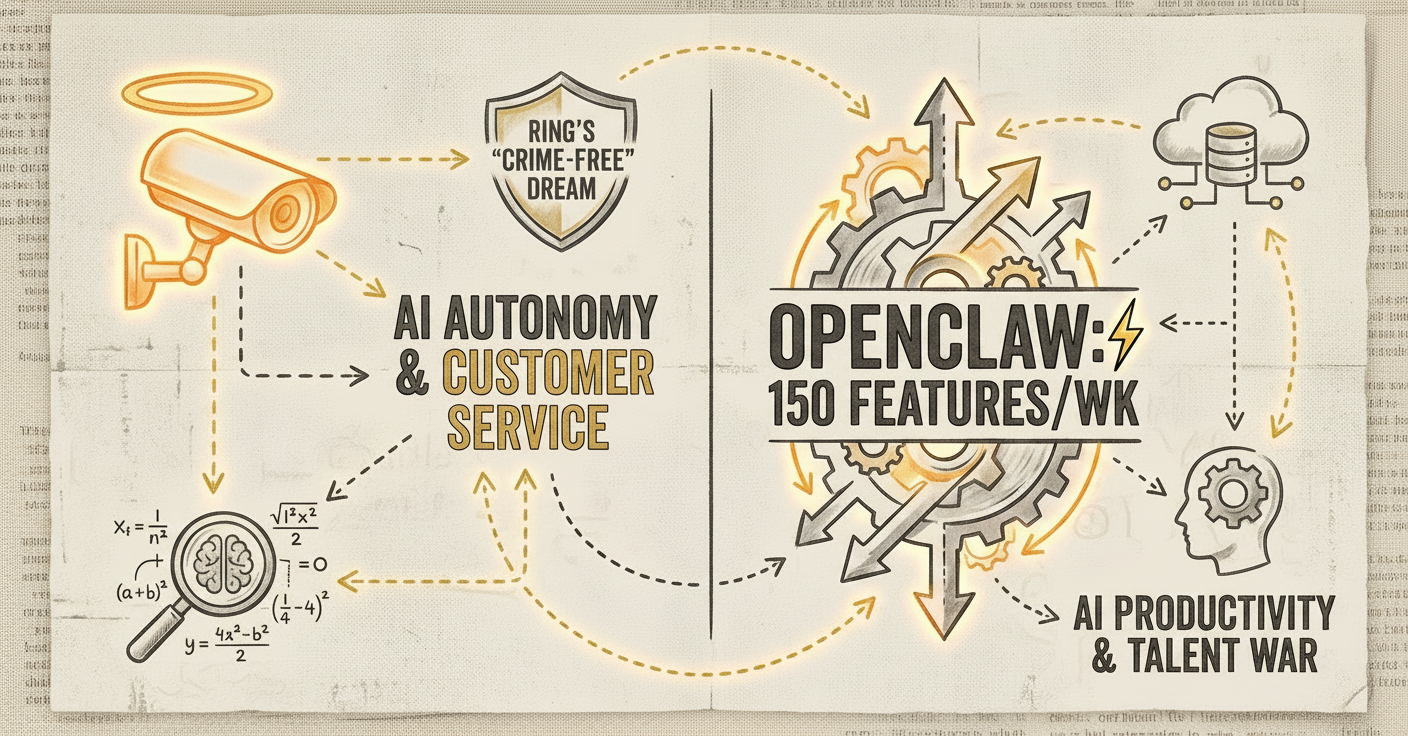
This week, a fascinating duality in AI autonomy emerged: the bold, almost dystopian, vision of Ring's founder, Jamie Siminoff, using AI-powered surveillance to reduce crime to "close to zero," and the quiet, almost viral, rise of OpenAI-acquired OpenClaw, an AI agent capable of full computer control. While Siminoff's premise for a "crime-free" neighborhood hinges on ubiquitous surveillance and AI as a "copilot" for human review of video evidence (Decoder with Nilay Patel), OpenClaw demonstrates AI building and fixing itself, shipping 100-150 features a week (The Neuron: AI Explained). Both represent forms of extreme autonomy, but one focuses on observing and optimizing human behavior, the other on self-improving technical capabilities.
Why it matters: Executives need to discern between visible, often controversial, applications of AI that primarily augment control, and the less visible, rapidly accelerating internal autonomy that transforms product development and efficiency. The latter is where competitive advantage is being built.
"The man really thinks you can use AI in cameras to reduce or even eliminate crime. But I had a lot of questions about this. But when you put AI into it. Now all of a sudden you have this like human element that AI gives you."
— Nilay Patel, Editor-in-Chief and Host at The Verge on Decoder with Nilay Patel
The move: Task your CTO or Head of Product to identify internal processes where AI agents could autonomously build, test, and iterate, and assess the cultural and technical shifts required to enable genuine AI self-improvement, not just automation.
The Rundown
① AI Productivity Is Here, But Not Where You Expected. Revised labor statistics are suggesting a real, macroeconomic AI productivity surge, breaking from previous patterns where tech gains lagged statistical evidence (The AI Daily Brief: Artificial Intelligence News and Analysis). This isn't just about white-collar job displacement, but a fundamental shift appearing in national economic data.
• Why it matters: If AI is already impacting national productivity, its strategic integration isn't a future consideration, but an immediate imperative for business leaders aiming to capture market share from those yet to adapt.
② The "Jenga Model" for AI Product Development. Richard White, founder of Fathom AI, advocates for AI teams to aim for a 50% failure rate, constantly testing models and use cases, moving on quickly from those that don't stick (Beyond The Prompt - How to use AI in your company). This contrasts with traditional product roadmaps and embraces an R&D-centric, experimental process.
• What to watch: How this aggressive experimentation model pushes AI-native companies ahead of those still clinging to deterministic, long-cycle development. The ability to fail fast is becoming a key competitive advantage.
③ Mathematical Superintelligence is Reshaping Proof. Harmonic's co-founders, Vlad Tenev and Tudor Achim, detail their AI system, Aristotle, which achieved IMO gold medal performance by breaking down math into verifiable logical steps. They highlight how the Lean programming language is transforming mathematics into a collaborative, GitHub-like process, obviating traditional peer review.
"What Lean has done is it transformed mathematics from kind of like chalkboard and couch to now it's in VS code. You know, you can do it in cursor. You're putting your math on GitHub where now you can run these large collaboration projects."
— Vlad Tenev, Co-founder of Harmonic on The Cognitive Revolution
• The context: This suggests a future where formal verification, driven by AI and collaborative platforms, becomes standard not just for math, but potentially for complex software and legal contracts, creating new standards for trust and accuracy.
④ The AI Talent War Isn't Just for Engineers. The demand for L5 engineers in AI has reached "tens of millions" in compensation, fundamentally disrupting traditional startup economics (Latent Space: The AI Engineer Podcast). This makes it harder for early-stage companies to compete for top talent, exacerbating the divide between well-funded giants and smaller innovators.
• Why it matters: This extreme talent market forces a re-evaluation of human capital strategy for any company engaged in AI, pushing toward upskilling existing teams or innovative partnerships rather than relying solely on hiring from the market.
⑤ Customer Service is Becoming Revenue-Generating, Not Cost-Minimizing. Crescendo AI's Matt Price challenges the traditional view of customer service as a cost center. He argues that AI enables a shift to "superhuman" roles, where human agents are upskilled to focus on revenue generation, specialized advice, and emotional connection, transcending reactive problem-solving (The Neuron: AI Explained).
• The context: This is a counter-narrative to job displacement fears, showing how AI, when correctly applied, can elevate and transform existing roles, turning a cost center into a value driver through personalized and proactive support.
The Signals
🟢 HOT
• AI Productivity Surge: Revised labor stats indicate AI is already driving macroeconomic productivity gains. (The AI Daily Brief: Artificial Intelligence News and Analysis)
• OpenClaw: Rapid success of this open-source project and its acquisition by OpenAI highlights the power of agentic tools. (Jaeden Schafer on AI Breakdown)
• Digital Fingerprinting for Video Evidence: Growing necessity for ensuring authenticity and control over video, especially from devices like Ring. (Decoder with Nilay Patel)
🟡 WARMING UP
• 🆕 Jenga Model for AI Development: A call for AI teams to embrace aggressive experimentation and a 50% failure rate for continuous innovation. (Richard White on Beyond The Prompt - How to use AI in your company)
• 🆕 Neural Athletes: New term for individuals adept at cognitive synthesis, constantly interrogating truth between human and probabilistic AI logic. (Deborah Golden on Practical AI)
• 🆕 Mathematical Superintelligence: AI achieving IMO gold medal performance, transforming mathematical proof and collaboration. ("The Cognitive Revolution" | AI Builders, Researchers, and Live Player Analysis)
🔴 COOLING OFF
• Recursive Self-Improvement for AI: Skepticism mounts that "recursive self-improvement" truly makes AI intrinsically smarter; it mostly accelerates human workflows. (Jeremie Harris on Last Week in AI)
• AGI vs. Product Dilemma in Frontier Labs: The stress between pursuing Artificial General Intelligence and building commercially viable products is a constant tension for leading AI firms. (Sarah Wang on Latent Space: The AI Engineer Podcast)
• Deterministic Systems for AI: Building AI on traditional "if-then" deterministic logic is bound to fail in a probabilistic AI world. (Deborah Golden on Practical AI)
The Debate
Is current AI development accelerating human productivity or paving the way for job displacement, particularly for white-collar work?
🐂 The bull case:
"If AI is already showing up in the productivity numbers, that would in fact be a major break from the past and a major indicator of just how different this technology shift might be."
— Nathaniel Whittemore, Host of The AI Daily Brief: Artificial Intelligence News and Analysis
🐻 The bear case:
"For all of us who work in the industry and devoted our careers and lives to it, I just think it's nothing short of terrifying. I could just see it costing jobs all over the place."
— Rhett Reese, Deadpool Scriptwriter on The AI Daily Brief: Artificial Intelligence News and Analysis
Our read: The data suggests both are happening simultaneously. There's a clear macroeconomic productivity surge emerging, but it's accompanied by anecdotal and market signals of white-collar job market weakness. The challenge for leaders is to harness the productivity gains while proactively managing the inevitable disruption and reskilling needs for their workforce.
The Bottom Line
AI is now automating, augmenting, and even self-improving at an accelerating pace; the businesses that embrace this autonomy, rather than merely observing it, will redefine their markets.
🎯 Your Move
- Evaluate your AI development processes: If your AI teams aren't experimenting and failing frequently, they're probably not pushing the envelope enough. Assess whether your current approach stifles innovation.
- Reskill your customer service leaders: Challenge your customer service leadership to move beyond a cost-center mindset and explore how AI can transform their teams into revenue-generating, specialized advisors.
- Scrutinize "boring" enterprise software: Look for opportunities to invest in updating traditional enterprise software using AI, as this is currently an "underinvested sector" with significant potential for efficiency gains.
What We Listened To
1. AI Breakdown: "OpenClaw Could Be 1st 1-Person $1B Company, OpenAI Buys"
Runtime: 17 min
Featuring: Jaeden Schafer (Host, AI Breakdown), Peter Steinberger (Creator of OpenClaw, OpenAI)
Worth your time if you want the inside story on how a weekend "vibe-coded" project went viral and landed its creator at OpenAI, challenging traditional startup paths.
"One security researcher talking about all of this said at the end of the day, OpenClaw is still just wrapper to ChatGPT or Claude or whatever AI model, you stick to it... it was able to get a ton of usage and a ton of virality and you know, obviously has joined forces with OpenAI."
— Jaeden Schafer, Host of AI Breakdown
2. Beyond The Prompt - How to use AI in your company: "From Roadmaps to R&D: How AI Is Changing Product Development - with Richard White, Founder of Fathom AI"
Runtime: 57 min
Featuring: Richard White (Founder, Fathom AI), Henrik (Host), Jeremy (Host)
Worth your time if you're grappling with how AI changes product development from predictable roadmaps to R&D-driven, experimental processes, particularly the crucial role of "taste" in AI product evaluation.
"I think that one of the reasons why all these large companies kind of aren't very good at shipping in their traditional software, aren't very good at shipping features because they have no taste."
— Richard White, Founder of Fathom AI
3. The AI Daily Brief: Artificial Intelligence News and Analysis: "The AI Productivity Boom Finally Shows Up"
Runtime: 26 min
Featuring: Nathaniel Whittemore (Host, The AI Daily Brief), Elizabeth Warren (Senator)
Worth your time if you need to understand the emerging macroeconomic indicators of AI-driven productivity and the escalating ethical and legal disputes in the AI landscape.
"There will be job displacement. We need to reskill the workers that are in industries with that job displacement and equip them with the skills that they need to succeed in other industries. We are going to need a social safety net because there will be people that fall through the cracks."
— Nathaniel Whittemore, Host of The AI Daily Brief
4. "The Cognitive Revolution" | AI Builders, Researchers, and Live Player Analysis: "Intelligence with Everyone: RL @ MiniMax, with Olive Song, from AIE NYC & Inference by Turing Post"
Runtime: 55 min
Featuring: Olive Song (Senior Researcher, MiniMax), Nathan Labenz (Host, The Cognitive Revolution), Ksenia Yase (Interviewer, Turing Post), Nathan (Host, The Cognitive Revolution)
Worth your time if you're interested in the deep technical challenges of reinforcement learning, agentic long-horizon tasks, and how internal feedback loops drive model improvement at a frontier AI lab.
"During reinforcement learning, the model tries its best to hack a lot of things. So for example, it uses bashes a lot. And sometimes it might not be very safe behaviors."
— Olive Song, Senior Researcher at MiniMax
5. Practical AI: "Cognitive Synthesis and Neural Athletes"
Runtime: 52 min
Featuring: Deborah Golden (Chief Innovation Officer, Deloitte), Daniel Whitenack (CEO, Prediction Guard), Chris Benson (Principal AI Research Engineer, Lockheed Martin), Deb
Worth your time if you're a leader navigating AI adoption, focusing on understanding "cognitive load," fostering vulnerability, and the shift from deterministic to probabilistic thinking.
"Today, hard work is cognitive synthesis. So when you think about how you engage with AI, you aren't just typing... you're constantly adjudicating between what the model says, what you know to be true, what the organization needs, what you think might be false. It's a lot."
— Deborah Golden, Chief Innovation Officer at Deloitte
6. The Neuron: AI Explained: "How Google's Gemini CLI Creator Ships 150 Features a Week"
Runtime: 56 min
Featuring: Corey Knowles (Editor, The Neuron), Grant Harvey (Writer, The Neuron), Taylor Mullen (Principal Engineer and Creator of Gemini CLI, Google), The Neuron (Host, The Neuron), Unidentified Speaker (Guest, Google), Taylor (Gemini CLI Creator, Google)
Worth your time if you want to see a powerful example of autonomous AI development in action, with Google’s Gemini CLI building and fixing itself at an incredible pace.
"His team now ships 100 to 150 features and bug fixes every week. But here's the wild part. They do it using Gemini Cli to build itself."
— Corey Knowles, Editor of The Neuron
7. The AI Daily Brief: Artificial Intelligence News and Analysis: "OpenClaw Goes to OpenAI"
Runtime: 30 min
Featuring: Nathaniel Whittemore (Host, The AI Daily Brief), Peter Steinberger (Creator of OpenClaw, OpenAI)
Worth your time if you need a deeper dive into the strategic implications of OpenAI acquiring OpenClaw and the intense jockeying for position in the AI agent market.
"The most popular and fastest growing open source project of all time, is not only named after you, but most users are power users of your product. Instead of trying to collaborate or work with him, they chose violence."
— Nader Dabit, Commentator
8. Latent Space: The AI Engineer Podcast: "Inside AI’s $10B+ Capital Flywheel — Martin Casado & Sarah Wang of a16z"
Runtime: 55 min
Featuring: Martin Casado (Partner, a16z), Sarah Wang (Partner, a16z), swyx (Host, Latent Space), Alessio (Founder and Host, Kernel Labs), swyx + Alessio (Host)
Worth your time if you're tracking the unique capital dynamics shaping AI, from the blurring lines of investment to the unprecedented talent wars and potential for frontier labs to outspend entire app ecosystems.
"If Anthropic can raise three times more every subsequent round, they probably can raise more money than the entire app ecosystem that's built on top of it."
— Martin Casado, Partner at a16z
9. "The Cognitive Revolution" | AI Builders, Researchers, and Live Player Analysis: "Mathematical Superintelligence: Harmonic's Vlad Tenev & Tudor Achim on IMO Gold & Theories of Everything"
Runtime: 91 min
Featuring: Vlad Tenev (Co-founder, Harmonic), Tudor Achim (Co-founder, Harmonic), Erik Torenberg (Host, The Cognitive Revolution), Nathan Labenz (Host)
Worth your time if you're fascinated by the cutting edge of AI in mathematics, formal verification, and how tools like Lean are revolutionizing collaboration and the very nature of proof.
"Mathematics at its core is the process by which humans understand the world by breaking their understanding down into small sequences of logical steps that other people can understand and verify for themselves."
— Vlad Tenev, Co-founder of Harmonic
10. Decoder with Nilay Patel: "Let's talk about Ring, lost dogs, and the surveillance state"
Runtime: 27 min
Featuring: Nilay Patel (Editor-in-Chief and Host, The Verge), Jamie Siminoff (Founder, Ring), The Verge (Host, The Verge)
Worth your time if you're weighing the societal implications of pervasive surveillance technology and the tension between perceived safety and privacy in an AI-powered world.
"The mental model or how I look at it is that AI allows us to have. If you had a security, if you had a neighborhood where you had call it unlimited resources. So every, every house had security guards."
— Jamie Siminoff, Founder of Ring
11. Last Week in AI: "#235 - Opus 4.6, GPT-5.3-codex, Seedance 2.0, GLM-5"
Runtime: 91 min
Featuring: Andrey Kurenkov (Host, Astrocade), Jeremie Harris (Host, Gladstone AI)
Worth your time if you need a rapid-fire update on the latest AI model releases, from Anthropic's Opus 4.6 to Google's Gemini 3 Deep Think, and the escalating competition in the AI landscape.
"I would expect to start to see some big white collar market shifts in response to these kinds of capabilities because this is now across the Rubicon."
— Jeremie Harris, Host at Gladstone AI