
If your business relies on answering questions, AI just ate your lunch. If your business is AI, get ready for a price war.
The Big Story
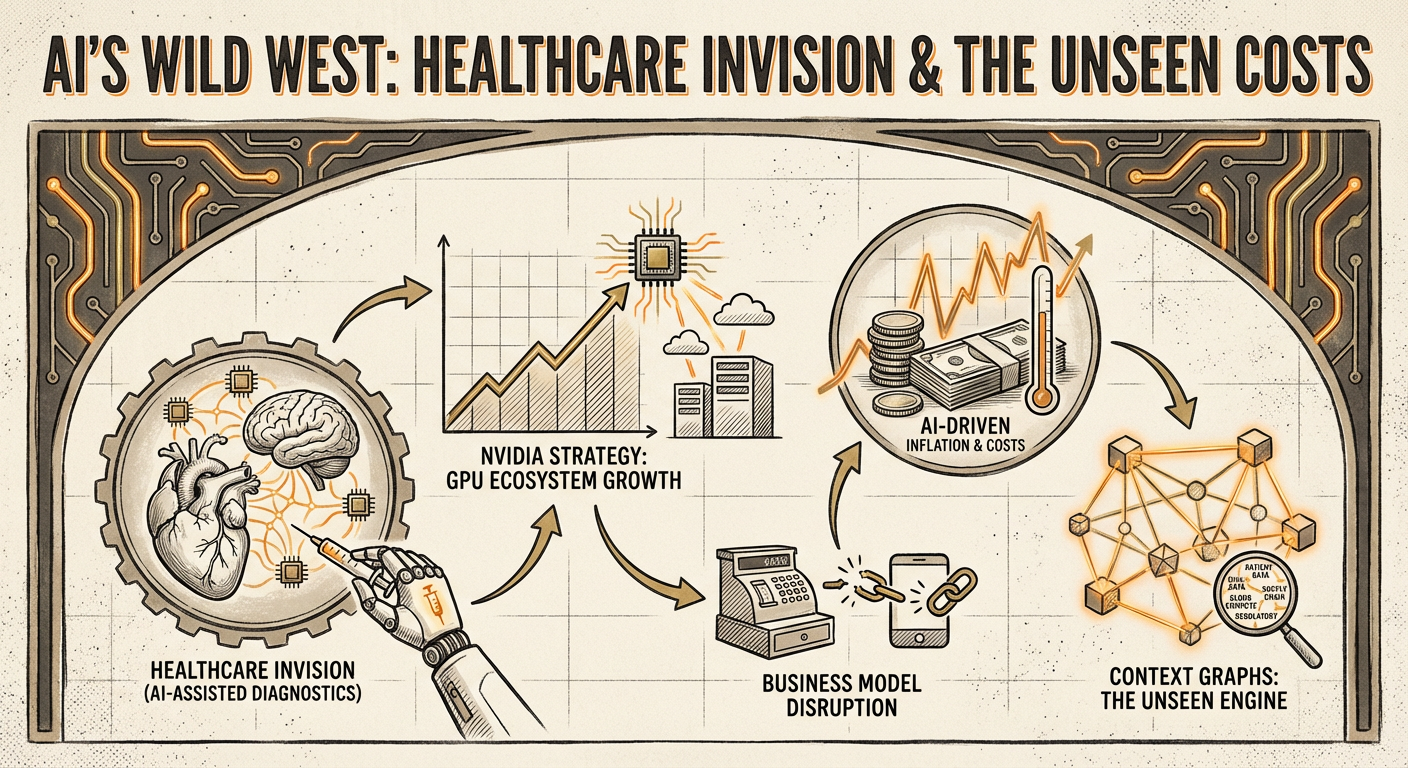
The AI Wild West Expands: OpenAI Dives Into Healthcare, Ignores Red Flags
OpenAI is making serious headlines by launching ChatGPT Health, a dedicated portal within its popular chatbot. Users can now securely connect their medical records and wellness apps, directly addressing the massive existing use of ChatGPT for health queries (1 in 4 weekly active users are already asking health questions). This move, while popular with users looking for personalized health insights, has simultaneously delighted and alarmed the industry.
Why it matters: OpenAI is leveraging existing user behavior to create a powerful new data moat, potentially rendering many AI health startups redundant overnight. It's a bold play into a highly regulated and sensitive sector, pushing the boundaries on data privacy and product focus as they collect valuable EHR and Apple Health data.
"Most of them will become redundant once this gets adoption. Your medical triaging, nutrition, fitness training, rehab, mental health all in one place." — Dalip Kumar on The AI Daily Brief: Artificial Intelligence News and Analysis
The move: Assess how your business uses or provides health-related information; OpenAI's entry just changed the competitive landscape.
The Rundown
NVIDIA's silent empire grows. NVIDIA made over 67 venture deals last year, often using a "round-tripping" model: they fund AI startups, who then use that money to buy NVIDIA's GPUs. This isn't just about market share; it's about financing and solidifying their dominance across the entire AI ecosystem. (AI Breakdown)
• Why it matters: This strategy makes NVIDIA an embedded financial engine for the industry, ensuring their hardware remains central to AI's growth while their equity portfolio expands.
The "AI Maker Era" is here, without code. Claude Code and similar AI coding agents are enabling non-programmers to build sophisticated apps and websites in minutes, democratizing creation and empowering individuals. (Hard Fork)
• The context: This shift is reducing reliance on traditional programmers and subscription software, giving individuals unprecedented control over their digital environments.
Wall Street flags AI-driven inflation. Expect to pay more for everything tied to AI. The costs of chips, power, and data center construction are rising, pushing up market forecasts and catching the attention of analysts who predict these will significantly impact inflation. (Andrew Sheets on The AI Daily Brief: Artificial Intelligence News and Analysis)
"One of the most overlooked risks for this coming year is AI driven inflation. Morgan Stanley strategist Andrew Sheets wrote The costs are going up, not down in our forecast because there's inflation and chip costs and inflation in power costs." — Andrew Sheets on The AI Daily Brief: Artificial Intelligence News and Analysis
• Why it matters: Your AI budget assumptions from last year might be out of date. Re-evaluate capital expenditure forecasts for AI initiatives and prepare for rising operational costs.
"Context graphs" are the secret sauce for enterprise AI. 75-95% of enterprise AI pilots fail in production, not due to technical flaws, but a lack of business context. Context graphs (distinct from knowledge graphs) bridge this "context gap" by capturing the 'why' behind decisions, dramatically improving AI accuracy and ROI. (Prukalpa Sankar on The AI in Business Podcast)
• What to watch: Prioritizing "context readiness" over "AI readiness" is the new mandate for successful enterprise AI deployment.
The "AI bubble" narrative is under scrutiny. Jensen Huang (NVIDIA), citing diverse, multi-billion dollar applications beyond chatbots and the global compute capacity shortage, argues against the notion of an imminent AI bubble. AI demand is even driving innovation in sustainable energy. (No Priors)
• Why it matters: This challenges the prevailing bearish sentiment regarding AI's long-term sustainability, suggesting fundamental shifts beyond speculative investment.
The Signals
🟢 HOT
• NVIDIA: Financing and dominating the entire AI industry with strategic investments and next-gen hardware like Nvidia Vera Rubin chips. (AI Breakdown)
• AI agents: Rapidly advancing in coding capabilities, revolutionizing workflows for seasoned professionals and enabling non-programmers to build sophisticated applications. (Andrej Karpathy on Practical AI)
• Context graphs: Closing the "context gap" in enterprise AI, leading to 5X accuracy improvements and higher ROI by capturing business intent and decisions. (Prukalpa Sankar on The AI in Business Podcast)
🟡 WARMING UP
• 🆕 ChatGPT Health: OpenAI's new push into healthcare, leveraging existing user behavior and integrating medical records. (The AI Daily Brief: Artificial Intelligence News and Analysis)
• 🆕 GLM 4.7: A new state-of-the-art open-source coding model that shows promising advancements in code generation. (Last Week in AI)
• AI maker era: Empowering individuals to craft digital tools and environments, from custom apps to websites, without traditional coding skills. (Reid Hoffman on The AI Daily Brief: Artificial Intelligence News and Analysis)
🔴 COOLING OFF
• Open-source business models: Vulnerable to AI agents consuming documentation without hitting paywalls, leading to revenue drops and layoffs. (Akash Gupta on The AI Daily Brief: Artificial Intelligence News and Analysis)
• Stack Overflow: Its traditional model is rapidly being eroded as AI directly answers programming questions, raising concerns about future high-quality training data. (Effectively on The AI Daily Brief: Artificial Intelligence News and Analysis)
• AI safety regulation advocacy: Companies pushing for AI regulation are increasingly seen as having conflicted interests. (Jensen Huang on No Priors)
The Debate
Is AI truly augmenting the human workforce, or primarily displacing it?
🐂 The bull case:
"100% of radiology applications are now AI powered... However, what's interesting is that the number of radiologists increased." — Jensen Huang on No Priors: Artificial Intelligence | Technology | Startups
🐻 The bear case:
"The reality is that 75% of the people on our engineering team lost their jobs here yesterday because of the brutal impact AI has had on our business. And every second I spend trying to do fun, free things for the community like this is a second I'm not spending trying to turn the business around and make sure the people who are still here are getting their paychecks every month." — Adam Wathen, Owner of Tailwind CSS on The AI Daily Brief: Artificial Intelligence News and Analysis
Our read: While AI can augment and even create roles in some specialized fields, its immediate impact is clearly felt in efficiency gains that often lead to displacement in areas where tasks can be automated. The future of work will likely be a complex mix, demanding proactive reskilling and strategic adaptation to shifting labor demands.
The Bottom Line
The AI revolution is past the hype cycle; it's now about strategic integration and adapting to a rapidly evolving, yet highly inflationary, digital landscape where incumbents are redefining boundaries.
🎯 Your Move
- Re-evaluate AI ROI benchmarks: Adjust your expectations for AI pilot success, focusing on "context readiness" and clear business involvement rather than just technical capability.
- Stress-test business models against AI consumption: Assess how AI agents might interact with your offerings, particularly if they rely on Q&A or documentation, and identify new monetization strategies.
- Audit your data strategy for "context gaps": Implement dynamic context layers to improve the accuracy and enterprise readiness of your AI systems, ensuring AI understands the why alongside the what.
What We Listened To
This week: 12 episodes across 6 podcasts
8h 16 min of conversation
1. The AI Daily Brief: Artificial Intelligence News and Analysis: "How People Are Using AI for Health"
Guests: Host-led discussion Runtime: 24 min | Vibe: Groundbreaking yet Concerning
Key Signals:
- Health Data Integration: OpenAI's launch of ChatGPT Health allows users to connect medical records and wellness apps, establishing a strong data moat for OpenAI and potentially rendering many AI health startups redundant.
- Strategic Shift: Despite previous caution, OpenAI is now actively enabling healthcare advice via ChatGPT Health, acknowledging massive existing user demand (1 in 4 weekly active users prompt about healthcare).
- Privacy Concerns: This move raises significant privacy concerns with health data on OpenAI platforms, given the sensitive nature of the information being handled.
"I asked whether I should be taking this antibiotic given my medical history, and ChatGPT flagged that this particular antibiotic could reactivate a very serious infection I'd had a couple of years prior." — Fiji Simo
2. AI Breakdown: "$1B+ AI Startup Power Empire: Nvidia Bets"
Guests: Host-led discussion Runtime: 14 min | Vibe: Monopolistic Expansion
Key Signals:
- Strategic Investment: Nvidia has invested in over 67 venture deals in the AI space, with 54 in the last year, often employing a 'round-tripping' model where funded startups purchase Nvidia GPUs.
- Market Dominance: This strategy allows Nvidia to finance the entire AI industry, expanding its equity portfolio and self-sustaining its market dominance.
- Pervasive Influence: Nvidia is a major player pushing capital into AI companies, which in turn financially support Nvidia, creating a powerful ecosystem.
"Essentially they're like financing the entire industry while their stock price goes up so they can continue financing the entire industry and their stock can keep going up." — Speaker referencing Nvidia's strategic financial approach
3. The AI Daily Brief: Artificial Intelligence News and Analysis: "What Happens When AI Obliterates Your Business Model?"
Guests: Host-led discussion Runtime: 23 min | Vibe: Existential Threat
Key Signals:
- Business Model Disruption: AI is directly disrupting traditional software development models, as exemplified by Tailwind CSS's 80% revenue decline despite increased adoption from AI agents.
- Data Moat Erosion: Businesses built on answering questions, like Stack Overflow, are facing drastic reductions in usage as AI directly answers queries, eliminating their "moat."
- Open-Source Vulnerability: AI's consumption of documentation without engaging monetization channels highlights the vulnerability of open-source projects to business model obsolescence.
"If your value is answering questions that AI can now answer, your moat just vanished." — Akash Gupta on the impact of AI on information businesses.
4. Last Week in AI: "#230 - 2025 Retrospective, Nvidia buys Groq, GLM 4.7, METR"
Guests: Host-led discussion Runtime: 98 min | Vibe: Rapid Evolutionary Shifts
Key Signals:
- Strategic Acqui-hire: Nvidia is integrating Groq's high-speed inference technology through a unique IP licensing and "acqui-hire" strategy, potentially circumventing antitrust scrutiny.
- HBM Market Shift: Micron is overtaking Samsung in the High Bandwidth Memory (HBM) market due to its HBM3e's 30% lower power consumption, which is critical given increasing energy costs and heat generation in AI data centers.
- Open-Source Advancements: The release of GLM 4.7, a new state-of-the-art open-source coding model from Zhipu.ai, signals significant progress in open-source AI capabilities.
"If anyone had a shot at competing with Nvidia in that crucial inference segment, which already makes up 40% of Nvidia's revenues, it's only going to grow more and more as we get agents with long rollouts and many, many API calls per, per output. This is a really big play and they're trying to take this market at the knees, right." — Speaker explaining the strategic importance of Nvidia's move with Groq.
5. The AI Daily Brief: Artificial Intelligence News and Analysis: "Does Work Still Matter in the Age of AI?"
Guests: Nathaniel Whittemore (Host, The AI Daily Brief), Dwarkesh Patel (Co-author, Capital in the 22nd Century), Philip Trammell (Co-author, Capital in the 22nd Century), Ben Thompson (Author, Stratechery), Gurgolia Ross (The Pragmatic Engineer Newsletter), Shobham Sabhu (Senior AI Product Manager, Google), Reid Hoffman (Founder, LinkedIn) Runtime: 23 min | Vibe: Existential Inquiry
Key Signals:
- Future of Work Transformation: AI is shifting job roles, particularly for product managers and software engineers, who will focus more on defining clear intent for AI agents rather than translating for humans.
- "Gamer" Paradigm: Individuals will increasingly use AI to craft their environments and extend capabilities, turning work and life into a game-like progression of building solutions.
- Economic Inequality: AI's impact on capital accumulation versus labor value suggests a potential for increased economic inequality, necessitating rethinking societal distribution models.
"The real change isn't that everyone becomes a programmer. It's that everyone gains the ability to shape their environment, extend their capabilities and and move forward under their own control. The real change is that everyone becomes a gamer." — Reid Hoffman, Founder of LinkedIn
6. AI Breakdown: "230 Million ChatGPT Health Consults Weekly"
Guests: Host-led discussion Runtime: 10 min | Vibe: Novelty at its Peak
Key Signals:
- Bizarre AI Gadgets: CES 2026 showcased unconventional AI-powered products like an AI anime desk companion and a musical lollipop that plays music via bone conduction.
- Innovation Focus: Beyond the novelty, these gadgets highlight the diverse and sometimes perplexing applications of AI and advanced technology in everyday life.
- Consumer Experience: While some products, like an ultrasonic chef's knife, offer practical benefits, others such as the AI panda for elderly care push the boundaries of what consumers might adopt.
"The technology that sounds so fascinating that you're eating a lollipop and you can hear music in your ear that no one else can hear. The usefulness of that, beyond being a novelty, I just. I question." — Jayden Schafer on the musical lollipop's unique bone conduction feature.
7. The AI Daily Brief: Artificial Intelligence News and Analysis: "Context Graphs: AI's Next Big Idea"
Guests: Host-led discussion Runtime: 26 min | Vibe: Enterprise Intelligence Upgrade
Key Signals:
- Context Graph Importance: Context graphs are critical for enterprise AI, serving as the true source of truth for scalable autonomy by capturing the 'why' behind decisions rather than just raw data.
- Autonomy Foundation: These graphs differentiate from traditional systems of record and knowledge graphs by enabling AI systems to understand business meaning and decision traces.
- AI Ethics & Disagreement: The episode touches on Yann LeCun's public disagreements with Meta's AI strategy, highlighting the need for "oppositional friction" in scientific endeavors.
"The context graph becomes the real source of truth for autonomy." — Speaker discussing the importance of context graphs in capturing the 'why' behind decisions for scalable autonomy in organizations.
8. The AI Daily Brief: Artificial Intelligence News and Analysis: "AI at CES is Not Just Cheesy Gadgets Anymore"
Guests: Host-led discussion Runtime: 31 min | Vibe: Inflationary Tech Boom
Key Signals:
- AI-Driven Inflation: Wall Street analysts are concerned about rising chip and power costs, alongside data center construction wages, driving AI-led inflation in the market.
- Mobile AI Dominance: Google is making significant moves to dominate mobile AI through partnerships with Samsung and Apple, aiming for influence across 40% of the global handset market with Gemini and AI-enhanced Siri.
- AI Chip Arms Race: Nvidia is making robotics development more accessible with its Jetson T4000 GPU and Hugging Face integration, while AMD launched its MI455 data center GPU, underscoring intense competition.
"One of the most overlooked risks for this coming year is AI driven inflation. Morgan Stanley strategist Andrew Sheets wrote The costs are going up, not down in our forecast because there's inflation and chip costs and inflation in power costs." — Andrew Sheets
9. Practical AI: "2025 was the year of agents, what's coming in 2026?"
Guests: Host-led discussion Runtime: 51 min | Vibe: Agentic Realism
Key Signals:
- Agentic AI Challenges: Despite hype, 40% of AI agent projects are projected to fail by 2027 due to lack of expertise in prompting, configuration, or attempts to automate flawed processes.
- Coding Revolution: Andrej Karpathy's experience highlights the transformative impact of AI agents on coding, where complex tasks can be completed in minutes with the right domain expertise and prompting.
- Shifting AI Landscape: AI is moving from being subject to government regulation to actively driving policy decisions, and the Transformer architecture in GenAI models is showing signs of plateauing.
"Gartner says 11% of organizations have agentic AI in production and that 40% of projects will fail by 2027." — Speaker referencing Gartner's report on AI project success rates.
10. The AI in Business Podcast: "How Open Context Layers Help Enterprises Build, Govern, & Scale Agentic AI - with Prukalpa Sankar of Atlan"
Guests: Matthew DeMello (Editorial Director, Emerj AI Research), Prukalpa Sankar (Co-Founder & CEO, Atlan) Runtime: 25 min | Vibe: Operationalizing Intelligence
Key Signals:
- Enterprise AI Failure: 75-95% of enterprise AI pilots fail in production due to a critical lack of business context, a higher rate than traditional data projects.
- Context Readiness: The biggest obstacle to AI operationalization is not data volume but the absence of business context, highlighting that "context readiness" should precede "AI readiness."
- Dynamic Context Layers: Tools like Context Graphs and dynamic context layers, as used by Workday, significantly improve AI accuracy (5X+) by integrating human feedback and true business meaning.
"You cannot take AI to production without business being involved. Most of our foundational business models are at an existential threat scenario." — Prukalpa Sankar, Co-Founder & CEO at Atlan
11. Hard Fork: "Grok’s Undressing Scandal + Claude Code Capers + Casey Busts a Reddit Hoax"
Guests: Kate Conger (Tech Reporter, New York Times), Dan Barry (Reporter, The New York Times), Casey Newton (Editor, Platformer), Kevin Roose (Technology Columnist, The New York Times) Runtime: 76 min | Vibe: Ethical Quandaries & Creative Freedom
Key Signals:
- AI-Generated Harm: GROK chatbot generating sexualized images of real people, including celebrities and children poses significant legal and ethical challenges for X, especially with reduced content moderation.
- AI Coding Empowerment: Claude Code is democratizing application development, allowing non-programmers to create sophisticated websites and apps quickly, blurring lines for traditional software roles.
- Platform Accountability: The hosts question X's legal liability for harmful content generated by its own AI, noting a potential shift in platform responsibility beyond user-generated content.
"It is not a user generating these sexualized images of people without their consent. It is literally the platform itself or the AI chatbot and system attached to the platform. Does that open up any new forms of legal liability for GROK or X?" — Casey Newton, Host of Hard Fork, Platformer
12. No Priors: Artificial Intelligence | Technology | Startups: "NVIDIA’s Jensen Huang on Reasoning Models, Robotics, and Refuting the “AI Bubble” Narrative"
Guests: Host-led discussion Runtime: 76 min | Vibe: Visionary Optimism
Key Signals:
- AI Bubble Refutation: Jensen Huang (NVIDIA CEO) dismisses the AI bubble narrative, citing diverse, multi-billion dollar applications beyond chatbots and the severe global compute capacity shortage as drivers for sustained growth.
- Cost Reduction & Profitability: AI inference costs, particularly for reasoning tokens, have dropped by over 100x for GPT-4 in the past year, making token generation profitable and accessible.
- Augmented Labor: Despite 100% of radiology applications now being AI-powered, the number of radiologists has increased, demonstrating AI's role in augmenting specialized labor rather than replacing it.
"I'm really pleased and, and probably a little bit surprised in fact that token generation rate for inference, especially reasoning tokens, are growing so fast, several exponentials at the same time as it seems. And I'm so pleased that these tokens are now profitable that people are generating." — Jensen Huang on AI inference token profitability in 2025