
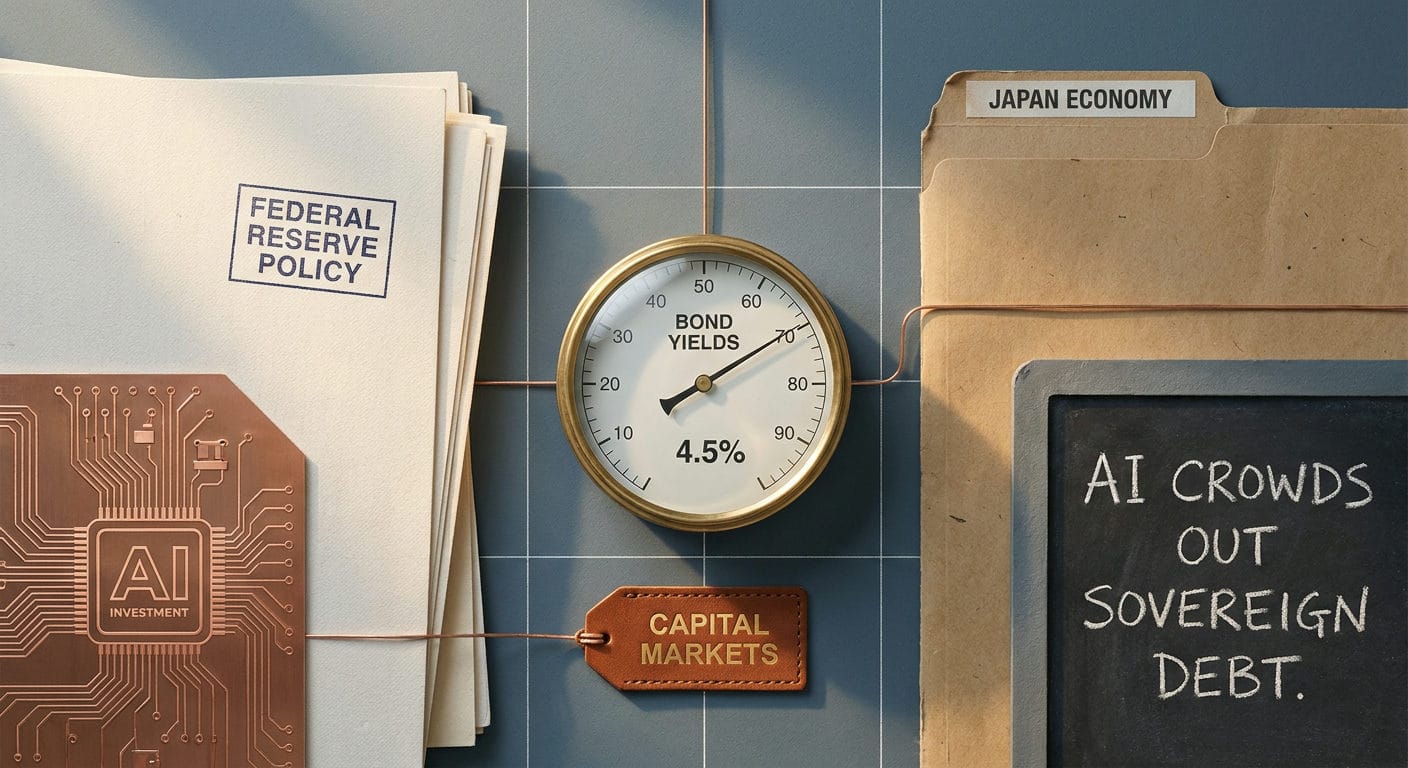
The capital markets are wrestling with a Fed that is more hawkish than expected, AI demand crowding out government debt, and a global economy increasingly dependent on quiet industrial giants like Japan.
📊 12 episodes across 8 podcasts
⏱ 540 minutes of intelligence analyzed
🎙 Featuring: Ed Zitron (Founder and CEO, EZPR), Downtown Josh Brown (Host, Ritholtz Wealth Management), Michael Batnick (Host, Ritholtz Wealth Management), Andreas Steno (Host, Real Vision: Finance & Investing)
|

The Big Shift
Federal Reserve communication is increasingly complex, with recent hawkish remarks creating unexpected market reactions and sparking debate about the path of interest rates. This shift is not just about words; it's about the very mechanics of capital formation and allocation.
What's happening: This week, former Fed Governor Kevin Warsh (🆕) delivered a surprisingly hawkish speech at Jackson Hole, signaling persistent inflation concerns and increasing the probability of a September rate hike. While markets braced for impact, the long end of the bond yield curve did not react as uniformly as anticipated. Several analysts noted the Fed's communication is becoming harder to interpret, with mixed messages and dissent creating uncertainty.
"He made a big point of saying don't call this forward guidance, but he did give a trail map, so, so to speak, which sounded a lot like forward guidance. And it feels like the markets all reacted as if it were forward guidance."
— Sarah Hunt, Chief Market Strategist at Alpine Saxon Woods on Bloomberg Surveillance
Why it matters: This isn't just about another rate hike; it's about the credibility and clarity of the Fed's signaling. When investors and executives struggle to read the central bank's intentions, it introduces a layer of systemic risk that complicates capital planning, M&A timing, and refinancing strategies. The market's nuanced reaction—some yields moving, others not—suggests a deeper disconnect where factors beyond Fed policy are now at play. This opacity means operators need to build in larger buffers and contingencies for capital costs, as future rate paths are less predictable than ever.
The level to watch: The market's implied probability of a September rate hike, and how long-dated bond yields respond to future Fed commentary versus actual economic data. Any sustained divergence indicates a broken feedback loop between policy and market reaction, making capital access more volatile.
The Rundown
① AI's Capital Demands Are Crowding Out Government Debt.
Hyperscalers are issuing debt at unprecedented magnitudes to fund AI infrastructure, leading to demand for government debt being "crowded out" and contributing to rising long-term yields. (Haseeb Qureshi on Bankless)
→ Implication for CFOs: This dynamic means the cost of long-term capital for both private and public entities is likely to remain elevated as AI's insatiable appetite for capex competes directly with sovereign borrowing needs.
② Institutions Are Driving Inbound Demand for Compliant On-Chain Finance.
There is "massive demand for privacy institutions" to adopt Ethereum-based solutions, driven by their observation of DeFi innovation and the need for compliant participation. (Oskar Thoren, Co-founder of ETH Systems on Bankless)
→ Why it matters: This is a signal that institutional adoption of blockchain is not a theoretical future, but a current reality with significant, specific requirements for privacy and regulatory compliance that companies like ETH Systems (companies) are now addressing.
③ Japan's Quiet Industrial Prowess Is Indispensable to Global Supply Chains.
Despite mainstream narratives, Japan remains a critical industrial power, deeply embedded in global supply chains, especially in advanced manufacturing and semiconductors, which is making its intellectual property highly sought after. (Andrew McDermott (Partner, Mission Value Partners) on The Grant Williams Podcast)
→ Strategic Takeaway: Companies should re-evaluate their supply chain dependencies and investment opportunities in Japan, recognizing its crucial role in high-tech components and defense manufacturing, often undervalued due to currency-focused narratives.
④ Cash is No Longer "Easy"—Investors Need to Lock in Longer Duration.
Investors are moving out of ultra-short cash positions and into longer-duration investments to lock in yields, as anticipating potential rate cuts makes staying in cash a missed opportunity. (Brandon Clark, ETF Business Director at Federated Hermes on Animal Spirits Podcast)
→ Actionable Insight: CFOs and treasury managers should review their cash management strategies, moving beyond short-term rates to secure longer-term yields and hedge against anticipated rate cuts, or risk "leaving money on the table."
⑤ AI's Near-Term ROI is Facing Increased Scrutiny.
The market is starting to question the immediate return on investment for AI, with some analysts noting a disconnect between the hype and tangible short-term economic benefits. (David Zervos, Chief Market Strategist at Jefferies on CNBC's "Fast Money")
→ Capital Allocation Signal: For businesses considering large AI investments, this indicates a need for clearer, quantifiable ROI projections and a focus on proven use cases rather than speculative deployments, as investor patience may be waning.
Signal Board
📈 Heating Up
• AI-powered automation in industrial settings: This segment is seeing significant practical application and economic benefits, driving productivity and creating higher-quality jobs. (Shahin Farshchi on Bankless)
• Information technology sector investment: Strong corporate earnings and positive forward guidance are supporting continued investment, particularly in semiconductors and communication services. (Tracy McMillian on Bloomberg Surveillance)
• The "debasement trade": Treasury long-end bond buybacks suggest increased money supply and lack of fiscal discipline, boosting both Bitcoin's "gold-like" and "risk asset" appeal. (Haseeb Qureshi on Bankless)
🆕 On Watch
• Private credit funding for data centers: Billions are flowing into AI data center infrastructure via private credit, raising concerns about due diligence and long-term sustainability. (Ed Zitron on The Compound and Friends)
• Tokenized stocks: While growing, current demand heavily favors derivatives due to liquidity and efficiency issues, suggesting spot market challenges. (Haseeb, Host on Bankless)
• European economic resilience: Contrary to common perceptions, Europe, particularly Germany and the UK, is showing positive growth and strong startup activity, including in AI. (Ethan Debitt on Bloomberg Surveillance)
📉 Cooling Off
• Humanoid robots: Despite the hype, investors express caution about the near-term practicality and economic viability of domestic humanoid robots compared to industrial automation. (Shahin Farshchi on Bankless)
• Consumer spending behavior in retail: While some discretionary retailers outperform, concerns persist about overall consumer health and the loan books of "buy now, pay later" platforms. (Julie, Analyst on CNBC's "Fast Money")
• High market expectations for AI stocks: Marvell Technology's stock drop despite raised forecasts highlights that extreme expectations are already priced in, making even good news insufficient for a rally. (Laura Martin on CNBC's "Fast Money")
The Debate
The market is grappling with the true economic impact of current AI investment.
🐂 The bull case: Advocates argue that AI is driving tangible productivity gains and creating new opportunities, with companies finding new ways to integrate AI weekly. Downtown Josh Brown noted, "As an AI user, it's going to slow down. At a company every week we're finding new things that we can plug into AI and do better than we did the week before."
🐻 The bear case: Skeptics, like Ed Zitron, argue much of the AI boom is unsustainable, financially dependent on unprofitable startups, and backed by under-scrutinized private credit. He fears a significant misallocation of capital, stating, "All of the investment in AI data centers terrifies me to my core."
Our read: While AI is undoubtedly transformative, the market's enthusiasm has outpaced verifiable economic returns, creating a significant risk of overinvestment in the near term.
The Bottom Line
Between a hawkish Fed, AI's capital black hole, and quietly resilient global players, navigating capital markets now demands a deeper read than headlines allow—the price of admission is parsing signals from the noise.
Episode Guide (Web Version)
1. Bankless — "Ethereum Privacy for Institutions | Mo Jalil and Oskar Thoren"
Runtime: 52 min | Guests: Mo Jalil (Co-founder, ETH Systems), Oskar Thoren (Co-founder, ETH Systems), David (Host, Bankless)
Who should listen: Financial institutions, compliance officers, and blockchain developers interested in the practicalities of bringing traditional finance onto Ethereum while maintaining necessary privacy and regulatory standards.
This episode dives into the crucial need for institutional privacy on Ethereum to facilitate wider adoption. Mo Jalil and Oskar Thoren of ETH Systems explain how they are engineering bespoke privacy solutions for TradFi use cases, highlighting the immense inbound demand from institutions for compliant on-chain capabilities.
"For institutions, they need that [privacy] in order to basically access the benefits of basically Ethereum."
— Mo Jalil, Co-founder of ETH Systems
Connects to: Institutional demand for on-chain finance is inbound and massive
2. Macro Voices — "MacroVoices #547 Daniel Lacalle: The Future of Reserve Currency"
Runtime: 42 min | Guests: Erik Townsend (Host, MacroVoices), Daniel Lacalle (Chief Economist and Fund Manager, Tressis)
Who should listen: Macro strategists, investors concerned about currency debasement, and anyone tracking the long-term shifts in global reserve currency dynamics.
Daniel Lacalle explores the potential displacement of the US Dollar as governments push economic, fiscal, and inflationary limits. He argues that stablecoins could serve as a transition bridge, while central banks are increasingly turning to gold, reflecting a shift away from a US-centric financial system.
"Governments have surpassed all of the limits that give them credibility to maintain their debt as a reserve of value. And those limits are the economic limit, the fiscal limit, and the inflationary limit."
— Daniel Lacalle, Chief Economist and Fund Manager at Tressis
Connects to: US Dollar reserve currency status, Central bank gold accumulation trends
3. Bloomberg Surveillance — "Jackson Hole Preview"
Runtime: 32 min | Guests: Andrew Sheets (Global Head of Fixed Income Research, Morgan Stanley), Angelo Zino (SVP and Tech Lead, CFRA Research), Brett Ewing (Chief Market Strategist, First Franklin Financial Services), Tom Keene (Host, Bloomberg), Paul Sweeney (Host, Bloomberg), Ethan Debitt (Senior Investment Advisor, Moneta Group)
Who should listen: Portfolio managers, analysts, and anyone looking for a comprehensive overview of the key themes and expectations heading into a major central bank event.
This preview covers the bond market's surprising resilience amidst high U.S. debt, Nvidia's growth drivers, and challenges in interpreting Fed signals. Discussions range from European economic resilience and AI sovereignty to the implications of a "debasement trade" for the dollar and upcoming IPO market timing.
"The bond market is currently fine with that number [40 trillion US debt]. Rates of implied volatility in the bond market are pretty low. Levels of inflation expectations are still pretty modest."
— Andrew Sheets, Global Head of Fixed Income Research at Morgan Stanley
Connects to: Federal Reserve Jackson Hole expectations, Dollar debasement trade and bond market support
4. CNBC's "Fast Money" — "Fast Money 8/28/26"
Runtime: 44 min | Guests: Frank Holland (Host, CNBC), Steve Liesman (Senior Economics Reporter, CNBC), Steve Grasso (Fast Money Trader, CNBC), Julie Beal (Fast Money Trader, CNBC), Mike Koh (Fast Money Trader, CNBC), David Zervos (Chief Market Strategist, Jefferies), Courtney Garcia (Fast Money Trader, CNBC), Courtney (Analyst, CNBC), Grasso (Analyst, CNBC), Mike (Analyst, CNBC), Julie (Analyst, CNBC), Mackenzie Segalis (Reporter, CNBC)
Who should listen: Active traders and investors interested in immediate market reactions to Fed policy and expert opinions on sector-specific trends.
The panel reacts to Kevin Warsh's hawkish Jackson Hole remarks, discussing the increased probability of a September rate hike and the market's questioning of AI's immediate ROI. The episode also touches on the debate between software vs. hardware investments in tech, retail sector performance, and consumer spending behavior.
"The good news is markets were relatively resilient to this [Jackson Hole news] and I think there was concern that markets weren't going to do well if Fed is raising interest rates. But the question is why that's going to happen. So odds went up that they're going to raise rates, but that's happening because we're in a strong economy."
— Courtney Garcia, Fast Money Trader at CNBC
Connects to: Federal Reserve September rate hike probability, AI's near-term ROI is facing increased scrutiny
5. The Compound and Friends — "The Four Horsemen of the AI Apocalypse with Ed Zitron"
Runtime: 87 min | Guests: Ed Zitron (Founder and CEO, EZPR), Downtown Josh Brown (Host, Ritholtz Wealth Management), Michael Batnick (Host, Ritholtz Wealth Management)
Who should listen: Investors and executives who want a critical, "ultra-bear" perspective on the current AI boom, challenging popular narratives and highlighting financial risks.
AI skeptic Ed Zitron presents his case against the current AI boom, arguing that much of the demand is unsustainable, dependent on unprofitable AI companies, and fueled by dubious private credit in data centers. He questions the true economic value of AI versus its astronomical costs, while Josh Brown offers counterpoints on practical AI applications.
"I think the ones who are like Anthropic and OpenAI are going to grow to $284 billion in revenue. That's what OpenAI is projecting in 2030. The people who read that and they're like, yeah, sounds good to me. Those people are not living in reality."
— Ed Zitron, Founder and CEO of EZPR
Connects to: Private credit funding for data centers, AI's capital demands are crowding out government debt
6. Bankless — "ROLLUP: The Debasement Trade is Back | Bessent Put | Tokenized Stocks | AI Capital Crunch"
Runtime: 65 min | Guests: Ryan (Host, Bankless), Haseeb Qureshi (Guest Host, Bankless), Haseeb (Host, Bankless)
Who should listen: Crypto investors, macroeconomists, and anyone interested in how monetary policy, AI's capital demands, and digital assets intersect.
This rollup covers the resurgence of the "debasement trade" for Bitcoin due to Treasury bond buybacks, the impact of AI capital demand crowding out government debt, and the current state of tokenized stocks. Haseeb Qureshi explains how increased money supply boosts Bitcoin's appeal and discusses Stan Druckenmiller's critique of artificial yield suppression.
"The long term treasury yield is the most important price in the world. It is also the only fiscal disciplinarian the US has left. Every basis point of artificial yield suppression is is a subsidy to procrastination. If the 30 year must trade at 5.5% to clear, that isn't a crisis, it's an invoice."
— Stan Druckenmiller, Investor
Connects to: AI capital demand crowding out government debt, Tokenized stock demand for derivatives vs spot
7. CNBC's "Fast Money" — "Fast Money 8/27/26"
Runtime: 43 min | Guests: Brian Sullivan (Host, CNBC), Tim Seymour (Trader, CNBC), Robert Tipp (Chief Investment Strategist, Head of Global Bonds, PGIM Fixed Income), CNBC (Host), Laura Martin (Analyst, Needham), Bobby Buerg (Partner and Portfolio Manager, Oakmark Select Fund, Oakmark Harris), Anika Kim Constantino (Reporter, CNBC), Dan Nathan (Founder, RiskReversal Advisors), Guy Adami (Founder, Adami's Advice)
Who should listen: Traders and investors seeking expert opinions on the likely market impact of Fed communications and deep dives into sector-specific stock performance.
The panel anticipates Fed Chairman Kevin Warsh's Jackson Hole speech, discussing its potential impact on bond and stock markets and the ongoing debate about monetary policy. The episode also analyzes Marvell Technology's stock drop due to high expectations and the valuation of software stocks like Salesforce (companies).
"One in every four hyperscaler investment dollars is going to in video. One in every four. That's incredible."
— Laura Martin, Analyst at Needham
Connects to: Fed Chairman Kevin Warsh Jackson Hole speech anticipation, High market expectations affecting stock performance
8. Bankless — "Bullish on Automation and Robotics, but not Humanoid Robots | Shahin Farshchi"
Runtime: 55 min | Guests: David (Host, Bankless), Shahin Farshchi (General Partner, Lux Capital)
Who should listen: Technology investors, manufacturing executives, and anyone interested in the practical, investable trends in robotics and industrial automation.
Shahin Farshchi of Lux Capital argues that while humanoid robotics capture headlines, the real opportunity lies in AI-powered industrial automation. He highlights how advanced AI and cheaper hardware are creating new markets for factory and warehouse robotics, creating higher-quality jobs and benefiting consumers.
"My personal excitement in robotics and automation isn't rooted in the humanoids, is rooted in this more macro tailwind around the software that drives the robots and the commoditization of the hardware that the software runs on."
— Shahin Farshchi, General Partner at Lux Capital
Connects to: AI-powered automation in industrial settings (factories, warehouses), Humanoid robots are not the main event in robotics
9. Animal Spirits Podcast — "Talk Your Book: Cash Was Easy… Now What?"
Runtime: 33 min | Guests: Michael Batnick (Host, Ritholtz Wealth Management), Ben Carlson (Host, Ritholtz Wealth Management), Brandon Clark (ETF Business Director, Federated Hermes), Brandon (Representative, Federated Hermes)
Who should listen: Financial advisors, retail investors, and anyone managing personal or corporate cash, looking for strategies to navigate changing interest rate environments.
Michael Batnick and Ben Carlson discuss with Brandon Clark of Federated Hermes (companies) the shift from short-term cash to longer-duration investments. They explore how investors, often focused on nominal income, are now looking to lock in yields ahead of potential rate cuts, highlighting behavioral finance aspects in fixed income decision-making.
"I found that people think about income nominally. They don't think like, oh, oh man, my cash has given me 3.25% but inflation still running at 3 or whatever it is, I'm only actually getting 25%, 25 basis points above inflation. They never think like that."
— Michael Batnick, Host at Ritholtz Wealth Management
Connects to: Investor shift from cash to longer duration bonds, Risk of holding cash amidst potential rate cuts
10. Bloomberg Surveillance — "Yields Respond to Kevin Warsh's Jackson Hole Speech"
Runtime: 26 min | Guests: Kristina Hooper (Chief Market Strategist, Man Group), Tracey Manzi (Senior Investment Strategist, Raymond James), Sarah Hunt (Chief Market Strategist, Alpine Saxon Woods), Tracie McMillion (Head of Global Asset Allocation Strategy, Wells Fargo), Tracy McMillian (Global Head of Asset Allocation Strategy, Wells Fargo), Tom Keene (Host, Bloomberg), Paul Sweeney (Host, Bloomberg)
Who should listen: Fixed income specialists, equity analysts, and macro investors dissecting the implications of Fed rhetoric on various asset classes.
The discussion centers on Kevin Warsh (person) hawkish Jackson Hole speech, with strategists debating the "higher for longer" interest rate environment and its impact on equities. The panel explores the attractive income story in fixed income, sector preferences for equities (IT, semiconductors), and the disconnect between Fed guidance and market reactions.
"That income story that you just talked about in fixed income is the best that it's been in years. And with yields on the AG close to 5% right now, you can have pretty good clarity that you can earn 5%."
— Tracey Manzi, Senior Investment Strategist at Raymond James
Connects to: Higher for longer interest rates implication, Short-end investment grade credit strategy
11. Real Vision: Finance & Investing — "Is Risk-On Too Risky? | Macro Mondays: August 31, 2026"
Runtime: 31 min | Guests: Andreas Steno (Host, Real Vision: Finance & Investing), Mikkel Rosenvold (Host, Real Vision: Finance & Investing), Kevin Warsh (Former Governor, Federal Reserve), Scott Bessent (Founder, CEO & CIO, Key Square Capital Management)
Who should listen: Macroeconomists and investors interested in deep dives into inflation metrics, geopolitical risks, and central bank policy divergences.
Andreas Steno and Mikkel Rosenvold analyze Kevin Warsh's hawkish Jackson Hole speech, focusing on the divergence between PCE and CPI as inflation indicators. They also discuss geopolitical tensions in the Middle East and the economic impact of the AI buildout on global jobs and construction, providing context for central bank policy.
"I'm tempted to say that he kind of solidified the mandate around PCE again right when the PC is about to roll over."
— Andreas Steno, Host at Real Vision: Finance & Investing
Connects to: PCE vs. CPI inflation divergence, Kevin Warsh's hawkish Jackson Hole speech
12. The Grant Williams Podcast — "The Grant Williams Podcast Ep. 131 - Andrew McDermott"
Runtime: 30 min | Guests: Grant Williams (Host, The Grant Williams Podcast), Andrew McDermott (Partner, Mission Value Partners)
Who should listen: Long-term value investors, geopolitical analysts, and those interested in underappreciated global industrial strengths.
Andrew McDermott (person) and Grant Williams challenge the common narrative about Japan's economy, emphasizing its indispensable role as an industrial power. McDermott argues that Japan's quiet technological prowess in manufacturing, semiconductors, and robotics, despite a weakening yen, underpins critical global industries and offers unique investment opportunities.
"There isn't a single US reshoring story that doesn't rely on some form of Japanese automation equipment... we need Japan."
— Andrew McDermott, Partner at Mission Value Partners
Connects to: Japan's indispensable role in US defense industry, Reframing narrative of Japan's economic status