
The Intake
Your Monday morning edge. The AI and tech intelligence you need before everyone else gets to their inbox.
This week's scan:
📊 10 episodes across 6 podcasts
⏱️ 436 minutes of conversation — so you don't have to
🎙️ Featuring: The Neuron, Eno Reyes, Eno, Andrew White, RJ Honicky, Brandon Anderson, Andrey Kurenkov, Jeremie Harris
🔥 32 emerging signals this week
The Big Shift
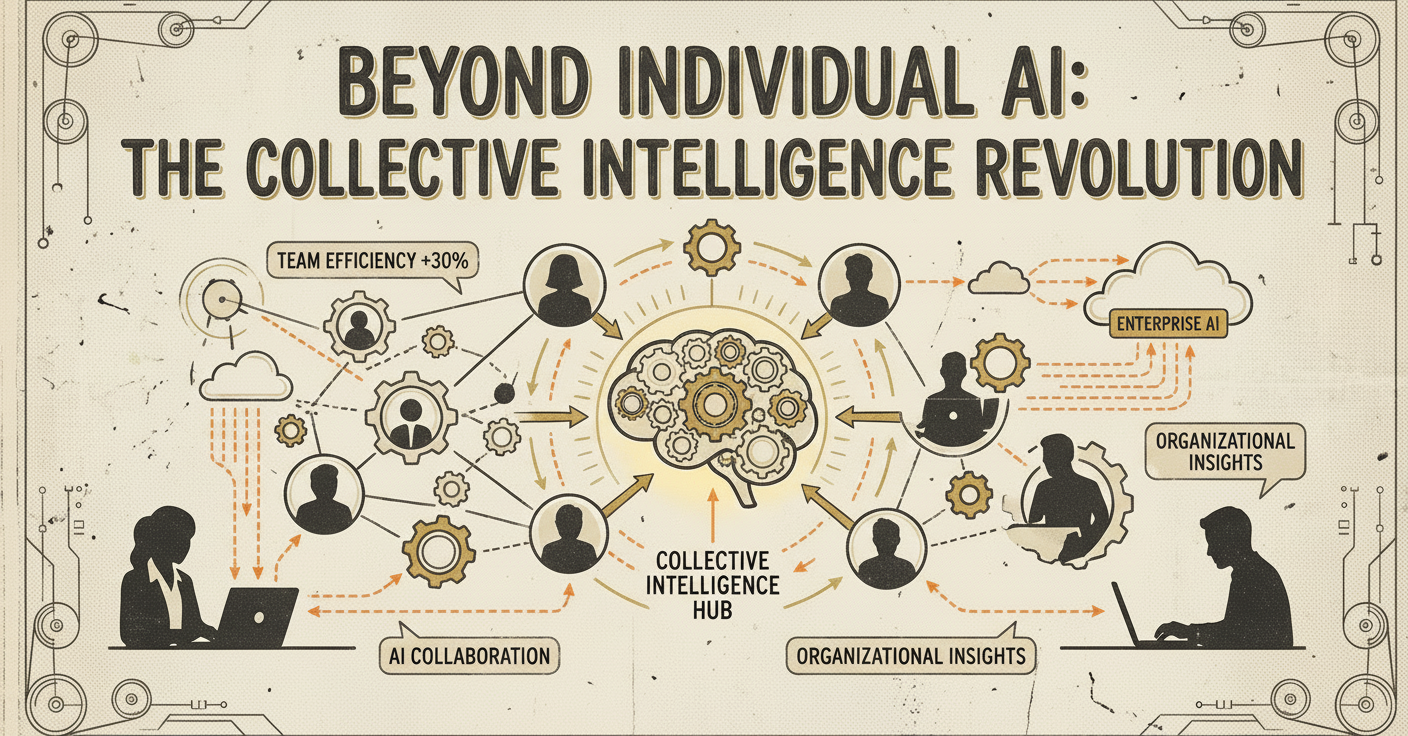
AI's Next Frontier Isn't Individual Genius, It's Group Collaboration
This week, a new player, HumansAnd, made waves by raising an astonishing $480 million seed round without a public product. Their audacious goal? To build AI specifically for human collaboration and social intelligence, a "central nervous system for human-plus-AI." This isn't about making individuals smarter; it's about making teams, and potentially entire organizations, operate as a more cohesive, intelligent unit. (AI Breakdown)
Why it matters: Most AI to date focuses on enhancing individual output (writing, coding, information retrieval). HumansAnd signals a major paradigm shift towards leveraging AI to optimize group dynamics, coordination, and collective problem-solving. This moves AI from a personal assistant to a team captain, with massive implications for enterprise efficiency, project management, and even organizational structures. If they succeed, it reshapes where and how AI delivers its greatest value.
"We are building a product and a model that is centered on communication and collaboration. Our goal is to help people work together more efficiently, not with AI tools, but with one another." — Eric Zeekerman, CEO at HumansAnd
The move: Ask your leadership team: "How are we leveraging AI to improve team collaboration and coordination, not just individual productivity?"
The Rundown
① Autonomous Agents Are Getting Seriously Good at Developing Software. Factory AI's 'Droids' are fully autonomous binaries that handle the entire software development lifecycle, from tickets to codebase modifications, with advanced context management. They even found that "agent readiness" (clean code) is the sole factor correlating with productivity gains when adopting AI tools. (The Neuron: AI Explained)
• Why it matters: This isn't just about faster coding; it's about fundamentally reshaping engineering teams. Expect to see agents take on more end-to-end development tasks, freeing human developers for more complex, higher-level problem-solving and architectural design.
② AI is Hyper-deflating the Cost of Intelligence 100x. Sam Altman predicts GPT-5.2 level intelligence will be 100 times cheaper by the end of 2027. This isn't just a minor cost reduction; it's a profound shift that blows open the door for entirely new applications and business models where current costs are prohibitive. (The AI Daily Brief)
• The context: This prediction highlights the relentless pace of efficiency gains in AI, pushing the boundary of what's economically feasible. It means that capabilities currently reserved for high-budget projects will soon be accessible to everyone, reshaping competitive landscapes.
③ OpenAI is Giving Scientists a "Cursor for AI." OpenAI is launching 🆕Prism, a free AI-native LaTeX editor with GPT-5.2 embedded, allowing scientists to generate lecture notes, convert diagrams to LaTeX, and even verify equations with parallel chat sessions. (Latent Space: The AI Engineer Podcast)
"Our goal is not to win a Nobel Prize ourselves. It is for 100 scientists to win Nobel Prizes using our technology." — Kevin Weil, VP of Science at OpenAI for Science
• What to watch: This exemplifies a targeted professional workflow AI tool. Expect more vertical-specific AI tools that deeply integrate LLMs into existing complex professional workflows, making them dramatically more efficient.
④ The AI Acceleration Gap is Widening Dramatically. Early adopters are gaining an accelerating advantage, going beyond simply using AI tools to fundamentally rethinking their processes and mindsets. Many companies, however, still expect employees to learn AI on their own time, hindering wider adoption within businesses. (The AI Daily Brief)
• Why it matters: This gap isn't just about tool adoption; it's about a divergence in strategic capability. Organizations that empower and integrate AI literacy across their workforce will outpace those treating AI as a side project.
⑤ AI is Revolutionizing Disaster Response with Direct Cash Transfers. GiveDirectly is using AI and mobile money for rapid, efficient direct cash assistance in humanitarian crises. AI identifies vulnerable communities via satellite imagery and poverty data, with funds disbursed digitally sometimes within 24-48 hours. (NVIDIA AI Podcast)
• The context: This demonstrates AI's profound impact in high-stakes, real-world applications where speed and accuracy can save lives and prevent long-term economic hardship. It also challenges traditional aid models, favoring empowerment and flexibility over in-kind donations.
The Signals
🟢 HOT
• HumansAnd: A new startup just raised $480M to build AI focused on human collaboration, challenging the paradigm of individual intelligence. (AI Breakdown)
• Autonomous Software Agents (Droids): Factory AI's agents can handle the entire software development life cycle, showing model-agnostic capabilities. (The Neuron: AI Explained)
• 🆕Direct Cash Transfers: GiveDirectly is using AI to identify vulnerable populations and urgently dispense aid, proving more effective and efficient than traditional aid. (NVIDIA AI Podcast)
🟡 WARMING UP
• 🆕Prism: OpenAI's free AI-native LaTeX editor integrating GPT-5.2 directly into scientific writing workflows, allowing scientists to convert diagrams and verify equations. (Latent Space: The AI Engineer Podcast)
• AI Acceleration Gap: The divergence between early AI adopters and others is widening, indicating a critical need for proactive organizational AI strategy. (The AI Daily Brief)
• 🆕Moonshot Kimi K2.5: This Chinese AI model is setting benchmarks for agent swarm capabilities in collaborative tasks, signaling increased global competition. (The AI Daily Brief)
🔴 COOLING OFF
• Molecular Dynamics (MD) and Density Functional Theory (DFT): These traditional scientific simulation methods are deemed significantly "overrated" for their inability to model complex real-world phenomena. (Latent Space: The AI Engineer Podcast)
• Microsoft's AI "sparkle": Despite large investments, Microsoft is losing its edge in AI narrative due to perceived caution and increased competition, contrasting with Meta's gains. (The AI Daily Brief)
• AI Bubble Fears: Markets are becoming more selective about AI investments, rewarding visible revenue impact (Meta) and scrutinizing CapEx without clear returns (Microsoft). (The AI Daily Brief)
The Bottom Line
The next wave of AI isn't just about smarter individual tools; it's about collective intelligence, strategic integration, and accelerating impact in the real world.
🎯 Your Move
- Investigate AI for team collaboration: Explore tools that optimize group dynamics and project coordination, moving beyond individual productivity.
- Audit your AI ecosystem for "agent readiness": Ensure your codebases and data are clean and accessible to maximize the impact of end-to-end autonomous agents.
- Encourage targeted AI experimentation: Task teams with exploring vertical-specific AI tools (like Prism for scientific writing) to identify high-leverage workflow integrations.
What We Listened To
1. HumansAnd Raises $480M Seed Round to Build AI for Human Collaboration
Guests: Jaden Schaefer (Host, AI Breakdown), Annie Peng (Co-founder, HumansAnd), Eric Zeekerman (CEO, HumansAnd), Yujun He (Co-founder, HumansAnd)
Runtime: 16 min | Vibe: Groundbreaking startup launch
Key Signals:
- Collaboration-First AI: HumansAnd secured a massive seed round to develop an AI model focused on human collaboration and social intelligence, signaling a shift from individual-centric AI to collective intelligence.
- Deep Context & Memory: The core to their approach is building an AI with robust memory capabilities to understand evolving contexts in human interactions, crucial for effective collaborative agents.
- Pedigree Over Product (for now): The founders' backgrounds from top AI labs allowed them to raise a near half-billion-dollar round without a public product, banking on their team's ability to execute a paradigm shift.
"We're now entering a second wave where the average user is trying to figure out what to actually do with all of these systems." — Annie Peng, Co-founder at HumansAnd
2. This AI Agent Builds Better Code Than Most Developers (Factory AI)
Guests: The Neuron (Host), Eno Reyes (Co-founder and CTO, Factory AI), Eno (Guest, Factory AI)
Runtime: 56 min | Vibe: Deep dive into autonomous agents
Key Signals:
- End-to-End Agent Autonomy: Factory AI's 'Droids' are fully autonomous binaries that can take on the entire software development lifecycle, from ticket to codebase modification.
- Advanced Context Management ("Compaction"): Their proprietary context compaction system significantly outperforms competitors in instruction following, accuracy, and context awareness, crucial for long, complex agent sessions.
- "Agent Readiness" for Productivity: The sole factor correlating with productivity gains from AI tools isn't the tools themselves, but the "agent readiness" of the codebase—i.e., clean, well-structured code.
"From the beginning, it was droids, fully autonomous systems. Our mission when we first started and to this day is to bring autonomy to software engineering." — Eno Reyes, Co-founder and CTO of Factory AI
3. 🔬 Automating Science: World Models, Scientific Taste, Agent Loops — Andrew White
Guests: Andrew White (Co-founder at Future House and Edison Scientific, Future House/Edison Scientific), RJ Honicky (Co-founder and CTO at MiraOmics, MiraOmics), Brandon Anderson (AI systems for RNA drug discovery at Atomic AI, Atomic AI)
Runtime: 74 min | Vibe: Philosophical and practical take on scientific AI
Key Signals:
- AI in Scientific Discovery: AI agents like Kosmos are automating hypothesis generation and filtering scientific literature and data, accelerating research beyond traditional simulation approaches.
- "Scientific Taste" & Human Feedback: AI is learning "scientific taste" by observing human choices and data, enabling it to prioritize promising research avenues.
- "Overrated" Simulations: Traditional methods like molecular dynamics (MD) and DFT are criticized as "overrated," consuming vast resources without accurately modeling complex real-world phenomena.
"I think molecular dynamics is overrated. In fact, DFT may be even more overrated than, like, the dynamics. simulations simulate really boring things really well. They don't simulate interesting things very well." — Andrew White, Co-founder at Future House and Edison Scientific
4. #232 - ChatGPT Ads, Thinking Machines Drama, STEM
Guests: Andrey Kurenkov (Host, Astrocade), Jeremie Harris (Host, Gladstone AI)
Runtime: 101 min | Vibe: Broad-ranging commentary on AI news
Key Signals:
- China's AI Independence: Jipu AI's model, trained entirely on Huawei's Ascend processors, signals China's capability for a fully domestic AI stack, reducing reliance on Western tech.
- Semiconductor Shift: Samsung is emerging as a critical alternative to TSMC for advanced chip fabrication, driven by surging demand for AI chips and TSMC's oversubscription.
- Gigawatt AI Supercluster: Xai controversially deployed a gigawatt-scale AI supercluster using on-site gas turbines and Tesla megapacks, circumventing traditional energy infrastructure.
"China has deployed AI at a large scale already with things like facial recognition, right? So they have cameras everywhere, like they do track you. It's kind of like Minority Report as is." — Andrey Kurenkov, Host at Astrocade
5. Ralph Wiggum, Clawdbot, and Mac Minis: How Pros Are Vibe Coding in 2026
Guests: Nathaniel Whittemore (Host, The AI Daily Brief: Artificial Intelligence News and Analysis)
Runtime: 25 min | Vibe: Forward-looking and humorous take on AI in coding
Key Signals:
- "Ralph Wiggum Loop" for AI Coding: This iterative AI coding process breaks down complex projects into atomic units, using git history for memory, enabling agents to ship features overnight.
- Local, Self-Improving Agents: 🆕Clawdbot, an open-source AI agent, runs locally on hardware like Mac Minis, performing complex tasks and even writing its own skills, demonstrating self-improvement.
- OpenAI's Enterprise Push: OpenAI's CFO states 50% of their business will come from enterprise customers by year-end, signaling an aggressive shift towards API capabilities for businesses.
"The leading agent decoders are in the midst of trying to build systems that work all the time with extremely minimal input from them. They want nothing less than armies of agents that work while they sleep." — Nathaniel Whittemore, Host of The AI Daily Brief: Artificial Intelligence News and Analysis
6. The AI Daily Brief: Artificial Intelligence News and Analysis: "The AI Acceleration Gap"
Guests: Nathaniel Whittemore (Host, The AI Daily Brief), Sam Altman (Co-founder, OpenAI), Andrej Karpathy (Co-founder, OpenAI), David Holz (Founder, MidJourney), Kevin Roos (Columnist, New York Times), John Bailey (Fellow, AEI), Reza Martin (Co-creator, NotebookLM), Ethan Malik (Professor), Kevin Warbach, Matt Bean (MIT Sloan), Dean Ball, Joe Weisenthal (Host of Odd Lots, Bloomberg)
Runtime: 29 min | Vibe: Urgent call to action on AI adoption
Key Signals:
- Hyper-deflation of AI Costs: Sam Altman predicts GPT-5.2 level intelligence will be 100 times cheaper by end of 2027, opening up vast new applications.
- Widening AI Acceleration Gap: A significant and growing divide exists between early AI adopters (individuals and organizations) and those falling behind, impacting competitive advantage.
- Corporate AI Literacy Lag: Many companies expect employees to learn AI tools on their own time, hindering broader adoption and creating internal disparities in AI proficiency.
"The gap between the early adopters and everyone else, both in terms of their AI use but also in their ways of thinking, has never been wider and appears to be widening at an accelerating rate." — Dean Ball
7. Are Agent Swarms the Next AI Paradigm?
Guests: Nathaniel Whittemore (Host, The AI Daily Brief)
Runtime: 22 min | Vibe: Exploring advanced AI agent systems
Key Signals:
- Emergence of AI Agent Swarms: Moonshot’s Kimi K2.5 demonstrates cutting-edge collaborative multi-agent capabilities, excelling in complex parallel task execution and storyboarding.
- Chinese AI Parity: Kimi K2.5's performance suggests Chinese models are rapidly closing the gap with, or even rivaling, top Western models like GPT-4 and Gemini in certain benchmarks.
- Resource-Aware AI: Kimi K2.5 surprised users by recognizing when parallelization wasn't needed for "noob tasks" and refunding credits, indicating advanced task-appropriate resource allocation.
"If this actually works like that, it opens up a significant new frontier in AI coding that you have to imagine that everyone will raise to copy very quickly." — Nathaniel Whittemore, Host of The AI Daily Brief
8. ⚡️ Prism: OpenAI's LaTeX "Cursor for Scientists" — Kevin Weil & Victor Powell, OpenAI for Science
Guests: Kevin Weil (VP of Science, OpenAI for Science), Victor Powell (Product Lead on Prism, OpenAI for Science), swyx + Alessio (Host)
Runtime: 36 min | Vibe: Practical application of AI in science
Key Signals:
- AI-Native LaTeX Editor: OpenAI is launching 🆕Prism, a free AI-native LaTeX editor with GPT-5.2 embedded, streamlining scientific writing by automating complex formatting and verification.
- Workflow Integration for Acceleration: Prism accelerates scientific writing by embedding AI directly into the workflow, allowing researchers to focus on actual science rather than tedious tasks.
- Enabling, Not Monopolizing, Discovery: OpenAI's goal with Prism is to empower "100 scientists to win Nobel Prizes" using their technology, rather than seeking scientific accolades themselves.
"But the real acceleration came when you embedded AI into the actual workflow. And so that's what we're doing here. OpenAI for science. It's both building great models for scientists and also speeding them up by bringing AI into the workflow." — Kevin Weil, VP of Science at OpenAI for Science
9. Are Markets Still Worried About an AI Bubble?
Guests: Nathaniel Whittemore (Host, The AI Daily Brief: Artificial Intelligence News and Analysis)
Runtime: 28 min | Vibe: Financial analysis of the AI market
Key Signals:
- Selective AI Investment: Investors are becoming highly selective, rewarding companies like Meta for visible AI revenue impact and scrutinizing those like Microsoft for less clear CapEx returns.
- Microsoft's Diminishing AI Edge: Despite early moves, Microsoft's "AI sparkle" is dimming due to increased competition, a perceived cautious approach, and Anthropic's competitive impact.
- AI Gold Rush in Memory: The booming demand for high-bandwidth memory (HBM) for AI chips is driving massive profit surges for companies like Samsung and SK Hynix, signaling a deeper infrastructure play.
"Meta wins, Microsoft loses when it comes to after hours market reaction to earnings. Both beat on earnings and revenue both yanked up capex. Both talked of the positive impact of AI spending, but investors found it hard to see the CapEx rewards for Microsoft." — Caroline Hyde, Bloomberg Columnist
10. Accelerating Disaster Response with GiveDirectly's Nick Allardice - Ep. 287
Guests: Nick Allardice (President and CEO, GiveDirectly), NVIDIA (Host)
Runtime: 49 min | Vibe: Humanitarian AI innovation
Key Signals:
- AI for Direct Cash Transfers in Aid: 🆕GiveDirectly uses AI to identify vulnerable communities via satellite imagery and poverty data, delivering direct cash assistance faster and more efficiently than traditional aid.
- Hybrid Model for Impact: GiveDirectly operates as a blend of fintech, humanitarian nonprofit, and economic research institute, showcasing an innovative organizational structure for maximizing aid effectiveness.
- Trust in Data-Poor Environments: Building trust and transparency is crucial when deploying AI in humanitarian settings where data quality can be low and cultural nuances are significant.
"We could make extraordinary progress on the most important problems in the world simply by equipping people with the resources and technology they needed to solve their own problems, rather than us solving it for them." — Nick Allardice, President and CEO of GiveDirectly