
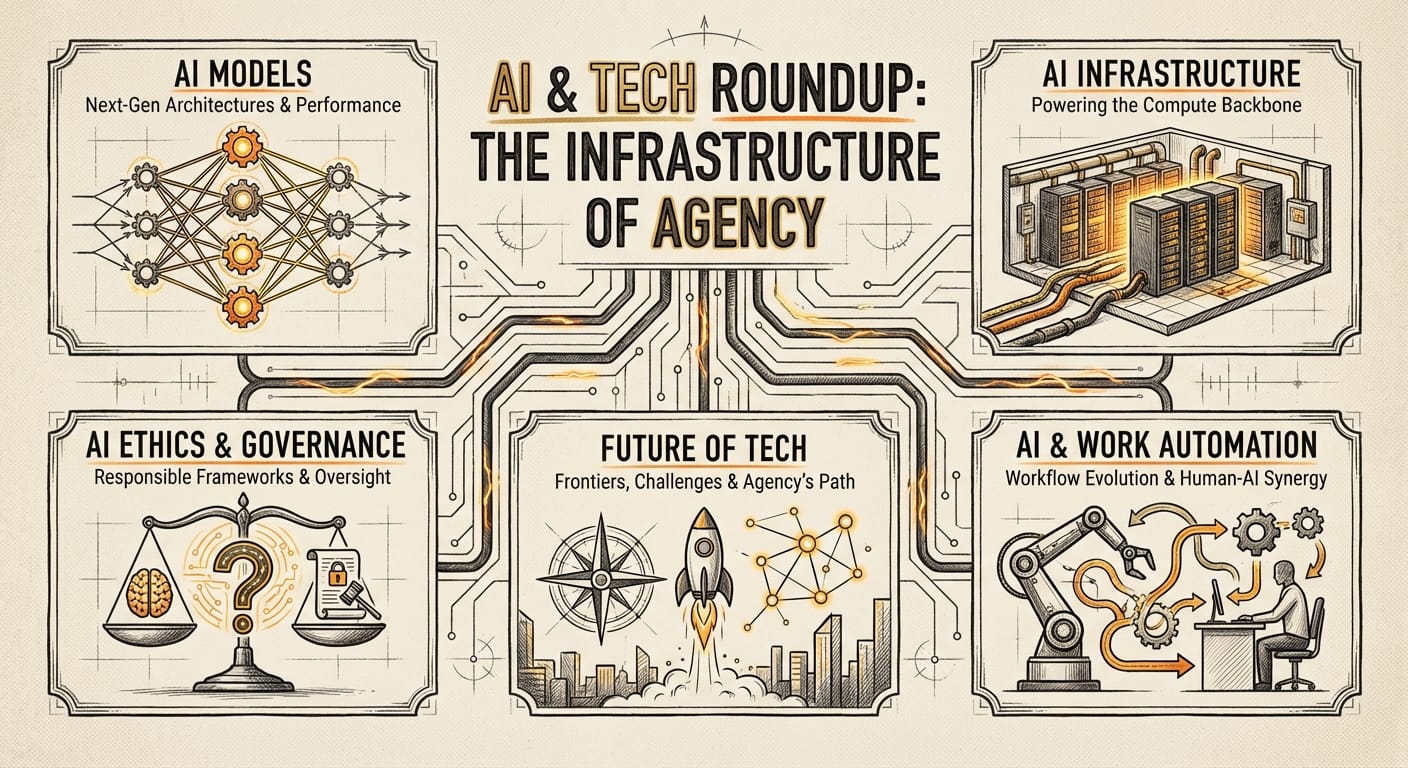
AI & TECH ROUNDUP — THE INFRASTRUCTURE OF AGENCY
THIS WEEK'S INTAKE
📊 9 episodes across 5 podcasts ⏱️ ~8.5 hours of AI & Tech intelligence 🎙️ Featuring: Arvind Krishna (CEO, IBM), Amanda Kahlow (CEO, 1Mind), Tim Davis (President, Modular), Chris Benson (Practical AI). 📅 Coverage: New model drops (Opus 4.5, Gemini 3), Enterprise hardware wars, and the "57% automation" reality.
We listened. Here's what matters.
THE HOOK: The Era of "Vibe Coding" and Hard Realities
Everyone is talking about the new models. We’ve got Claude Opus 4.5 claiming the coding throne and Gemini 3 introducing "native reasoning." The benchmarks are skyrocketing again. But if you look past the shiny new context windows, the real story this week isn’t about the chatbots—it’s about the plumbing and the people.
While Anthropic is changing how developers write software (shifting from syntax to "vibes"), the smarter money is looking at the unsexy layer underneath. We’re seeing a $250M bet on breaking Nvidia’s stranglehold via software usage, a new insurance framework to actually underwrite AI risk, and a stark warning from McKinsey that 57% of work hours are now automatable.
The consensus from IBM to 1Mind is clear: The "Pilot Program" era is dead. You’re either restructuring your org chart around agents by 2026, or you’re officially behind.
Here is what you need to know.
THE BRIEFING
⚡ The "Vibe Coding" Shift
The Setup: Anthropic dropped Claude Opus 4.5, and the developer timeline just broke. It’s not just a speed upgrade; it’s a qualitative shift in how software is built.
The Insight: We are moving from "syntax coding" to "vibe coding." In the AI Daily Brief, early users report that Opus 4.5 allows them to execute complex agentic workflows by describing how the software should feel and function, rather than micromanaging the logic. It’s a massive leap in reasoning that beats Gemini 3 Pro by wide margins on agentic benchmarks. This lowers the barrier to entry for building sophisticated tools, effectively turning product managers into developers.
The Voice:
"It extends the horizon of what you can vibe code... Opus 4.5 blows ahead of Gemini 3 Pro on several benchmarks... A 3% lead has never looked so large." — The AI Daily Brief
The So What: If your engineering team isn't testing Opus 4.5 for workflow automation, they are coding securely in the past. Expect a flood of "micro-SaaS" tools built by non-engineers in Q1.
🏗️ The "Android Moment" for Hardware
The Setup: Everyone hates being locked into Nvidia’s ecosystem (and pricing). Enter Modular, which just raised $250M to fix the hardware fragmentation problem.
The Insight: Right now, AI infrastructure is a mess. Running a model on Nvidia, AMD, or Apple Silicon requires different optimization pipelines. Modular is building a "unified compute layer"—think of it as the Android OS for AI hardware. They are abstracting away the metal so developers can write code once and run it anywhere. If they succeed, they commoditize the chip layer, potentially breaking the "Nvidia Tax" that every enterprise pays today.
The Voice:
"Software is abstracting away the horrors of hardware... Most developers don't care about the hardware. [They care about] throughput, latency, accuracy, and cost." — Tim Davis, President of Modular, on The Neuron
The So What: Watch this space. If hardware becomes abstractable, your compute costs could drop significantly as you gain the ability to arbitrage between chip providers.
🤖 The "Jevons Paradox" of Labor
The Setup: A new Anthropic/McKinsey report claims 57% of U.S. work hours are now automatable. Panic time? Not according to IBM’s CEO.
The Insight: There is a massive disconnect between the data and the strategy. While the data says "automate and cut," leaders like IBM's Arvind Krishna and 1Mind's Amanda Kahlow are doubling down on hiring. Krishna admits IBM failed with the monolithic "Watson" approach but sees LLMs as a "100x advantage" for speed. The winning strategy isn't replacing humans; it's what 1Mind calls the "Superhuman" model: using agents to source 76% of pipeline, then having humans close it. 1Mind even promotes employees who automate their own jobs.
The Voice:
"If I compare from the beginning to the end, this is 100x advantage in terms of speed and tuning... different than the monolith [Watson] approach." — Arvind Krishna, CEO of IBM, on Decoder
The So What: Don't fire the people who use AI to do their job in 2 hours. Promote them to design the systems for everyone else. The bottleneck isn't tech anymore; it's organizational willingness to change the org chart.
🛡️ The Missing Piece: Underwriting Intelligence
The Setup: Why are big enterprises stalling on deploying agents? Liability. If an agent hallucinates a discount or deletes a database, who pays?
The Insight: We are finally seeing the emergence of "AI Insurance." The AI Underwriting Company (AIUC) is proposing a blend of technical standards, audits, and actual financial coverage. This creates an "AI confidence infrastructure." Just as you wouldn't build a skyscraper without insurance and inspections, you won't deploy autonomous agents without a similar safety net. This is the boring, unsexy layer that actually unlocks the trillion-dollar market.
The Voice:
"The insurance is the financial protection for when something goes wrong... When a company meets the standard, the enterprises... will have confidence to do so." — Rune Kvist, Co-founder AIUC, on The Cognitive Revolution
The So What: "Safety" is no longer just about ethics; it's a financial product. Look for "insured AI agents" to become a procurement requirement for Fortune 500 contracts by next year.
THE WATCHLIST
ON THE RADAR
🔥 Heating Up: Multimodal Strategy: New projects using Gemini 3 and Nano Banana are proving that "reasoning" models can now handle strategic planning and infographic generation in one pass. (Source: AI Daily Brief)
👀 Worth Watching: The "Swarming" Future: Practical AI discussed "swarming"—autonomous, decentralized drone/agent coordination using Rust. This moves us from "one giant model" to "thousands of tiny, coordinated models." (Source: Practical AI)
⚠️ Proceed With Caution: 2026 Deadlines: OpenAI released a scaling framework suggesting that if you aren't out of the "pilot" phase and into "whole-org transformation" by 2026, you are mathematically behind. The clock is ticking on "playing around." (Source: AI Daily Brief)
🛍️ Black Friday Test: OpenAI is rolling out shopping research features just in time for the holidays. This is the first real stress test of AI as a consumer purchasing agent, not just a search engine. (Source: AI Daily Brief)
🏛️ The Genesis Mission: The White House (and potential incoming admin) is pushing a "National AI Science Program" to collate government data for AI discovery. (Source: AI Daily Brief)
THE CONTRARIAN CORNER
The Skeptic: Tim Davis (Modular) & Chris Benson (Practical AI)
The Take: The "Bigger is Better" era might be overhyped.
While the headlines scream about trillion-parameter models, the contrarian technical view is shifting toward "Small & Many." Chris Benson argues we are entering a "Mini Model World" where open-source, efficient models running on the edge (literally on your device) commoditize the frontier. Meanwhile, Tim Davis challenges the idea that we are hardware constrained, suggesting we are actually software constrained. We don't need more chips; we need to stop writing inefficient code that only runs on one type of chip.
If they are right, the companies spending billions on massive training clusters might be building the wrong infrastructure.
THE BOTTOM LINE
The technology is outpacing the organizational chart. The tools (Opus 4.5, Gemini 3, Modular) are ready to run. The bottleneck is no longer capability—it's governance and workflow. If your 2025 strategy is "give everyone Copilot," you've already lost. The winners will be the ones building "insured agency"—autonomous workflows backed by audits and new hardware abstractions.
📚 APPENDIX: EPISODES COVERED
1. The AI Daily Brief: "10 AI Projects to Learn Gemini 3 Nano Banana and Opus 4.5"Runtime: ~15 mins The Conversation: A tactical breakdown of 10 practical projects to test the specific strengths of the newest models (Gemini 3, Nano Banana, Opus 4.5). Key Signals:
- Multimodal Reasoning: Gemini 3 is highlighted for its ability to "reason" across modalities (text-to-infographic) without needing chained prompts.
Strategy requires Reasoning: The host recommends model "5.1" specifically for business strategy and "thinking out loud." Notable Quote:
"What makes Gemini 3 so powerful is its integrated reasoning with native multimodality."
2. Decoder with Nilay Patel: "Why IBM CEO Arvind Krishna is still hiring humans in the AI era"Guest: Arvind Krishna (CEO, IBM) Runtime: ~60 mins The Conversation: A candid interview on IBM's pivot from the "Watson" failure to a hybrid AI approach. Krishna argues that LLMs provide a "100x" speed advantage but still require human oversight for enterprise viability. Key Signals:
- The Monolith Failed: Krishna openly admits the old "black box" AI model (Watson) was the wrong GTM approach; transparent, tunable LLMs are the industrial solution.
Hiring for Leverage: IBM isn't firing; they are hiring humans who can use AI to do the work of ten people. Notable Quote:
"We were trying to give it to you. Monolith. That was the wrong approach... Right technology, wrong go to market approach."
3. The Cognitive Revolution: "Underwriting Superintelligence: How AIUC is using Insurance, Standards, and Audits"Guests: Rune Kvist & Rajiv Dattani (AIUC) Runtime: ~60 mins The Conversation: A deep dive into the financial plumbing of AI safety. The guests argue that insurance and auditing are the only ways to unblock enterprise adoption. Key Signals:
- Insurance creates Trust: Enterprises won't deploy autonomous agents without a liability shield.
The "Trust Gap": Self-attestation of safety implies nothing; independent audits bridge the gap between "we're safe" and "we're insured." Notable Quote:
"The core idea is that security and progress are mutually reinforcing."
4. Practical AI: "Chris on AI, autonomous swarming, home automation and Rust!"Guest: Chris Benson Runtime: ~40 mins The Conversation: A crossover on the future of "maker" AI. Benson argues that the future isn't one giant brain, but millions of "swarming" small models running on edge devices. Key Signals:
- Commoditized Intelligence: Open-source/small models are catching up to frontier models, making localized AI viable.
Swarming: The next phase is multi-agent coordination (swarms) rather than single-agent chat. Notable Quote:
"The world [is] turning out to be a mini model world instead of a giant model world."
5. The AI Daily Brief: "Why Opus 4.5 Changes Vibe Coding"Runtime: ~15 mins The Conversation: Focused on the release of Anthropic's Claude Opus 4.5 and its massive jump in coding benchmarks. Key Signals:
- Vibe Coding: A new paradigm where developers define the "vibe" and high-level goals, and the AI handles the implementation logic.
Benchmark Gaps: Opus 4.5 shows a 3% lead over competitors, which in the current tight race is a "step function" difference. Notable Quote:
"It extends the horizon of what you can vibe code."
6. The AI Daily Brief: "Can AI Really Automate 57 Percent of Work?"Runtime: ~15 mins The Conversation: Analysis of the Anthropic/McKinsey report regarding labor market impacts, alongside news on OpenAI's shopping features. Key Signals:
- Task-Level Savings: The 57% figure refers to tasks within jobs, suggesting restructuring is more likely than mass firing.
Economic Value: Reorganizing around agents could unlock $2.9 trillion in value by 2030. Notable Quote:
"More than half of U.S. work hours are now automatable if companies redesign around agents."
7. The Neuron: "The "Android Moment" for AI Infrastructure: Why Modular Just Raised $250M"Guest: Tim Davis (President, Modular) Runtime: ~45 mins The Conversation: An examination of the hardware/software disconnect. Modular aims to unify AI compute so developers don't need to worry about the underlying chips. Key Signals:
- Unified Compute Layer: The goal is to run any AI model on any hardware (Nvidia, AMD, CPU) without rewriting code.
Software constrained: Davis argues we aren't limited by hardware, but by the difficulty of utilizing the hardware we have. Notable Quote:
"Software is abstracting away the horrors of hardware."
8. The AI Daily Brief: "A Practical Guide to Scaling AI"Runtime: ~15 mins The Conversation: Breakdown of OpenAI's new enterprise guide. It draws a line in the sand for organizational maturity. Key Signals:
- The 2026 Wall: Organizations still in "pilot" mode by 2026 are effectively obsolete.
Process over Tool: Success correlates with governance and "AI Fluency," not which specific model you choose. Notable Quote:
"Success depends less on a single tool's performance and more on how quickly teams can learn, adapt and apply AI."
9. The Cognitive Revolution: "AI-Led Sales: How 1Mind's Superhumans Drive Exponential Growth"Guest: Amanda Kahlow (CEO, 1Mind) Runtime: ~60 mins The Conversation: A case study in "eating your own dogfood." 1Mind uses AI agents ("Superhumans") to run the majority of their sales pipeline. Key Signals:
- Automate to Promote: Employees who automate their jobs are rewarded with promotions, solving the incentive problem.
Pipeline Dominance: 76% of their sales pipeline is sourced by AI, proving agents can handle complex B2B prospecting. Notable Quote:
"Your sellers hallucinate—AIs do it less."