
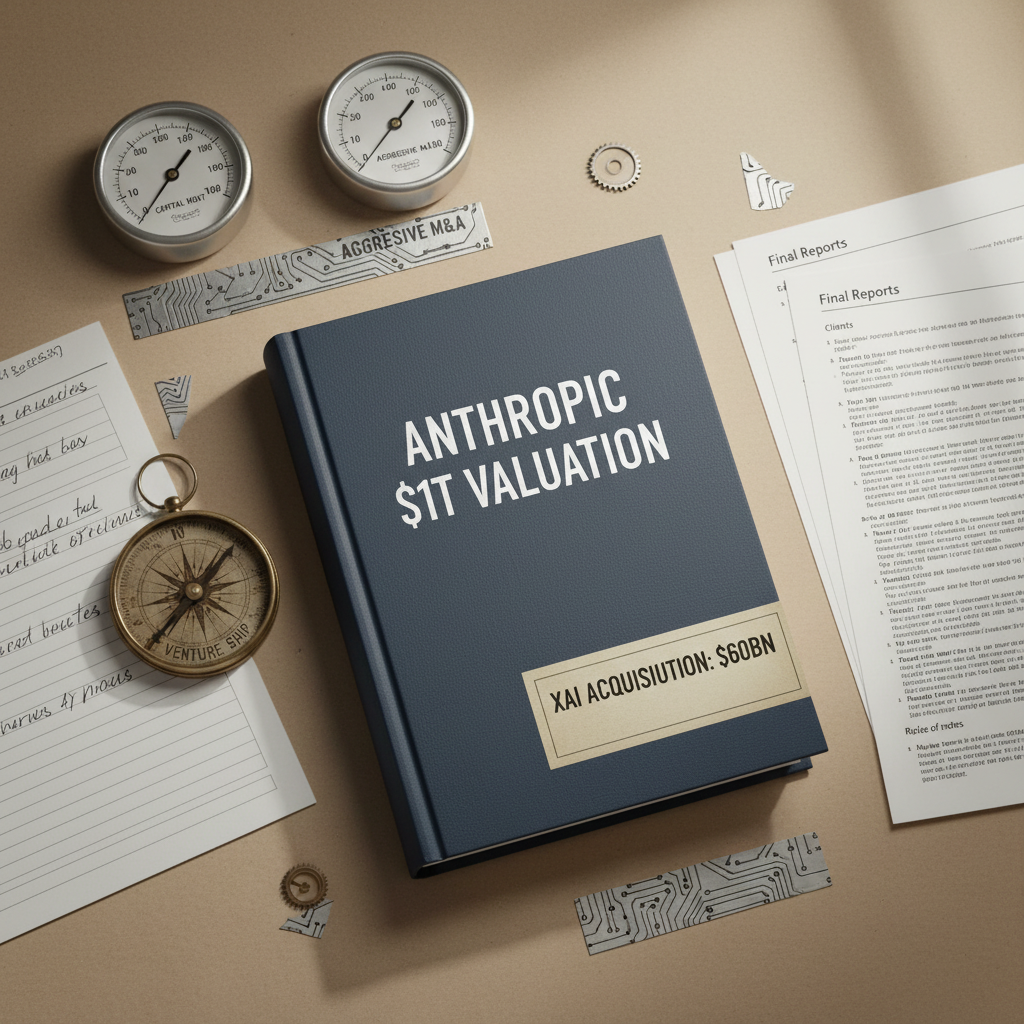
The venture landscape is undergoing a capital-driven paradigm shift, where AI's immense compute and data needs mean money itself is becoming the ultimate moat.
The Intake
📊 11 episodes across 7 podcasts
⏱ 713 minutes of intelligence analyzed
🎙 Featuring: Cat Wu (Head of Product for Claude Code and Cowork, Anthropic), Lenny (Host), Adam Foroughi (Co-Founder and CEO, Applovin), Harry Stebbings (Host, The Twenty Minute VC (20VC))
|

The Big Shift
The venture capital landscape is fundamentally changing as AI makes capital itself a primary competitive advantage. The old adage that "you couldn't throw money at the problem" no longer holds true; access to GPUs and vast datasets means that those with the deepest pockets can out-execute competitors, making code and user interfaces less defensible. This shift means the "capital race" has become paramount for AI-native companies. Ben Horowitz, Co-founder of Andreessen Horowitz, highlighted this, stating, "With AI that's really changed and that you can throw money at the problem because if you have enough GPUs and enough data, you can basically solve most problems right now. Like that. That just is what it is. And so now the capital race becomes a real thing."
"With AI that's really changed and that you can throw money at the problem because if you have enough GPUs and enough data, you can basically solve most problems right now. Like that. That just is what it is. And so now the capital race becomes a real thing."
— Ben Horowitz, Co-founder of Andreessen Horowitz on The a16z Show
This dynamic is creating a new class of "AI-native" companies where product development cycles are compressed dramatically, sometimes from months to days. Cat Wu, Head of Product at Anthropic, noted on Lenny's Podcast: Product | Career | Growth that "The timelines for a lot of our product features have gone down from six months to one month and sometimes to one week or even one day." Product taste and the ability to leverage a society of models for rapid iteration are now more valuable than traditional long-term roadmapping. The implications of this shift are profound: valuations are skyrocketing for companies like Anthropic (which is seeing $1TRN valuations in secondary markets 🆕), and acquisitions are reaching unprecedented scales (e.g., the rumored Cursor acquisition by xAI for $60BN). This environment favors well-capitalized players who can effectively deploy billions to secure compute, data, and top talent, fundamentally altering the competitive dynamics for startups and incumbents alike.
The Rundown
① China's AI Nationalism is Freezing International Collaboration.
Chinese government intervention is aggressively blocking foreign tech acquisitions of AI companies, exemplified by the thwarted Meta-Manus deal. This signals an end to legal loopholes like "Singapore washing" for Chinese entrepreneurs, significantly escalating the global "AI wars." (Jason on This Week in Startups)
→ What to watch: This aggressive stance could severely limit international AI research and development partnerships, forcing companies to choose sides and secure domestic supply chains for talent and compute.
② Anthropic's Product Velocity Redefines the PM Role.
Anthropic's product features are now shipping in days, not months, which means the traditional Product Manager role is being compressed into one focused on "product taste" and rapid iteration rather than slow-burn roadmaps. Cat Wu noted that "As code becomes much cheaper to write, the thing that becomes more valuable is deciding what to write." (Cat Wu on Lenny's Podcast: Product | Career | Growth)
→ The signal: PMs need to adapt by developing a 'first principles' understanding of AI capabilities and user needs, quickly translating ideas into deployable features, and embracing a more chaotic, goal-oriented development cycle.
③ Elon Musk's "Debt-Fueled Strategy" is Terrorizing Stakeholders.
Musk's approach to xAI involves aggressive, high-risk acquisitions like the proposed $60BN Cursor deal (with a $10BN breakup fee), funded by complex, potentially dilutive maneuvers involving SpaceX and Tesla stock. This strategy is seen as a relentless doubling down on AI to secure a win, regardless of the cost or potential market impact. (Jeff Richards on The Twenty Minute VC)
→ Why it matters: This high-stakes game demonstrates an extreme "risk-on" mentality driving current AI M&A, where strategic financial engineering is as critical as technological innovation, potentially terrifying public shareholders of his other ventures.
④ SaaS Apocalypse Justified: Vertical SaaS and Micro-Entrepreneurs Challenge Incumbents.
While core systems of record remain strong, SaaS incumbents face significant disruption from nimble vertical SaaS and micro-entrepreneurs who leverage AI to offer more tailored and cost-effective solutions. Amjad Masad mentioned on The Twenty Minute VC that this shift is creating a "SaaS Apocalypse" for those unable to adapt.
→ What to watch: Incumbents need to focus on delivering clear ROI to operational teams by enhancing maintainability and security of AI-generated code, or risk being outmaneuvered by AI-native challengers.
⑤ AppLovin's $10M EBITDA Per Head Signals a New Era for Tech Efficiency.
Applovin's ability to rebound from a 92% stock drop through a radical rebuild of its core advertising tech and a culture focused on "A-players" and "doers" has led to an astonishing $10M EBITDA per head, highlighting extreme capital efficiency. Adam Foroughi stated, "If you go fire 50% of people and the culture and the team is mediocre, you're left with half mediocrity." (Adam Foroughi on The Twenty Minute VC)
→ The signal: This case study demonstrates that for some tech companies, a brutal, performance-based culture paired with a deep tech rebuild can drive unprecedented financial efficiency, setting a new bar for operational excellence.
Signal Board
🔥 Heating Up
• Capital as a competitive advantage in AI: The ability to deploy significant capital for GPUs and data acquisition is now a primary moat, shifting competitive dynamics. (Ben Horowitz on The a16z Show)
• Anthropic: Trading at higher valuations than OpenAI on secondary markets, approaching a $1 trillion valuation. (Harry Stebbings on The Twenty Minute VC)
• Product Taste as Most Valuable Skill: With AI making code cheaper, the discernment to decide "what to build" becomes paramount for PMs. (Cat Wu on Lenny's Podcast: Product | Career | Growth)
👀 On Watch
• 🆕 Stealth Churn: Users are quietly abandoning products like Netflix and Canva for AI alternatives without immediately canceling subscriptions, masking true engagement declines. (Harry Stebbings on The Twenty Minute VC)
• 🆕 Agent Fabric: The next evolution of AI, where models can perform actions over long horizons, moving beyond simple code generation. (Amjad Masad on The Twenty Minute VC)
• 🆕 Network Effects: Re-emerging as a critical defense mechanism, especially for platforms that can leverage large user bases to train and deploy advanced AI. (Ben Horowitz on The a16z Show)
• 🆕 IPO market reopening: Signals the growing shift towards public markets as a preferred capital source for leading AI companies like Anthropic over private rounds. (Harry Stebbings on The Twenty Minute VC)
❄️ Cooling Off
• Traditional IDEs: Becoming obsolete as AI automates much of their functionality, shifting developer workflows. (Amjad Masad on The Twenty Minute VC)
• Mentorship in business: Some argue that the "best" founders and leaders do not need extensive mentorship or one-on-one meetings, favoring performance-driven cultures. (Adam Foroughi on The Twenty Minute VC)
• 'Follow your passion' advice: Criticized as misleading; "follow your bliss and blisters" or "find a loop that you love" are presented as more effective frameworks for career fulfillment. (Shaan Puri on My First Million)
The Debate
The role of forgiveness and accountability in public discourse, especially for controversial public figures.
🐂 The bull case: Scott Galloway argued for increasing the "aperture of forgiveness" in a culture of constant surveillance, believing that society needs to allow for rehabilitation. He suggested that "When people say, 'I fucked up and this guy is bad,' fine, welcome them. That's the smart thing to do." (Scott Galloway on Pivot)
🐻 The bear case: Kara Swisher countered that true forgiveness requires a reckoning for genuinely harmful actions and a genuine apology, distinct from strategic rebrands. She stressed that while some may like to watch the "villain," there must be adherence to justice, not just a shift in persona. (Kara Swisher on Pivot)
Our read: While a broader capacity for forgiveness is essential in a hyper-public world, it must be balanced with genuine accountability and rectifying past harms, not merely accepting a figure's strategic rebrand.
The Bottom Line
Capital is now the ultimate AI moat, fundamentally reshaping venture dynamics and accelerating aggressive M&A as early wins dictate future market dominance.
📖 Want the full episode breakdowns, guest details, and listen links?
Episode Guide (Web Version)
My First Million — "How to find your thing"
Runtime: 55 min | Host: Sam Parr, Shaan Puri | Guest: Host-led discussion
For Founders & Career Accelerators: This episode challenges conventional career advice, offering a framework to identify work that aligns with enjoyment and mastery, crucial for sustainable success.
Sam Parr and Shaan Puri dissect "follow your passion," advocating for "bliss and blisters" and the "loop that you love" as healthier paths to career fulfillment and mastery. They discuss the importance of finding repeatable tasks you genuinely enjoy to build an enduring enthusiasm that leads to passion.
"Don't follow your passion, follow your bliss. And later he changed it to follow your blisters."
— Shaan Puri, Host at My First Million
This Week in Startups — "To the left of this of thumbnail i want to add a chinese flag to the left destroying the meta logo. because the title is China Kills Meta / Manus Deal (Story Of The Year) | E2281"
Runtime: 53 min | Host: Jason, Lon | Guest: Host-led discussion
For Geopolitical Investors & AI Strategists: This episode provides critical insights into the escalating geopolitical AI landscape, particularly China's aggressive defensive maneuvers.
Jason and Lon analyze China's blocking of Meta's acquisition of ManusAI, signifying an escalation in "AI wars." They also cover the OpenAI-Microsoft partnership restructuring and the implications of self-driving car incidents on public adoption in the US.
"The Chinese Communist Party canceling Meta's acquisition of Manus is the story of the year. This is the ultimate escalation of AI wars."
— Jason, Host of This Week in Startups
Pivot — "Tucker Carlson's Rebrand, Apple’s New Era, and SpaceX’s AI Deal"
Runtime: 63 min | Host: Kara Swisher, Scott Galloway | Guest: Host-led discussion
For Media Executives & Tech Policy Analysts: This discussion offers a sharp critique of media narratives, corporate successorship, and the intertwined world of tech, politics, and finance.
Kara Swisher and Scott Galloway delve into topics from public accountability and forgiveness for figures like Tucker Carlson to Tim Cook's legacy at Apple and Elon Musk’s ambitious moves with SpaceX and xAI, questioning valuations and corporate governance.
"Tim Cook is the most successful successor in corporate history. Talk about a guy that was set up to fail by virtue of the idolatry of the person who was taking over for it. They were immediately second guessing."
— Scott Galloway, Host on Pivot
This Week in Startups — "Naval’s $500 VC fund, the Maduro Polymarket scandal, and NYT defends theft and murder | E2280"
Runtime: 50 min | Host: Jason Calacanis, Jason | Guest: Host-led discussion
For Emerging Fund Managers & Retail Investment Platforms: This episode explores new frontiers in venture capital access and raises ethical questions around prediction markets and media responsibility.
Jason Calacanis discusses AngelList's new USVC fund for non-accredited investors, drawing comparisons to his own "learning by betting" philosophy. He also condemns media figures for normalizing violence amidst societal frustrations, advocating for non-violent protest.
"People need to be able to place bets. They need to be able to try these devices. If you're an, you know, if you were Lon and you, Lon's got a decent nest egg. It's, it's not retiring yet. It's got another 10 years of work in him. Maybe 15. Yeah, 15, 20, something like that. 15, 20. You know, he could buy $500 of this. Learn by betting. Yes, that's what I do. I place bets to learn."
— Jason Calacanis, Host of This Week in Startups
Lenny's Podcast: Product | Career | Growth — "How Anthropic’s product team moves faster than anyone else | Cat Wu (Head of Product, Claude Code)"
Runtime: 86 min | Host: Lenny | Guest: Cat Wu (Head of Product for Claude Code and Cowork, Anthropic)
For Product Leaders & AI Engineers: This essential listen reveals how a leading AI-native company is radically transforming product development and the PM role.
Cat Wu, Head of Product at Anthropic, explains how her team's rapid development cycles (days, not months) for Claude Code and Cowork necessitate a shift from traditional roadmapping to intense iteration. She highlights "product taste" and a blend of engineering and product roles as key to Anthropic’s unparalleled speed.
"The timelines for a lot of our product features have gone down from six months to one month and sometimes to one week or even one day."
— Cat Wu, Head of Product for Claude Code and Cowork at Anthropic
Pivot — "WHCD Shooting Aftermath, Musk and Altman Face-Off, Spirit Airlines Bailout"
Runtime: 70 min | Host: Kara Swisher, Scott Galloway, Kara, Scott | Guest: Host-led discussion
For Public Relations Professionals & Corporate Strategy Leaders: This episode offers sharp critiques on media politicization, corporate legal battles, and the economic impact of AI.
Kara Swisher and Scott Galloway discuss the media's handling of controversies, Elon Musk's legal battle with Sam Altman over OpenAI, and the implications of tech layoffs. They also debate government intervention in struggling companies like Spirit Airlines.
"The only thing is Musk loves this. He's already a villain. And when you. You start wrestling with a pig, the pig likes it and you get filthy. And so I don't think it's good for OpenAI at all."
— Kara Swisher, Host of Pivot
The Twenty Minute VC (20VC): Venture Capital | Startup Funding | The Pitch — "20VC: Applovin: $160BN Market Cap, $5.48BN Revenue, $10M EBITDA Per Head | Why the Best Do Not Need Mentorship | Why Founders Should Not Angel Invest | Why Kindness in Business Will Slow You Down with Adam Foroughi"
Runtime: 81 min | Host: Harry Stebbings | Guest: Adam Foroughi (Co-Founder and CEO, Applovin)
For CEOs & Growth Equity Partners: A deep dive into extreme operational efficiency, founder resilience, and strategic rebuilding in the face of market adversity.
Adam Foroughi, CEO of Applovin, shares his philosophy on leadership, winning, and recovering from severe stock drops. He details how rebuilding their core advertising technology and fostering a high-performance culture led to a phenomenal $10M EBITDA per employee.
"I think you almost, if you've had success, you almost have to be inspired by winning. If you're fearful of losing or you have a fear of failure, I feel like you're almost certain to be stuck."
— Adam Foroughi, Co-Founder and CEO of Applovin
The Twenty Minute VC (20VC): Venture Capital | Startup Funding | The Pitch — "20Product: Replit CEO on Why Coding Models Are Plateauing | Why the SaaS Apocalypse is Justified: Will Incumbents Be Replaced? | Why IDEs Are Dead and Do PMs Survive the Next 3-5 Years with Amjad Masad"
Runtime: 47 min | Host: Harry Stebbings | Guest: Amjad Masad (Co-founder and CEO, Replit)
For CTOs & Software Founders: This episode offers critical insights into the future of coding, the SaaS landscape, and the evolving role of developers and product managers in an AI-dominated world.
Amjad Masad, CEO of Replit, discusses the plateauing of coding models and the emergence of "Agentic AI." He argues that IDEs are dead and predicts a "SaaS Apocalypse" where vertical SaaS and micro-entrepreneurs challenge incumbents with AI-driven efficiency.
"We're approaching a certain plateau in how good coding models could get."
— Amjad Masad, Co-founder and CEO at Replit
Equity — "Apple's new CEO, and why Elon Musk wants to buy Cursor for $60B"
Runtime: 38 min | Host: Kirsten Korosec, Anthony Ha, Sean O’Kane | Guest: Host-led discussion
For Tech Industry Analysts & M&A Scouts: This provides an inside look at the high-stakes financial maneuvers and leadership transitions shaping the tech giants. The $60B valuation of Cursor is a significant talking point.
Kirsten Korosec, Anthony Ha, and Sean O’Kane examine Amazon's investment in Anthropic and the rumored $60BN SpaceX-Cursor deal, analyzing the motivations and implications for Elon Musk's AI strategy and the broader IPO market.
"It also is a flex of sort of Elon Musk and SpaceX's power, right, where he could basically say, I want to buy you and I'm going to overpay... but I'm not going to do it yet. And like you're going to have to prove to me that you're going to be able to do what I need you to do."
— Sean O’Kane, Senior Reporter at TechCrunch
The a16z Show — "Ben Horowitz on Venture Capital and AI"
Runtime: 69 min | Host: Anjney Midha | Guest: Ben Horowitz (Co-founder, Andreessen Horowitz)
For Venture Capitalists & AI Founders: Essential for understanding the fundamental shifts in venture dynamics, defensibility, and opportunity creation in the age of AI.
Ben Horowitz discusses how AI is transforming VC, making capital a crucial moat by enabling "throwing money at the problem" (compute, data). He highlights opportunities for young entrepreneurs and the importance of solving problems, even small ones, to unlock larger ones, citing Skype as an early a16z success.
"With AI that's really changed and that you can throw money at the problem because if you have enough GPUs and enough data, you can basically solve most problems right now. Like that. That just is what it is. And so now the capital race becomes a real thing."
— Ben Horowitz, Co-founder of Andreessen Horowitz
The Twenty Minute VC (20VC): Venture Capital | Startup Funding | The Pitch — "20VC: Cursor Acquired for $60BN by xAI | Anthropic Hits $1TRN in Secondary Markets | Did Anthropic Just Kill Figma, Adobe and Canva | Rippling Hits $1BN in ARR | Salesforce Goes Headless: Smart or Stupid | Cerebras IPO 2.0"
Runtime: 101 min | Host: Harry Stebbings | Guest: Rory O'Driscoll (Partner, Scale Venture Partners), Jason Lemkin (Founder, SaaStr), Jeff Richards (General Partner, GGV Capital), Jason (Guest)
For Investment Committee Members & SaaS Executives: This offers a critical look at the unprecedented scale of AI acquisitions, valuations, and the existential threats to traditional software categories.
Harry Stebbings and guests dissect the $60BN Cursor-xAI acquisition, Anthropic's $1TRN secondary market valuation, and the "stealth churn" impacting Figma, Adobe, and Canva as AI alternatives emerge. They discuss how public companies use stock as M&A currency, and the acceleration of Rippling's ARR.
"This is the biggest private acquisition ever in venture. It used to be Wiz at 32. Before that it used to be WhatsApp at 16. Now it's a $60 billion outcome in three years if this deal closes."
— Harry Stebbings, Host of The Twenty Minute VC