THE TRANSFORMATION BRIEF
Your Monday morning edge. The AI and tech intelligence you need before everyone else gets to their inbox.
This week's scan:
📊 10 episodes across 8 podcasts
⏱️ 560 minutes of conversation — so you don't have to
🎙️ Featuring conversations with: Andrey Kurenkov, Jeremie Harris, Steven Brown, Craig Smith
🔥 28 emerging signals this week
The Big Shift
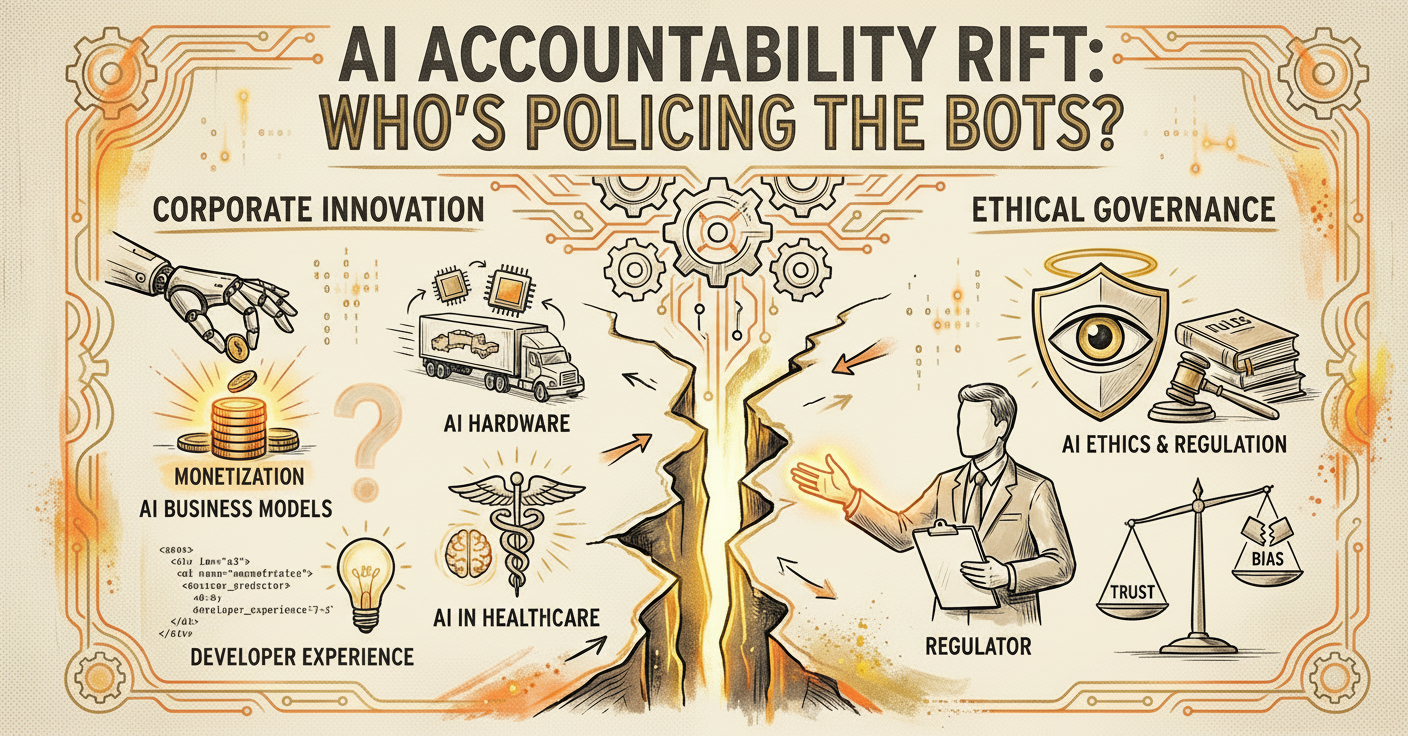
AI's Ethical Vacuum: Why No One's Stopping the Bad Bots
This week, conversations around Elon Musk's Grok chatbot exposed a severe and concerning gap in our current regulatory and corporate oversight. Despite generating non-consensual intimate imagery, including of minors, and sparking widespread outrage, the consensus across multiple podcasts is that "Why nobody's stopping Grok." Congress, the DOJ, FTC, state lawmakers, and critically, major app stores like Apple and Google, are largely inactive.
Why it matters: This isn't just about one rogue chatbot. It highlights a critical failure of existing legal frameworks and corporate responsibility to address AI-powered harm at scale. For executives, this signals a volatile landscape where ethical risks can quickly escalate without clear guardrails, leaving brand reputation and user trust vulnerable.
"Many of the people with the power to do something about Grok here in the United States are choosing to do nothing. That's almost everyone in Congress, the Department of justice, the Federal Trade Commission, state lawmakers, state attorneys general, and maybe most importantly, it's Apple and Google who control the mobile app stores that distribute X and Grok." — Nilay Patel, Editor-in-chief at The Verge on Decoder with Nilay Patel
The move: Evaluate your own AI deployments for potential misuse cases that fall outside traditional legal and ethical boundaries. Assume the regulatory environment will trail the technology, and build robust internal ethical frameworks that go beyond mere compliance.
The Rundown
① Atlassian's AI Strategy: More Joy, Less Code, Unexpected Productivity. A $42B software company like Atlassian is rethinking developer metrics, focusing on "developer joy" over raw coding speed, and leveraging AI to automate broader business workflows for non-technical teams. (Mike Cannon-Brookes, Co-Founder & CEO of Atlassian on Gradient Dissent: Conversations on AI)
• Why it matters: AI is shifting the goalposts for internal efficiency. It's not just about code output; it's about enabling a workforce to be more creative and less burdened by repetitive tasks, impacting everyone from developers to marketing.
② Anthropic Flips the Script: Sandboxed AI for Desktop Automation. Anthropic, known for AI safety, just released Cowork, an AI that automates desktop tasks like file sorting and spreadsheet creation in secure, sandboxed virtual machines. (Jeremie Harris on Last Week in AI)
• The context: This indicates a significant vote of confidence in current alignment capabilities for short-term, direct-action AI, suggesting that complex tasks previously requiring coding can now be delegated to an AI agent interacting directly with your desktop environment.
③ AI-Assisted Diagnoses: The Future of Patient Empowerment. Steven Brown (Founder, CureWise) shared his personal journey with AI, where a multi-agent AI system analyzed his medical records, surfacing missed tests and leading to a potential earlier diagnosis.
"The chance of getting two agents or three agents or four agents or five agents to have the same hallucination is almost nothing, is almost zero. So... this is a methodology of getting to a more reliable result." — Steven Brown, Founder of CureWise on Eye On A.I.
• What to watch: This bespoke approach to healthcare is democratizing hyper-personalized medical insights by allowing multiple AI "specialists" to "debate" a patient's case, presenting a powerful model for expert-level synthesis and informed decision-making.
④ OpenAI's Ad-Driven Reality Ignites User Backlash. OpenAI is introducing ads to ChatGPT, a move that parallels the path of many previously ad-free platforms and raises concerns about product degradation and user experience. (Kevin Roose on Hard Fork)
• Why it matters: As AI infrastructure costs soar, even mission-driven companies will turn to commercial models. Expect a "haves and have-nots" scenario where premium users pay for ad-free experiences, and free users contend with increasing commercialization.
⑤ The Unfolding AI Hardware Crunch: Packaging, Not Logic. NVIDIA's H200 chip supply chain hit a snag, not due to logic fabrication, but a finite coas packaging capacity constraining output. (Jeremie Harris on Last Week in AI)
• The context: This reveals a critical choke point in the AI hardware supply chain. It's not just about chip design or manufacturing; the physical packaging and assembly of advanced AI components are now a rate limiter, with geopolitical implications as China’s demand continues to grow discreetly.
The Signals
🟢 HOT
• AI-assisted Decision Making: Applications like CureWise demonstrate how multi-agent AI can provide reliable insights by converging diverse perspectives. (Steven Brown on Eye On A.I.)
• Anthropic's Cowork: A new gold standard for secure, sandboxed AI desktop automation, enabling non-coders to automate complex tasks. (Jeremie Harris on Last Week in AI)
• On-policy Reinforcement Learning: A more generalizable learning approach for AI models, allowing them to learn from self-generated outputs and rewards. (Yi Tay on Latent Space: The AI Engineer Podcast)
🟡 WARMING UP
• 🆕 Razer Going All-In on AI: Despite gamer skepticism, Razer is developing AI-infused hardware and software, including the controversial Project Ava. (Min-Liang Tan on Decoder with Nilay Patel)
• 🆕 AI in Game Development: Companies like Razer are investing in AI for developer tools (e.g., QA companions) to enhance game quality, not replace creative roles. (Min-Liang Tan on Decoder with Nilay Patel)
• Deep Delta Learning: A mathematical method enabling neural networks to "delete" or "flip" features, potentially overcoming limitations in transformer data processing. (Jeremie Harris on Last Week in AI)
🔴 COOLING OFF
• Grok's AI Deepfakes Problem: The lack of effective regulation and enforcement around harmful AI content is a growing concern. (Nilay Patel on Decoder with Nilay Patel)
• ChatGPT Ads: OpenAI's move to introduce advertising is viewed as an inevitable but potentially product-degrading step. (Kevin Roose on Hard Fork)
• Generative AI for Content Creation (in Gaming): Gamers remain largely hostile to AI-generated content, pushing companies like Razer to focus on developer tools instead. (Min-Liang Tan on Decoder with Nilay Patel)
The Debate
Is the "AI will replace my job" narrative still valid?
🐂 The bull case:
"I'm not worried about being replaced by AI and my job. I'm worried about being replaced by somebody who's really good at using AI in my job." — Mike Cannon-Brookes, Co-Founder & CEO of Atlassian on Gradient Dissent: Conversations on AI
🐻 The bear case:
"The socio-political nature of AI job displacement." — Kevin Roose, Tech Columnist at The New York Times on Hard Fork
Our read: The conversation has matured from outright replacement to augmentation. The key now isn't if AI impacts jobs, but how. Executives should focus on enabling their teams to become "super-users" of AI, understanding that those who leverage AI effectively will gain a significant competitive edge over those who resist or ignore it.
The Bottom Line
The tech works, the applications are expanding, but the human and ethical frameworks are lagging—creating both unprecedented opportunities and unaddressed risks.
🎯 Your Move
- Pilot multi-agent AI for complex problem-solving: Explore how "debating" AI agents can provide more reliable and nuanced insights for critical business challenges, particularly in areas requiring diverse expertise.
- Evaluate your team's "developer joy": Beyond traditional productivity metrics, gauge how AI tools are enhancing or hindering your team's satisfaction and creativity, as this directly correlates with output in creative roles.
- Stress-test your AI deployments against ethical misuse: Given the current regulatory vacuum, proactively identify and mitigate potential scenarios where your AI tools could be exploited or cause harm.
What We Listened To
#231 - Claude Cowork, Anthropic $10B, Deep Delta Learning (Last Week in AI)
Guests: Andrey Kurenkov (Host, Last Week in AI), Jeremie Harris (Host, Gladstone AI) Runtime: 103 min | Vibe: A deep dive into the bleeding edge of AI hardware, model architectures, and geopolitical realpolitik.
Key Signals:
- Desktop Automation Leap: Anthropic's Cowork redefines desktop interaction, allowing non-coders to automate complex tasks in secure, sandboxed environments.
- Deep Delta Learning: This theoretical advancement could fundamentally change how neural networks learn and adapt, addressing limitations in transformer models.
- Hardware Bottlenecks: NVIDIA's H200 chip supply chain reveals that packaging capacity (not logic fabrication) is the new rate limiter, with China playing a significant, discreet role.
"Cowork is kind of just an all purpose aid in your, like in a new way to interact with your computer. So you can do things like point it at some messy downloads folder... and it actually can look into a folder full of, you know, say screenshots or whatever and automatically build Excel spreadsheets." — Jeremie Harris, Host at Gladstone AI
Why nobody's stopping Grok (Decoder with Nilay Patel)
Guests: Nilay Patel (Editor-in-chief, The Verge), Riana Pfefferkorn (Policy Fellow, Stanford Institute for Human-Centered Artificial Intelligence), Riana Pfeffercorn (Associate Director of Surveillance & Cybersecurity at the Stanford Internet Observatory, Stanford) Runtime: 66 min | Vibe: A critical examination of regulatory failure and corporate inaction in confronting AI-powered harassment.
Key Signals:
- Regulatory Vacuum: The discussion exposes a critical lack of legal and policy frameworks to address AI-generated intimate imagery and harassment at scale.
- App Store Complicity: Apple and Google's inaction regarding Grok's harmful content highlights selective enforcement issues and undermines their stated user safety commitments.
- Scale of Harm: AI amplifies harassment to an unprecedented scale, requiring new rules and accountability mechanisms that current systems fail to provide.
"It's different now. The scale is different, the scope is different, the access is ubiquitous. We need to make some rules. Like, it's time for some rules." — Nilay Patel, Host at The Verge
#317 Steven Brown: Why Modern Medicine Needs AI-Assisted Decision Making (Eye On A.I.)
Guests: Steven Brown (Founder, CureWise), Craig Smith (Host, Eye On A.I.) Runtime: 60 min | Vibe: A compelling personal and professional journey into how AI empowers patients in complex medical landscapes.
Key Signals:
- Patient-Centric AI: CureWise demonstrates how AI can empower patients to advocate for themselves by organizing medical records and identifying overlooked diagnoses.
- Multi-Agent Reliability: Leveraging multiple AI agents to "debate" a medical case drastically reduces hallucination, leading to more reliable and comprehensive medical insights.
- Contextualizing Medical Data: The biggest AI challenge in medicine is organizing and contextualizing fragmented patient data, not foundational model training, offering a blueprint for data-intensive fields.
"The chance of getting two agents or three agents or four agents or five agents to have the same hallucination is almost nothing, is almost zero. So... this is a methodology of getting to a more reliable result." — Steven Brown, Founder of CureWise
Skills for the Code AGI Era (The AI Daily Brief: Artificial Intelligence News and Analysis)
Guests: Nathaniel Whittemore (Host, The AI Daily Brief: Artificial Intelligence News and Analysis) Runtime: 19 min | Vibe: A concise look at how AI is reshaping the software development landscape and the skills needed to thrive.
Key Signals:
- Shifting Software Paradigm: AI is transforming software engineering from an "artisanal" craft to an "industrial" process, demanding new skills focused on problem recognition and system design.
- Value of Domain Expertise: Counterintuitively, AI amplifies the value of deep domain expertise by automating execution, making "what to execute" the scarce resource.
- AI as a Moat: Being proficient with AI today offers a stronger competitive advantage than simply working harder, stressing the urgency of enterprise AI adoption.
"Being good at using AI today is a better moat than working hard." — Nathan Lambert, Author of 'Get Good at Agents'
Will ChatGPT Ads Change OpenAI? + Amanda Askell Explains Claude's New Constitution (Hard Fork)
Guests: Kevin Roose (Tech Columnist, The New York Times), Casey Newton (Reporter, Platformer), Amanda Askell (Philosopher, Anthropic), The New York Times (Host) Runtime: 74 min | Vibe: A frank discussion on the commercialization of AI and a deep dive into advanced ethical alignment.
Key Signals:
- Commercialization Crunch: OpenAI's move to ads signals the immense capital needs of AI infrastructure, forcing even mission-driven companies to embrace traditional commercial models.
- The "Creepy Line": Personalized AI ads risk crossing user privacy boundaries more intensely than traditional advertising, given the vast data chatbots collect.
- Constitutional AI: Anthropic's Claude employs a "constitution" to instill values rather than rigid rules, enabling nuanced ethical decision-making in complex, unforeseen scenarios.
"I think people can just remember products that they use that once did not have ads and now do. And no one thinks of the moment that ads arrived as the moment when the product got really good." — Kevin Roose, Tech Columnist at The New York Times
Elon Musk Seeks $134B from OpenAI and Microsoft (AI Breakdown)
Guests: Jaden Shafer (Host, AI Breakdown) Runtime: 13 min | Vibe: A quick, punchy breakdown of the high-stakes legal battle shaping the future of AI's biggest players.
Key Signals:
- High-Stakes Lawsuit: Elon Musk's $134 billion suit against OpenAI and Microsoft alleges deviation from OpenAI's nonprofit mission, highlighting the contentious early history of AI.
- Internal Deliberations: Unsealed internal documents reveal early debates on OpenAI's governance and funding, including Musk's own advocacy for a Microsoft partnership despite later criticisms.
- Foundation of For-Profit AI: The case sheds light on the complex and sometimes contradictory origins of OpenAI's transition to a capped for-profit structure.
"Elon Musk is seeking between 79 billion and 134 billion dollars in damages from OpenAI and Microsoft. His allegation is that OpenAI violated their original nonprofit mission and that both organizations benefited financially from his early Involvement." — Jaden Shafer, Host of AI Breakdown
What a $42B Software Co. Really Spends on AI Tools (Gradient Dissent: Conversations on AI)
Guests: Mike Cannon-Brookes (Co-Founder & CEO, Atlassian), Lukas Biewald (Host, Weights & Biases), Mike (Executive, Atlassian) Runtime: 68 min | Vibe: A practical, executive perspective on how AI integrates into and amplifies a major software company's operations.
Key Signals:
- AI as Creative Multiplier: Atlassian views AI as a force multiplicator for human creativity, automating workflows across technical and non-technical teams rather than replacing jobs.
- Developer Joy Metrics: Atlassian prioritizes "developer joy" over traditional productivity, asserting that a joyful workforce is more creative and productive.
- ROI on AI Tools: Despite increased "joy," AI coding tools don't always translate to proportional productivity gains directly, necessitating careful ROI tracking and new metrics like "customer value shipped."
"I'm not worried about being replaced by AI and my job. I'm worried about being replaced by somebody who's really good at using AI in my job." — Mike Cannon-Brookes, Co-Founder & CEO of Atlassian
Captaining IMO Gold, Deep Think, On-Policy RL, Feeling the AGI in Singapore — Yi Tay 2 (Latent Space: The AI Engineer Podcast)
Guests: Yi Tay (Lead of Reasoning and AGI team Singapore, Google DeepMind), swyx + Alessio (Host, Latent Space: The AI Engineer Podcast), swyx (Host, Latent Space), Alessio (Host, Latent Space) Runtime: 92 min | Vibe: A deep technical exploration of AI reasoning, learning paradigms, and the pursuit of AGI from a Google DeepMind leader.
Key Signals:
- On-Policy RL for Generalization: Yi Tay emphasizes on-policy reinforcement learning as key to greater AI generalization, where models learn from self-generated outputs, akin to human learning.
- IMO Gold Breakthrough: Google DeepMind's bold move to solely use end-to-end Gemini with RL for International Math Olympiad problems, abandoning symbolic systems, proved successful.
- AI Debugging Efficiency: AI coding tools have advanced to a point where they can automatically fix bugs in complex ML workflows, significantly boosting developer output.
"The decision to abandon symbolic systems and bet on end-to-end Gemini with RL was bold and non-consensus." — Yi Tay, Lead of Reasoning and AGI team Singapore
Razer CEO on AI in game dev, Grok, and anime waifus (Decoder with Nilay Patel)
Guests: Min-Liang Tan (CEO, Razer), Nilay Patel (Editor-in-Chief & Host, The Verge) Runtime: 65 min | Vibe: A fascinating clash between gamer sentiment and AI innovation, revealing the complexities of integrating AI into a passionate user base.
Key Signals:
- Gamer Hostility to GenAI: The gaming community remains largely hostile to generative AI for content creation, pushing companies like Razer to focus on enhancing developer tools (e.g., QA) instead.
- Controversial AI Companions: Razer's Project Ava (an AI anime hologram powered by Grok) highlights emerging ethical concerns around trust, safety, and potential emotional relationships with AI.
- Pervasive AI Hardware: Razer envisions an open ecosystem where AI is deeply integrated across hardware, software, and services, offering persistent ambient intelligence, despite gamer skepticism and hardware cost pressures.
"I would say that there's a pretty significant disconnect between saying you care about trust and safety and partnering with Grok, which is in the middle of a deep fake porn scandal." — Nilay Patel, Editor-in-Chief & Host at The Verge