
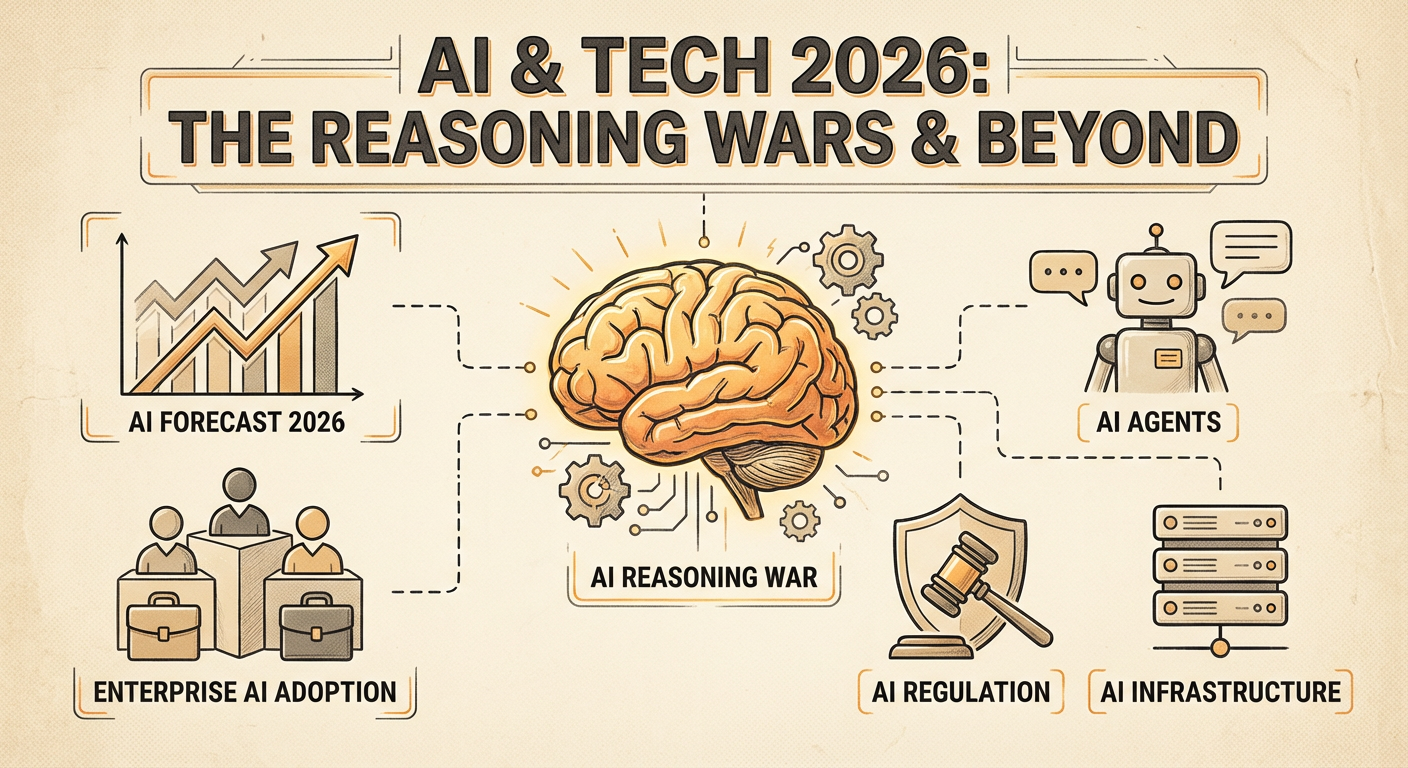
AI & TECH ROUNDUP: 2026 FORECAST EDITION
The Reasoning Wars Are Here — And Nobody's Winning Yet
THIS WEEK'S INTAKE
📊 14 episodes across 8 unique podcasts
⏱️ 6.5 hours of AI & Tech intelligence
🎙️ Featuring: Sarah Guo, Elad Gil, Azeem Azhar, Aakanksha Chowdhery, Dean Ball, Nilay Patel
📅 Coverage: Reflections & Predictions
We listened. Here's what matters.
Okay, so here's the deal: as we wrap up another year, everyone in AI is looking ahead, speculating on what 2026 will bring. And what I heard, loud and clear, across hours of conversations with some seriously smart people, is this: the battle for true "reasoning" in AI models and agents is the next frontier, and it's far messier than anyone is letting on.
On one hand, we're seeing incredible, tangible ROI from AI today. Companies are deploying it, seeing impact, and expecting gains to accelerate. On the other, the foundational work needed to move beyond impressive parlor tricks to truly intelligent, agentic systems is still very much in flux. We've got new models like GPT 5.2 and Gemini 3 Flash blowing away benchmarks, multimodal capabilities are exploding, and enterprise adoption is accelerating. But beneath the surface, there's a growing acknowledgment that scaling these systems, ensuring they actually perform complex tasks reliably, and dealing with the sheer logistical and political overhead of AI... that's where the real work (and real money) will be made or lost in 2026.
This isn't about an AI bubble; it's about an AI fog. Everyone's building agents, everyone's touting new models, but the infrastructure, the regulatory landscape, and even the fundamental pre-training paradigms required for genuinely smart, effective AI are still TBD.
Here's what you need to know about where we're really headed:
2026: The Year AI Goes to Work (For Real)
The Surprise: Industries You Least Expected Are Leaping Ahead
Forget the flashy consumer apps for a moment. The real action in 2026, according to venture capital stalwarts like Sarah Guo and Elad Gil, will be in the established, often slower-moving industries. Finance, medicine, and law are rapidly adopting AI, leveraging its capabilities to solve complex, domain-specific problems. This isn't just about efficiency; it's about entirely new forms of problem-solving. It seems the "slowest adopters of technology love AI" because it offers such a step-change in their analytical capabilities.
The Insight: This accelerated adoption in traditionally conservative sectors indicates that AI's value proposition has moved beyond novelty to clear, strategic advantage. It shifts the narrative from "what can AI do?" to "what problems can AI solve for us?".
"The people who tended to be the slowest adopters of technology love AI. That's positions, that's lawyers, that's certain accounting types. It's actually kind of fascinating." — Sarah Guo, on No Priors
The So What: If you're not seeing AI adoption in your most complex, information-dense departments, you're missing a trick. These are the areas with the highest leverage for AI-driven transformation, and they're leading the charge.
ROI Is Here, But It's Not Where You Think
Good news, everyone: AI is already delivering positive ROI for 82% of companies, with 37% reporting "significant or transformational impact." But here's the kicker: smaller organizations are consistently overperforming in terms of AI impact. The secret? They're more agile, less burdened by legacy systems, and often more willing to experiment. The biggest gains aren't coming from simple "time saved" but from strategic benefits like improved decision-making and deeper insights.
The Insight: The "soft" benefits of AI — better decisions, strategic clarity, empowered employees — are translating into hard cash, particularly for those nimble enough to identify and exploit these opportunities. This isn't just about automating tasks; it's about augmenting intelligence.
"82% of organizations report positive ROI today, 37% report significant or transformational impact, and nearly all expect gains to accelerate over the next year." — The AI Daily Brief
The So What: Focus on strategic impacts first, and don't underestimate the agility advantage of smaller teams. Prioritize AI projects that enhance cognitive functions and decision-making, not just brute-force automation.
The Agentic Future: More Than Just Chatbots, Less Than We Imagine (For Now)
Moving Beyond Chatbots: The SOP Revolution
One of the most compelling predictions for 2026 is the rise of AI agents designed to tackle Standard Operating Procedures (SOPs). This isn't just about automating simple tasks; it's about offloading entire workflows to AI, freeing up human capital for more creative, human-centric work. The focus here is on a human-centered approach, engaging leadership, and rethinking workflows from scratch.
The Insight: AI agents will graduate from being mere conversational interfaces to powerful workflow orchestrators. This isn't just about efficiency; it's about redefining "meaningful work" in the enterprise. Properly deployed, agents can empower employees, allowing them to focus on unique intellectual contributions.
"People wake up in the morning and they want their jobs to matter. They want to feel like they're making a difference." — Practical AI
The So What: Start identifying your "AI-ready" SOPs now. Prioritize workflows that are well-defined, repeatable, and currently a drain on high-value human time. The goal is augmentation, not just automation.
The Elephant in the Room: Re-thinking Pre-Training for True Agentic AI
While the vision of powerful agents is exciting, the underlying science still has a long way to go. Aakanksha Chowdhery of Reflection highlights a critical challenge: current pre-training paradigms for large language models (LLMs) are still fundamentally geared towards static benchmarks. For true agentic AI — models that can interact with environments, plan, reason over long contexts, and dynamically learn new tools — the entire pre-training process needs to be rethought.
The Insight: The leap from current LLMs to truly intelligent, autonomous agents isn't just about bigger models or more data. It requires a fundamental shift in how we build and train these systems, emphasizing dynamic interaction and adaptive learning over static knowledge recall. This implies a slower, more deliberate path to advanced agent capabilities than some hype cycles might suggest.
"If you want these models to be useful as agents, they need to be able to interact with environments. And when we start caring about those agent tech tasks, pre training needs to rethink from fundament..." — Aakanksha Chowdhery, on TWIML AI Podcast
The So What: Don't mistake impressive demos for fundamental breakthroughs in agentic reasoning. Understand that the core research for truly intelligent agents is still in its early stages. Invest in R&D that focuses on adaptive, interactive learning, not just scaling existing LLM architectures.
The Infrastructure Battles & Regulatory Crossfire
The Compute Bottleneck is Real (and Getting Worse)
As AI progresses, the physical realities of compute and energy are becoming undeniable constraints. Azeem Azhar points out that while AI technology accelerates, its reliance on vast amounts of energy and physical infrastructure creates a bottleneck. This isn't just an engineering problem; it's a geopolitical and economic one. The "K-shaped economy" of 2025, where AI tech advanced dramatically but organizational adoption lagged, hints at a future where access to compute power dictates who wins and loses.
The Insight: The "bits not atoms" dream for AI is over. The physical world's limitations — energy grids, chip supply chains, data center construction — are now direct impediments to AI's unchecked growth. This transforms AI infrastructure into a strategic national asset.
"The more powerful AI becomes... the more it bumps against people who don't want to adopt it, or institutional systems where that does not get incorporated into the workflows." — Azeem Azhar, on Exponential View
The So What: Don't underestimate the capital expenditure and logistical challenges associated with scaling AI. Treat compute as a strategic resource. For national leaders, this means securing supply chains and investing in energy infrastructure.
Regulation is Coming (Hard and Fast)
The push for AI regulation is gaining serious momentum. The RAISE Act in the US, aimed at curbing catastrophic AI risks, is just one example of how governments are moving from discussion to concrete legislative action. This isn't a niche concern; it's a popular political stance. Whether it's about safety, data privacy, or preventing misuse, 2026 will see a significant acceleration in regulatory efforts globally.
The Insight: AI regulation isn't an "if," it's a "when and how." Policymakers are motivated, and the public is increasingly concerned. This will shift the burden onto developers to demonstrate meaningful risk mitigation plans.
"All the RAISE Act is saying is you as a developer should have a meaningful plan that reduces the risk of those bad things happening." — Alex Boris, New York Assemblymember, on The Cognitive Revolution
The So What: Proactively engage with regulatory discussions, and build AI systems with guardrails and transparency in mind from day one. Compliance will become a non-negotiable cost of doing business in AI.
ON THE RADAR
🔥 Heating Up:
- Multimodal AI for Creatives: Expect models like GPT Image 1.5 to push creative boundaries, integrating various forms of reference content to generate new or edit existing scenes. (Source: The AI Daily Brief, Power Ranking the Big AI Ideas)
- Humanoid Robots: Small-scale deployment of humanoid and semi-humanoid robots is forecast for 2026 in both consumer and industrial settings. (Source: Sarah Guo, on No Priors)
- Public Awareness of AI Risk: The "K-shaped economy" and increasing public discussion mean more people are aware of AI's societal impacts, leading to more scrutiny. (Source: Azeem Azhar, on Exponential View)
👀 Worth Watching:
- AI for Scientific Discovery: Significant breakthroughs are predicted in using AI to solve complex scientific problems, moving beyond traditional applications. (Source: Elad Gil, on No Priors)
- Agent-Native Infrastructure: The need to re-architect control planes for agents means a new wave of infrastructure designed specifically for dynamic, agent-led operations. (Source: The AI Daily Brief, Power Ranking the Big AI Ideas)
⚠️ Proceed With Caution:
- Consumer AI Innovation Pace: Despite continuous progress, consumer AI is often slower and less transformative than expectations might suggest. (Source: Elad Gil, on No Priors)
- Dependence on Cloud Giants: OpenAI's ability to secure investment from every major tech company (Amazon, Microsoft) raises questions about concentration of power and future vendor lock-in. (Source: The AI Daily Brief, The Most Important AI Stories This Week)
THE CONTRARIAN CORNER
While the advancements in models like OpenAI's GPT Image 1.5 are impressive, some creators are expressing skepticism. Despite benchmark improvements and early impressions, there's a quiet concern that these new image generation models, while powerful, can sometimes miss the "vibe check" or struggle with character consistency, particularly faces. This suggests that raw benchmark scores might not always translate directly into superior real-world creative utility, leaving room for niche competitors to excel where the giants stumble on artistic nuance. It's a reminder that truly effective creative AI requires more than just technical horsepower.
THE BOTTOM LINE
2026 will be the year AI truly hits the enterprise, driving tangible ROI in unexpected places, especially in traditional industries. But the path to ubiquitous, intelligent agents is steeper than many realize, challenged by fundamental research gaps in pre-training and very real physical constraints around compute and energy. Expect a rapid acceleration of regulatory efforts, forcing developers to prioritize safety and accountability. The future isn't just about building smarter AI; it's about building responsible and resilient AI in a world increasingly attentive to its impact.
📚 APPENDIX: EPISODE COVERAGE
1. The AI Daily Brief: "82% of Companies Are Seeing Positive AI ROI"
Guests: Not explicitly mentioned, analysis of industry report
Runtime: 10m | Vibe: Data-driven optimism
Key Signals:
- High ROI Achieved: A significant 82% of organizations are already reporting positive ROI from their AI investments, with 37% experiencing "significant or transformational impact." This confirms AI is no longer just a hypothetical cost center.
- Small is Mighty: Smaller organizations frequently outpace larger enterprises in realizing AI's benefits, overperforming across various impact categories, likely due to greater agility and less legacy overhead.
- Strategic vs. Efficiency Gains: The highest returns are linked to strategic benefits like improved decision-making rather than simple time savings, underscoring AI's potential to augment cognitive functions.
"82% of organizations report positive ROI today, 37% report significant or transformational impact, and nearly all expect gains to accelerate over the next year."
2. No Priors: "The 2026 AI Forecast: Foundation Models, IPOs, and Robotics with Sarah Guo and Elad Gil"
Guests: Sarah Guo (Managing Partner, Benchmark), Elad Gil (Author, investor, entrepreneur)
Runtime: 1h 2m | Vibe: Forward-looking, investment-centric
Key Signals:
- Unlikely AI Adopters: Industries traditionally slow to adopt technology, such as law and medicine, are emerging as rapid adopters of AI, driven by its capacity to solve complex, domain-specific problems.
- Robotics on the Horizon: Semi-humanoid and humanoid robots are predicted to see small-scale deployment in 2026 across industrial and consumer environments, marking a critical step towards practical integration.
- Consumer AI Lag: Despite overall rapid advancement, innovation in consumer-facing AI applications is observed to be slower than expected compared to enterprise or infrastructure AI.
"The people who tended to be the slowest adopters of technology love AI. That's positions, that's lawyers, that's certain accounting types. It's actually kind of fascinating."
3. Last Week in AI: "#228 - GPT 5.2, Scaling Agents, Weird Generalization"
Guests: Not explicitly mentioned, hosts discuss AI news
Runtime: 45m | Vibe: Up-to-the-minute AI news analysis
Key Signals:
- GPT 5.2's Breakthrough Performance: OpenAI's new GPT 5.2 model demonstrates significant performance improvements, reportedly beating or tying top industry professionals on 71% of comparisons, indicating major advances in reasoning.
- Content Generation Dominance: Disney's substantial $1 billion investment in OpenAI signals a growing trend of major content companies leveraging advanced AI models like Sora for character and media generation.
- Geopolitical AI Tensions: The ongoing US-China tensions over AI chip exports continue to shape the global AI landscape, impacting supply chains and national AI strategies.
"GPT 5.2 thinking beating or tying industry professionals, top industry professionals... on 71% of comparisons."
4. Practical AI: "Beyond chatbots: Agents that tackle your SOPs"
Guests: Not explicitly mentioned, topic-focused
Runtime: 35m | Vibe: Practical, human-centric AI application
Key Signals:
- AI for Workflow Automation: AI is moving beyond simple chatbots to become instrumental in automating Standard Operating Procedures (SOPs), aiming to free employees for more meaningful and creative tasks.
- Human-Centered AI Integration: Successful AI adoption requires a primary focus on the human element, including addressing employee fears, securing leadership buy-in, and redesigning workflows with people at the core.
- Empowering Employees: By automating routine tasks, AI can enhance employee empowerment and job satisfaction, allowing individuals to focus on impactful work that leverages their unique skills.
"People wake up in the morning and they want their jobs to matter. They want to feel like they're making a difference."
5. The AI Daily Brief: "4 Reasons to Use GPT Image 1.5 Over Nano Banana Pro"
Guests: Not explicitly mentioned, product comparison
Runtime: 12m | Vibe: Comparative, user-focused review
Key Signals:
- OpenAI's Image Generation Push: OpenAI's GPT Image 1.5 is a direct competitive response to models like Nano Banana Pro and Gemini 3, indicating a fierce contest in high-end AI image generation.
- Quality & Comparison: Initial benchmarks and creator feedback suggest that GPT Image 1.5 performs comparably or even better than leading alternatives in certain aspects, despite different underlying architectures.
- Increased Creator Choice: The emergence of strong contenders like GPT Image 1.5 means creative professionals now have more diverse and powerful tools at their disposal for AI-driven image generation.
"Overall, this is one that I kind of expected you might remember in the December prediction episode... My best guess for A response to Gemini 3 and Nanobana Pro was an OpenAI image model."
6. The Cognitive Revolution: "AI 2025 → 2026 Live Show | Part 1"
Guests: Various guests discussed including researchers and builders
Runtime: 1h 15m | Vibe: Fast-paced, expert panel discussion
Key Signals:
- AGI Benchmarking Challenges: The ongoing race between OpenAI, Anthropic, and Google is pushing the boundaries of AGI benchmarks, but there's a sense that "normal technology" status is elusive.
- Context Limits of Continual Learning: Despite advancements in long context windows and context stuffing, there's a persistent feeling that something fundamental is missing in how models continually learn and integrate information.
- AI for Scientific Advancement: AI is poised to revolutionize scientific decision-making, offering new avenues for discovery and problem-solving beyond traditional human capabilities.
"When does it stop becoming normal technology?"
7. Azeem Azhar's Exponential View: "What I learned from the world's leading minds in 2025"
Guests: Not explicitly mentioned, Azeem Azhar's reflections
Runtime: 40m | Vibe: Reflective, macro-level insights
Key Signals:
- AI as a General-Purpose Technology: AI continues to demonstrate its power as a foundational technology capable of transforming numerous sectors, akin to the internet or electricity.
- "If it barely works, you're building right.": A heuristic for startups: if your product is barely functional but relies on the next model to truly shine, you're likely working on a breakthrough that scales with AI advancements.
- Friction with Institutional Adoption: The increasing power of AI is met with friction when it encounters institutional systems and workflows unprepared for its integration, highlighting a socio-technical gap.
"If you're building something that really just barely works and, and you can't wait for our next model because you know it's going to make your product sing, then you're probably building in the right ..."
8. The Cognitive Revolution: "AI 2025 → 2026 Live Show | Part 2"
Guests: New York Assemblymember Alex Boris, Dean Ball (former White House AI advisor), Peter Wildeford (forecaster)
Runtime: 1h 10m | Vibe: Regulatory and policy-focused debate
Key Signals:
- The RAISE Act's Significance: The proposed RAISE Act represents a concrete legislative effort to mitigate catastrophic AI risks, signaling a shift from discussion to active regulation in the US.
- Popularity of AI Regulation: Regulating AI is emerging as a politically popular stance, pushing politicians to define their positions and prioritize AI oversight.
- US-China Chip Policy and AI Safety: Geopolitical competition, specifically US-China chip policy, intertwines with AI safety, creating a complex web of national security and ethical considerations for AI development.
"All the RAISE Act is saying is you as a developer should have a meaningful plan that reduces the risk of those bad things happening."
9. The AI Daily Brief: "Power Ranking the Big AI Ideas for 2026"
Guests: Not explicitly mentioned, analysis of a16z's "Big Ideas"
Runtime: 15m | Vibe: Predictive, strategic outlook
Key Signals:
- Multimodal AI Takes Center Stage: 2026 is anticipated to be the year AI truly goes multimodal, allowing models to process and generate content across various input forms (text, images, audio, video) for creation or editing.
- Rise of Agent-Native Infrastructure: The increasing dominance of AI agents necessitates a re-architecture of control planes, leading to the development of specific infrastructure designed to handle "thundering herd patterns" as a default state.
- AI-Driven Industrial Renaissance: AI is poised to fuel an "industrial renaissance," transforming manufacturing, logistics, and other heavy industries through automation and optimization.
"26 is the year that AI goes multimodal. Give a model whatever form of reference content you have to work with to make something new or edit an existing scene."
10. Decoder with Nilay Patel: ""All chaos and panic": Nilay answers your burning Decoder questions"
Guests: Nilay Patel (Host), Producers
Runtime: 38m | Vibe: Retrospective, engaging listener questions
Key Signals:
- Importance of Decision-Making Transparency: Nilay's "decoder questions" emphasize how crucial it is for leaders to articulate their decision-making processes, warning listeners to "run" if their boss cannot.
- AI's Broad Impact (General Context): While not the primary focus, the discussion implicitly places AI as a significant, overarching trend alongside other major tech topics like CarPlay and the creator economy, impacting various business models.
- Value of Clear Questioning: The podcast highlights the power of structured, probing questions in understanding complex topics and revealing core motivations or challenges, applicable to AI discussions.
"If your boss can't answer how they make decisions, you should run."
11. The AI Daily Brief: "The Most Important AI Stories This Week"
Guests: Not explicitly mentioned, news aggregation
Runtime: 14m | Vibe: Urgent, industry update
Key Signals:
- Gemini 3 Flash's Disruptive Performance: Google's Gemini 3 Flash model is described as punching "way above its weight class," surpassing previous models like 2.5 Pro on benchmarks while offering greater efficiency and cost-effectiveness.
- OpenAI's Strategic Fundraising: OpenAI's success in securing investments from major tech powerhouses like Amazon highlights its unique position in the AI ecosystem and ability to tie industry giants to its scaling efforts.
- AI Investment & Infrastructure Trends: Significant organizational shifts within Amazon's AI division and general market activity underscore the colossal funding and infrastructure required to compete in the leading edge of AI development.
"Gemini 3 Flash punches way above its weight class, surpassing 2.5 Pro on many benchmarks while being much cheaper, faster and more token efficient."
12. Azeem Azhar's Exponential View: "Reflecting on 2025 (the K-shaped economy, AI's impact on work and human judgement, energy bottlenecks)"
Guests: Not explicitly mentioned, Azeem Azhar's reflections
Runtime: 48m | Vibe: Critical and thought-provoking
Key Signals:
- The "K-shaped" AI Economy: 2025 saw a widening gap between rapid technological AI advancements and the slower pace of organizational adoption, creating an uneven economic impact.
- The Cost of Inadequate Experimentation: Viewing AI merely as an "operating system upgrade" is a mistake; organizations that fail to experiment rigorously with AI will miss out on its transformative benefits.
- Physical Infrastructure Bottlenecks: The exponential growth of AI is increasingly constrained by underlying physical infrastructure, particularly energy supply and compute capacity, limiting its ultimate scale.
"If you treat AI like a simple operating system upgrade, you will miss out on the benefits."
13. NVIDIA AI Podcast: "How Anyone Can Build Meaningful AI Without Code - Ep. 283"
Guests: Shanea Leven (CEO, Empromptu AI)
Runtime: 25m | Vibe: Accessible, empowering
Key Signals:
- Democratizing AI Creation: Empromptu AI's platform, leveraging NVIDIA CUDA, aims to enable individuals without coding skills to build accurate, production-ready AI applications, making AI accessible to a broader audience.
- Redefining AI Success as Task Success: The focus for no-code AI platforms is to optimize entire systems in real-time towards specific, definable task goals, redefining accuracy in terms of successful outcome completion.
- AI for Generative Thinking: Accessible AI tools go beyond automating old processes; they empower "generative thinking," allowing users to create living, breathing applications that address novel problems.
"AI accessibility at this stage is allowing anyone with an idea, not just to use AI to build old technologies...AI can put generative thinking, living breathing applications into people's hands."
14. The TWIML AI Podcast: "Rethinking Pre-Training for Agentic AI with Aakanksha Chowdhery - #759"
Guests: Aakanksha Chowdhery (Reflection)
Runtime: 50m | Vibe: Deep dive, research-oriented
Key Signals:
- Shift from Static to Interactive Pre-training: For AI models to function effectively as agents capable of interacting with environments, their pre-training must fundamentally shift away from static benchmarks towards dynamic, interactive learning.
- Beyond Attention: Planning & Reasoning: Agentic AI necessitates capabilities like long-form planning and reasoning over extended contexts, requiring a re-evaluation of attention mechanisms and loss objectives in pre-training.
- Dynamic Tool Learning: Future agentic models will need to dynamically learn and integrate new tools in real-time within complex environments, a significant paradigm shift from current model capabilities.
"If you want these models to be useful as agents, they need to be able to interact with environments. And when we start caring about those agent tech tasks, pre training needs to rethink from fundament..."