
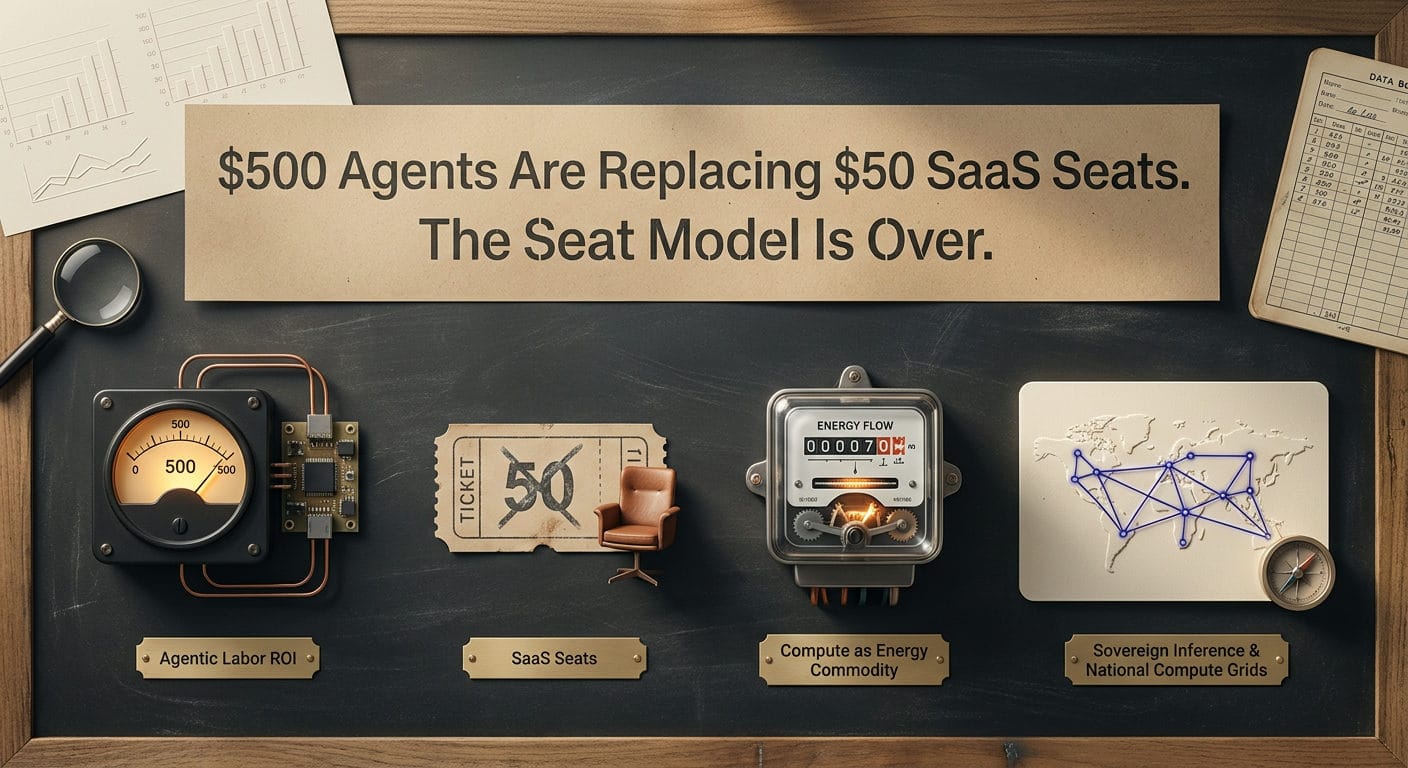
Compute is shifting from a hardware purchase to a volatile energy-conversion commodity, while the "bottleneck" in venture-backed companies is migrating from engineering throughput to high-judgment strategic direction.
📊 10 episodes across 4 podcasts
⏱ 10 hours 13 minutes of intelligence analyzed
🎙 Featuring: Kush Bavaria (ORN), Sherif Mansour (Atlassian), Anjney Midha (AMP), David Heinemeier Hansson (37signals), Tim Draper (Draper Associates), Ray Dalio (Bridgewater Associates)
|

The Big Shift
The Transition from SaaS Seats to Agentic Labor ROI. A structural rot is appearing in the SMB software market, as net-new customer acquisition for legacy SaaS titans like HubSpot and Monday.com begins to falter. The signal is clear: customers are no longer buying "crap" seat-based tools; they are shifting budgets toward agentic services that replace human front- and back-office labor at a fraction of the cost.
Why it matters: This isn't just a spending dip—it’s a fundamental change in the unit of value. Small businesses are increasingly opting for labor-automation agents that close deals at $500–$1,000 per month rather than adding more $50 seats. This shift is exposing venture funds holding 2021–22 SaaS marks to a brutal valuation cleanup as the traditional M&A backstop from giants like NVIDIA appears increasingly unstable due to regulatory and leadership uncertainty.
"SMBs are saying: I don't want to buy this crap... For small SMBs, where the workflow and the auth and all the kind of corporate legacy stuff isn't that important, the winner is probably Claude."
— Jason Lemkin, Investor and entrepreneur on The Twenty Minute VC (20VC)
The Move: Investors must audit portfolio companies for "direction" bottlenecks. As Atlassian’s Sherif Mansour noted, AI speeds up throughput so much that the ability to steer the ship—not the ability to build—becomes the binding constraint. If your founders are celebrating shipping speed without a corresponding increase in strategic conviction, they are just accelerating toward a cliff.
The Rundown
① GPU pricing expectations have reversed toward a commodity index.
Kush Bavaria (ORN) argues that compute is becoming a commodity market, where GPU-hour prices for Rubin capacity could hit $20–$30 as demand for inference tokens outstrips supply. (Kush Bavaria on The Twenty Minute VC (20VC))
→ The signal: The era of simple rapid-depreciation assumptions for chips is over; older A100s and H100s are retaining value by shifting from training to verticalized inference workloads.
② Product Management is evolving into "Context Management."
Atlassian’s 🆕Sherif Mansour argues that in the AI era, PMs create value by filling context gaps across customer and business domains rather than owning every ticket. (Sherif Mansour on Lenny's Podcast)
→ What to watch: The 🆕PM Craft Triangle (General Manager, Scientist, Artist); as feature-building gets cheaper, the "Artist" PM focused on vision and experience becomes the ultimate differentiator.
③ The 🆕Omarchy OS signal: Agents prefer Linux's "liabilities."
🆕David Heinemeier Hansson (DHH) notes that "agents love... a command line interface for everything" and "predictable config files," turning Linux’s traditional user hurdles into an agentic advantage. (David Heinemeier Hansson on The a16z Show)
→ The signal: Agent-generated software is enabling a revival of pseudonymous hacker culture, where individual builders can recreate flagship apps like Lightroom in just two weeks.
④ Reputation-based networks are replacing static profiles.
🆕Cosign is building a network where "trusted endorsements" from peers surface hidden high-impact operators that traditional titles miss. (David Booth on The a16z Show)
→ Why it matters: Professional discovery is moving from a talent shortage problem to a timing-and-trust problem, curated by human signals for AI agent search.
⑤ Biological discovery is being industrialized by thousands of agents.
OpenAI’s 🆕Joy Jiao revealed that using 2,000 agents to analyze 8 million mouse-brain cells found disease patterns that humans missed in manual passes. (Joy Jiao on The a16z Show)
→ The signal: The "One-Person Biotech" is becoming a reality by using agents to monitor trial operations and reconcile complex eligibility criteria, though biology still dictates the final timeline.
Signal Board
🔥 HEATING UP
• Energy-Centric AI Infrastructure: Frontier AI is now viewed as an energy-conversion business, favoring physical infra over software wrappers. (Anjney Midha on 20VC)
• Verticalized Inference: General-purpose horizontal platforms are losing ground to specialized inference providers optimized for cost and modality. (Kush Bavaria on 20VC)
• Believability-Weighted Decisions: Organizations are moving toward meritocratic decision systems where domain expertise weights input more than seniority. (Ray Dalio on a16z)
👀 ON WATCH
• 🆕Undertow: A Qloo-powered hackathon winner using taste-affinity signals to outperform traditional polls in election forecasting. (Abdul Hasani on This Week in Startups)
• 🆕National Compute Grid: The push for modular 5–10 MW compute pods to utilize stranded power and counter Chinese state-backed cluster buying. (Anjney Midha on 20VC)
• 🆕Sovereign Inference: Regulated enterprises shifting toward running proprietary models on-prem to avoid U.S. Cloud Act exposure. (Anjney Midha on 20VC)
❄️ COOLING OFF
• Tranche Financing: Milestone-less rounds based on cosmetic markups are being labeled a "house of cards" that most VCs won't survive. (Anjney Midha on 20VC)
• "Uncoachable" Founder Archetype: While Calacanis still favors abrasive founders, the smart money is pivoting toward evidence-responsive thinking. (D.A. Wallach on This Week in Startups)
• Static Resume Profiles: Static LinkedIn-style data is being rendered obsolete by agents that inspect real-time feeds and verified work lists. (David Booth on a16z)
The Debate
The Validity of the "Training vs. Inference" Divide.
🐂 The Bull Case: Traditional accounting and market positioning benefit from this split. General-purpose providers and specialized neoclouds rely on these categories to sell GPU-hours and project depreciation curves. (Kush Bavaria, ORN)
🐻 The Bear Case: 🆕Anjney Midha argues the separation is "technically imprecise." Reinforcement learning generates massive amounts of inference data that is fed back into model weights, making the two effectively a single research loop. Anjney Midha noted that "[t]he whole training versus inference separation is just technically imprecise" during his discussion on 20VC.
Our Read: Midha is right on the physics; the market is right on the billing. The "Energy-Conversion" view of AI will eventually force LPs to look at cost-per-completed-job rather than hourly GPU rental rates.
The Bottom Line
The "PM bottleneck" has shifted from shipping code to providing direction, as agentic labor begins cannibalizing legacy SaaS seat revenue.
Episode Guide (Web Version)
The Twenty Minute VC (20VC) — "The State of Compute: Kush Bavaria"
Runtime: 73 min | Host: Harry Stebbings | Guest: Kush Bavaria (Co-Founder and CEO, ORN)
For Infrastructure Investors: A masterclass in why GPU prices might rise and why neoclouds are more like landlords than tech companies.
Kush Bavaria challenges the assumption of rapid GPU depreciation, arguing that A100s and H100s remain valuable for inference. He introduces Ornn's mission to create GPU price indices and futures to stabilize the "energy-conversion" business of AI.
"I would not be surprised if their Rubin costs are like 20, $30 per GPU hour." — Kush Bavaria, Co-Founder and CEO, ORN
The a16z Show — "Principles and Algorithms: Ray Dalio"
Runtime: 51 min | Host: Alex Rampell & Sonal Chokshi | Guest: Ray Dalio (Founder, Bridgewater Associates)
For GPs & Operating Partners: A foundational framework for encoding human decision logic into repeatable, machine-ready algorithms.
Ray Dalio details his philosophy of "believability-weighted" decision making and the "Holy Grail" of investing: finding 15 uncorrelated return streams to maximize return-to-risk ratios.
"Knowing what you don't know, it's so much more valuable than anything you know." — Ray Dalio, Founder, Bridgewater Associates
The Twenty Minute VC (20VC) — "Will Jensen Return? Mega-Rounds & Anthropic"
Runtime: 73 min | Host: Harry Stebbings | Guests: Rory O’Driscoll, Jason Lemkin
For Growth-Stage CEOs: Understanding how NVIDIA’s export-control risk could permanently impair the venture M&A backstop.
The panel debates the "efficiency gap" of Anthropic potentially reaching $100B revenue with only 6,000 employees and the decline of net-new customer additions in the SMB software sector.
"LPs are going to grade us all on how many 20 billion and up portfolio companies we have." — Jason Lemkin, Investor and entrepreneur
The a16z Show — "The Professional Network for AI Agents"
Runtime: 18 min | Host: Sophia Dew | Guests: David Booth (a16z), Bella Nazzari (Cosign)
For Talent Partners: How reputation-based curation is enabling agents to find the "right person at the right moment."
Cosign is moving professional networking away from static profiles and toward trusted peer endorsements, creating a "taste layer" for professional discovery.
"What's the work they've done and who can vouch for that work." — David Booth, Ecosystem lead, Andreessen Horowitz
This Week in Startups — "Cedric the Entertainer Judges Qloo Hackathon"
Runtime: 54 min | Host: Jason Calacanis | Guests: Cedric the Entertainer, Alex (Qloo)
For Consumer Tech VCs: A deep dive into using 15 years of cultural "taste data" to build agents that actually understand human preference.
Finalists demonstrate Undertow, an election-prediction tool that uses taste signals to outperform traditional polls, and Backline, a budget-aware travel agent.
"Polls tell us what people say. Tastes tell us who they are and how they vote." — Abdul Hasani, Creator, Undertow
Lenny's Podcast — "What it takes to be a great PM in the AI era"
Runtime: 82 min | Host: Lenny Rachitsky | Guest: 🆕Sherif Mansour (Head of AI, Atlassian)
For Product Executives: Why Atlassian’s experiment without PMs failed—and what it teaches about the necessity of direction over throughput.
Mansour argues that AI amplifies craft strengths and weaknesses, making direction the binding constraint in the development loop.
"We realized throughput's not our problem, direction's our problem. I need more people to steer a ship." — Sherif Mansour, Head of AI and Product Craft, Atlassian
This Week in Startups — "NVIDIA Ousts Jensen & Walmart Bubble"
Runtime: 86 min | Host: Jason Calacanis | Guests: Tim Draper, D.A. Wallach, Dave McClure
For LPs & GPs: A historical comparison of current AI spend to the dot-com buildout, including a study on randomized VC portfolios.
Tim Draper reflects on the 80% dot-com drawdown, while the panel discusses how marketing machines and access to elite deals drive VC success more than stock picking.
"I think the marketing machine matters a lot more than people care to." — Dave McClure, Managing Partner, Practical Venture Capital
The a16z Show — "The One-Person Biotech"
Runtime: 66 min | Host: Jay Rughani & Jorge Conde | Guests: 🆕Joy Jiao, Ashoka Rajendra (OpenAI)
For Life Sciences Investors: How GPT Rosalind and thousands of agents are identifying disease-relevant patterns humans missed.
OpenAI’s Life Sciences team explains how agents can monitor clinical trial operations to prevent delays, even if they can't speed up biological maturation.
"When we threw 2,000 agents at this problem... insights were not found before when humans did a manual pass." — Joy Jiao, OpenAI Life Sciences
The a16z Show — "Why the Agent Era Needs a New OS"
Runtime: 53 min | Host: Martin Casado & Anish Acharya | Guest: 🆕David Heinemeier Hansson (DHH)
For Software Founders: Why open-weight models running on local hardware are the only way to avoid an AI duopoly.
DHH presents Omarchy, a Linux distro where users reshape the OS through prompts, and argues that agent-built software is eroding app ecosystem lock-in.
"These are the three things agents love... predictable config files that they can just edit and update." — David Heinemeier Hansson, Co-founder, 37signals
The Twenty Minute VC (20VC) — "Fire the Bankers with Anjney Midha"
Runtime: 57 min | Host: Harry Stebbings | Guest: 🆕Anjney Midha (AMP / National Compute)
For Fund Managers: A brutal critique of Sand Hill Road’s "intellectual dishonesty" regarding SaaS marks and tranche financing.
Midha explains National Compute’s grid strategy and why reinforcement learning is blurring the lines between training and inference.
"The intellectual dishonesty I'm seeing up and down Sand Hill Road is bananas." — Anjney Midha, Founder, AMP; Venture Partner, a16z