The "doomsday" predictions for AI are starting to materialize, not as a catastrophic event, but as an economic and political shake-up of who controls the means of production—and at what cost.
The Intake
📊 12 episodes across 7 podcasts
⏱ 471 minutes of intelligence analyzed
🎙 Featuring: Jonas (CEO, Cursor), Aaron Levie (CEO, Box), Ben Sooter (Director of R&D, EPRI)
The Big Shift
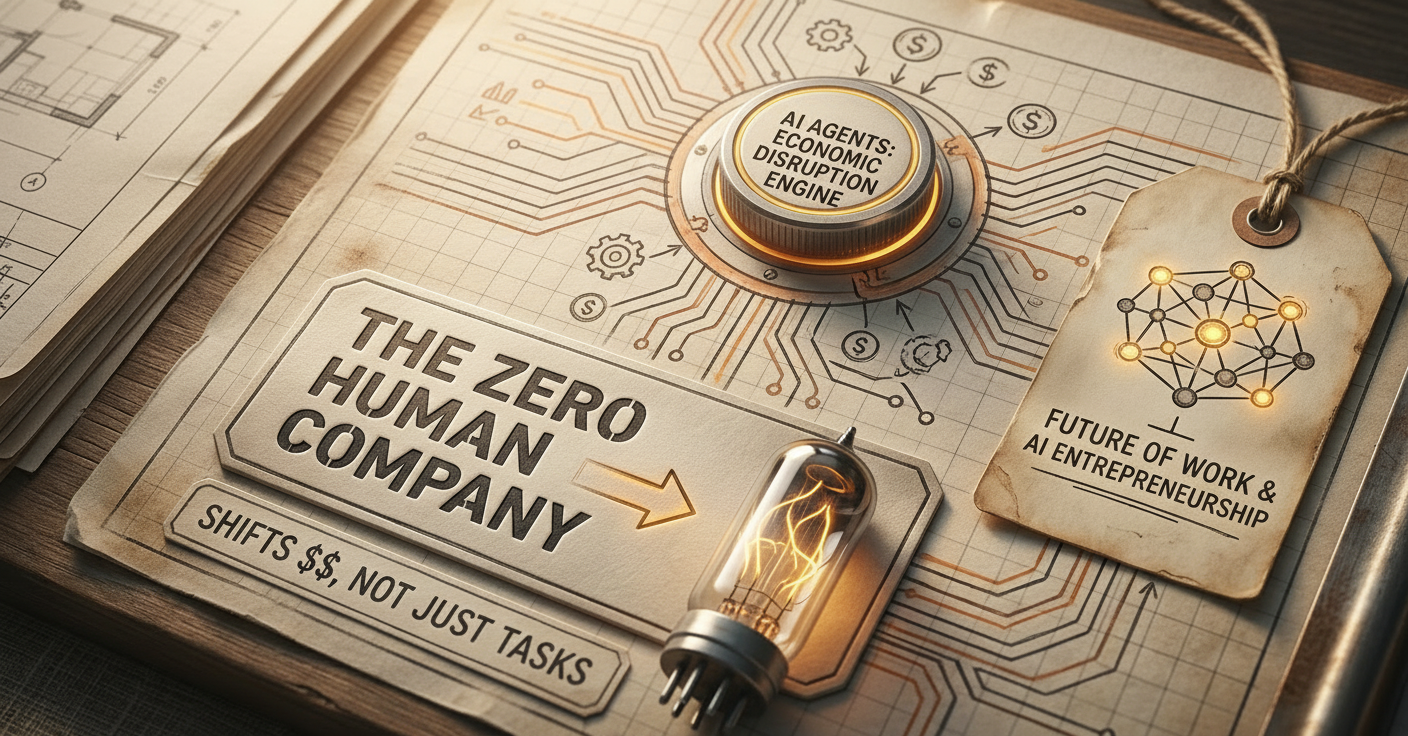
The "Zero Human Company," once a fringe concept, is emerging as a tangible — and deeply disruptive — force, moving beyond hype cycles into actual revenue generation and altering the very fabric of enterprise operations. This isn't just about automation; it's about shifting the means of production into the hands of AI agents, creating a new class of entrepreneur and posing an existential threat to traditional business models.
Where VC funding once chased generic "AI wrappers," the signal is now clear: investors and early adopters are prioritizing AI that completes tasks, builds businesses, and operates with increasing autonomy. Nathaniel Whittemore on The AI Daily Brief: Artificial Intelligence News and Analysis highlighted companies like FelixCraft generating significant revenue from AI-written guidebooks and marketplaces, with platforms like Pulcia emerging to manage these AI-driven enterprises. This isn't just about efficiency; it's about the complete restructuring of labor, capital, and value creation.
"The most exciting thing to me at this point as an entrepreneur is not to build another SaaS or try to target a specific demographic or problem to solve. It's to build the platform that where could build a thousand companies."
— Nathaniel Whittemore, Host of The AI Daily Brief (quoting Ben Serra/Broca)
The implications are profound. If AI agents can run a business, what does that mean for human-centric organizations? While there's skepticism about the quality and scalability of these early ventures, their existence provides invaluable experimental insights into agent capabilities. And it’s not just small players; Aaron Levie (CEO, Box) on Latent Space: The AI Engineer Podcast underscored how companies are already having to adapt their workflows to make agents effective, rather than the other way around. He notes that "coding... has any workflow in the entire economy changed that quickly? There's very rarely been an event where one piece of technology and work practice has so fundamentally changed what you do. You don't write code, you talk to an agent and it goes and does it for you."
The shift is further emphasized by Azeem Azhar's personal experience, as shared on his podcast. His AI "chief of staff," R Mini Arnold (RMA) 🆕, operates a range of tasks equivalent to a 5-10 person team. This individual-level augmentation is widening the productivity gap between those leveraging such tools and those who aren't, illustrating how deeply this agentic shift is impacting even solo endeavors.
The move:
Recognize that this isn't just a technological shift but a fundamental re-evaluation of how work gets done and value is created. Scrutinize your operating model: which tasks currently performed by humans could be executed more efficiently and autonomously by AI agents?
The Rundown
① VCs are demanding deep integration and proprietary data for AI investments. Generic "AI wrappers" and UI-driven differentiation are no longer sufficient to attract capital as the market matures. (Jaeden Schafer on AI Breakdown)
→ Why it matters: If you're building or investing in AI, ensure the solution creates a defensible moat through proprietary data or deeply embedded "systems of action" that complete tasks, rather than just assisting workflows.
② Cloud agents are redefining software development from individual to collaborative. Cursor's new cloud agents can parallelize tasks, facilitating team collaboration and tackling bottlenecks in code review and production, dramatically increasing development throughput. (Jonas and Samantha on Latent Space: The AI Engineer Podcast)
→ What to watch: The ability to conduct agent swarms and parallel processing significantly strains CI/CD systems and consumes massive amounts of tokens, highlighting new infrastructure bottlenecks.
③ The Pentagon's AI procurement is becoming a political battlefield. Anthropic was blacklisted as a supply chain risk due to its ethical red lines against military use, only for OpenAI to secure the $200 million contract with similar safeguards but a different approach. (Jaeden Shafer on AI Breakdown)
→ The context: This signals a growing tension between Washington and Silicon Valley over AI control, ethics, and national security, shaping who gets to build and deploy frontier AI for government use.
④ The majority of an AI model's energy consumption comes from inference, not training.Ben Sooter (Director of R&D, EPRI) noted that 80% of an AI model's lifetime energy consumption is from inference, leading to a "compute wave" that requires new infrastructure solutions. (Ben Sooter on NVIDIA AI Podcast)
→ What to watch: Microdata centers, placed near underutilized substations, offer a solution to latency and grid resilience, leveraging existing power infrastructure for distributed inference loads.
⑤ AI's macroeconomic impact is being framed as a "Schrödinger's Apocalypse." While some predict a "2028 Global Intelligence Crisis" of mass job displacement, others argue AI will expand markets and create new opportunities for abundance. (Nathaniel Whittemore on The AI Daily Brief: Artificial Intelligence News and Analysis)
→ The context: This tension between economic doomsday and productivity expansion indicates extreme uncertainty in market sentiment, where both radical change and continued normalcy coexist, often depending on who's doing the analyzing.
⑥ AI governance must prioritize accountability and transparency, especially in HR.Carey Smith (CTIO, Blue Cross and Blue Shield of Minnesota) stressed the "black box accountability gap" in HR AI, where bias can lead to legal and cultural liabilities, advocating for a "governance first" approach. (Carey Smith on The AI in Business Podcast)
→ What to watch: Enterprises must establish clear guardrails, decision rights, and audit mechanisms for agentic AI, ensuring humans augment rather than are replaced by AI in sensitive areas like talent management.
The Signals
🔥 HEATING UP
• OpenClaw: OpenClaw's rapid open-source adoption has surpassed Linux in GitHub stars, signaling its unprecedented momentum. (Jensen Huang on The AI Daily Brief: Artificial Intelligence News and Analysis)
• AI Coding Adoption 🆕: Programming has fundamentally changed; developers are now talking to agents rather than writing code, with immediate implications for workflows. (Aaron Levie on Latent Space: The AI Engineer Podcast)
• Zero Human Company 🆕: AI agents are building and running businesses autonomously, generating revenue, and shifting the entrepreneurial landscape. (Nathaniel Whittemore on The AI Daily Brief: Artificial Intelligence News and Analysis)
👀 ON WATCH
• Microdata Centers for AI Inference 🆕: Strategically deploying microdata centers near underutilized electrical substations to meet the energy demands of AI inference. (Ben Sooter on NVIDIA AI Podcast)
• AI Agent Standard (AIUC1) 🆕: The emergence of AI agent standards and enterprise adoption certifications is on the horizon. (Nathaniel Whittemore on The AI Daily Brief: Artificial Intelligence News and Analysis)
• China's leading-edge chip output increase 🆕: China plans to dramatically increase its 7nm and 5nm chip production to 100,000 wafers/month by 2030, despite export control hurdles. (Jeremie Harris on Last Week in AI)
🧊 COOLING OFF
• Shallow Product Depth in AI: VC interest is waning for AI startups with differentiation primarily in UI and automation, lacking proprietary data moats or deep integration. (Igor Ray Bensky on AI Breakdown)
• AI Models as Political Donations: Anthropic's CEO Dario Amodei attributed the Pentagon dispute to their lack of political donations and praise for the Trump administration, contrasting with OpenAI's alleged actions. (Dario Amodei on The AI Daily Brief: Artificial Intelligence News and Analysis)
• ChatGPT User Growth Stagnation: Earlier stagnation has been completely reversed with record growth in January and February, but the initial "Code Red" serves as a reminder of competitive pressures. (Nathaniel Whittemore on The AI Daily Brief: Artificial Intelligence News and Analysis)
The Debate
Is AI's impact leading to economic doom due to mass job displacement, or will it expand markets and create new opportunities?
🐂 The bull case: Pessimism over job displacement misunderstands the creative expansion AI enables. The argument is that if the cost to produce code, for instance, drops by 99%, we won't get a proportional reduction in coders; instead, "we get 100 times more code." This frames AI as a force for abundance, unlocking new markets and vastly increasing productivity in previously unaddressable areas. (Aaron Levie on Latent Space: The AI Engineer Podcast)
"If the cost to produce code is 1/100 of what it used to be, we don't get 1/100 of the coders, we get 100 times more code."
— Aaron Levie, CEO at Box
🐻 The bear case: The "2028 Global Intelligence Crisis" thesis posits that AI's very success could lead to an economic downturn. Michael Gad on The AI Daily Brief: Artificial Intelligence News and Analysis suggests that the ability of AI to perform knowledge work at scale will result in "huge layoffs," reducing consumer spending and creating a "doom spiral." This perspective emphasizes that if AI does everything, companies cut human workers, which reduces spending, which reduces available capital, forcing more layoffs.
"AI is so good that it's actually bearish, creating a doom spiral where AI does everything, allowing companies to cut human workers, which reduces spending, which reduces available capital from consumers, which forces companies to lay off more, and so on and so forth."
— Nathaniel Whittemore, Host of The AI Daily Brief (quoting Michael Gad)
Our read: The truth likely lies between these extremes, but the scale and speed of labor market adjustments will determine if it's a smooth transition to abundance or a disruptive, painful reallocation of human capital. The signals lean towards significant, localized disruption before broader market expansion.
The Bottom Line
AI agents are not just augmenting tasks; they're autonomously building and running businesses, rewriting the rules of the enterprise, and making AI-driven productivity a critical differentiator at both individual and corporate levels.
Your Move
Here are three concrete actions to take:
- Audit: Identify 3-5 existing workflows or reporting tasks that could be fully offloaded to an AI agent if given the right tools and access.
- Pilot: Delegate a small, well-defined task to an existing AI agent solution this week, even a personal one, to understand its capabilities and limitations firsthand.
- Evaluate: Begin assessing your IT/security posture for "AI agent readiness." What are the security implications of granting autonomous agents access to enterprise data and systems?
📖 Want the full episode breakdowns, guest details, and listen links?
Quick Appendix
AI Breakdown: "What VC's Are Looking For in AI Startups Today" · 11 min · Featuring Jaeden Schafer ▶ Listen
AI Breakdown: "OpenAI Steals $200M Contract in Anthropic vs. Pentagon Battle" · 12 min · Featuring Jaeden Shafer ▶ Listen
Azeem Azhar's Exponential View: "Showing you my AI chief of staff (OpenClaw practical guide)" · 42 min · Featuring Azeem Azhar ▶ Listen
Latent Space: The AI Engineer Podcast: "Cursor's Third Era: Cloud Agents" · 67 min · Featuring Jonas ▶ Listen
Latent Space: The AI Engineer Podcast: "Every Agent Needs a Box — Aaron Levie, Box" · 77 min · Featuring Aaron Levie ▶ Listen
Last Week in AI: "#235 - Sonnet 4.6, Deep-thinking tokens, Anthropic vs Pentagon" · 102 min · Featuring Andrey Kurenkov ▶ Listen
NVIDIA AI Podcast: "Powering the AI Inference Wave with EPRI's Ben Sooter - Ep. 292" · 32 min · Featuring Noah Kravitz ▶ Listen
The AI Daily Brief: Artificial Intelligence News and Analysis: "The Month AI Woke Up" · 26 min · Featuring Nathaniel Whittemore ▶ Listen
The AI Daily Brief: Artificial Intelligence News and Analysis: "Schrödinger’s Apocalypse" · 30 min · Featuring Nathaniel Whittemore ▶ Listen
The AI Daily Brief: Artificial Intelligence News and Analysis: "The Rise of the Zero Human Company" · 29 min · Featuring Nathaniel Whittemore ▶ Listen
The AI Daily Brief: Artificial Intelligence News and Analysis: "AI Is Officially Political" · 28 min · Featuring Nathaniel Whittemore ▶ Listen
The AI in Business Podcast: "Funding Agentic AI in HR Without Losing Control - with Carey Smith of Blue Cross and Blue Shield" · 15 min · Featuring Nick Gertsch ▶ Listen