
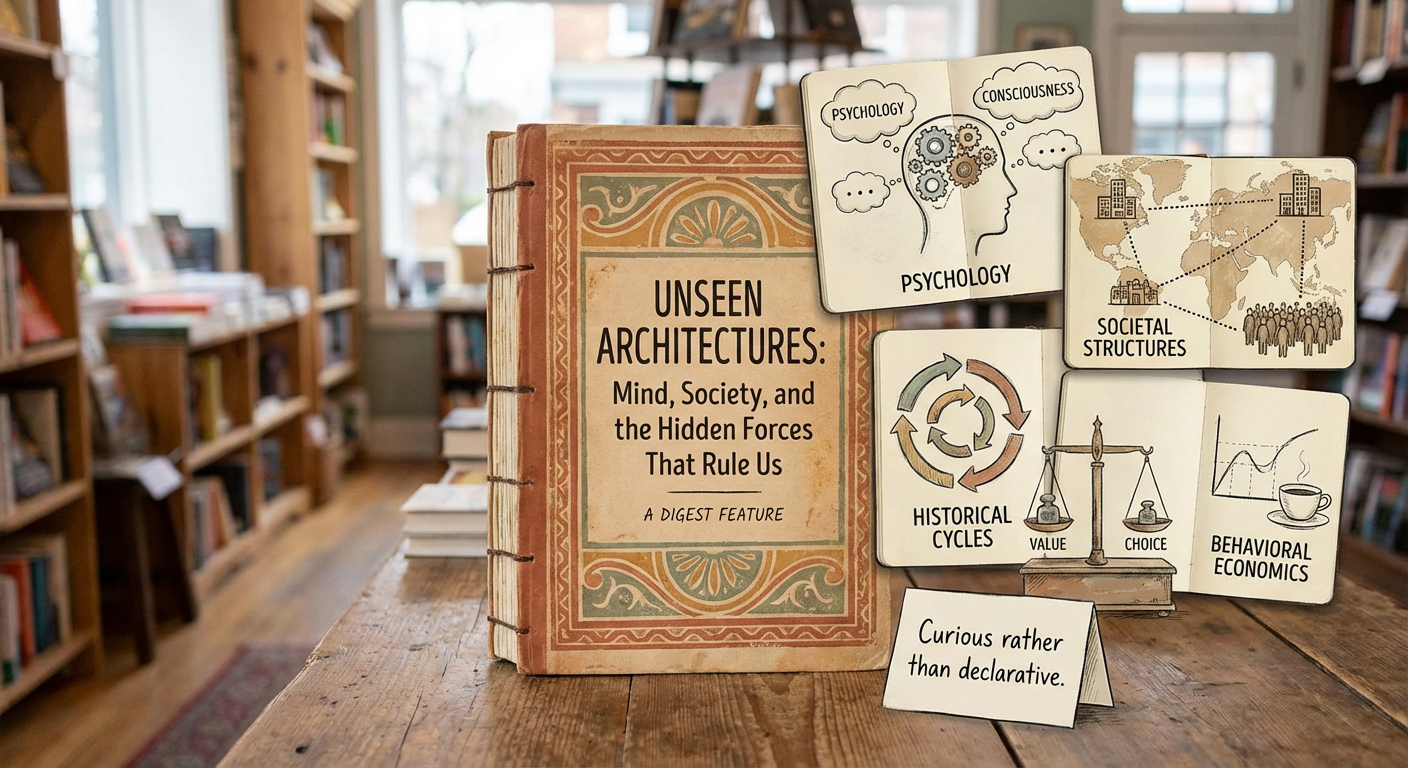
The Unseen Architecture of Our Minds and Societies
THIS WEEK'S INQUIRY
📚 10 conversations with 15 thinkers
⏱️ ~18 hours of long-form intellectual exploration
🎙️ Featuring: Sam Harris, Malcolm Gladwell, Rory Sutherland, Reid Hoffman, Mel Robbins, William James (via Very Bad Wizards), Paul Starr, David Edmonds, Bari Weiss, Glenn Loury, Mark Rober, Hoda Kotb.
The ideas worth your attention. Here's what we're thinking about.
It's easy to get caught up in the daily churn of events, issues, and arguments. But beneath the surface, there's a deeper conversation happening about the fundamental structures that shape our lives — from the subtle biases that dictate our decisions to the grand historical forces that bend the arc of nations. This week, we've listened in on some extraordinary thinkers exploring these hidden architectures.
What emerges is a powerful, if sometimes disquieting, insight: we are rarely operating on a level playing field. Our individual perceptions are stream-of-consciousness experiments, our moral choices are riddled with psychological traps, and our societies are built on inherited contradictions that erupt into cycles of revolution and revenge. Whether it's the invisible hand of marketing nudging our choices or the deeply ingrained cultural narratives that define "good" and "evil," the forces at play are often more profound and less rational than we’d like to admit.
This digest isn't about the headlines. It's about the underlying code. The frameworks that, once understood, can change how you see everything. Here's how the smartest people are approaching the often-unseen forces that shape our world.
The Subtle Art of Rationalizing Our Own Irrationality
The Case for Understanding Human Psychology Before Engineering Solutions
We pride ourselves on rationality. We build systems, design policies, and make decisions based on logical models. Yet, time and again, these "rational" constructs collide with the messy, unpredictable reality of human behavior. This collision is often where our best-laid plans go awry, and it's precisely where the insights from behavioral economics and marketing psychology become indispensable.
The Setup: Many conventional approaches to problem-solving, whether in business, ethics, or personal development, assume that people act primarily out of logical self-interest or a clear understanding of the 'right' thing to do. If we present the facts, or build an efficient system, people will naturally conform.
The Argument: Rory Sutherland persuasively argues that this purely rationalist view is deeply flawed. Human beings are far more complex, driven by perceived value, trust, social cues, and even delightful irrationality, which often outweigh pure efficiency. He contends that many brilliant engineering solutions fail because they neglect the psychological reality of their users. Marketers, at their best, understand this. They recognize that solving a "real" problem isn't always about optimizing an objective function, but about optimizing perceived value or creating a desired experience. The value of a Dyson isn't just its aerodynamic efficiency; it's the feeling of quality and innovation it evokes. Similarly, personal transformation isn't just about setting logical goals; it's about framing life as an experiment, making the process fun, and owning the narrative of your journey.
The Voice:
"When you allow tech bros too much power over decision making... you're optimizing for something which may be very, very distant from what your real world customers really care about." — Rory Sutherland, The Knowledge Project
The Tension: This behavioralist perspective challenges the prevailing notion that "more information" or "more efficient systems" are always the answer. It implies that true progress often requires a deeper dive into qualitative human experience, cultural context, and even seemingly irrational preferences. This can be uncomfortable for those who prefer objective, quantifiable metrics.
The Implication: If we want to genuinely influence behavior — whether our own, our customers', or our society's — we need to move beyond purely logical frameworks. We must consider the psychological architecture of decision-making, the power of narrative, and the often-hidden levers of motivation. This means embracing a degree of "irrationality" as a key input for successful design, policy, and personal change.
The Unfolding River of Consciousness: Why William James Still Matters
The Enduring Relevance of Pre-Analytic Experience in an Age of AI
In an era consumed by debates about artificial intelligence and the future of human cognition, revisiting the foundational insights of early psychology becomes remarkably prescient. Long before neural networks, William James offered a profoundly insightful view of consciousness as a dynamic, flowing "stream of thought."
The Setup: Most scientific and even philosophical attempts to understand consciousness have tended towards reductionism, trying to break down experience into discrete, atomistic units – individual thoughts, sensations, or memories. This approach seeks to define consciousness by cataloging its components.
The Argument: As explored by Very Bad Wizards, James fiercely resisted this atomistic view. He argued that consciousness is better understood as a continuous, flowing river, where thoughts are not separate beads but inseparable parts of a dynamic whole. He described "transitive" and "substantive" parts of this stream, highlighting how our experience is constantly moving between focal points and the fleeting connections between them. Crucially, James emphasized the subjective and personal nature of this stream – it is always my stream of thought, not a universal, disembodied one. This continuous, holistic, and personal nature of consciousness is fundamental to the human experience and resists easy categorization or replication.
The Voice:
"He argues that it's a mistake to even start thinking about consciousness or thought as atomistic." — Tamler Sommers, Very Bad Wizards
The Tension: James's approach, while phenomenologically rich, is notoriously difficult to quantify or model scientifically. In a world increasingly obsessed with data and replicable experiments, his emphasis on subjective, qualitative experience can feel almost heretical. Yet, as AI rapidly advances, its limitations in replicating genuine consciousness bring James's insights back into sharp relief. What can AI not do? Perhaps it's precisely this deeply personal, non-atomistic, unquantifiable "flow."
The Implication: A deeper appreciation of James's "stream of thought" encourages us to value and cultivate our internal, subjective experience. It suggests that reducing human consciousness to a series of data points or computational processes misses the essential, flowing nature of what it means to be alive and thinking. In education, in art, and in our personal lives, focusing on the quality and continuity of our subjective experience might be a vital counterpoint to an increasingly quantitative world.
The Weight of History: How Cycles of Revolution and Revenge Shape Nations
Understanding the American Contradiction and the Limits of Progress
We often view history as a linear, progressive march, or at least a series of discrete events. But some thinkers argue for a more cyclical, even recursive, view — where unresolved contradictions from the past act as latent forces, shaping contemporary conflicts as echoes of older battles.
The Setup: The narrative of American history often highlights moments of triumph and progress, from the founding principles of liberty to successive liberation movements. The assumption is that once a struggle is won, progress is consolidated.
The Argument: Paul Starr, discussed on The Glenn Show, offers a nuanced counter-narrative in his "American Contradiction" theory. He argues that American history is characterized by a recurring pattern: a "liberal revolution" (a movement for equality or expansion of rights) is invariably met with a "conservative revenge" (a backlash aimed at restoring or reasserting older hierarchies and power structures). The Civil Rights Movement, for instance, wasn't just a victory; it became a template for other liberation movements but also sowed the seeds for a conservative counter-revolution that continues to shape our political landscape. This isn't just about political parties; it's about deep-seated cultural and social forces, exacerbated by societal fragmentation and changing media landscapes that prevent genuine reconciliation and instead fuel cycles of reaction.
The Voice:
"The black freedom struggle as a template for change" but also the origin of deep-seated reactions that continue to play out. — Paul Starr, The Glenn Show
The Tension: This framework challenges the optimistic view of inevitable societal progress. It suggests that societal change is less like a smooth upward curve and more like a volatile oscillation, where every step forward risks igniting a defensive, often destructive, reaction. It also implicates contemporary issues like political polarization and institutional distrust not as new phenomena, but as manifestations of these deeply ingrained historical patterns.
The Implication: To understand the current political and social turmoil in America (and potentially other nations), we must look beyond immediate causes and recognize these deeper historical cycles. Solving current problems may not just require new policies, but a profound reckoning with unresolved historical contradictions. For leaders and citizens alike, this means engaging with the past not as a finished story, but as a living force that continues to sculpt our present and future.
The Question Worth Asking
Can a society truly flourish if it constantly struggles between the desire for progress and the pull of historical backlash? Specifically, when does a "conservative revenge" become a justified correction, and when does it become a destructive force that undermines the very foundations of a democratic society? Is there a way to break these historical cycles, or are they an inherent feature of collective human endeavor?
This question is hard because it forces us to reconcile our ideals of justice and equality with the often-uncomfortable realities of power, identity, and historical grievances. Answering it would require not just political will, but a collective maturity to acknowledge both the legitimate claims of progress and the understandable anxieties of change, without resorting to tribalism or demonization. It asks if we can evolve beyond simply reacting to each other's perceived threats.
IF YOU WANT TO GO DEEPER
📖 "American Contradiction: Revolution and Revenge from the 1950s to Now" by Paul Starr — The foundational text for understanding the cyclical nature of American political and social conflict explored on The Glenn Show.
📖 "The Principles of Psychology" by William James — A classic, though dense, exploration of consciousness and subjective experience. Read Chapter 9, "The Stream of Thought," to immerse yourself in his radical ideas.
📖 "Thinking, Fast and Slow" by Daniel Kahneman — An accessible dive into the dual processes of human thought, illustrating why our "rational" decisions are often a façade for intuitive, emotional processes, highly relevant to Rory Sutherland's points.
🎧 Modern Wisdom: #1029 - Malcolm Gladwell - How to Convince the World of Bulls & Evil — A fascinating dive into the "weirdness" of America and the unseen forces that drive social epidemics and exceptionalism.
THE CONTRARIAN CORNER
In the context of the perennial debates about societal progress and the nature of American exceptionalism, Malcolm Gladwell often plays the role of the insightful contrarian. While many lament America's current struggles as signs of decline, Gladwell points out that "America is weird." He argues that many features often seen as problematic (like its unique approach to capital punishment, or its susceptibility to social epidemics) are not just flaws but manifestations of deeply ingrained cultural and historical traits that distinguish it from other developed nations. This perspective is less about critique and more about a sober acceptance of fundamental, often uncomfortable, elements of American identity, suggesting that some issues are less about fixing perceived problems and more about understanding intrinsic characteristics.
THE BOTTOM LINE
Parsing the signals from the noise requires us to look beyond immediate events and grapple with the deeper frameworks at play, whether they are the psychological biases guiding individual thought, the historical currents shaping national identity, or the ethical dilemmas that define our collective future. What hidden architectures are shaping your decisions, and the decisions of those around you? The real work lies in uncovering them.
📚 APPENDIX: EPISODE COVERAGE
1. The Mel Robbins Podcast: "The Life Experiment Theory: One Rule That Changes How You Do Everything"
Guests: Mark Rober (Former NASA Engineer, YouTube Science Educator)
Runtime: 00:54:00 | Vibe: Empowering, Action-Oriented, Scientific Optimism
Key Signals:
- Life Experiment Theory: Rober advocates for approaching life's challenges like scientific experiments, viewing failures as data points rather than personal shortcomings. This framework encourages iterative learning and reduces the emotional sting of setbacks.
- Making Goals Fun: Success often hinges on making the process of achieving goals enjoyable and engaging, transforming daunting tasks into playful challenges. This intrinsic motivation is critical for sustained effort and creativity.
- Embracing Failure as Data: The episode redefines failure not as an endpoint, but as essential feedback in the experimentation process, offering valuable insights that guide future attempts. This perspective normalizes struggle and promotes resilience.
"Treat your entire life like an experiment."
2. Very Bad Wizards: "Episode 322: A Theater of Simultaneous Possibilities (William James' "The Stream of Thought")"
Guests: David Pizarro (Professor of Psychology), Tamler Sommers (Professor of Philosophy)
Runtime: 01:21:00 | Vibe: Intellectually Playful, Deeply Analytical, Contrarian
Key Signals:
- James's Non-Atomistic Consciousness: William James's seminal work views consciousness not as a collection of discrete thoughts, but as a continuous, flowing "stream" that resists categorization into separate units. This highlights the integrated and fluid nature of subjective experience.
- The Batman Effect: Discussion of a modern psychology paper on how adopting a "Batman persona" can enhance prosocial behavior, illustrating how subtle psychological framing influences action. This links perceived identity to ethical conduct.
- AI's Impact on Cognitive Skills: Concerns are raised about AI undermining students' deep thinking and writing abilities, turning them into passive information consumers rather than active knowledge constructors. This warns against the erosion of intellectual rigor.
"He argued that it's a mistake to even start thinking about consciousness or thought as atomistic."
3. Making Sense with Sam Harris: "#448 — The Philosophy of Good and Evil"
Guests: David Edmonds (Philosopher, journalist)
Runtime: 01:31:00 | Vibe: Incisive, Ethical Inquiry, Consequentialist
Key Signals:
- Consequentialism's Scope: The debate highlights the strength of consequentialism when all possible consequences of an action are considered, arguing that ignoring this comprehensive view weakens moral arguments against it. This emphasizes the importance of holistic ethical evaluation.
- The Problem with Thought Experiments: Thought experiments like the trolley problem are critiqued for their artificiality, which can lead to unreliable intuitions when applied to real-world moral dilemmas. This calls for caution in extrapolating from idealized scenarios.
- Effective Altruism Critique: The discussion explores the complexities and potential pitfalls of the Effective Altruism movement, acknowledging its noble goals while scrutinizing its real-world implications and public perception. This examines the gap between intent and outcome.
"The problem with thought experiments is that they are often very strange, very artificial, and so we shouldn't trust our intuitions."
4. Honestly with Bari Weiss: "Should We Legalize Assisted Suicide?"
Guests: David Hoffman (Healthcare Attorney), Dr. Lydia Dugdale (Physician, Medical Ethicist)
Runtime: 00:54:00 | Vibe: Intense, Ethical Debate, Public Policy Focused
Key Signals:
- Distinction in End-of-Life Choices: The debate centers on differentiating between pain alleviation and active medical intervention to end life sooner, emphasizing the complex terminology and ethical implications of "assisted suicide" vs. "medical aid in dying." This clarifies the moral stakes.
- Erosion of Caregiver Duty: Dr. Dugdale argues that legalizing assisted suicide could subtly erode the medical profession's primary duty to preserve life and alleviate suffering, potentially shifting the focus from comprehensive care to hastening death. This highlights an institutional risk.
- Patient Autonomy vs. Safeguards: David Hoffman champions patient autonomy as paramount for those facing unbearable suffering, advocating for MAID as a compassionate choice while acknowledging the need for robust safeguards. This balances individual rights with societal protection.
"To call what a person who wants to end their suffering at the very end of their life by medication the same thing as someone who wants to end their life because otherwise their life and their suffering..."
5. The Knowledge Project: "How to Think Like a World-Class Marketer | Rory Sutherland"
Guests: Rory Sutherland (Vice Chairman of Ogilvy)
Runtime: 01:32:00 | Vibe: Insightful, Provocative, Behavioral Economic
Key Signals:
- Perceived Value Over Objective Value: Sutherland argues that human decision-making is often driven by perceived value, trust, and psychological convenience rather than purely rational or efficient metrics. This suggests marketing success lies in understanding subjective experience.
- The Importance of Behavioral Science: He emphasizes that an understanding of human irrationality and psychology is more crucial for effective marketing and policy than data-driven optimization alone. This elevates the human element in strategic thinking.
- Optimizing for Real-World Customer Needs: Many "tech-bro" solutions optimize for internal metrics or efficiency without truly understanding what customers value, leading to solutions that miss the mark. This warns against narrow, internal-focused innovation.
"When you allow tech bros too much power over decision making... you're optimizing for something which may be very, very distant from what your real world customers really care about."
6. The Glenn Show: "Paul Starr – Liberal Revolution, Conservative Revenge"
Guests: Paul Starr (Professor of Sociology and Public Affairs, Princeton University)
Runtime: 01:14:00 | Vibe: Historical, Analytical, American Political Science
Key Signals:
- The American Contradiction: Starr's central thesis describes a recurring historical pattern in the US where "liberal revolutions" (e.g., Civil Rights) are met with "conservative revenge" (backlash and attempts to reassert traditional power). This reveals deep, cyclical societal tensions.
- Black Freedom Struggle as Template: The Civil Rights movement not only fought for racial equality but also provided a blueprint and inspiration for other liberation movements, significantly shaping subsequent social changes. This highlights its foundational impact.
- Media Fragmentation's Role: The modern media landscape, fragmented and polarized, exacerbates these cycles of revolution and revenge, making it harder for society to find common ground or resolve historical tensions. This connects technological change to social division.
"The black freedom struggle as a template for change."
7. The Glenn Show: "TGS Live: Discontent in Nigeria, Trump's Sights on Venezuela, Bernie Calls for AI Regs, and Dealing with Public Disgrace"
Guests: Glenn Loury (Professor of Economics, Brown University)
Runtime: 00:54:00 | Vibe: Current Events, Incisive Commentary, Reflective
Key Signals:
- AI Regulation Concerns: The discussion touches on the political hazards of government regulation for AI, particularly fears of politically motivated oversight stifling innovation and leading to control. This raises alarms about state power over technology.
- Nuance in Public Disgrace: Loury offers a personal reflection on discerning between genuine wrongdoing and exaggerated public shaming, advocating for a more measured and humane approach to public condemnation. This calls for intellectual charity.
- Geopolitical Instability: The episode briefly covers global issues like discontent in Nigeria and US foreign policy interests in Venezuela, embedding local issues within a broader international context. This connects specific events to global trends.
"A politically motivated committee governing that is the road to serfdom."
8. Modern Wisdom: "#1029 - Malcolm Gladwell - How to Convince the World of Bulls**t & Evil"
Guests: Malcolm Gladwell (Author, Journalist)
Runtime: 01:40:00 | Vibe: Provocative, Sociologically Deep, Narrative-Driven
Key Signals:
- American Exceptionalism in Punishment: Gladwell highlights America's unique and often harsh stance on capital punishment compared to other developed nations, underscoring a deep cultural difference. This reveals a "weirdness" in U.S. societal values.
- The Tipping Point Revisited: His "Tipping Point" theory is applied to contemporary social phenomena, illustrating how ideas, behaviors, and even epidemics spread through asymmetrical social influence and specific conduits. This framework explains virality.
- Storytelling's Power: The discussion implicitly reinforces the profound impact of narrative and framing in convincing individuals and societies of certain "truths," whether beneficial or harmful. This emphasizes the persuasive power of shared stories.
"I do not believe that either Americans or nonAmericans fully appreciate just how weird America is."
9. Conversations With Coleman: "Big Tech Made Peace with Trump. Reid Hoffman Didn’t."
Guests: Reid Hoffman (Co-founder of LinkedIn, Investor)
Runtime: 01:28:00 | Vibe: Tech Ethics, Forward-Looking, Sociopolitical
Key Signals:
- Technology's Double-Edged Sword: Hoffman discusses how technology can both advance humanity and exacerbate issues like misinformation and erosion of trust in institutions. This frames tech as a powerful, but morally neutral, tool.
- "Homo technet" and Evolution: The concept of "Homo technet" implies humanity's intrinsic connection to and evolution alongside technology, urging careful navigation of this symbiotic relationship for positive societal outcomes. This posits a new stage of human development.
- Battling Misinformation and Deepfakes: The conversation addresses the critical need for tech-enabled solutions to counter deepfakes and the spread of misinformation, aiming to foster a more accurate understanding of truth. This calls for active defense of information integrity.
"How do we have technology help us towards kind of how we evolve as human beings."
10. The Mel Robbins Podcast: "The Reset You Need: How to Transform Your Life at Any Moment"
Guests: Hoda Kotb (Co-anchor of the Today Show)
Runtime: 00:58:00 | Vibe: Inspiring, Empathetic, Personal Growth
Key Signals:
- Permission to Pivot: Kotb emphasizes that it's never too late in life to make fundamental changes – career, relationships, personal growth – encouraging listeners to grant themselves permission to "hit the brakes" and reassess. This empowers radical personal agency.
- The Cost of "Good Enough": Settling for "good enough" is portrayed as a significant barrier to true fulfillment, advocating for an honest evaluation of one's life to pursue what genuinely brings joy. This challenges complacency.
- Self-Worth as a Foundation: A deep belief in one's own self-worth is identified as the core driver for having the courage to pursue significant life transformations. This links internal valuation to external action.
"You can stop, hit the brakes on your life at any time. I don't care if you're 20 or 40 or 60 or 80. Breaks pause and look. Look at your life... and then decide, do I want to change it?"