
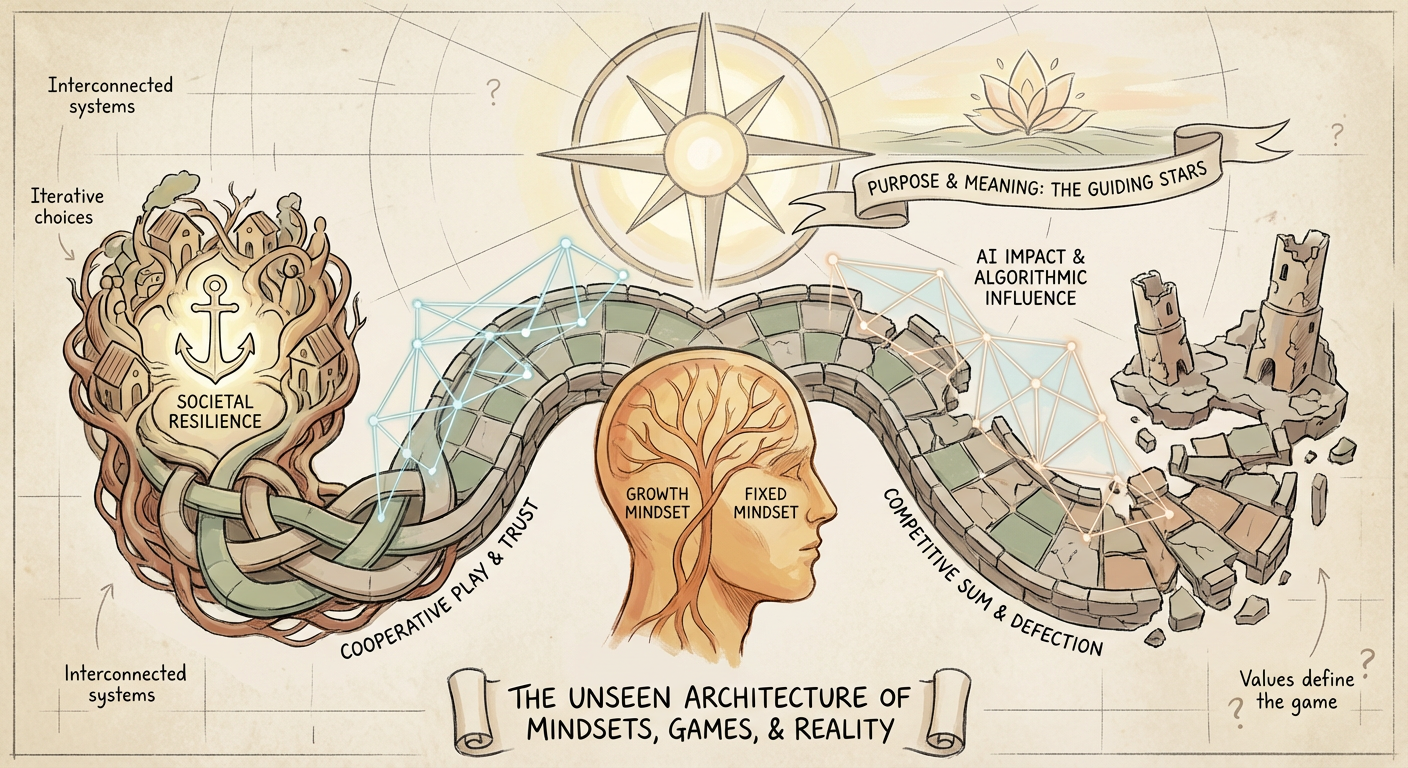
The Unseen Architecture: Mindsets, Games, and the Deep Structures of Our World
THIS WEEK'S INQUIRY
📚 10 conversations with 20+ thinkers
⏱️ ~10 hours of long-form intellectual exploration
🎙️ Featuring: Sam Harris, Mel Robbins, Thomas C. Schelling, Dr. Alia Crum, Coleman Hughes, and more.
The ideas worth your attention. Here's what we're thinking about.
We live in a world of accelerating change and relentless noise. Every day brings a new crisis, a fresh take, a technological breakthrough promising disruption. But what if much of what we perceive as flux is actually downstream from deeper, less visible structures? What if our responses to these changes are ultimately shaped by the "settings in our minds," as one thinker put it, or by the intricate, often unconscious "games" we're playing?
This week, diving into a rich harvest of long-form discussions, a fascinating pattern emerged. Several brilliant minds, approaching disparate topics from AI's societal impact to the global economy, from personal well-being to geopolitical strategy, found themselves grappling with the unseen architecture of our reality. They pointed not to the events themselves, but to the frameworks, mindsets, and strategic games that dictate how those events unfold and how we interpret them. It's a lens that suggests many of our current challenges aren't just about what is happening, but how we're perceiving and interacting with it.
From the power of our personal mindsets to physiologically alter our bodies, to the hidden "Schellingesque" games that shape international relations, to the elusive "ontology" of a chaotic global economy, the conversation isn't about the symptoms, but the underlying code. The stakes are immense: understanding these deeper structures might be the only way to navigate a future where human purpose and societal stability are increasingly challenged. Here's how the smartest people are approaching it.
What If "Mindset" Isn't Just Positive Thinking, But a Hidden Operating System?
The Case That Our Beliefs Physiologically Reconfigure Reality
Most discussions of "mindset" live firmly in the self-help aisle: think positive, visualize success. But what if our mindsets are far more fundamental, acting as a deep operating system that dictates physiological responses, economic outcomes, and even geopolitical strategies? This week, a powerful argument emerged that challenges the superficial understanding of mindset, positing it as an evidence-based mental framework with profound, measurable consequences.
The Setup: We often assume our bodies respond to objective reality — the calories in a milkshake, the physical sensation of stress, the hours on a treadmill. Similarly, economic models assume rational actors responding to clear data points. This "objective reality" view is powerful but incomplete.
The Argument: Dr. Alia Crum, a Stanford professor, argues that "mindset is the settings in your mind." These "lenses or frames of mind" fundamentally orient how we experience and react to the world. Her work, including the famous milkshake study, rigorously demonstrates that our beliefs about food, stress, or exercise can alter our body's ghrelin levels (hunger hormone), metabolic response, and even recovery from injury. This isn't just a mental trick; it’s a physiological recalibration based on our internal "settings." Similarly, in economics, if market participants believe the economy is chaotic, their actions can make it so, regardless of underlying data.
The Voice:
"Mindset is the settings in your mind. They're lenses or frames of mind which orient us to a particular set of experiences. And anybody can become aware of and change the settings." — Dr. Alia Crum, The Mel Robbins Podcast
The Tension: The counter-argument points to objective, material realities. Calories are calories. Global supply chains have physical limits. But Crum's work suggests that even these "objective" realities are mediated by our subjective interpretation. The tension lies in discerning where objective reality ends and the power of mindset begins, and if the two are inextricably intertwined. Can a positive mindset overcome true scarcity, or just our perception of it?
The Implication: If our mindsets literally change our physiological response to the world, then cultivating accurate, empowering mindsets becomes a critical life skill, not just a feel-good exercise. For leaders, understanding collective mindsets could be as crucial as understanding data. In a world experiencing rapid shifts, intentionally setting these internal "lenses" may be key to personal and collective resilience, and recognizing the hidden "games" of interaction may be the key to understanding complex systems.
The Games We Play: Schelling's Unseen Influence on Geopolitics and Economics
Beyond Rational Actors: The Power of Implicit Strategy
While individual mindsets shape our personal realities, collective "games" — often unstated, sometimes subconscious — shape our shared reality. Thomas C. Schelling, a Cold War strategist and Nobel laureate, proposed a way of understanding interaction that went beyond traditional economics' "rational actor" model and formal game theory. His "Schellingesque" point of view suggests that many of our most complex global problems — from nuclear deterrence to economic uncertainty — are structured by implicit rules, focal points, and shared expectations that often operate beneath the surface of explicit negotiation.
The Setup: When we think about international relations or economic policy, we often look for explicit treaties, stated intentions, or formal models. We want clear rules and quantifiable outcomes. But reality is messier.
The Argument: Schelling’s genius lay in dissecting situations where actors, even without direct communication, coordinate their behavior based on mutual expectation. It's about how we converge on a "focal point" (a Schelling point) not because it's objectively superior, but because it's salient and mutually recognized as a possible solution. This applies to nuclear deterrence, where the "threat that leaves something to chance" can be more powerful than an explicit declaration of war, or to the current global economy, where the "ontology...is unclear," defying traditional models. The game isn't just about maximizing individual utility; it's about navigating shared uncertainty and implicit signaling.
The Voice:
"I can't think of anybody who was quite like Tom Schelling as a thinker…The essence of Tom Shelling, what makes an observation, an insight, a turn of phrase, a way of looking at the world? Schellingesque, which of course one means simply, literally, of, or in the spirit of…" — Glenn Loury & John McWhorter, TGS Live
The Tension: The elegance of Schelling's framework is its ability to explain how order emerges from apparent chaos, or why certain outcomes seem path-dependent. However, the tension lies in its non-formal nature. How do you quantify "salience" or "mutual expectation"? Critics might argue it's too much art, not enough science. Yet, as the traditional economic models struggle to make sense of the current global economy — with its tariffs, AI boom, and disconnect between data and sentiment — Schelling's intuitive, non-formal approach appears increasingly relevant.
The Implication: Understanding our world "Schelling-style" means recognizing that many conflicts and collaborations aren't about explicit commands but about implicit understandings, perceived signals, and the "game" being played. For policymakers, it means focusing not just on stated goals, but on shaping the perception of the game. For individuals, it implies a deeper understanding of social dynamics and the unspoken rules that govern our interactions. It suggests that if we're struggling to understand why things are happening, we might be failing to grasp the underlying game.
When Data Meets Divinity: The Quest for Purpose in an AI-Driven, Secular Age
Navigating Obsolescence and the Search for Meaning
As AI advances, the prospect of human obsolescence looms larger, challenging our very definition of purpose. This fear was a recurring undercurrent, bringing into sharp relief a foundational question: What provides meaning and stability in a world where traditional sources of purpose (like work) are eroding and traditional sources of moral consensus (like religion) are increasingly absent?
The Setup: For millennia, work has provided purpose, and religion has offered a moral compass and a framework for understanding existence. Our modern, secular, technologically advanced society is rapidly chipping away at both these pillars.
The Argument: Sam Harris and Ross Douthat grappled with the notion of "human obsolescence in the 21st century," particularly as AI automation threatens to displace not just manual labor but also knowledge work. Simultaneously, declining birth rates across Western capitalist countries suggest a broader crisis of faith in the future, regardless of one's religious inclination. The concern is that if work no longer defines purpose, and secular society struggles to maintain a universally accepted moral consensus, what will keep us sane and cohesive? Will the void be filled by a renewed search for spiritual meaning, or will we collectively drift?
The Voice:
"I'm worried About a kind of sense of human obsolescence in the 21st century that I think has been partially forged by the experience of digital culture and disembodied ways of living..." — Sam Harris, Making Sense
The Tension: The critical tension here is between the perceived necessity of religion for societal stability — providing clear moral precepts and a sense of cosmic significance — versus the secular argument that human reason and empathy are sufficient to build a just and purposeful society. Harris questions if it’s "surprising to find that the only thing keeping us sane was that most people spend most of their lives doing sort of fairly arbitrary things to earn a living." Douthat, from a more traditional perspective, might argue that secularism leaves a deeper longing unfulfilled, making societies vulnerable to new forms of "dogma" or aimlessness.
The Implication: As AI continues its inexorable march, these questions move from academic speculation to urgent societal challenges. Leaders and individuals must proactively consider how to foster purpose and moral frameworks outside of traditional employment structures and religious institutions. This might involve re-evaluating the role of community, engaging in more explicit philosophical inquiry, or even discovering new, shared narratives that transcend traditional divides. The search for a new "Schelling point" of shared values in a post-work, post-religious landscape is paramount.
The Question Worth Asking: Can We Architect for Resilience Against Unseen Defaults?
Across these deeply thoughtful conversations, from personal mindsets to global games, a generative question emerged: If our realities are so deeply shaped by often unexamined internal 'settings' and implicit strategic 'games,' can we intentionally design for greater resilience — both individually and collectively — against the default trajectories of anxiety, obsolescence, and instability? This isn't just about problem-solving; it's about architecting our mental and societal operating systems. How do we consciously choose the "mindset settings" that foster well-being, purpose, and cooperation, rather than allowing default or negative frames to dominate? And how do we become more astute "game theorists" in our daily lives and global interactions, identifying and shifting the implicit rules that lead to suboptimal outcomes?
IF YOU WANT TO GO DEEPER
📖 "The Strategy of Conflict" by Thomas C. Schelling — The foundational text for understanding game theory in its most human, less formal sense.
📖 "The Man Who Mistook His Wife for a Hat" by Oliver Sacks — Dive into the work of Sacks, but with a new awareness of the intellectual debate around his narrative style.
🎧 "Mindset: The New Psychology of Success" by Carol Dweck — While not explicitly discussed, Dr. Crum's mindset theory builds upon and expands Dweck's influential work.
🎧 "Atomic Habits" by James Clear — A practical guide on how small, consistent changes can recalibrate our default settings, echoing the idea of mindset shifts.
🎧 "The Denial of Death" by Ernest Becker — Provides a profound philosophical backdrop to the search for purpose and meaning in the face of existential threats.
THE CONTRARIAN CORNER
A powerful contrarian thread emerged regarding the nature of being "stuck." While common wisdom suggests that being stuck means not knowing what to do next, Mel Robbins (channeling expert insights) flipped this script: "You're not stuck. You're actually grieving a past version of yourself." This view dismisses simple problem-solving as the solution and instead points to a deeper, emotional process of letting go. It radically redefines the challenge from a lack of information to an unacknowledged emotional burden, suggesting that progress isn't about finding the next step, but about processing what was lost. This insight implies that many self-help and productivity approaches miss the core issue, offering tactical advice for a problem that is fundamentally psychological.
THE BOTTOM LINE
The most profound transformations — personal, economic, geopolitical — often begin not with external changes, but with a shift in our internal and interactive frameworks. Paying attention to these invisible architectures, be they the mindsets that shape our biology or the implicit games that define our relationships, is the ultimate leverage point for navigating whatever future awaits.
📚 APPENDIX: EPISODE COVERAGE
1. Very Bad Wizards: "Episode 323: Debate Me 'Phro"
Guests: David Pizarro (Professor of Psychology), Tamler Sommers (Professor of Philosophy)
Runtime: ~1 hour 20 minutes | Vibe: Philosophically incisive with a touch of skeptical humor
Key Signals:
- Plato's Enduring Relevance: Discussion of Plato's Euthyphro dilemma highlights the timeless nature of philosophical inquiry, particularly concerning definitions of piety and morality, and its continuing applicability to modern ethical questions.
- The Ethics of Embellishment in Non-Fiction: Examination of a New Yorker article questioning Oliver Sacks' credibility raises critical questions about narrative truth, the line between embellishment and fabrication, and the impact of such practices on scientific and biographical understanding.
- Truth vs. Narrative Impact: The conversation implicitly explores the tension between objective truth and the power of storytelling, noting that Sacks' "exaggerations" might have made his work more impactful while simultaneously eroding trust for some readers and critics.
"This is where the famous euthyphro dilemma Comes up. Actually what we are talking about is Plato's early to mid period dialogue. This is where among other things, they investigate the nature of piety."
2. The Mel Robbins Podcast: "#1 Mindset Expert: Simple Mindset Shifts That Transform Your Body, Energy, & Life"
Guests: Dr. Alia Crum (Stanford Professor, Researcher)
Runtime: ~30 minutes | Vibe: Empowering, evidence-based, and actionable
Key Signals:
- Mindset as a Fundamental Operating System: Dr. Crum defines mindsets as "settings in your mind" – lenses or frames that fundamentally orient our experiences, influencing everything from physical health to emotional well-being.
- Physiological Impact of Belief: Groundbreaking research, such as the milkshake study, demonstrates how our beliefs (e.g., about food's indulgence level) physiologically alter our body's responses, like ghrelin levels, proving mindsets have tangible biological effects.
- Beyond Positive Thinking: The episode clarifies that mindset shifts are not wishful thinking but evidence-based mental strategies that involve recognizing existing beliefs, critically examining them, and then actively adopting more empowering perspectives.
"Mindset is the settings in your mind. They're lenses or frames of mind which orient us to a particular set of experiences. And anybody can become aware of and change the settings."
3. Making Sense with Sam Harris: "#449 — Dogma, Tribe, and Truth"
Guests: Ross Douthat (Op-Ed Columnist for The New York Times)
Runtime: ~1 hour 45 minutes | Vibe: Intellectually rigorous and cautiously speculative
Key Signals:
- AI and Human Obsolescence: A deep concern is voiced regarding AI's potential to diminish human purpose and value, particularly in the context of digital culture possibly already fostering a sense of "disembodied living."
- Religion's Role in Societal Stability: The discussion explores the historical function of religion in providing moral frameworks and societal cohesion, questioning whether secular societies can sustain equivalent structures in an era of rapid technological and cultural shifts.
- Work as a Foundation of Purpose: Harris contemplates whether the necessity of working for a living, even at "fairly arbitrary things," is a key component of human sanity and purpose, implying a significant challenge in a future of ubiquitous AI automation.
"I'm worried About a kind of sense of human obsolescence in the 21st century that I think has been partially forged by the experience of digital culture and disembodied ways of living..."
4. Modern Wisdom: "#1036 - The Best Moments of Modern Wisdom (2025)"
Guests: Various experts (e.g., Naval Ravikant)
Runtime: ~2 hours | Vibe: Inspiring, reflective, and practical
Key Signals:
- The Skill of Emotional Regulation: Naval Ravikant emphasizes the paramount importance of cultivating the ability to maintain a positive mood irrespective of external circumstances, framing it as the "single greatest skill" for sustained happiness.
- Avoiding a "Permanent Place of Lack": The episode highlights the psychological trap of constantly focusing on what's missing, arguing that this mindset prevents enduring happiness by keeping an individual in a perpetual state of dissatisfaction.
- Gen Z and Mental Health: Insights are shared into the particular mental health challenges facing Gen Z, linking issues like loneliness to societal changes and the nuances of modern identity.
"The single greatest skill you can develop is the ability to stay in a good mood in the absence of things to be in a great mood about."
5. Conversations With Coleman: "Coleman Hughes Answers Your End-of-Year Questions"
Guests: Coleman Hughes (Host)
Runtime: ~1 hour 15 minutes | Vibe: Thought-provoking and intellectually curious
Key Signals:
- Attention Economy and Political Dominance: Donald Trump's unique ability to captivate and dominate public attention is analyzed as a defining feature of modern politics, distinguishing him from traditional politicians in the age of the attention economy.
- Global Declining Birth Rates: The episode points to a widespread decline in birth rates across Western capitalist countries, identifying it as a significant, multifaceted societal trend with long-term implications.
- Cautious Optimism for Psychedelics: While acknowledging potential benefits for mental health, Hughes expresses a measured optimism regarding psychedelics, balancing their therapeutic promise with concerns about potential misuse or over-romanticization.
"Donald Trump's ability to absolutely dominate people's attention is maybe more than anything what makes him different from most politicians."
6. The Knowledge Project: "Be Your Best in 2026: The Most Important Lessons from The Knowledge Project (2025)"
Guests: Various world-class experts
Runtime: ~1 hour 50 minutes | Vibe: Strategic, insightful, and growth-oriented
Key Signals:
- The Value of Proactive Preparation: The importance of preparation is framed as a deferred cost — "paid in advance" — highlighting that foresight and diligence yield returns over time, acting as a crucial determinant of success.
- Identifying Root Causes: A core principle for effective problem-solving is emphasized: the need to delve into "first-order issues" and identify the ultimate root cause, rather than just treating symptoms, to achieve lasting solutions.
- Building Trust as a Foundation: The episode underscores the critical role of trust in all meaningful relationships and successful endeavors, presenting it as an essential, often understated, component of effective leadership and collaboration.
"The price of preparation is paid in advance before you get any results."
7. The Ezra Klein Show: "‘This is Something that Traditional Economics Isn’t Prepared to Deal With’"
Guests: Tracy Alloway (Bloomberg), Joe Weisenthal (Bloomberg)
Runtime: ~1 hour 20 minutes | Vibe: Analytical, candid, and questioning of established frameworks
Key Signals:
- Failure of Traditional Economic Models: The current global economy, characterized by tariffs, the AI boom, and a disconnect between data and sentiment, is shown to defy established economic theories, suggesting a need for new analytical paradigms.
- Unclear Economic Ontology: The statement "The ontology of the economy is unclear" signals a fundamental disorientation; economists are struggling not just with data, but with the very nature and structure of what they're trying to measure and understand.
- Public Sentiment vs. Data: A key theme is the divergence between official economic data and widespread public sentiment, suggesting that people's experience of the economy is not always reflected in traditional metrics, adding a psychological dimension to economic analysis.
"A lot of the sort of traditional economic thought that should dictate how things develop and unfold isn't bearing out."
8. The Mel Robbins Podcast: "9 Habits That Will Change Your Life: The Best Expert Advice I’m Using This Year"
Guests: Mel Robbins (Host)
Runtime: ~45 minutes | Vibe: Practical, motivating, and highly accessible
Key Signals:
- Overcoming Being "Stuck" Through Grieving: A powerful reframing of feeling stuck, arguing it's often not about lacking direction but about "grieving a past version of yourself," providing a deeper psychological lens for personal transformation.
- The Power of Letting Go: The core message emphasizes that what "holds you back" is often what "you're holding onto," advocating for the conscious release of old patterns, beliefs, or identities to enable personal progress.
- Holistic Personal Growth: The curated habits span various life domains—friendship, health, purpose—offering a comprehensive approach to self-improvement that recognizes the interconnectedness of different aspects of well-being.
"You're not stuck. You're actually grieving a past version of yourself."
9. Modern Wisdom: "#1037 - Life Hacks: A Christmas Special (2025)"
Guests: Chris, Jonny, Yusef, George (Various experts/hosts)
Runtime: ~1 hour 30 minutes | Vibe: Lighthearted, insightful, and personally reflective
Key Signals:
- Beyond Material Improvement: A deep insight suggests that many people are creating "nicer prison cells" by focusing on external acquisitions, indicating that true fulfillment and breakthroughs come from moving beyond superficial comforts and addressing internal states.
- Friction as a Behavioral Lever: The concept of consciously introducing "friction" (e.g., placing one's phone in another room) is presented as an effective life hack to disrupt undesirable habits and encourage more positive behaviors by making them just slightly harder.
- Internal States Drive Experience: The conversation emphasizes that true success and well-being are not solely about external achievements but heavily depend on one's internal mental and emotional states, echoing the sentiment of the "mindset" discussion.
"Everyone's in a dream. What about being a human being? And it's like the dream is you're in a prison cell, and everyone's trying to make the prison cell nicer by, like, buying things and moving them a..."
10. The Glenn Show: "TGS Live: A Cold War Genius on Today’s Threats"
Guests: Glenn Loury (Host), John McWhorter (Co-Host)
Runtime: ~1 hour 10 minutes | Vibe: Scholarly, analytical, and historically informed
Key Signals:
- Schelling's Unique Approach to Strategy: The discussion highlights Thomas C. Schelling's distinct contribution to social science, particularly his non-formal, intuitive, yet profoundly incisive application of game theory to complex international relations (e.g., nuclear deterrence).
- "Schellingesque" Thinking Defined: The episode defines the quality of being "Schellingesque" as a specific way of looking at the world — an insight, observation, or turn of phrase that captures the essence of strategic interaction without needing elaborate formal models.
- Relevance to Contemporary Geopolitics: Schelling's frameworks are shown to be highly applicable to current global crises like the Ukraine War and US national security, underscoring the enduring power of his ideas to understand deterrence and strategic dilemmas.
"I can't think of anybody who was quite like Tom Schelling as a thinker…The way in which Schelling presented himself in prose was un…"