The exit backlog isn't just about assets. It's about psychology, discipline, and who's willing to get uncomfortable next.
The Intake
The deals, the dynamics, the debates. What GPs, operators, and allocators are actually talking about.
This week's intelligence:
📊 11 episodes across 8 podcasts
⏱️ 471 minutes with dealmakers and operators
🎙️ At the table: Ted Seides, Ed Grefenstette, Patrick O'Shaughnessy, Chris Sznewajs, Hugh MacArthur, Josh Kushner, Corey duBrowa
The Big Shift
The "Unnatural Owner" Playbook: Scaling Complexity for Alpha
While many GPs chase pristine assets, Pacific Avenue Capital Partners is scaling a strategy built on complexity: acquiring non-core divisions from "unnatural owners." This isn't about rescuing distressed businesses, but capitalizing on situations where a parent company no longer prioritizes an otherwise healthy subsidiary. This week, we heard multiple mentions of this focus, with GPs specifically targeting carve-outs and multi-stage corporate divestitures—often with significant operational lift required post-acquisition. For Pacific Avenue, it’s about breaking down complexity to unlock value that others avoid.
Why it matters: In a market where traditional multiple arbitrage is squeezed, finding differentiated alpha means doing the harder work. This strategy targets the structural inefficiencies of large corporations.
"The term we use is unnatural owner. And as a result of oftentimes businesses being unnatural owners and obviously as a result motivated to transact, allows us to step into situations where we see, I wouldn't necessarily call them mistakes. I'd call them a lack of prioritization."
— Chris Sznewajs, Founder and Managing Partner of Pacific Avenue Capital Partners
The move: Audit your pipeline for complex carve-outs or non-core divisions from large strategic sellers—the bigger the headaches for the seller, the better the entry multiple for you.
The Rundown
① AI's Impact on Software Valuations. The "SaaSpocalypse" is here, with software company valuations plummeting not just from macro pressures, but from AI's potential to commoditize code. Companies are facing pressure to adapt, or perish. (Jared Sleeper on Odd Lots)
- Why it matters: AI will make software building cheaper, but the human element of understanding complex systems and managing change remains critical. Software due diligence now requires a deep dive into AI integration and its impact on competitive moats.
② The Private Equity "Inflection Point." Bain & Company projects that the PE industry has hit a critical inflection point, with flat fundraising in 2025 and a 16% decline in buyout funds. LPs are shifting to infrastructure and secondaries, demanding GPs rethink their strategy for talent, capital, and deals. (Hugh MacArthur on Dry Powder: The Private Equity Podcast)
- The signal: Alpha generation in a mature PE market now requires annual EBITDA growth of 12% to hit a 20% IRR, up from 5% a decade ago. The cost of capital, leverage, and multiples have fundamentally shifted.
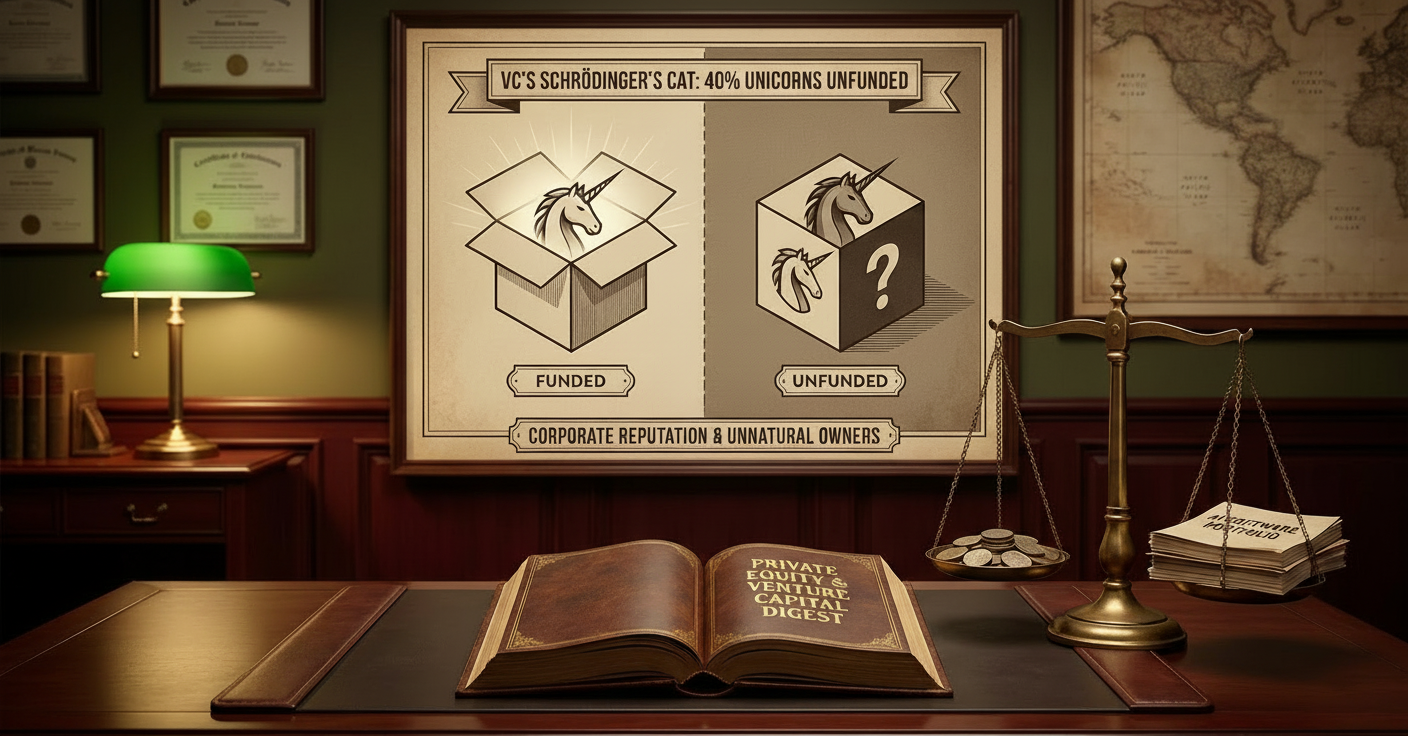
③ The VC "Schrödinger's Cat" Conundrum. Venture capital is "both dead and alive at the same time" (Ed Grefenstette on Capital Allocators – Inside the Institutional Investment Industry). Approximately 40% of US private unicorns haven't raised capital since 2021, leaving their true viability unknown until the next funding round.
"Venture capital is both dead and alive at the same time. Until you open the box, you'll know where the cat's alive or dead."
— Ed Grefenstette, CEO and CIO of The Dietrich Foundation
- What to watch: This creates a false sense of stability. Expect more zombie unicorns as the box opens and many struggle to raise at previous valuations.
④ Reputation as a $7 Trillion Asset. Burson's CEO, Corey duBrowa, highlights that corporate reputation now has quantifiable financial value. Companies with strong reputations realize almost 5% "unexpected additional shareholder returns," forming a reputation economy worth nearly $7 trillion. (Corey duBrowa on Masters of Scale)
- Why it matters: Beyond ESG, reputation is a tangible value driver. Due diligence should include a reputation audit, and value creation plans should actively manage external perception.
⑤ The "Uncomfortably Idiosyncratic" Portfolio. The Dietrich Foundation's Ed Grefenstette details their audacious strategy: 90% illiquid venture and private equity, no S&P 500 exposure since 1997. This allows for long-term outperformance through differentiated, often unpopular, investments. (Ed Grefenstette on Capital Allocators – Inside the Institutional Investment Industry)
- The signal: For institutional allocators with long horizons, embracing extreme illiquidity and a governance structure that empowers the CIO can unlock significant alpha away from crowded strategies.
Deal Flow Signals
🔥 ACTIVE
- Unnatural Owner Plays: Targeting complex carve-outs and non-core assets with operational upside. (Chris Sznewajs on The Private Equity Podcast, by Raw Selection)
- Operational Excellence Teams: Middle-market firms building megafund-like operational capabilities, including dedicated AI experts, to drive value. (David Andrews on Dry Powder: The Private Equity Podcast)
👀 EMERGING
- 🆕 China Venture (Least Crowded Trade): Despite geopolitical tensions, capital starvation creates impressive opportunities and founders with less frothy valuations. (Ed Grefenstette on Capital Allocators – Inside the Institutional Investment Industry)
- 🆕 AI for "Inside-Out" Disruption: Thrive Capital’s strategy of acquiring and transforming businesses by embedding AI internally to build defensible cost advantages. (Josh Kushner on Invest Like the Best with Patrick O'Shaughnessy)
- 🆕 Reputation Economy: Quantifiable shareholder returns linked to strong corporate reputation – a growing focus for strategic value-add. (Corey duBrowa on Masters of Scale)
🧊 QUIET
- Direct S&P 500 Exposure for Endowments: The trend of not holding US S&P 500 or any US index directly, embracing more illiquid, differentiated strategies. ([REPLAY] Ed Grefenstette on Capital Allocators – Inside the Institutional Investment Industry)
- Legacy Software Models: Companies focused solely on traditional recurring revenue models are under pressure from AI-driven commoditization, facing "SaaSpocalypse." (Jared Sleeper on Odd Lots)
⚠️ STRESSED
- Un-priced Unicorns: 40% of private unicorns haven't raised in 3 years, creating a looming wave of necessary down rounds or failures once new capital is sought. (Ted Seides on Capital Allocators – Inside the Institutional Investment Industry)
- LP Liquidity for Buyouts: Stressed LP liquidity is leading to a 16% decline in buyout fundraising, shifting capital to infrastructure and secondaries. (Hugh MacArthur on Dry Powder: The Private Equity Podcast)
The Bottom Line
The market is demanding differentiated alpha through operational lift in complex deals or disciplined, idiosyncratic portfolio construction, moving away from easily replicable strategies.
🎯 Your Move
- Re-evaluate your 'ideal deal' criteria: Consider how your firm can capitalize on complex carve-outs and "unnatural owner" situations for differentiated returns, leveraging operational expertise where competitors avoid.
- Stress-test software portfolio companies against AI: Assess how AI functionality and "results-based pricing" will impact valuation and competitive moats in your software assets, focusing on the human element of implementation.
- Quantify brand and reputation in diligence: Integrate advanced reputation metrics into your investment thesis and value creation plans, recognizing its growing and measurable impact on shareholder returns.
What We Listened To
The Private Equity Podcast, by Raw Selection: "Building a Value Creation Machine & Scaling a Private Equity Firm"
Runtime: 24 min
Featuring: Chris Sznewajs (Founder and Managing Partner, Pacific Avenue Capital Partners), Alex Rawlings (Host, Raw Selection)
Relevant if you're exploring niche strategies for alpha generation through operational complexity and geographic expansion.
"The term we use is unnatural owner. And as a result of oftentimes businesses being unnatural owners and obviously as a result motivated to transact, allows us to step into situations where we see, I wouldn't necessarily call them mistakes. I'd call them a lack of prioritization."
— Chris Sznewajs, Founder and Managing Partner of Pacific Avenue Capital Partners
Capital Allocators – Inside the Institutional Investment Industry: "Ed Grefenstette and Sean Warrington – Venture Market Update (EP.488)"
Runtime: 65 min
Featuring: Ted Seides (Host, Capital Allocators), Sean Warrington (Partner, Private Investments Team, Gresham Partners), Ed Grefenstette (CEO and CIO, The Dietrich Foundation)
Worth your time if you're navigating current venture market challenges, LP illiquidity, and global venture opportunities.
"Venture capital is both dead and alive at the same time. Until you open the box, you'll know where the cat's alive or dead."
— Ed Grefenstette, CEO and CIO of The Dietrich Foundation
Invest Like the Best with Patrick O'Shaughnessy: "Josh Kushner - Concentration and Conviction - [Invest Like the Best, EP.459]"
Runtime: 63 min
Featuring: Patrick O'Shaughnessy (Host, Colossus | Investing & Business Podcasts), Josh Kushner (Founder and Managing Partner, Thrive Capital)
Relevant for understanding high-conviction, concentrated investment strategies and the "inside-out" AI disruption model.
"That's always the right decision. You just better fucking pick. Right?"
— Stan Druckenmiller, Legendary investor
How I Built This with Guy Raz: "Advice Line with Pete Maldonado and Rashid Ali of Chomps"
Runtime: 49 min
Featuring: Guy Raz (Host of How I Built This, Wondery), Pete Maldonado (Co-founder, Chomps), Rashid Ali (Co-founder, Chomps), Yadi Deres (Co-founder, Yachty's Artisanal Empanada), Zachary (Co-founder, Noble Pies), Zachary Bonder (Co-owner, Noble Pies), Josh Schrenko (Co-founder and President, Achigan brand)
Useful if you are an operator scaling a consumer brand, considering retail distribution, or navigating founder commitment.
"Getting into the retailer is honestly the easiest part of the process. It's, it's staying and performing."
— Pete Maldonado, Co-founder of Chomps
The Prof G Pod with Scott Galloway: "Kai Ryssdal on Why the Economy Isn’t as Strong as It Looks"
Runtime: 56 min
Featuring: Kai Ryssdal (Senior Editor and Host, Marketplace), Scott Galloway (Professor, New York University Stern School of Business)
Worth a listen if you're trying to reconcile macro headlines with on-the-ground economic realities and consumer sentiment.
"AI will be the future, it's just not there yet. And I think as we look at what's going to happen to certainly white collar jobs, that is something that people in white collar Jobs ought to be thinking about not for tomorrow, but for some short number of years from now when these things are really actually workable."
— Kai Ryssdal, Senior Editor and Host of Marketplace
Dry Powder: The Private Equity Podcast: "Megafund Capabilities on a Mid-market Budget w/ Gryphon's David Andrews"
Runtime: 12 min
Featuring: David Andrews (Co-CEO, Gryphon Investors), Hugh MacArthur (Chairman of Global Private Equity Practice, Bain & Company)
Relevant for GPs considering how to build sophisticated operational value creation capabilities without a megafund budget.
"We have an OPS group that now has 40 employees in it and we have 160 plus employees for an 11 billion AUM firm."
— David Andrews, Co-CEO of Gryphon Investors
Odd Lots: "Jared Sleeper on Which Software Companies Will Survive the "SaaSpocalypse""
Runtime: 49 min
Featuring: Joe Weisenthal (Host, Bloomberg), Tracy Alloway (Host, Bloomberg), Jared Sleeper (Partner, Avenir)
Essential listening if you’re investing in software and grappling with AI’s impact on valuations, integration, and competitive moats.
"DocuSign has more employees today than OpenAI and Anthropic combined. Which is a crazy stat and probably a flex that labor is inefficiently allocated across the market."
— Jared Sleeper, Partner at Left Lane Capital
Masters of Scale: "Uncovering the $7 trillion reputation economy"
Runtime: 33 min
Featuring: Corey duBrowa (CEO, Burson), Bob Safian (Host, Rapid Response, WaitWhat), Corey (Google)
Relevant for understanding the quantifiable value of corporate reputation and navigating communication strategies in a 'polycrisis' world.
"Companies with strong reputations realized almost 5%, 4.78% unexpected additional shareholder returns, creating a reputation economy that's worth almost $7 trillion."
— Corey duBrowa, CEO of Burson
Masters of Scale: "Inside the business of hosting the Super Bowl"
Runtime: 30 min
Featuring: Jeff Berman (Host, WaitWhat), Zaileen Janmohamed (CEO, Bay Area Host Committee), Natasha Miller (CEO, Entire Productions)
Worth a listen if you're interested in the entrepreneurial challenges and economic impact of large-scale event management.
"I don't think I really fully realized how visible this space was gonna be and how political it was going to be. I had no idea."
— Zaileen Janmohamed, CEO of Bay Area Host Committee
Dry Powder: The Private Equity Podcast: "Bain & Company’s Global Private Equity Report 2026: Executive Summary"
Runtime: 16 min
Featuring: Hugh MacArthur (Chairman of Bain's Private Equity Practice, Bain & Company)
Essential listening for GPs and LPs navigating the evolving landscape of fundraising, capital shifts, and alpha generation in a mature PE market.
"EBITDA is going to have to roughly grow at something like 12% a year in the typical buyout in order to hit a 20% IRR versus the 5% EBITDA had to grow at about a decade ago."
— Hugh MacArthur, Chairman of Bain's Private Equity Practice
Capital Allocators – Inside the Institutional Investment Industry: "[REPLAY] Ed Grefenstette – Bold Allocations at The Dietrich Foundation (EP.437)"
Runtime: 74 min
Featuring: Ted Seides (Host, Capital Allocators), Ed Grefenstette (Chief Investment Officer, The Dietrich Foundation)
Critical for LPs seeking insights into long-term outperformance through highly idiosyncratic, illiquid portfolio strategies.
"You can't possibly target a performance that outperforms everyone else unless you're willing to embrace an uncomfortably idiosyncratic portfolio. And part of that has to be a willingness to look wrong some periods of time simply because you look totally different during those periods."
— Ed Grefenstette, Chief Investment Officer of The Dietrich Foundation