
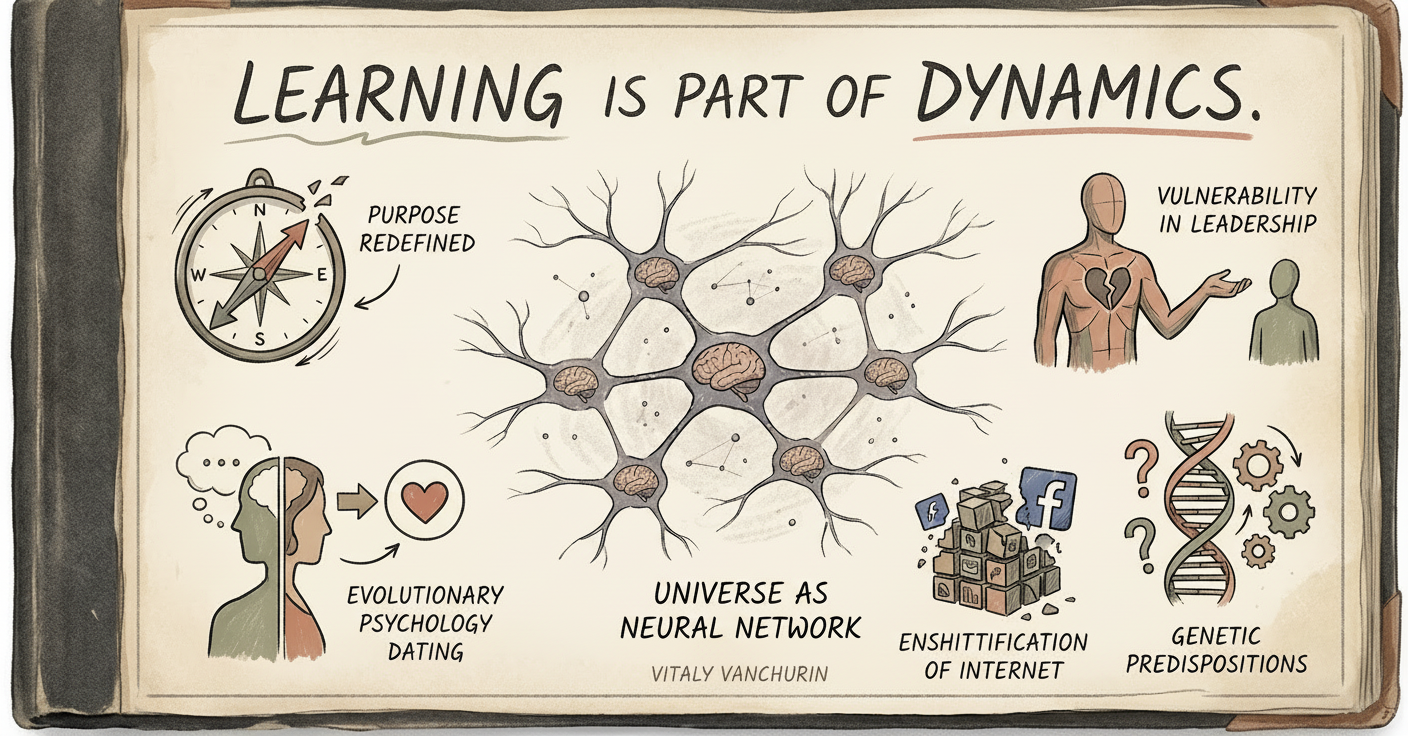
The universe isn't just described by physics; it's learning its way into existence.
The Intake
Friday thinking. The frameworks, tensions, and questions worth pondering going into the weekend.
This week's exploration:
📊 12 conversations across 11 podcasts
⏱️ 977 minutes of long-form intellectual exploration
🎙️ The thinkers: Vitaly Vanchurin, Lionel Shriver, Dr Paul Eastwick, Andrew Fox, Leslie John, Eli Finkel, Dr. Kathryn Paige Harden, Robert Patton-Spruill
The Big Idea
What if the Universe Itself is a Learning Algorithm?
The traditional view of the universe posits fixed laws and mechanisms that govern its behavior. Physics, in this framework, is about discovering these unchanging rules. But what if that perspective is incomplete? What if the universe isn't just *governed* by physics, but is actively *learning* its own physics?
Professor Vitaly Vanchurin proposes a radical new model: the universe as a neural network, where "learning dynamics" – the iterative optimization of a loss function – isn't just a computational tool, but a fundamental process shaping reality. This isn't just a simulation idea; it's a claim that the very act of learning *is* the dynamics of the universe. From this perspective, even curved spacetime can emerge from the efficiency requirements of learning algorithms, implying a profound connection between cosmic geometry and computational processes.
"The difference that I'm proposing is that I'm not only saying that the trained network is good at describing a given function or a given dynamics, but actually the process of training, the process of learning is a part of dynamics."
— Vitaly Vanchurin, Professor of Cosmology at Tufts University on Theories of Everything with Curt Jaimungal
Why it matters for leaders: This framework challenges us to see systems, not just as static structures, but as dynamic, learning entities. For organizations, it suggests that embracing iterative learning, constant optimization, and even a degree of "trial and error" is not just a methodology, but potentially a more fundamental approach to navigating complex reality. It raises the question: what if your organization isn't just executing a strategy, but learning its way to a better one?
The tension: While provocative, this theory still faces the immense challenge of incorporating quantum phenomena like fermion doubling. Critics would also point to Occam's Razor – is a universe-as-neural-network truly a simpler explanation than existing physical laws, or does it merely introduce another layer of complexity?
Ideas in Brief
① Redefining Purpose: From Finding to Following
The relentless pursuit of a predefined "purpose" can be actively counterproductive. Instead of trying to mentally construct a future destination, a more effective approach is to engage in real-time experimentation and follow where your curiosity and actions lead. Purpose, in this view, is not a fixed point to be discovered, but an evolving journey. (Joe Hudson on The Art of Accomplishment)
- The implication: For leaders, this suggests that fostering a culture of experimentation and allowing for emergent strategy, rather than rigid long-term planning, might be more conducive to discovering true organizational purpose and direction. It's about 'doing' to 'discover'.
② Vulnerability as a Power Play, Not a Weakness
Counterintuitively, revealing vulnerabilities can significantly increase respect and trust in both personal and professional contexts. Far from diminishing perceived competence, sharing struggles, even embarrassing ones, builds stronger connections and likability because it signals authenticity. (Leslie John on Hidden Brain)
"When the executive did that, people trusted him more, they wanted to work for him more, and it did not erode his perceived competence."
— Leslie John, Psychologist at Harvard University on Hidden Brain
- The implication: Leaders often feel pressured to project an image of unwavering strength. This insight suggests that strategic vulnerability—authentic, well-timed sharing—can be a potent tool for strengthening team cohesion and earning deeper trust, ultimately enhancing influence.
③ Evolutionary Psychology's Blind Spots in Modern Dating
Traditional evolutionary psychology models, particularly the "mating market" concept, often oversimplify human relationships by exaggerating mate value and gender differences, especially in long-term contexts. Initial consensus on attractiveness fades over time, and a mismatch in "mate value" doesn't predict lower relationship stability. (Dr Paul Eastwick on Modern Wisdom)
- The implication: For business, this challenges simplistic "market-based" views of talent or partnerships. It suggests that deep compatibility and sustained interaction eventually override initial, superficial assessments of "value." Building relationships, both internally and externally, may benefit from a focus on shared activities and long-term interaction over initial impressions.
④ The Enshittification of the Internet 🆕
The internet's decline from an open, user-centric space to one dominated by a few extractive corporations is a deliberate design. Platforms first attract users and businesses with utility, then leverage lock-in to extract value, eventually degrading the user experience. This "enshittification" leads to manipulation, polarization, and algorithmic discrimination. (Cory Doctorow & Tim Wu on The Ezra Klein Show)
- The implication: For any business reliant on digital platforms, this is a stark warning: the rules of engagement can and will change to the platform's benefit, not yours. Leaders must critically assess platform dependence, advocate for interoperability, and understand that user experience degradation is often not an accident, but a strategic outcome of monopolistic power.
The Tension
Are genetic predispositions merely biological facts, or do they carry a moral weight that influences our treatment of others?
🔵 One view:
"I think that substance use disorders are every bit as a neurodevelopmental disorder as ADHD. I think conduct disorder, which is characterized by impulsive aggression, is every bit a neurodevelopmental disorder as ADHD. Because if you look at the genes that are causing them, they seem to be affecting this pattern of brain development very, very early in life."
— Kathryn Paige Harden, Professor of Clinical Psychology at University of Texas on Huberman Lab
- The argument: Behaviors like risk-taking, impulsivity, and addiction have strong neurodevelopmental and genetic roots. Viewing these as "neurodevelopmental liabilities" rather than moral failings can foster empathy and lead to more effective interventions. Understanding the genetic influence on behavior moves towards a more compassionate, evidence-based approach to societal issues.
🔴 The counter:
"American culture's delight in punitiveness as a deeper 'original sin'"
— Chris Williamson, Host of Modern Wisdom
- The argument: While acknowledging genetic predispositions, there's a deep-seated cultural tendency to connect these traits with moral judgments, especially in American society. This leads to an overreliance on punishment rather than understanding or rehabilitation. The acknowledgment of genetic influence, while scientific, doesn't automatically overcome the societal "delight in punitiveness" and the moral framing of behavioral differences.
What's at stake: This tension highlights a critical challenge for leaders and policymakers: how do we integrate scientific understanding of genetic predispositions with a society's moral frameworks and legal systems? For organizations, it raises questions about how to approach issues of accountability, training, and support when individual behaviors are influenced by factors beyond conscious choice. Should hiring, assessment, or development strategies be informed by these insights, and what are the ethical boundaries?
The Question
If creativity is fundamentally "subversion" – taking existing concepts and re-fashioning them – rather than out-of-nothing invention, how does this reshape our approach to innovation and problem-solving? What are the implications for organizations that historically reward novelty over recombination, or conformity over "bending" established norms? What would it mean to foster a culture of creative subversion, and who is equipped to lead it without it devolving into chaos?
📚 The Bookshelf
- Atomic Habits by James Clear — Referenced as a guide for habit formation within the "24-hour turnaround" concept, emphasizing small, consistent actions for momentum.
- Enshittification: Why Everything Suddenly Got Worse and What to Do About It by Cory Doctorow — This book directly informs the discussion on how digital platforms degrade user experience for profit.
- The Age of Extraction: How Tech Platforms Conquered the Economy and Threaten Our Future Prosperity by Tim Wu — Provides context for the discussion on monopolistic practices and algorithmic discrimination by tech giants.
- Huberman Lab: How Genes Shape Your Risk Taking & Morals | Dr. Kathryn Paige Harden — This conversation offers a deep dive into the complex interplay of genetics, neurodevelopment, and human behavior, providing a scientific lens for understanding individual differences.
The Bottom Line
This week's insights force a re-evaluation of fundamental assumptions—about the universe, human purpose, relationships, and even the internet. The common thread is a push to move beyond conventional mental models and embrace dynamic, learning-oriented perspectives. The question for leaders isn't just what's happening, but how deeply you're willing to question the frameworks you use to make sense of it all.
What We Listened To
1. The Art of Accomplishment: "Bite-Sized Teaching Series: Finding Your Purpose is Hard Until You Understand This"
Guests: Joe Hudson (Host, The Art of Accomplishment)
Runtime: 12 min | Vibe: Provocative reframing for life's biggest questions
Key Signals:
- Purpose is Process, Not Destination: The podcast challenges the traditional notion of "finding" a fixed life purpose, arguing that such a pursuit often leads to frustration. Instead, it proposes that purpose is an emergent property, revealed through active engagement and experimentation in the present moment, rather than discovered through abstract thought.
- Beware Mental Models: The episode cautions against over-reliance on mental models or future-gazing when seeking purpose. It posits that trying to intellectually define purpose before living it can actually prevent its authentic discovery, highlighting the paradox that the intense search itself can hinder finding.
- From 'Finding' to 'Following': The core surprising insight is that shifting from an active "finding" of purpose to a responsive "following" of what feels right in real-time is the key. This involves letting go of the need for a preconceived outcome and trusting the unfolding process of small, deliberate actions.
"What you're actually doing is following it. And as you follow it, instead of find it, it leads you to a place where you all of a sudden go, holy shit, I'm living my purpose."
— Joe Hudson, Host of The Art of Accomplishment
2. Conversations With Coleman: "Lionel Shriver on the Immigration Taboo"
Guests: Lionel Shriver (Novelist and Journalist, null), null (Host, The Free Press)
Runtime: 91 min | Vibe: Unflinching dissection of uncomfortable immigration truths
Key Signals:
- Hypocrisy in Progressive Immigration Stances: The discussion highlights a perceived contradiction in how progressives approach immigration, particularly concerning cultural preservation. It suggests that while concerns about cultural erosion in communities of color are validated, similar concerns from white communities are often dismissed or labeled as racist, revealing a double standard.
- The Novel as Thought Experiment: Lionel Shriver's novel "A Better Life" serves as a literary device to explore the complexities and potential friction points of mass migration. The ambiguity of the migrant character is designed to reflect the broader societal debate, where narratives of heroism versus opportunism provide equally weighted interpretations.
- Unintended Consequences of Birthright Citizenship: The episode delves into the historical intent of the 14th Amendment, arguing it was solely for former slaves, not for mass immigration. It also touches on contemporary 'anchor baby' and 'birth tourism' phenomena, proposing they are exploited loopholes with potential national security implications, like China "farming" American citizens.
"There is a contradiction at the heart of how progressives think about immigration."
— null, Host at The Free Press
3. Modern Wisdom: "#1056 - Dr Paul Eastwick - Did Evolutionary Psychology Get Dating All Wrong?"
Guests: Chris Williamson (Host), Dr Paul Eastwick (Psychologist, Professor, and Researcher), Chris Willx (Host, Modern Wisdom), Dr. Paul Eastwick (Professor of Psychology, University of California, Davis)
Runtime: 96 min | Vibe: Academic deconstruction of dating myths
Key Signals:
- Critique of "Mating Market" Concepts: Dr. Eastwick challenges the oversimplified "mating market" models in evolutionary psychology, arguing they exaggerate initial attraction and gender differences. He suggests that as relationships develop, initial perceptions of attractiveness become less significant, and compatibility and attachment bonds play a greater role.
- Attractiveness & Relationship Stability Misconception: A surprising finding discussed is that a significant mismatch in "mate value" (e.g., physical attractiveness) between partners does not statistically predict lower relationship stability or satisfaction. This contradicts a common assumption in pop psychology and societal beliefs.
- The Rise of the "Gentle Male": The conversation explores an less-discussed evolutionary perspective: that human "altricial" (helpless) offspring may have created selective pressure for 'gentler' males who were invested in parental care, leading to an evolution of traits beyond mere dominance.
"The most stable relationships come from a match in mate value. We look at that kind of stuff. We can look at close relationships over time and how matched people are in mate value. You get matches, you get mismatches, none of it matters on average."
— Dr Paul Eastwick, Psychologist, Professor, and Researcher
4. Theories of Everything with Curt Jaimungal: "Vitaly Vanchurin: This Cosmologist Discovered Something Strange..."
Guests: Vitaly Vanchurin (Professor of Cosmology, Tufts University), Theories of Everything (Host, Theories of Everything with Curt Jaimungal)
Runtime: 119 min | Vibe: Mind-bending theoretical physics meets AI
Key Signals:
- Universe as Learning Neural Network: Professor Vanchurin proposes a model where the universe itself operates as a neural network, with the *process* of learning and optimizing a loss function being fundamental to its physics, not just a simulation tool. This fundamentally re-conceptualizes the nature of physical laws.
- Curved Spacetime from Optimization: A key insight is that curved spacetime, central to general relativity, naturally emerges from the efficiency requirements of learning algorithms. This suggests a deep, unexpected connection between cosmic geometry and the computational processes of a learning universe.
- Physics as a Trajectory, Not Just Minima: The theory implies that understanding physics involves not just finding solutions (minimums or maximums), but analyzing the entire "trajectory" of the universe as it learns and evolves. This suggests a more dynamic and process-oriented view of physical reality.
"The difference that I'm proposing is that I'm not only saying that the trained network is good at describing a given function or a given dynamics, but actually the process of training, the process of learning is a part of dynamics."
— Vitaly Vanchurin, Professor of Cosmology at Tufts University
5. EconTalk: "A Military Analysis of Israel's War in Gaza (with Andrew Fox)"
Guests: Russ Roberts (Host, Shalem College in Jerusalem and Stanford University's Hoover Institution), Andrew Fox (Military Researcher and Research Fellow, Henry Jackson Society)
Runtime: 68 min | Vibe: Grounded, analytical battlefield assessment
Key Signals:
- Necessity of Urban Destruction: Andrew Fox, a military researcher with unique access, argues that the extensive physical destruction in Gaza was an unavoidable consequence of dismantling Hamas's deeply embedded terror infrastructure. He quantifies the scale by mentioning up to 100,000 IEDs (improvised explosive devices).
- Challenging Starvation Allegations: Fox directly refutes claims of widespread starvation in Gaza, citing data that 3,000 calories per day per person on average entered Gaza during the war. He attributes distribution problems to internal issues rather than supply shortages.
- Outsourcing Long-Term Security: A critical observation is that long-term security in Gaza, post-conflict, has been largely "outsourced" to the United States, placing the onus of future stability on US diplomacy rather than Israeli military action or a local solution.
"If you make allegations of starvation, you have to get past the fact that 3,000 calories per day per person on average went into Gaza during the war. Like that is more than enough for every man, woman and child in Gaza to be well fed every single day. And so we can conclusively say that the issue is with distribution inside Gaza, not with the supply of food."
— Andrew Fox, Guest on EconTalk
6. Hidden Brain: "Coming Clean"
Guests: Shankar Vedantam (Host, Hidden Brain), Leslie John (Psychologist, Harvard University), Eli Finkel (Psychologist, Northwestern University)
Runtime: 97 min | Vibe: Deep dive into the psychology of self-disclosure
Key Signals:
- Vulnerability Builds Respect, Not Erodes It: Contrary to popular belief, Leslie John's research shows that strategic self-disclosure, even of embarrassing or seemingly negative information, can significantly increase trust and respect, both personally and professionally. It doesn't diminish perceived competence.
- The Pleasurable Nature of Disclosure: Self-disclosure is inherently pleasurable and activates reward centers in the brain. People often prefer partners to know 'unflattering' truths over exaggerated positives, as it fosters greater security and authenticity in relationships.
- "CV of Failures" as a Motivator: An academic who created a public "CV of failures" (listing rejected papers and failed grants) inadvertently created a powerful tool for junior scholars, normalizing setbacks and fostering community by showing that even established figures experience rejection.
"I might even go so far as to say that that is a way to gain respect is by being vulnerable at the right time, in the right place."
— Leslie John, Psychologist at Harvard University
7. The Mel Robbins Podcast: "The 24-Hour Turnaround to Get Your Life Back on Track"
Guests: Mel Robbins (Host, The Mel Robbins Podcast), Dr. Aditi Nurokar (Doctor), Jose Mora Gonzalez (Researcher), Erin Walsh (Stylist), James Clear (Author, Author of Atomic Habits), Dr. Martin Seligman (Psychology Professor & Father of Positive Psychology, University of Pennsylvania)
Runtime: 63 min | Vibe: Practical, science-backed motivation for immediate change
Key Signals:
- Zeigarnik Effect and Mental Clutter: The "Zeigarnik effect" dictates that the brain holds onto incomplete tasks more strongly than completed ones, consuming mental energy. A "brain dump" to list out all open loops, followed by tackling a single small task, is proposed to alleviate this mental burden.
- Small Movements, Big Mental Impact: Even brief, intentional physical activity (5-10 minutes) can significantly improve emotional state and cognitive function. This challenges the all-or-nothing mindset about exercise, emphasizing consistency and immediate benefit over intensity.
- "Three Good Things" for Rewiring the Brain: Dr. Martin Seligman's "three good things" exercise—consciously identifying daily positive events—can retrain the brain for progress and result in long-term benefits for happiness and reduced sadness, even months after regular practice.
"Movement doesn't just calm you down in the moment. It doesn't just break apart all the emotion that's keeping you feeling trapped and underwater right now. Movement helps you think better and function better all day."
— Mel Robbins, Host of The Mel Robbins Podcast
8. The Glenn Show: "TGS Live: A Black Panther's Son Discovers the Free Market"
Guests: Glenn Loury (Host, Merton P. Stoltz Professor of the Social Sciences and Professor of Economics, Brown University), Robert Patton-Spruill (Guest)
Runtime: 2 min | Vibe: Anecdotal deep dive into unexpected capitalism
Key Signals:
- Public Enemy as Capitalist Entrepreneurs: Robert Patton-Spruill highlights that Chuck D of Public Enemy, despite the group's anti-establishment image, was a "brilliant capitalist." He successfully prioritized direct-to-audience merchandise sales (t-shirts) over traditional music revenue streams, demonstrating a savvy business acumen that bypassed industry gatekeepers.
- Direct-to-Consumer Model Ahead of Its Time: Public Enemy's focus on direct sales to their audience, earning more from merchandise at shows than from their cut of music sales, foreshadowed the modern direct-to-consumer and creator economy models.
- Entrepreneurial Spirit in Unlikely Contexts: The conversation reveals that entrepreneurial drive and business intelligence can thrive in unexpected contexts, even among those outwardly rejecting traditional corporate structures.
"Chuck always felt that he had a direct connection to his audience. So he always felt it was irrelevant to go through the system to sell his products. Chuck made more money on his T shirt sales every show, practically, than he did off of his cut after the band was paid."
— Robert Patton-Spruill
9. Modern Wisdom: "#1058 - 4.1M Q&A - Health Update, Sobriety & Finding The One"
Guests: Chris Williamson (Host, Modern Wisdom), Chris WillX (Host, Modern Wisdom)
Runtime: 105 min | Vibe: Candid and reflective personal development insights
Key Signals:
- Hidden Struggles Behind Public Success: Chris Williamson candidly shares his personal struggles with chronic fatigue, brain fog, and emotional hardship over the past year, contrasting significantly with the outward perception of his successful podcast. This highlights the often-invisible challenges faced by individuals, even in positions of public influence.
- Learning vs. Unlearning Habits: The episode posits that "it is a hundred times harder to unlearn something than it is to learn something." This emphasizes that avoiding the accumulation of bad habits is often more critical than the effort to build new good ones, as old patterns tend to persist.
- Dating Challenges for High-Achieving Women: For high-achieving, educated women, the biggest challenge in dating isn't attractiveness or success, but finding a deep emotional and intellectual connection. This suggests a mismatch between linear achievement metrics and the nuanced needs for fulfilling relationships.
"It is a hundred times harder to unlearn something than it is to learn something. Not accumulating bad habits is more of a priority than accumulating good ones."
— Chris Williamson, Host of Modern Wisdom
10. Huberman Lab: "How Genes Shape Your Risk Taking & Morals | Dr. Kathryn Paige Harden"
Guests: Andrew Huberman (Professor of Neurobiology and Ophthalmology, Host of Huberman Lab Podcast, Stanford School of Medicine), Kathryn Paige Harden (Psychologist, Behavioral Geneticist, Professor of Psychology, University of Texas at Austin), Dr. Kathryn Paige Harden (Professor of Psychology, University of Texas at Austin)
Runtime: 162 min | Vibe: Authoritative deep dive into behavioral genetics
Key Signals:
- Neurodevelopmental Roots of "Sins": Dr. Harden argues that behaviors often labeled as "the seven deadly sins" (like impulsivity, addiction) are better understood as neurodevelopmental disorders. These traits are heavily influenced by polygenic factors primarily expressed during brain development in utero, affecting the brain's excitation-inhibition balance.
- Epigenetic Clock & Lifespan Connection: Pubertal timing, specifically early puberty, is linked to epigenetic changes that predict accelerated biological aging and a shorter lifespan. This reveals a profound molecular connection between reproductive development and overall lifespan, with implications for long-term health.
- Polygenic Risk Scores vs. Individual Prediction: While polygenic risk scores are powerful for understanding population-level risk for complex behavioral outcomes (like alcohol use disorder), they are currently less effective for precise individual prediction, highlighting the limitations of current genetic tools.
"Most cases of substance use disorders or addiction begin in adolescence. That's when people's risk for depression goes up. If you're gonna have a first psychotic episode, that's gonna be in late adolescence, early adulthood."
— Kathryn Paige Harden, Psychologist, Behavioral Geneticist, Professor of Psychology at University of Texas at Austin
11. From The Culture: "S1, E6 - The Space Where Creativity Happens"
Guests: Marcus Collins (Host), Amanda Slavin (Host), Marcus (Host, From The Culture), Amanda (Host, From The Culture), Alejandro Chaveta (Chief Creative Officer at Adobe, Adobe)
Runtime: 75 min | Vibe: Conversational exploration of creative processes
Key Signals:
- Creativity as Subversion, Not Invention: The episode proposes that creativity is fundamentally about "subversion," taking existing concepts and bending or re-fashioning them. This reframes invention as a process of recombination and reinterpretation rather than creating something entirely from scratch.
- Decoupling Creativity from Output & Expertise: Creators often mistakenly link creativity solely to direct output or expert-level performance. They argue that fostering creative freedom means allowing for ideas and contributions from everyone, divorcing it from the pressure to produce immediately monetizable or perfect results.
- Embracing the "Suck" Phase: To truly develop creative skills, one must be willing to endure the "suck" phase – the period of risk-taking and making mistakes. This iterative process, akin to jazz improvisation, is essential for reaching a high level of proficiency and developing one's unique creative voice.
"When you're taking risks, you're going to make mistakes. It's. That's the sucking. You're going to make mistakes, and you're saying that that's okay. That's a part of the process."
— Amanda on From The Culture
12. The Ezra Klein Show: "Everything Wrong With the Internet and How to Fix It"
Guests: Ezra Klein (Host, New York Times Opinion), Cory Doctorow (Activist, Science Fiction Writer, Author of Enshittification: Why Everything Suddenly Got Worse and What to Do About It, Electronic Frontier Foundation), Tim Wu (Professor, Author of The Age of Extraction: How Tech Platforms Conquered the Economy and Threaten Our Future Prosperity, Columbia Law School), Judson Jones (Reporter and Meteorologist, The New York Times)
Runtime: 87 min | Vibe: Urgent critique of digital platform capitalism
Key Signals:
- Enshittification as a Design Flaw: The internet's degradation ("enshittification") from a user-friendly space to one dominated by ads and extractive practices is not accidental but by design. Platforms first attract users and businesses, then use leverage to extract value, ultimately worsening the experience for everyone except the platform owners.
- 96% Opt-Out from Surveillance: A striking statistic revealed is that when Apple gave users the option to opt-out of Facebook's tracking, 96% chose to do so. This powerfully refutes the idea that users implicitly 'consent' to surveillance or that they don't mind data extraction.
- Algorithmic Wage Discrimination: Tech platforms are employing algorithmic wage discrimination, allowing employers to offer lower wages to nurses based on credit history and debt levels. This highlights how unchecked data collection and algorithmic power can exploit vulnerable populations, enabled by outdated consumer privacy laws.
"When I was a larvae on the early Internet and I saw things that sucked, I would think, someone's gonna fix this, and maybe it could be me. And now when I see bad things on the Internet, I'm like, this is by design, and it cannot be fixed because you would be violating the rules if you even tried."
— Cory Doctorow, Activist, Science Fiction Writer, Author of Enshittification: Why Everything Suddenly Got Worse and What to Do About It