
PE INTELLIGENCE BRIEFING — DIGEST 142
THE INTAKE
THIS WEEK'S INTELLIGENCE 📊 14 episodes across 9 sources ⏱️ ~16 hours of conversation with operators, GPs, and advisors 🎙️ Featuring: Martín Escobari (General Atlantic), Palmer Luckey (Anduril), Danny Meyer (USHG), John McMahon (Salesforce/Snowflake legend), Tony Spring (Macy’s) 📅 Coverage: Current Market Cycle / Q4 2024 Outlook
The signal from the noise. Here's what matters.
THE BRIEF
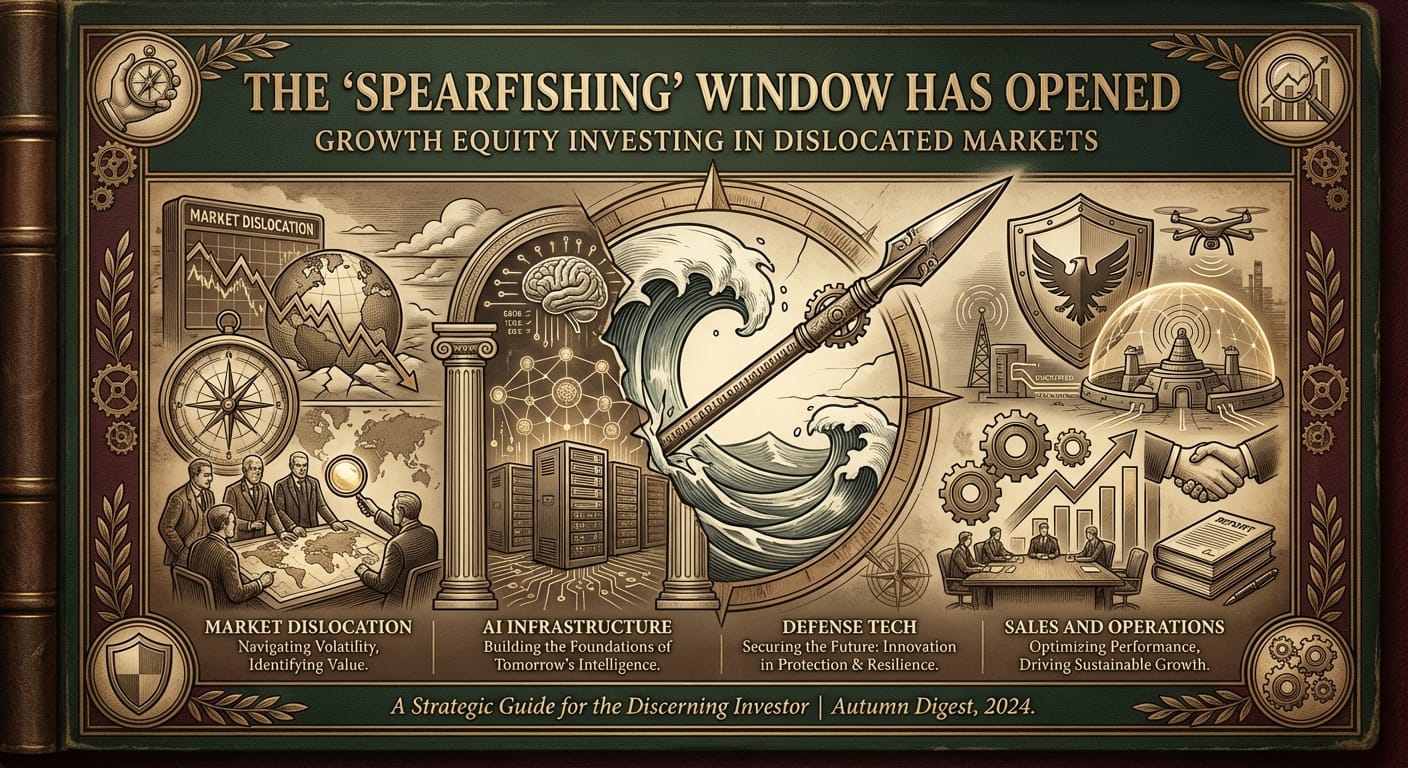
The "Spearfishing" Window Has Opened.
While the headlines are dominated by the multi-billion dollar AI capex wars, the smartest growth equity investors are quietly pivoting their strategy. The consensus across this week’s intelligence is that we are entering a bifurcated market: "Infinite Capital" for national defense and AI infrastructure, and extreme discipline for everything else.
General Atlantic’s Martín Escobari provides the thesis of the week: We are in a classic "dislocation window" — a period that occurs only once every 3-4 years. The play isn't to chase the momentum (which is currently overpriced in AI hardware), but to "anchor" and wait for the unique distortions that allow you to pick up dominant platforms at 6x EBITDA.
Simultaneously, the operator playbook has shifted back to basics. The era of "growth at all costs" PLG (Product-Led Growth) is dead. The new religion is old-school, regimented enterprise sales (MEDDIC) and operational "excellence vs. perfection."
Here is your briefing for the week.
INTELLIGENCE BRIEFING
1. THE MACRO: SPEARFISHING IN A DISLOCATED MARKET
The Situation: Growth equity valuations have been sticky, but the spread between "premium" assets and the rest of the market is creating specific pockets of opportunity. The Intelligence: Martín Escobari (General Atlantic) argues that we are currently in the best vintage window for growth equity since 2009. His framework is "Spearfishing": unlike public markets (net fishing), you don't chase the school. You anchor in a sector and wait for the "big fish" — market leaders that temporarily misstep or get dragged down by sector sentiment. The Voice:
"You don't chase the fish. You wait. You decide where you're going to anchor... and you're waiting for the big fish. Every three or four years there's a once in a generation opportunity." — Martín Escobari, Invest Like the BestThe Implication: Stop looking at average entry multiples. The alpha right now is in idiosyncratic liquidity events where good assets are trapped in bad cap tables or sectors temporarily out of favor (like non-AI software).
2. DEFENSE TECH & THE "INFINITE CAPITAL" THESIS
The Situation: Defense tech is no longer a niche VC bet; it's becoming the primary recipient of industrial policy capital. The Intelligence: Palmer Luckey (Anduril) suggests the U.S. is shifting from "World Police" to "World Gun Store." This mirrors the "Infinite Capital" sentiment seen in AI infrastructure (Anthropic/Nvidia). The market is pricing in a protracted conflict period (Thucydides Trap) where supply chain resilience and hard tech command a premium over software optimization. The Numbers: Defense primes and startups are betting that synthetic fuels will render the trillions spent on EV batteries obsolete for military applications. The Implication: Hardware is hard, but it’s the only place receiving price-insensitive capital right now. If your portfolio has dual-use technology (commercial + defense), pivot the narrative to national interest immediately to unlock non-dilutive capital and government contracts.
3. THE CRACKS IN THE NVIDIA TRADE
The Situation: Nvidia remains the kingmaker, but the hyperscalers (Google, Amazon, Microsoft) are its biggest customers and its biggest future threats. The Intelligence: The 20VC analysis suggests a looming margin compression. If hyperscalers are handing Nvidia $20B+ in profit annually, their incentive to vertically integrate (build their own TPUs/chips) is existential. We are seeing the early signs of a "Breaker Switch" moment where large buyers internalize chip production to defend their own margins. The Voice:
"The biggest potential alternative customers for the Google TPU are Google's sworn enemies... From Google's game theory perspective, do they take the capital, or do they continue to just keep it in house?" — 20VCThe Implication: Be wary of downstream AI application layers that don't own their compute or data. The infrastructure layer is about to undergo a brutal margin war.
4. SALES HYGIENE: THE "ECONOMIC BUYER" REVIVAL
The Situation: Portfolio companies missing forecasts is the #1 headache for GPs right now. The culprit is often sloppy sales execution disguised as "lengthening sales cycles." The Intelligence: John McMahon (legendary CRO) dismantles the excuse of "macro headwinds." His view: If a rep hasn't met the Economic Buyer, there is no deal. In a high-interest rate environment, PLG (Product-Led Growth) is insufficient for enterprise retention. Net Dollar Retention (NDR) is the new valuation anchor. The Tactic: Implement strict deal qualification (MEDDIC) immediately. If your sales leaders cannot articulate the customer's "implicated pain," they are just touring, not selling.
DEAL FLOW SIGNALS
WHERE THE ACTION IS
🔥 Active (Defense & Hard Tech): Synthetic fuels, autonomous systems, and "World Gun Store" supply chain plays. Palmer Luckey’s commentary suggests the EV battery thesis is vulnerable in defense contexts.
🧊 Quiet (Traditional Retail): Macy’s CEO Tony Spring highlights the "tariff turbulence" ahead. Retailers reliant on cross-border supply chains are in "forecast version 27" mode—aka, they have no visibility.
👀 Emerging (Global Growth): Emerging markets (specifically India/LatAm) are decoupling from the "China Slowdown" narrative. General Atlantic is aggressively deploying here while others retreat.
⚠️ Stressed (Gig Economy labor): China’s slowdown is creating a massive labor surplus (~200M gig workers). This deflationary pressure is a signal for global labor arbitrage plays but a red flag for consumer demand in APAC.
THE OPERATOR'S EDGE
Tactics from the best in the business.
1. The "Excellence vs. Perfection" Scale Danny Meyer (Shake Shack) argues that "perfection" prevents scaling because it is a recipe for unhappiness and paralysis. The winning framework is "scaled excellence"—honoring how it was done yesterday but finding one efficiency for tomorrow. Application: Stop delaying exits or expansions waiting for perfect metrics. Perfect is the enemy of the 3x return.
2. Marketing as Category Creation Red Bull’s Dietrich Mateschitz didn't focus on market share; he focused on interest. He explicitly ignored focus groups that said the product tasted "medicinal." Application: In consumer portfolio cos, if you are fighting for shelf space, you’ve already lost. Back the brand that is weird enough to create its own category (see also: Spindrift’s refusal to use "flavor houses").
3. The "Champion" Test Sales tactic from John McMahon: A "Champion" isn't just someone who likes your product; it's someone with power who actively sells for you when you aren't in the room. Application: Audit your portfolio's pipeline today. Ask: "Who is the Champion?" If the answer is a mid-level manager without budget authority, kill the opportunity or retarget immediately.
THE CONTRARIAN POSITION
High Expenses Are Marketing, Not Waste. While most PE playbooks call for immediate SG&A cuts, the deep dive into credit card economics (Odd Lots) reveals a counter-intuitive truth: High costs (like rewards programs or high CAC) are often the product itself. The 20%+ interest rates on cards aren't just covering default risk; they are funding the marketing war (points/miles) that acquires the prime customer. The Takeaway: Be careful cutting "marketing fat" in fintech or consumer loyalty businesses. You might be cutting the actual value proposition that allows for premium pricing.
THE BOTTOM LINE
The "easy money" era of rising tides lifting all boats is over. We are now in a stock-picker's market where entry price and operational rigor matter more than sector beta.
For the IC Meeting:
- Are we "spearfishing" for a dislocated leader, or just paying up for a B-player in a hot sector?
- Does this software asset have the sales hygiene (Economic Buyer access) to survive a budget freeze?
- Is our defense/industrial thesis reliant on batteries (risk) or synthetic fuels/autonomy (opportunity)?
Format your conviction. The vintage is being made right now.
APPENDIX: EPISODE-BY-EPISODE INTELLIGENCE 📚
1. Palmer Luckey - Inventing the Future of Defense
Podcast: Invest Like the Best | Guest: Palmer Luckey (Anduril) The Conversation: A masterclass on defense strategy and hard tech. Luckey argues the US must transition from "World Police" to "World Gun Store," supplying allies rather than intervening directly. Key Intelligence:
- Energy Disruption: Luckey is bearish on EV batteries for defense, betting instead on synthetic long-chain hydrocarbon fuels as the long-term winner for cost and density.
- R&D Strategy: Innovation in defense isn't about new physics; it's about applying commercial electronics cost curves to military hardware. Notable Quote: "If you can make synthetic long chain hydrocarbon fuels cheaply enough, then all of these trillions of dollars in investment into battery electric vehicles... become a waste of money." Relevant For: Defense/Aerospace investors, Hard Tech VCs.
2. Red Bull's Billionaire Maniac Founder
Podcast: Founders | Subject: Dietrich Mateschitz The Conversation: A case study on Dietrich Mateschitz, who built Red Bull not by making a better drink, but by inventing a category and controlling the image with iron discipline. Key Intelligence:
- Marketing > Product: Mateschitz believed the product was secondary to the myth. He generated interest by allowing rumors about ingredients to persist rather than correcting them.
- Privately Held Power: He refused to go public to maintain total control over cash flow reinvestment, prioritizing "fun" and brand dominance over quarterly earnings. Notable Quote: "The most dangerous thing for a branded product is low interest." Relevant For: Consumer branding teams, Family Office operators.
3. Raging Moderates: MAGA in Turmoil
Podcast: The Prof G Pod | Hosts: Scott Galloway, Jessica Tarlov The Conversation: A political-economic breakdown of the MAGA movement's friction with actual governance and the economic implications of the incoming administration. Key Intelligence:
- Economic Populism: Economic frustration is swamping ideology; both parties are pivoting to populism, which implies higher volatility in policy.
- Infrastructure: There is bipartisan pressure for massive infrastructure spend (e.g., high-speed rail), presenting a potential PE tailwind for construction/logistics. Notable Quote: "Today's economic frustration is swamping ideology, and both parties are scrambling to harness it." Relevant For: Infrastructure funds, Macro strategists.
4. Replay: Dinner table wisdom with Danny Meyer
Podcast: Masters of Scale | Guest: Danny Meyer (Union Square Hospitality) The Conversation: The hospitality legend discusses the "fear of scaling" and how to overcome it by distinguishing between "perfection" (impossible) and "excellence" (repeatable). Key Intelligence:
- Innovation Definition: Meyer views innovation not as invention, but as connecting two existing "dots" (ideas) in a fresh way.
- ** Leadership:** A great idea cannot survive bad leadership. Talent assessment is more critical than concept assessment during expansion. Notable Quote: "I've never seen a great idea overcome bad leadership." Relevant For: Consumer/Retail operators, Human Capital leads.
5. 20VC: Anthropic Raises $30BN & Nvidia Threat
Podcast: 20VC | Guest: Discussion Panel The Conversation: A deep dive into the AI capital cycle, specifically the tension between Nvidia’s margins and the hyperscalers' desire to kill those margins with internal chips (TPUs). Key Intelligence:
- Verticalization Risk: Major tech companies are handing Nvidia $20B/year in profit; this "customer concentration" is actually Nvidia's biggest long-term risk as customers build efficient alternatives.
- Infinite Capital: In unstable times (technologically), having "infinite capital" (like Microsoft/OpenAI) is a strategy in itself to drown out competition. Notable Quote: "If you're giving someone $20 billion of profit a year... you got to say to yourself, maybe I can invest... a billion a year for five years [to build my own chip]." Relevant For: Tech investors, Semiconductor analysts.
6. Martín Escobari - Inside General Atlantic
Podcast: Invest Like the Best | Guest: Martín Escobari (Co-President, General Atlantic) The Conversation: A definitive guide to Growth Equity. Escobari outlines his "Spearfishing" framework—waiting years for specific dislocations—and why he believes the current vintage is historic. Key Intelligence:
- Market Timing: Just like 2009, the current era offers a rare window to buy dominant platforms at reasonable multiples due to macro fear.
- Aggressive Defense: When a portfolio winner stumbles due to macro (not structural) issues, that is the time to double down, not retreat. Notable Quote: "You don't chase the fish. You wait... Every three or four years there's a once in a generation opportunity." Relevant For: Growth Equity GPs, LPs allocators.
7. This Is Why Credit Card Interest Rates Are So High
Podcast: Odd Lots | Guest: Itamar Drechsler (Wharton) The Conversation: A technical breakdown of credit card unit economics. High rates are driven less by default risk and more by the vigorous competition for "transactors" via expensive rewards programs. Key Intelligence:
- The Marketing Tax: A significant portion of APR goes to funding points/miles for prime customers. This creates a cross-subsidy from revolvers (borrowers) to transactors (spenders).
- Unit Eco: Marketing and opex drive rates as much as the Fed does. Notable Quote: "The rate that you're paying on the credit card is actually more important potentially than something like your mortgage rate." Relevant For: Fintech investors, Credit funds.
8. China Decode: Economic Slowdown & Gig Workers
Podcast: The Prof G Pod | Hosts: Alice Han, James Kynge The Conversation: An analysis of China’s pivot from a fixed-asset investment economy to... something else. The transition is painful, marked by a massive surplus of gig workers. Key Intelligence:
- Investment Cliff: The primary driver of Chinese growth (fixed asset investment/real estate) has collapsed.
- Labor Supply: China has ~200M gig workers. This labor overhang puts deflationary pressure on wages and complicates the consumption recovery thesis. Notable Quote: "The biggest motivator of Chinese growth has just fallen off a cliff." Relevant For: Global macro funds, APAC specialists.
9. 20Sales: John McMahon - Hire, Train & Retain
Podcast: 20VC | Guest: John McMahon (Board Member: Snowflake, MongoDB) The Conversation: The godfather of enterprise sales breaks down why "The Art of the Sale" is actually a rigid science. He details the necessity of the "Economic Buyer." Key Intelligence:
- Process > Personality: Sales success isn't about charisma; it's about sticking to the MEDDIC framework to qualify deals out early.
- Pain Implication: If the customer hasn't admitted pain, you cannot create urgency. Discounts at the end of the quarter don't create urgency; they just lower margins on deals that would close anyway. Notable Quote: "Whoever locks down the decision criteria is going to lock down the deal." Relevant For: Operating Partners, CROs, SaaS Boards.
10. Graham Allison on the Risks of a US-China War
Podcast: Odd Lots | Guest: Graham Allison (Harvard) The Conversation: The creator of the "Thucydides Trap" explains why the structural stress between the US (ruling power) and China (rising power) makes conflict statistically probable, even if irrationial. Key Intelligence:
- The Trap: Historical data shows that when a rising power threatens a ruling power, war occurs ~75% of the time.
- Miscalculation Risk: War usually starts not by design, but by a third-party accident (e.g., Taiwan) escalating due to lack of trust. Notable Quote: "China is a meteoric rising power... Never before in history has a nation risen so far so fast." Relevant For: Geopolitical risk analysts, Supply chain strategists.
11. Advice Line with Bill Creelman of Spindrift
Podcast: How I Built This | Guest: Bill Creelman (Spindrift) The Conversation: A session on preserving brand equity while scaling. Creelman advises early-stage founders on the trade-offs between authentic ingredients and scalability. Key Intelligence:
- Ingredient as Moat: Using fresh ingredients (which spoil/vary) is a nightmare for operations but a massive moat against competitors using "flavor houses."
- Scalability Value: Sometimes the "unscalable" creates the only defensible value in a crowded consumer market. Notable Quote: "I am stubborn about ingredients. What ultimately emerged is really our key point of difference." Relevant For: CPG investors, Early-stage founders.
12. $10M Business Ideas w/ Sheel Mohnot
Podcast: My First Million | Guest: Sheel Mohnot (Better Tomorrow Ventures) The Conversation: A brainstorming session on niche actionable business ideas, from surrogacy marketplaces to AI-driven home services. Key Intelligence:
- The "Boring" Opportunity: Markets like surrogacy (~$1B revenue) or lawn care quoting (Deep Lawn) are fragmented and ripe for software layers.
- Contrarian learning: Don't read business books; watch the author's talk to get the 80/20 in a fraction of the time. Notable Quote: "The solution is creating more supply... not to induce demand." (On housing) Relevant For: Search funds, Incubators.
13. Beyond the Parade: Macy’s Navigates Tariffs
Podcast: Masters of Scale | Guest: Tony Spring (CEO, Macy’s) The Conversation: Inside the turnaround of a legacy retailer facing modern headwinds. Spring discusses the reality of planning in a tariff-heavy environment. Key Intelligence:
- Planning Fluidity: Macy's is on "forecast version 27" for 2025 due to macro unpredictability. Agility is now a survival metric, not a buzzword.
- Physical Reality: 70% of business is still brick-and-mortar. The digital transition has plateaued into an omnichannel balance. Notable Quote: "What matters tomorrow is going to be different than mattered yesterday." Relevant For: Retail PE, Real Estate investors.
14. Molly's Game Uncensored
Podcast: All-In | Guest: Molly Bloom The Conversation: A look into the psychology of high-stakes risk. Bloom breaks down how she built a business on trust and fear management among the ultra-wealthy. Key Intelligence:
- Losing Psychology: Wealthy individuals often behave irrationally due to fear of loss rather than logic. Managing this "tilt" was key to her game's liquidity.
- Trust as Currency: In illicit or gray markets, your only asset is reliability. She never took shortcuts on payouts. Notable Quote: "I will always choose courage over comfort." Relevant For: Behavioral finance enthusiasts, Risk managers.