
The exit backlog isn't shrinking. It's being creatively circumvented—and where the smart money is moving tells a sharper story about value than any headline.
The Intake
The deals, the dynamics, the debates. What GPs, operators, and allocators are actually talking about.
This week's intelligence:
📊 10 episodes across 7 podcasts
⏱️ 492 minutes with dealmakers and operators
🎙️ At the table: Alice Han, Michal Meidan, James Kynge, Scott Middleton
The Big Shift
The Silent Energy Revolution: Data Centers, AI, and the Unseen Infrastructure Boom
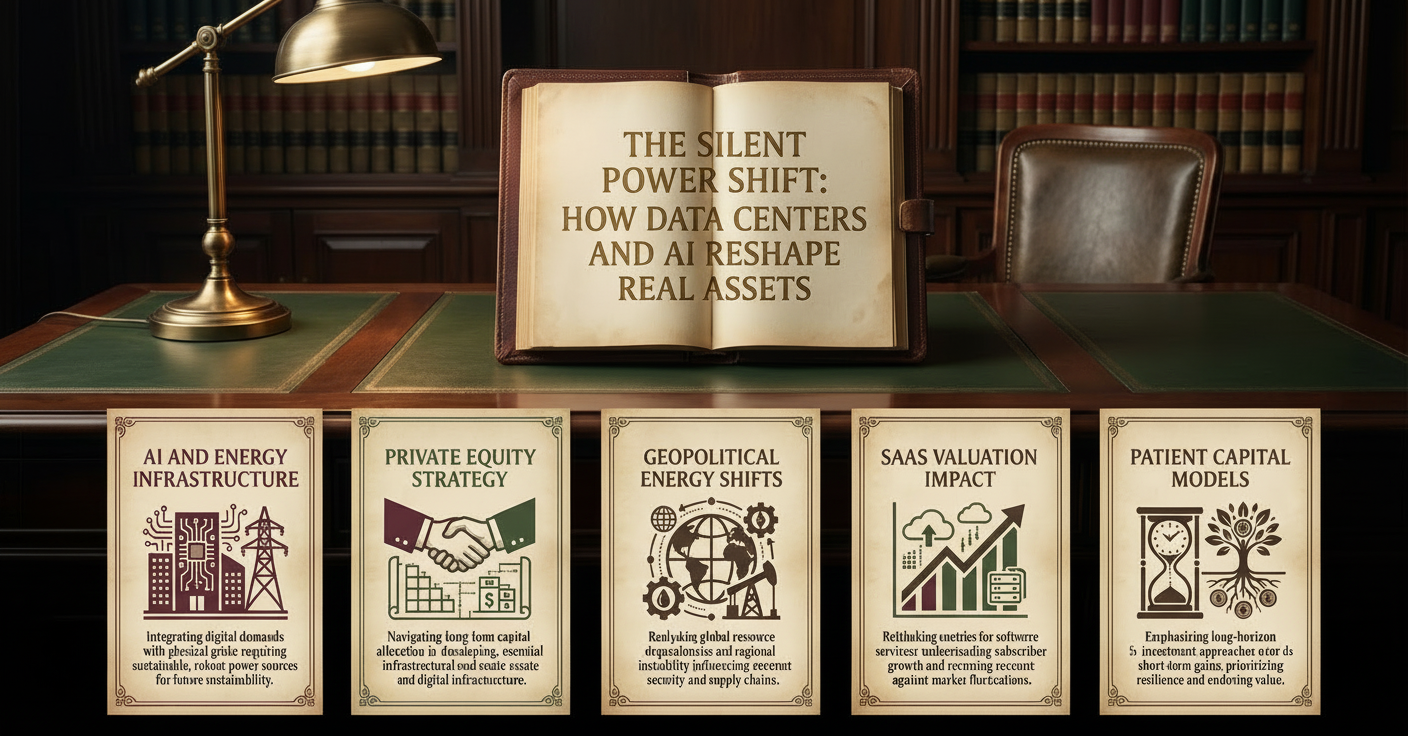
Forget the macro headlines. The real, immediate shift in capital allocation is happening at the intersection of energy and technology. Data centers and AI are creating unprecedented, non-cyclical demand for electricity, driving a silent re-industrialization that's reshaping utility investment and creating new "picks and shovels" opportunities. GPs are moving capital into the underlying infrastructure, not just the tech layers. Utilities that can leverage existing unused capacity by attracting hyperscalers are actually lowering local bills, countering the narrative of energy strain. China, for instance, is pursuing energy independence (including nuclear and coal) in response to geopolitical instability, mirroring a global push for self-sufficiency. This isn't a future trend; it's happening now, with profound implications for real asset development.
Why it matters: This isn't just about AI; it's about the physical infrastructure needed to power it. Deals in real assets, especially utilities and energy infrastructure, are becoming a crucial component of tech value creation. Operators need to understand how their power consumption impacts their P&L and how this demand is reshaping local energy markets.
"Five years ago it was clean, stable and we want to have more. Today it's kind of flipped, right? We need more, it has to be stable and then we do want it to be clean, but we can't necessarily sacrifice the clean for the more in the stable part of it." — Bloomberg
The move: Re-evaluate your portfolio companies' energy consumption and future power needs. Are you factoring in the coming squeeze on electricity supply and the opportunity for utilities adapting to hyperscaler demand?
The Rundown
① AI's Impact on SaaS Valuations. The advent of tools like Claude Code is forcing SaaS companies, particularly in CRM and enterprise software, to rethink their core value proposition. If AI can transform unstructured data directly, the "build vs. buy" paradigm shifts, challenging traditional SaaS subscription models. (Noah Brier on Why the Tech World Is Going Crazy for Claude Code)
• The signal: Expect downward pressure on SaaS valuations—especially commoditized offerings—as AI agents take over tasks previously requiring specialized software licenses.
② The 'Venture Orphan' Opportunity in Australia. An estimated 500-900 institutionally-backed software companies in Australia, under $10M in funding, require an exit in the next 2-5 years. This segment is overlooked by larger PE firms, creating a niche for patient holding companies. (Scott Middleton on Software Holdcos in Australia)
• Why it matters: For agile, operationally-focused holdcos, Australia presents a robust, less crowded market for strong, cashflow-positive software acquisitions.
③ Unrest in Iran is a Problem for China. Geopolitical shifts in Iran and Venezuela could disrupt 20% of China's imported oil. While operationally manageable, the financial and strategic losses for China from canceled contracts due to US assertive policy are substantial. (James Kynge on China Decode: Why Unrest in Iran is a Problem for China)
"If we add up Venezuela's contribution to Chinese oil imports and Iran's contribution to the same oil imports, we get close to about 20%. That's 1/5 of China's imported oil needs, which could be disrupted..." — James Kynge, Vox Media Podcast Network
• What to watch: China is proactively seeking energy independence through diversified sources and domestic investments, including a surge in coal and nuclear.
④ Microsoft Sets New Precedent for Hyperscalers. Microsoft is committing to cover all its data center energy and water costs, including grid upgrades, without tax breaks. This signals a future where tech giants proactively manage their environmental footprint, potentially shifting costs and responsibilities. (Jason Calacanis on Iran's Breaking Point, Trump's Greenland Acquisition, and Solving Energy Costs)
• The signal: The free ride for hyperscaler energy consumption is over. Expect other tech giants to follow suit, leading to higher operating costs for data centers but potentially more stable local energy grids.
⑤ The Rise of the Patient Holdcos.Terem Capital's model emphasizes "patience" as the most crucial element in building a software holding company, focusing on 10-15% annual profit growth rather than rapid, VC-style scaling. This creates a sustainable, long-term alternative to traditional PE. (Scott Middleton on Software Holdcos in Australia)
• Why it matters: This model offers founders an alternative exit and contrasts sharply with the pressure for quick exits and high growth typical in traditional PE, suggesting a more sustainable path to value creation.
Deal Flow Signals
🔥 ACTIVE
• Energy Infrastructure: Booming demand from data centers and AI driving capital into utilities. (Tyler Rosenlicht on How to Make Money From the Booming Demand for Energy)
• Waste-to-Value Investing: Significant market gap for waste repurposing, especially biotech and advanced materials. (Maxwell Nee on Private Equity market trends and investing techniques)
👀 EMERGING
• 🆕 Australian Software Market: "Venture orphan" opportunity for patient software holdcos. (Scott Middleton on Software Holdcos in Australia)
• 🆕 GLP-1 Drug Market: China's over 60 GLP-1 drug candidates are poised to trigger a global price war. (Alice Han on China Decode: Why Unrest in Iran is a Problem for China)
🧊 QUIET
• High-Yield Bonds: Apollo actively avoided deploying capital in 2021 due to unfavorable risk-return profiles, signaling continued caution. (Scott Kleinman on Scott Kleinman – Apollo's Integrated Alternatives Platform (EP.481))
⚠️ STRESSED
• California Real Estate: Over-regulation and "gyno-fascism" blamed for slow rebuilding post-disasters, risking flight of capital. (Adam Carolla on Adam Carolla on California's Collapse: Fires, Failed Leadership, and Gyno-Fascism)
• Iranian Economy: Extreme financial stress, currency collapse, and corruption driving widespread civil unrest. (Maciej Wojtal on Lots More on the Protests and Financial Crisis in Iran)
The Debate
Are Private Equity's semi-liquid products truly offering liquidity?
🐂 The bull case:
"The biggest constraint on our growth was origination. The whole industry thinks in terms of capital formation. I just got to raise more capital and I'll deploy it. We flipped that on its head and said, no, the limiter of our growth is not capital." — Scott Kleinman, Co-President at Apollo Asset Management
🐻 The bear case:
"At the same time, you know, there's complete blackout. What works right now is the actually outgoing landline calls, but with limited time." — Maciej Wojtal, Founder and CIO of Amtelon Capital
Our read: Apollo, with its integrated platform and strong balance sheet, views capital formation as secondary to origination, implying it can create bespoke liquidity. However, the macro reality (like Iran's info blackout, which symbolizes broader market uncertainty) suggests liquidity is an illusion when real information is scarce. LPs should scrutinize terms on semi-liquid products carefully.
The Bottom Line
Operational value creation in real assets powering AI, smart sector plays in overlooked markets, and disciplined capital allocation are the playbook; everything else is struggling for attention.
🎯 Your Move
- Audit Portfolio Energy Consumption: With data centers driving energy demand, understand your portcos' power needs and how they'll impact operating costs and supply in the next 12-24 months.
- Scrutinize SaaS Business Models: Challenge traditional SaaS with the question: "What parts of this can an AI agent replace by Q4 2026?" Adjust diligence for an AI-native future.
- Explore Overlooked Geographies: Research the "venture orphan" opportunity in regions like Australia for software acquisitions, where competition is lighter and patient capital can thrive.
What We Listened To
How to Make Money From the Booming Demand for Energy
Guests: Tyler Rosenlicht (Senior Vice President, Portfolio Manager for Global Listed Infrastructure and Head of Natural Resource Equities, Cohen & Steers), Joe Weisenthal (Host, Bloomberg), Tracy Alloway (Host, Bloomberg), Bloomberg (Host, Bloomberg) Runtime: 51 min | Vibe: Deep dive into power infrastructure Key Signals:
- Data Center Demand: Unprecedented growth in electricity demand from data centers and re-industrialization is driving utility investment and creating opportunities in energy infrastructure.
- Shifting Energy Priorities: The global energy imperative has shifted from 'clean, stable, more' to 'more, stable, clean', reflecting a new urgency for abundance and stability.
US Nuclear Renaissance: Government backing is expected to mitigate cost overruns, spurring a new era of nuclear construction in the US.
"There is so much capital required in utility investment today that it's really causing affordability problems. And some utilities we think are really going to struggle because elections are being won about utility bills." — Tyler Rosenlicht, Senior Vice President, Cohen & Steers
Iran's Breaking Point, Trump's Greenland Acquisition, and Solving Energy Costs
Guests: Chamath Palihapitiya (Host, All-In Podcast, LLC), Jason Calacanis (Host, All-In Podcast, LLC), David Sacks (Host, All-In Podcast, LLC), David Friedberg (Host, All-In Podcast, LLC), Jason (Host, All-In with Chamath, Jason, Sacks & Friedberg), Friedberg (Host, All-In with Chamath, Sacks, Jason & Friedberg), Chamath (Host, All-In with Chamath, Sacks, Jason & Friedberg) Runtime: 71 min | Vibe: Geopolitical and economic provocations Key Signals:
- Iran Regime Change: High inflation and youth aspirations in Iran point to potential geopolitical instability, driven by sanctions and economic hardship.
- Microsoft's Energy Precedent: Microsoft's commitment to covering all data center energy/water costs, including grid upgrades, sets a new standard for hyperscalers.
California "Billionaire Tax" Warning: Proposed asset seizure in California is framed as an erosion of private property rights, a dangerous precedent for taxation.
"The next major thing is when you actually create 100 or $200 billion tax equity vehicle and you have them completely subsidize and pay for the electricity costs of homeowners. How do you do that? You do that by paying for them to get solar and storage." — David Sacks, Host at All-In Podcast, LLC
China Decode: Why Unrest in Iran is a Problem for China
Guests: Alice Han (Host, Vox Media Podcast Network), James Kynge (Host, Vox Media Podcast Network), Michal Meidan (Head of China Energy Research, Oxford Institute for Energy Studies) Runtime: 50 min | Vibe: China's global strategy and vulnerabilities Key Signals:
- China's Geopolitical Setbacks: US actions are disrupting China's oil imports from Venezuela and Iran, highlighting vulnerabilities in its energy security.
- Latin America Space Infrastructure: China has more space infrastructure in Latin America than anywhere outside mainland China, raising US national security concerns.
Chinese GLP-1 Price War: Over 60 GLP-1 drug candidates in late-stage trials in China are set to trigger a global price war, making weight-loss drugs more accessible.
"China has already economically displaced the US in 10 out of 12 countries in South America. So South America is obviously the southern part of Latin America." — James Kynge, Host at Vox Media Podcast Network
The AI agents in your wallet, with Mastercard CEO Michael Miebach
Guests: Michael Miebach (CEO, Mastercard), Bob Safian (Host of Rapid Response, WaitWhat) Runtime: 25 min | Vibe: Payments innovation and consumer trends Key Signals:
- Holiday Spending Growth: Consumer spending remains strong with 3.9% year-over-year growth, driven by early shopping for deals and focused affordability.
- Evolving Payment Choices: Mastercard is adapting to new trends like Buy Now, Pay Later, emphasizing consumer choice and brand trust in security.
CEO's Competitive Analysis: The Mastercard CEO personally tests competitor products to understand user experience and market dynamics.
"Where do we invest to really understand where consumer or business payments are going? The payments need to be smarter, they need to be faster, they need to be safer, all those kind of things." — Michael Miebach, CEO of Mastercard
Adam Carolla on California's Collapse: Fires, Failed Leadership, and Gyno-Fascism
Guests: David Friedberg (Host, All-In Podcast, LLC), Adam Carolla (Comedian, Author, Host, The Adam Carolla Show) Runtime: 70 min | Vibe: Provocative criticism of California governance Key Signals:
- Overregulation's Impact: Overregulation is blamed for slow rebuilding post-disaster, leading to societal and economic stagnation.
- Self-Segregation Trend: Americans are self-segregating to politically aligned states, with "safe space" cities facing societal decay and "octagons" (freedom states) thriving.
DEI's Impact on Meritocracy: DEI initiatives in Hollywood are criticized for negatively affecting meritocracy and product quality, shifting focus from pure talent.
"No, there is no just helping one group. There has to be a couple of funny middle aged white guys who aren't employed because you made room for the Latina chicks." — Adam Carolla, Comedian, Author, Host at The Adam Carolla Show
Scott Kleinman – Apollo's Integrated Alternatives Platform (EP.481)
Guests: Ted Seides (Host, Capital Allocators), Michael Klein (Former Boss, Smith Barney), Ruth Peratt (Former Boss, Smith Barney), Scott Kleinman (Co-President, Apollo Asset Management) Runtime: 68 min | Vibe: Evolution of alternative asset management Key Signals:
- Origination Over Capital: Apollo prioritizes origination over capital formation, a contrarian view in PE, emphasizing deal sourcing as the growth limiter.
- Disciplined Capital Deployment: Apollo actively avoids deploying capital in asset classes with unfavorable risk-return profiles, such as high-yield bonds and commercial real estate in 2021.
Integrated Platform Value: Being a public company and fostering cross-collaboration across asset classes helps Apollo find value in overlooked areas and align incentives.
"If we don't have a home on the Apollo balance sheet that thinks that's an interesting risk return, I'm not going to go out and raise that money because that may be right for the asset management business. But that's not right for what we're trying to do in the big picture. We are long term greedy, not short term greedy." — Scott Kleinman, Co-President at Apollo Global Management
Lots More on the Protests and Financial Crisis in Iran
Guests: Maciej Wojtal (Founder and CIO, Amtelon Capital), Bloomberg (Host, Bloomberg) Runtime: 22 min | Vibe: On-the-ground report from Iran Key Signals:
- Information Blackout: Government-imposed internet blackouts make accurate information on Iran's civil unrest extremely difficult to obtain.
- Economic Drivers of Protest: Current Iranian protests are primarily driven by deep financial stress, currency collapse, and corruption, unifying diverse demographics.
Stock Market Uncertainty: The Iranian stock market trades with extreme uncertainty, reflecting the internal turmoil and government's opacity.
"It's around 1.5 million rial per $1, which means it went down around 97, 98% over the last decade and around 50, almost 50% since before the war with Israel last year." — Maciej Wojtal, Founder and CIO of Amtelon Capital
Why the Tech World Is Going Crazy for Claude Code
Guests: Joe Weisenthal (Host, Bloomberg), Tracy Alloway (Host, Bloomberg), Noah Brier (Co-founder, Alpehic), Bloomberg (Host, Bloomberg) Runtime: 55 min | Vibe: AI's transformative coding impact Key Signals:
- Claude Code's Breakthrough: Its ability to read/write files and use UNIX commands fundamentally changes AI's role in coding, transforming it into a powerful "pair programmer."
- Disrupting SaaS with AI: AI capable of transforming unstructured data directly threatens CRM and other enterprise software, challenging traditional "build vs. buy" and SaaS valuations.
Role Shift for Developers: Software developers are transitioning from writing code to managing AI agents, significantly shifting their function and output.
"Claude Code is much more designed to be kind of a pair programmer." — Noah Brier, Co-founder at Alpehic
Private Equity market trends and investing techniques
Guests: Maxwell Nee (Chairman & Managing Partner, Family Office Insider & Black Mountain Capital), Alex Rawlings (Host, Raw Selection) Runtime: 23 min | Vibe: Contrarian view on deal sourcing Key Signals:
- "10x Deals" Philosophy: Larger deals can sometimes be simpler due to fewer distractions and more experienced professionals, contrary to usual complexity assumptions.
- Market Gap Identification: Investing should focus on "force of nature" market gaps, like waste repurposing, where demand is inherent and unavoidable.
Cheap Solar Technology: The cost of solar panels has become so low that it's cheaper to build structures out of them than IKEA furniture, signaling profound energy shifts.
"Typically, the bigger the numbers are, the sometimes the simpler it is to get it done. Because what happens is that when you have the big numbers, you know, 10x the numbers, there's less distractions." — Maxwell Nee, Chairman of Family Office Insider & Managing Partner at Black Mountain Capital
Software Holdcos in Australia
Guests: Scott Middleton (CEO and Founder, Terem Capital), Devin (Host) Runtime: 57 min | Vibe: Niche holdco strategy Key Signals:
- "Venture Orphan" Opportunity: The Australian market presents a unique opportunity with 500-900 institutionally-backed software companies needing exits, overlooked by larger PE.
- Patience as Key: The holding company model emphasizes patience (10-15% annual profit growth) over hyper-growth, offering a sustainable alternative to traditional PE.
Lean Operational Approach: Terem Capital focuses on a lean, operationally-focused strategy over a "roll-up" model, emphasizing individual asset growth and management incentives.
"The most important with the holding company model is patience, which is actually really, really hard. Waiting until the right opportunity that really fits your model comes about." — Scott Middleton, CEO and Founder of Terem Capital