
THE CRITICAL THINKING DIGEST
THIS WEEK'S INQUIRY
📚 10 conversations with 14 thinkers
⏱️ ~20 hours of long-form intellectual exploration
🎙️ Featuring: Sam Harris, Connor Beaton, Niall Ferguson, John McWhorter, Dr. Mark Hyman, Gerd Gigerenzer, Dr. Katy Milkman, Alain de Botton, Adam Grant, Joel David Hamkins, and more.
The ideas worth your attention. Here's what we're thinking about.
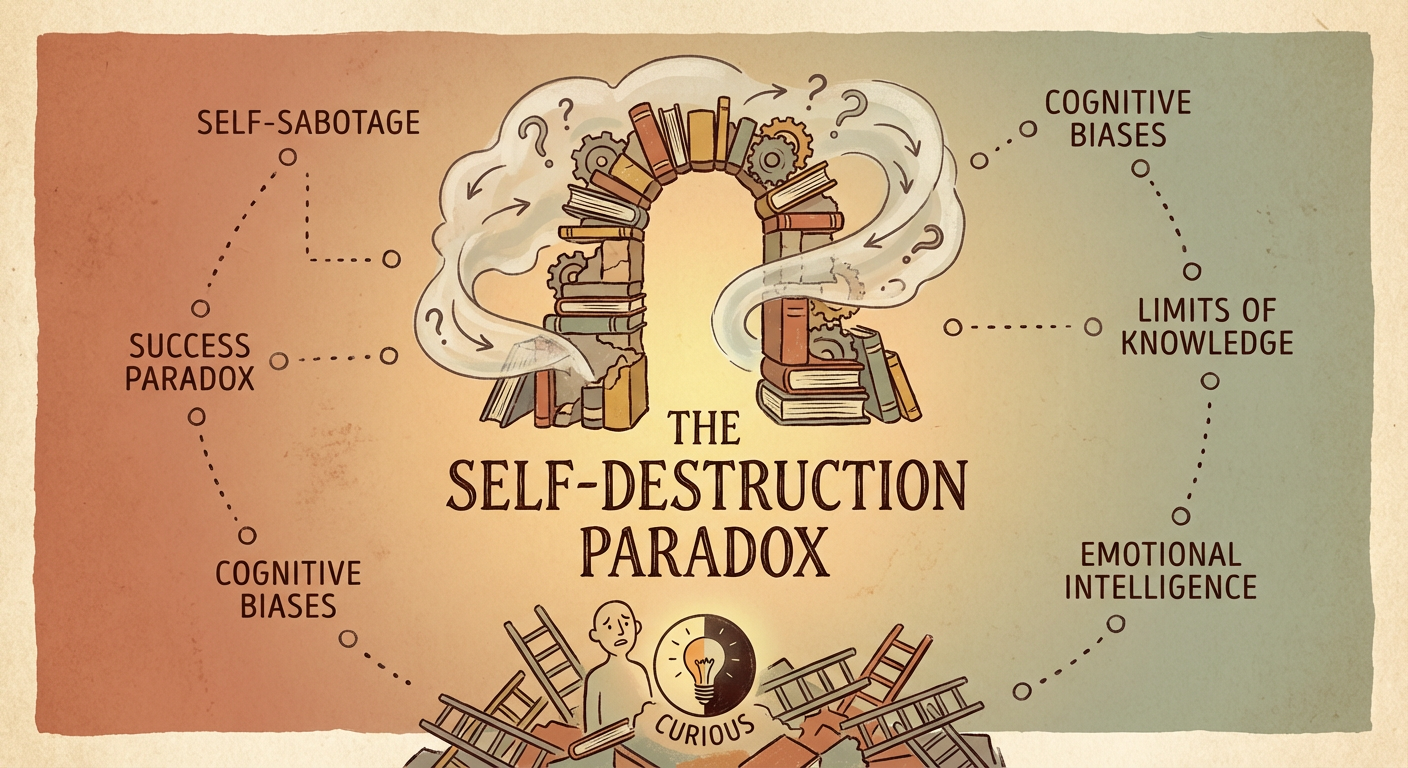
The Self-Destruction Paradox: What Happens When Our Tools for Success Become Our Undoing?
We spend an inordinate amount of time discussing the threats posed by external forces — AI arms races, geopolitical instability, crumbling institutions. And rightly so. But what if the more insidious threat lies within? What if the very qualities that drive us to success also contain the seeds of our downfall?
Across diverse conversations this week, something remarkable emerged: a pattern of self-sabotage, misalignment, and hidden fragility, not in the weak or the struggling, but in the highly successful, the ambitious, and even in our foundational systems of knowledge. From successful men who privately self-destruct, to the intellectual traps inherent in how we approach decision-making, to the very mathematical paradoxes that shook the foundations of certainty, a core tension reveals itself: our pursuit of ambition, control, and objective truth often creates blind spots and vulnerabilities we're ill-equipped to handle.
This isn't about mere failure; it’s about a deeper, systemic issue where the mechanisms intended for progress — ambition, reason, digital connectivity, even the concept of infinity itself — often generate unexpected and damaging consequences. The smartest people are grappling with this fundamental irony. Are we building systems (and lives) that are inherently unstable, precisely because of their drive towards optimization and achievement? And if so, what's the path forward?
Here's how the smartest people are approaching it.
What Drives Success Might Also Drive You Off a Cliff
Why "Strength Through Suppression" Is a Recipe for Meltdown
The modern narrative of success, particularly for men, often champions resilience, stoicism, and an unwavering drive. We lionize those who "power through," suppress emotion, and project an image of invulnerability. But what if this cultural directive, "strength through suppression," is functionally an Achilles' heel? Connor Beaton posits that a significant reason successful men often self-destruct in private is precisely this cultivated inability to process emotion or acknowledge their achievements genuinely. It's a system designed to keep the engine running at all costs, but without an exhaust manifold.
The Setup: Society often equates emotional restraint with strength, particularly in masculine archetypes. This leads to an external projection of perfection and control, while internally, individuals are often left without the tools to manage their emotional landscape.
The Argument: Beaton argues that teaching "strength through suppression" and using shame as a motivator creates an environment where men are forced to maintain a flawless external image. This prevents them from developing healthy emotional regulation and self-compassion. The relentless pressure to achieve, coupled with an inability to acknowledge success or failure authentically, leads to burnout, disconnection, and often, private implosion. The "perfectionist image" demanded by this culture leads to maladaptive coping mechanisms.
The Voice:
"There's trying to maintain this image externally, and part of that image is the perfectionist. In male culture it's very common that we teach strength through suppression." — Connor Beaton, Modern Wisdom
The Tension: The tension lies between the aspirational ideal of stoic achievement and the biological reality of human emotional processing. While resilience is vital, an absolute suppression of emotion isn't resilience; it's a denial that taxes mental and physical health. Some might argue that discipline requires a level of emotional control, but Beaton suggests that true strength comes from integrating, not suppressing, one's emotional life.
The Implication: For leaders, founders, and ambitious individuals, this implies a critical re-evaluation of how success is defined and pursued. Prioritizing emotional intelligence, self-compassion, and authentic self-expression isn't a weakness; it's a foundational requirement for sustainable, long-term achievement without self-destruction. Organizations and cultures that reward emotional suppression are, in effect, setting up their most capable people for private collapse.
When Logic Itself Breaks: Infinity, Paradoxes, and the Limits of Knowing
The Unsettling Truth That Our Foundations Are Not Solid
Just as individuals can self-destruct from internal pressures, so too can entire systems of knowledge, particularly when confronted with ideas that expose their inherent limits. Mathematics, the very bedrock of objective truth and logical consistency, faced such a crisis when confronted with the concept of infinity. Joel David Hamkins takes us through the profound and almost existential challenges posed by infinity and related paradoxes, revealing that our quest for definitive answers often reveals the incompleteness of our frameworks.
The Setup: Mathematics is often seen as the epitome of certainty and logical rigor. Its foundations are assumed to be unshakeable, providing universally agreed-upon truths.
The Argument: Hamkins meticulously details how the concept of infinity, particularly articulated by Cantor, "broke mathematics before rebuilding it." This wasn't a minor glitch; it exposed fundamental paradoxes that challenged the very consistency of mathematical thought. Gödel's incompleteness theorems further cemented this unsettling truth: within any sufficiently complex formal system (like arithmetic), there will always be true statements that cannot be proven within that system. This isn't a flaw in our understanding; it's an inherent property of logic itself. Our quest for complete, self-contained truth is fundamentally limited.
The Voice:
"This idea from Cantor at the end of the 19th century, I think it's fair to say, broke mathematics before rebuilding it. The distinction between truth and proof is fundamental to our understanding of mathematical logic." — Joel David Hamkins, Lex Fridman Podcast
The Tension: The tension is between our deep human desire for absolute, consistent truth and the elegant, yet humbling, reality that true consistency often comes with inherent limitations and unprovable truths. It challenges the rationalist's ultimate ideal of a fully comprehensible system, showing that the most powerful systems also contain an element of mystery or self-referential paradox.
The Implication: For anyone building complex systems — be they software architectures, legal frameworks, or even philosophical arguments — Hamkins' insights are a stark reminder of the inevitability of incompleteness. Absolute certainty is a chimera. Acknowledging intrinsic limitations, designing for robustness in the face of the unprovable, and embracing a certain degree of non-determinism might be more productive than endlessly pursuing perfect, self-contained closure. It suggests that even our most rigorous intellectual endeavors demand a certain humility.
Redefining Rationality: The Unsung Power of Intuition and the Bias-Bias Fallacy
What If Our "Biases" Are Actually Intelligent Shortcuts?
In an age obsessed with data, algorithms, and "rational" decision-making, we're constantly warned about the pitfalls of human bias. Behavioral economics has made a cottage industry out of highlighting our cognitive shortcuts. Yet, Gerd Gigerenzer offers a provocative counter-narrative, suggesting that many perceived biases are misinterpretations and that intuition, far from being a flaw, is a highly refined and essential form of intelligence. This calls into question our very definition of what it means to be "rational" and how we design systems (from AI to personal habits) to optimize for success.
The Setup: The prevailing view, heavily influenced by behavioral economics, is that humans are rife with cognitive biases that lead to irrational decisions. AI is often presented as the "unbiased" solution.
The Argument: Gigerenzer introduces the concept of "bias bias": the tendency to over-attribute irrationality to human heuristics, often comparing them unfavorably to ideal, but unrealistic, logical models. He argues that true intuition is not a gut feeling born of ignorance, but a "feeling based on years of experience that comes fast into your consciousness." These fast-and-frugal heuristics are often highly adaptive and efficient in complex, uncertain environments. He advocates for "boosting" human intuition and capacity rather than "nudging" individuals (which he sees as a form of manipulation), emphasizing that human intelligence and synthetic intelligence are fundamentally different.
The Voice:
"True intuition is a feeling based on years of experience that comes fast into your consciousness. One should not confuse deep artificial neural networks with human intelligence." — Gerd Gigerenzer, EconTalk
The Tension: This creates a direct tension with the popular narrative of "System 1 vs. System 2" thinking, where System 1 (intuitive, emotional) is often framed as error-prone and System 2 (rational, deliberate) as superior. Gigerenzer suggests this framing is too simplistic and often dismisses the sophisticated intelligence embedded in our rapid, implicit judgments. The debate is fundamental: is the human mind inherently flawed, requiring external correction, or is it exquisitely adapted to its environment in ways we often fail to appreciate?
The Implication: If Gigerenzer is right, then approaches that seek to "de-bias" every human decision may be throwing out the baby with the bathwater, stripping away invaluable experiential intelligence. For organizations, it suggests that over-reliance on purely data-driven, de-humanized decision processes might lead to a form of brittleness. Instead, cultivating expert intuition, fostering environments for rapid learning, and understanding the ecological rationality of human heuristics could unlock more robust and adaptive outcomes. It calls for a deeper respect for the subtle, accumulated wisdom of human experience in an increasingly data-saturated world.
The Question Worth Asking
At every turn, whether in personal ambition, mathematical foundations, or cognitive processes, we encounter the subtle, self-defeating aspects of our highest aspirations. The drive for certainty reveals incompleteness; the pursuit of strength through suppression breeds fragility; the quest for pure rationality overlooks the intelligence of intuition.
The central question that emerges, then, is this: Are we consistently failing to design for the human condition, often by trying to engineer around it, rather than through it? And, more provocatively, are our sophisticated tools and aspirations — from AI to optimized personal development — inadvertently amplifying our vulnerabilities by ignoring these deep-seated paradoxes of self-destruction and incompleteness? What would it look like to design systems (and lives) that embrace the inherent human messiness, the necessary paradoxes, and the limits of knowing, rather than trying to sanitise or transcend them?
IF YOU WANT TO GO DEEPER
📖 Gödel, Escher, Bach: An Eternal Golden Braid by Douglas Hofstadter — An exploration of recursive structures, Gödel's theorems, and how they apply to art, music, and the mind. Essential for understanding Hamkins' points more deeply.
📖 Thinking, Fast and Slow by Daniel Kahneman — The seminal work on cognitive biases and dual-process theory, providing the traditional view that Gigerenzer challenges. Useful for contrasting perspectives.
🎧 "In Defense of Intuition (with Gerd Gigerenzer)": EconTalk — The full conversation is a masterclass in re-evaluating our assumptions about rationality.
📖 Man's Search for Meaning by Viktor Frankl — Connects with Beaton's theme of finding meaning and resilience through adversity, and de Botton's embrace of struggle.
🎧 "ReThinking: Overcoming status anxiety with Alain de Botton and RaQuel Hopkins": Worklife with Adam Grant — De Botton's perspective on pessimism as a friend and the nature of human suffering offers a philosophical counterpoint to pure achievement-driven thinking.
THE CONTRARIAN CORNER
Alain de Botton, in his conversation on status anxiety, offers a delightfully contrarian view on the pursuit of happiness. While much of modern self-help and progress narratives focus on achieving happiness and positive states, de Botton proposes that "a certain degree of pessimism is a friend to all sorts of good things." He argues that society's misinterpretation of happiness, treating it as a constant or achievable state, leads to immense dissatisfaction when reality inevitably falls short. Instead, he advocates for embracing a "tragic mindset" and accepting melancholy as a vital, realistic component of the human experience. This stands in stark contrast to the relentless optimism often pushed by self-improvement gurus, suggesting that true contentment might paradoxically be found not in chasing joy, but in wisely accepting suffering.
THE BOTTOM LINE
The threads woven through this week's conversations point to a crucial insight: sustainable success, whether personal, systemic, or intellectual, often requires a profound re-evaluation of what strength, truth, and rationality truly mean. Perhaps the most robust path forward isn't through eradicating our perceived weaknesses or achieving absolute certainty, but through a deeper and more compassionate understanding of the inherent limitations, paradoxes, and emotional realities that define the human (and intellectual) condition. What if the path to true growth lies in integrating the messy, uncertain, and even self-destructive parts of ourselves and our systems, rather than trying to engineer them out of existence?
📚 APPENDIX: EPISODE COVERAGE
1. Making Sense with Sam Harris: "#451 — The One Resolution That Matters Most"
Guests: Sam Harris (Neuroscientist, philosopher, host of Making Sense podcast)
Runtime: 1 hr 25 mins | Vibe: A focused call to attention in a distracted world
Key Signals:
- Mindfulness as a Foundational Skill: Harris argues that mindfulness isn't just a spiritual practice but a practical, essential skill for navigating the digital age. It's about consciously directing attention, rather than being passively consumed by distraction.
- Reclaiming Attention: The pervasive fragmented attention caused by smartphones and constant digital stimulus demands a deliberate counter-strategy. Mindfulness allows individuals to regain control over their focus, clarifying what truly deserves their mental energy.
- Beyond Suppressing Thoughts: True mindfulness isn't about emptying the mind or achieving a blissful state. Instead, it's about clear, moment-to-moment attention to the contents of consciousness—sensations, thoughts, emotions—exactly as they arise, without judgment.
"Mindfulness clarifies what deserves your attention and what doesn't. It allows you to notice pointless and even painful distractions and to drop them."
2. Modern Wisdom: "#1039 - Connor Beaton - Why Successful Men Always Self-Destruct"
Guests: Connor Beaton (Founder of ManTalks, author)
Runtime: 1 hr 53 mins | Vibe: Unpacking the silent crisis of male ambition
Key Signals:
- Strength Through Suppression is Damaging: Many men are taught that strength means suppressing emotions, leading to an inability to process feelings, acknowledge achievements, or develop self-compassion. This creates internal fragility despite external success.
- The Perfectionist Image: A societal pressure on men to maintain a perfect external facade often results in maladaptive coping mechanisms. The fear of appearing weak or flawed drives a cycle of overachievement followed by private internal collapse.
- Shame-Fueled Motivation: Shame is often used as a motivator in male culture, but it leads to a collapsed self-worth and a fragile motivation system. True, sustainable drive comes from healthier, intrinsic sources, not the avoidance of shame.
"There's trying to maintain this image externally, and part of that image is the perfectionist."
3. Honestly with Bari Weiss: "What to Expect in 2026 with Niall Ferguson, John McWhorter, Dr. Mark Hyman, Leandra Medine Cohen, Suzy Weiss, and Sarah Isgur"
Guests: Niall Ferguson (Historian), John McWhorter (Linguist), Dr. Mark Hyman (Physician), Leandra Medine Cohen (Fashion entrepreneur), Suzy Weiss (Journalist), Sarah Isgur (Legal analyst)
Runtime: 1 hr 20 mins | Vibe: A diverse, candid look into future trends
Key Signals:
- Political Ineffectiveness as a Prediction: One prediction suggests a potential second Trump administration might be historically ineffective due to executive overreach without congressional support, leading to gridlock and limited policy impact.
- The Diet & Health Crisis: Dr. Hyman highlights that ultra-processed foods make up 60% of the American diet, directly linking them to major health crises like obesity, diabetes, and mental health issues. He emphasizes systemic food problems over individual willpower.
- Cultural and Linguistic Shifts: Expect continued fragmentation of cultural identity and speech patterns, alongside evolving norms in fashion (from quiet luxury to "clown core") and the continued impact of geopolitical events on global stability.
"In America, 60% of our diet is something called ultra processed food. It's directly linked to obesity, type 2 diabetes, heart disease, depression, anxiety, dementia, cancer. Mark says it's not willpow..."
4. EconTalk: "In Defense of Intuition (with Gerd Gigerenzer)"
Guests: Gerd Gigerenzer (Psychologist, author of "A Case for Smart Simplicity")
Runtime: 1 hr 14 mins | Vibe: A compelling re-evaluation of human decision-making beyond pure rationality
Key Signals:
- Intuition as Experienced Intelligence: Gigerenzer defines true intuition not as irrational guessing, but as a "feeling based on years of experience that comes fast into your consciousness." It's a highly efficient form of derived knowledge, particularly effective in uncertain environments.
- The "Bias Bias": He challenges the pervasive notion that human decision-making is inherently flawed by biases, arguing that many perceived biases are misinterpretations. Our heuristics are often ecologically rational, optimized for real-world complexity rather than laboratory ideals.
- Boosting vs. Nudging: Gigerenzer distinguishes between "boosting" (empowering individuals with skills and knowledge) and "nudging" (subtly manipulating choices). He advocates for boosting, emphasizing that true agency and understanding lead to better decisions than behavioral engineering.
"True intuition is a feeling based on years of experience that comes fast into your consciousness. One should not confuse deep artificial neural networks with human intelligence."
5. The Mel Robbins Podcast: "Change Your Life This Year: How to Get From Where You Are to Where You Want to Be"
Guests: Dr. Katy Milkman (Behavioral scientist, author of "How to Change")
Runtime: 1 hr 14 mins | Vibe: Practical, evidence-based strategies for lasting personal change
Key Signals:
- Beyond Willpower: Milkman debunks the myth that sheer willpower is enough for lasting change. She identifies seven hidden barriers to goal achievement (e.g., impulsivity, procrastination, lack of confidence), stressing that understanding them is key to overcoming them.
- The Fresh Start Effect: Life transitions (new year, birthday, new job) serve as powerful psychological fresh starts, creating a perceived break from past failures and boosting motivation for goal pursuit. This offers strategic windows for initiating change.
- Skill, Not Innate Trait: Learning how to create change and achieve goals is presented as a learnable skill, much like any other practical competency. It requires strategy and understanding behavioral science principles, not just inherent self-discipline.
"The biggest lie is that you should just work harder or use your willpower, and that there's something wrong with you if you can't push through the pain and achieve this challenging goal."
6. The Knowledge Project: "The Outlier Playbook: The Patterns Behind Enduring Success"
Guests: No specific guest; host Shane Parrish synthesizes patterns
Runtime: 25 mins | Vibe: Distilling actionable wisdom from historical figures who achieved extraordinary success
Key Signals:
- Adversity as Raw Material: Enduring success isn't defined by the absence of challenges, but by the ability to transform "hard times" into an advantage. Outliers leverage setbacks, using them as catalysts for growth and innovation.
- Bias Towards Action: Waiting for perfect information or conditions is the "silent killer of ambition." Truly successful individuals exhibit a relentless bias towards action, making progress incrementally rather than being paralyzed by the pursuit of perfection.
- Clarity Through Simplification: The ability to cut through noise and simplify complex problems is a hallmark of outliers. They focus on fundamental principles and persistent effort, avoiding unnecessary complexity to achieve their goals.
"Hard times aren't obstacles to overcome. They're the raw material from which greatness is forged."
7. Worklife with Adam Grant: "ReThinking: Overcoming status anxiety with Alain de Botton and RaQuel Hopkins"
Guests: Alain de Botton (Philosopher, author), RaQuel Hopkins (Life coach)
Runtime: 55 mins | Vibe: A philosophical inquiry into the nature of happiness, discontent, and modern striving
Key Signals:
- The Price of Status Anxiety: The modern ideal of individual achievement and meritocracy fuels widespread status anxiety, as people feel constant pressure to prove their worth. This anxiety stems from misinterpreting happiness as a constant state.
- Embracing a Tragic Mindset: De Botton argues for a "certain degree of pessimism" as a friend to good outcomes. A tragic mindset acknowledges the inevitability of suffering and disappointment, providing resilience and preventing disillusionment when life doesn't meet unrealistic expectations.
- Suffering Twice: Many experience unhappiness not just from adverse events, but from a second layer of suffering: the belief that things should have gone their way. This highlights unrealistic expectations of constant positivity and smooth sailing.
"A certain degree of pessimism is a friend to all sorts of good things."
8. The Art of Accomplishment: "Bite-Sized Teaching Series: Ambition and Doubt"
Guests: Joe Hudson (Co-founder)
Runtime: 15 mins | Vibe: A concise reframing of doubt as an emotional signal for growth
Key Signals:
- Doubt as Emotional Protection: The episode reframes doubt not as an intellectual hurdle, but as an emotional signal. It's seen as a protective mechanism, shielding individuals from uncomfortable feelings like the fear of failure or, paradoxically, the fear of success.
- Welcome, Don't Resist, Emotions: The key to overcoming doubt lies in "welcoming" the underlying emotions that generate it. By leaning into and accepting these feelings (e.g., fear, anxiety), rather than resisting them, the emotional charge of doubt dissipates, leading to clarity.
- Clarity Through Action: True clarity about one's path and capabilities often emerges from taking action despite doubt, rather than waiting for doubt to fully subside. Embracing the emotional experience of action transforms doubt into a pathway for growth and freedom.
"Doubt isn't protecting you from failure, it's protecting you from your feelings."
9. Lex Fridman Podcast: "#488 – Infinity, Paradoxes that Broke Mathematics, Gödel Incompleteness & the Multiverse – Joel David Hamkins"
Guests: Joel David Hamkins (Mathematician and philosopher, University of Oxford)
Runtime: 3 hrs 24 mins | Vibe: A profound journey into the philosophical depths of mathematics and its limits
Key Signals:
- Infinity's Foundational Crisis: The concept of infinity, particularly Cantor's theories, did not merely expand mathematics but "broke it before rebuilding it." It introduced paradoxes that challenged the very consistency and foundational assumptions of the field.
- Gödel's Incompleteness: Gödel's theorems demonstrated that within any sufficiently complex formal system (like arithmetic), there will always be true statements that cannot be proven within that system. This reveals an inherent limit to logical completeness.
- Truth vs. Proof: A fundamental distinction exists between "truth" (a statement being objectively correct) and "proof" (a statement being derivable within a formal system). This separation challenges the idea that all mathematical truths are provable, and vice-versa.
"This idea from Cantor at the end of the 19th century, I think it's fair to say, broke mathematics before rebuilding it."
10. Making Sense with Sam Harris: "#450 — More From Sam: Resolutions, Conspiracies, Demonology, and the Fate of the World"
Guests: Sam Harris (Neuroscientist, philosopher, host), Jaron Lanier (Computer scientist, author)
Runtime: 2 hrs 42 mins | Vibe: A wide-ranging, candid conversation on contemporary societal and individual challenges
Key Signals:
- The Collapsing Shared Reality: Harris identifies the fragmentation of objective truth and the weaponization of information as a root cause of political polarization and societal instability. People live in increasingly divergent epistemic ecosystems.
- Living Like It's Your Last Year: A powerful framing for New Year's resolutions is to approach life "as though it were my last year." This provides profound clarity and motivation for prioritizing what truly matters, cutting through trivial distractions.
- Mindfulness Against Distraction: Reiterating the theme, Harris emphasizes that most people are constantly distracted until they learn mindfulness. This practice is crucial for navigating the overwhelming information landscape and maintaining mental clarity.
"Virtually everyone, until they learn to practice mindfulness in some form, is spending their life perpetually distracted."