
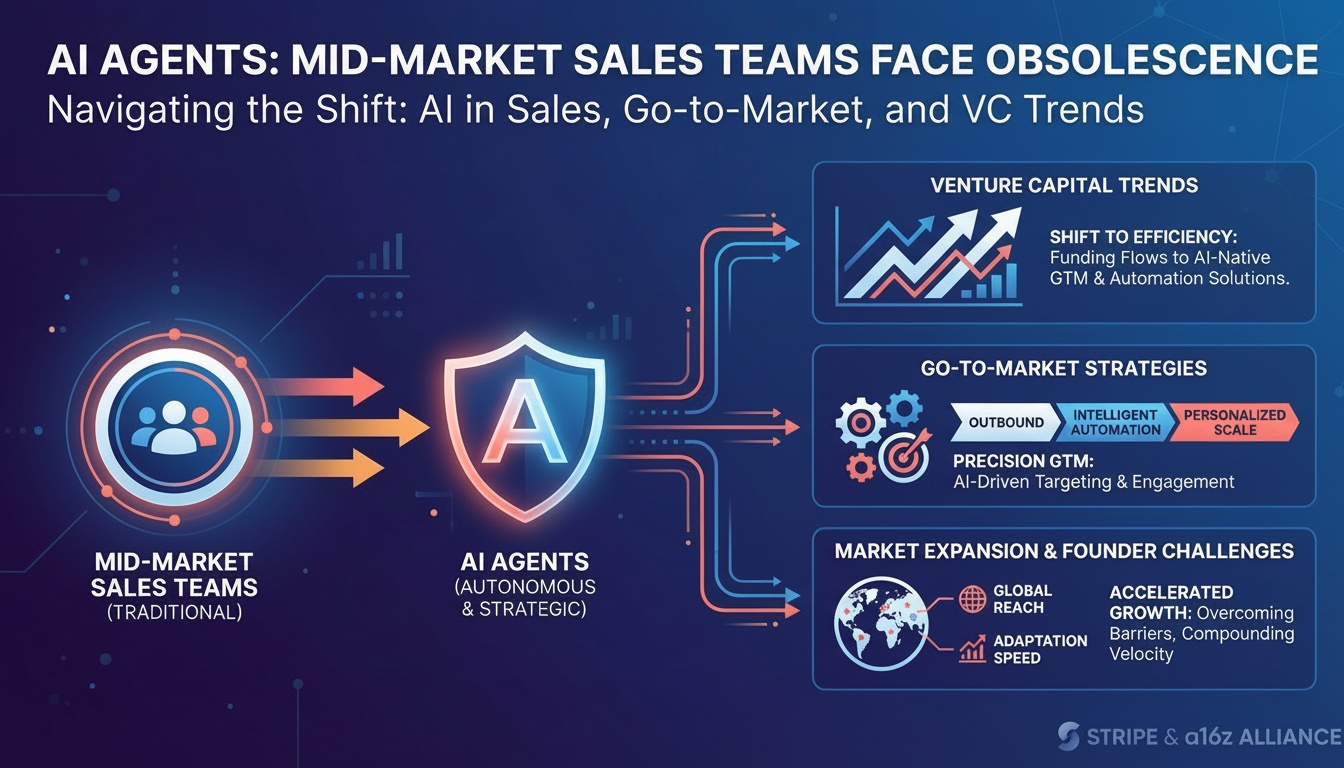
For many mid-market sales teams, AI is the new SDR. The speed at which AI is restructuring workflows and human capital is creating both opportunity and obsolescence faster than many realize.
The Intake
Where capital is flowing. What's getting funded. Insight from operators in the trenches.
This week's pattern recognition:
📊 10 episodes across 8 podcasts
⏱️ 565 minutes with GPs, founders, and LPs
🎙️ The voices: Satya Nadella, David Sacks, Marc Andreessen, Ben Horowitz, Jason Lemkin,
🆕 37 emerging themes on the radar
The Big Shift
AI Isn't Just Enhancing: It's Replacing Mid-Market GTM Roles, Rapidly.
This week's intelligence reveals a critical inflection point in the adoption of AI within go-to-market functions, particularly sales. While much of the conversation around AI has focused on augmentation, we're now seeing clear signals of direct replacement. SaaStr's CEO, Jason Lemkin, took the provocative step of replacing his entire SDR team with highly trained AI agents, citing better performance and lower turnover than human mid-pack reps. This isn't theoretical; it's an actionable decision by a prominent operator known for identifying market shifts. Microsoft's Satya Nadella also echoed this, emphasizing flat headcount growth while increasing output via AI, empowering "full stack builders."
Why it matters: For founders, this recalibrates expectations for GTM strategy and hiring. The "mid-pack" sales role is in terminal decline, which impacts fundraising narratives, capital efficiency, and competitive differentiation. For investors, it signals a need to scrutinize portfolio companies' GTM budgets and AI integration strategies. Those not aggressively deploying AI for efficiency are falling behind.
"Our AI agents are better than a mid pack. Better than the mid pack people I've worked over in my career. These jobs, these mid pack jobs, they're just in terminal decline in gtm. And so we just don't need them." — Jason Lemkin, CEO and Founder of SaaStr on The Official SaaStr Podcast
The move: Audit your GTM team structure and budget. Are you investing in 10x-productive elite reps leveraging AI, or are you still building for a mid-pack that's rapidly being automated?
The Rundown
① Vertical integration is becoming a competitive necessity, not just an option, for D2C brands. Oats Overnight's founder, Brian Tate, revealed they were forced into manufacturing from day one because co-manufacturers couldn't handle their unique product format, giving them unforeseen advantages in product development, supply chain control, and cost savings. (Brian Tate on Consumer VC)
• The signal: VCs evaluating D2C plays should look beyond typical GTM metrics to assess core operational advantages, especially in manufacturing or unique supply chains, that reduce reliance on external, often inflexible, partners.
② The "new computer" (AI) is set to expand market sizes by 10x or more, not just optimize existing ones. Marc Andreessen and Ben Horowitz highlighted that cloud software made on-premise markets 10x bigger, and AI is poised to do the same across industries by solving previously intractable problems. (Marc Andreessen on The a16z Show)
• Why it matters: This isn't just about efficiency; it's about unlocking entirely new demand and market potential. Founders need to articulate how AI expands their addressable market, not just their margins. Investors should focus on models that unlock new solutions vs. incremental improvements.
③ The venture capital world is shifting from founders pitching VCs to VCs actively pitching founders for top deals. Increased competition for high-quality startups means VCs are now "sprinting down to the Starbucks to meet them," emphasizing the need for authentic relationships and differentiated value props beyond just capital. (Isabelle Johannessen on Equity)
"I love the fact that now like when I hear about someone that's interesting, that's doing a, that like sprinting down to the Starbucks to meet them. I love that capital has shifted that way." — Isabelle Johannessen, Host of Equity
• What to watch: This trend intensifies the need for VCs to build strong firm brands and for founders to deeply vet individual investors, not just the firm name, as relationships are paramount.
④ Building a beloved brand can lead to profound personal and financial distress for founders, a hidden cost rarely discussed. Joan Barnes' journey with Gymboree, despite its eventual $1.8 billion acquisition, highlights financial struggles, trademark issues, and severe health consequences, serving as a cautionary tale of entrepreneurial growth. (Joan Barnes on How I Built This with Guy Raz)
• Why it matters: This serves as a critical reminder for investors to balance growth demands with founder well-being, and for founders to proactively build support systems.
⑤ AI-driven growth means "revenue and profit with flat headcount" is the new paradigm for tech giants. Microsoft CEO Satya Nadella articulated a strategy of increasing output significantly without needing to grow the employee base, leveraging AI to boost individual productivity and create "full stack builders." (Satya Nadella on All-In with Chamath, Jason, Sacks & Friedberg)
• The signal: This model, pioneered by hyper-efficient tech leaders like Microsoft, will cascade down to startups, changing future hiring norms and the definition of scale. Investors should look for founders building for this reality.
Capital Signals
🔥 HOT
• AI Agents in GTM: Rapidly replacing human SDRs in mid-market roles due to higher efficiency and lower turnover. (Jason Lemkin on SaaStr)
• Global Talent for Leadership Roles: Executive-level roles are being filled more effectively and affordably with international talent, beyond just back-office outsourcing. (Nick Huber on My First Million)
👀 EMERGING
• 🆕 Prediction Markets (Regulated): Kalshi's legal victories are legitimizing the space, forcing competitors into similar regulated approaches and attracting mainstream attention. (Tarek Mansour on Pivot)
• 🆕 Salesforce as AI Agent Hub: Experiencing a renaissance as the central integration platform for various AI agents, driven by the need for unified data. (Jason Lemkin on SaaStr)
🧊 COOLING
• Mid-Pack SDR Roles: In "terminal decline" as AI agents prove more efficient at outreach and lead qualification. (Jason Lemkin on SaaStr)
• Traditional Cold Inbound Pitches (VC): Rendered "indistinguishable noise" by AI, making unsolicited outreach ineffective without prior relationship. (Ross Fubini on Equity)
⚠️ CROWDED
• AI Infrastructure Funding: While still hot, the focus is shifting to how it expands markets, not just optimizes existing ones; commoditization of LLMs is forecast. (Ben Horowitz on The a16z Show; Satya Nadella on All-In with Chamath, Jason, Sacks & Friedberg)
The Debate
Is human expertise still the ultimate resource, or is hyper-resourcefulness the only resource you need in the age of AI?
🐂 The bull case:
"The only resource you need is resourcefulness. If you're just lit on fire to do something, you just ask yourself the following question: Can I not achieve anything I want?" — Shaan Puri, Host at My First Million
🐻 The bear case:
"If you took the 300 people in this room, the brain power in this room that we're just spending on this like, you know, 10 hour tournament here, we could cure cancer." — Demis Hassabis, Founder of DeepMind on My First Million
Our read: While individual resourcefulness remains a founder's superpower, the sheer computational and intellectual firepower of elite AI and human teams (like DeepMind) is demonstrating that some problems still require immense, concentrated resources. The question isn't solely about individual drive, but how that drive can effectively leverage concentrated, high-quality resources (whether human or AI) to tackle truly ambitious problems.
The Bottom Line
The rapid acceleration of AI is fundamentally reshaping GTM, operational efficiency, and even the "rules" of competitive market expansion, forcing founders and investors to adapt to a landscape where flat headcounts and 10x market growth are the new normal.
🎯 Your Move
- Re-evaluate GTM hiring models: Challenge traditional SDR structures; assess where AI agents can drive superior efficiency and leverage human expertise for high-value tasks.
- Scrutinize operational advantages in D2C deals: Look beyond brand and marketing to identify unique production or supply chain integrations that offer defensibility and cost control.
- Vet investor relationships deeper: Understand that capital is a commodity; prioritize individual investor fit and their unique value-add beyond just the fund's name.
What We Listened To
1. When everything works, you learn the wrong lessons
Runtime: 57 min Guests: Shaan Puri (Host, My First Million), Nick Huber (Founder, Sweaty Startup) Vibe: Candid reflections on entrepreneurial humbling and practical remote hiring
Key Signals:
- Hiring for Leadership Remotely: The conversation challenges the notion that only junior roles can be outsourced, instead emphasizing that executive-level operational roles can be filled more effectively and affordably with international talent through objective, task-based assessments.
- Entrepreneurial Plateaus: The hosts and guest candidly discuss the current market's challenges, noting that the "easy money" of 2020-2022 is over, and founders who succeeded then may face humbling lessons in 2024-2025.
- AI Energy Consumption : A surprising bearish take on AI's sustainability, touching on concerns that massive energy increases will lead to decreased quality of life and higher energy costs, despite widespread hype.
"Business is hard. It's not the same as it was five years ago. 2024, 2025 are not the same as 2022, 2023 for any entrepreneur I know." — Nick Huber, Founder of Sweaty Startup
2. Microsoft CEO Satya Nadella on AI's Business Revolution: What Happens to SaaS, OpenAI, and Microsoft? | LIVE from Davos
Runtime: 32 min Guests: Satya Nadella (CEO, Microsoft), Jason (Host, All-In Podcast, LLC), David Sacks (Host, All-In Podcast, LLC) Vibe: Visionary insights from a tech titan on AI's market restructuring
Key Signals:
- Revenue Growth with Flat Headcount: Microsoft's strategy of achieving significant revenue and profit growth since the late 2010s to 2020s by maintaining a flat headcount through structural workflow changes and empowering 'full stack builders' via AI.
- Commoditization of LLMs: Nadella predicts that Large Language Models will largely be commoditized, similar to the database market, with a proliferation of both closed-source frontier models and open-source alternatives.
- AI-Accelerated Onboarding: Microsoft is experimenting with new apprenticeship models for college hires, where senior developers mentor cohorts, teaching them to leverage AI in their craft to accelerate learning and proficiency.
"Empowering an existing employee with these tools is so much easier than hiring and mentoring and bringing up the next generation." — Satya Nadella, CEO of Microsoft
3. SaaStr 838: The Present and Future of AI in Sales and GTM with SaaStr's CEO and Owner's CRO
Runtime: 56 min Guests: Jason Lemkin (CEO and Founder, SaaStr), Kyle Norton (CRO, Owner), Kyle (CRO, Owner.com) Vibe: Provocative and hands-on take on AI's disruptive impact on sales
Key Signals:
- AI Replacing SDRs: SaaStr's CEO replaced his entire SDR team with 20 AI agents, claiming they outperform mid-pack human reps due to turnover and inefficiency, signaling a terminal decline for these specific roles.
- Leaders Must Deploy AI Personally: A strong call for GTM leaders to personally get involved in training and deploying AI agents, as delegating this will lead to obsolescence and a lack of understanding of AI's capabilities.
- Salesforce's AI Renaissance: Salesforce is experiencing a significant resurgence by becoming the central hub for integrating various AI agents, driven by the need for a unified data repository for autonomous AI deployments.
"If you don't roll up your sleeves in the age of AI and AigTM, you will become obsolete. Find one tool that you believe in based on a demo and some research and then deploy it yourself." — Jason Lemkin, CEO and Founder of SaaStr
4. Ben & Marc: Why Everything Is About to Get 10x Bigger
Runtime: 58 min Guests: Marc Andreessen (Co-founder, a16z), Ben Horowitz (Co-founder, a16z), Packy McCormick (Founder, Not Boring), Erik Torenberg (General Partner and Host, a16z) Vibe: Grand vision of how AI will multiply market sizes and transform VC
Key Signals:
- AI as the "New Computer": The assertion that the new computer (AI) is 'far better' than the last 50 years of computing, allowing for the potential solution of 'almost every problem in the world,' implying a radical and immediate technological discontinuity.
- 10x Market Expansion: The belief that AI will drive 10x, 100x, or even 1000x expansions in market sizes, similar to how cloud software outsized on-premise solutions.
- The Power of VC Reputation: The original goal of building a 'dominant venture brand' for Andreessen Horowitz was not for ego, but to provide portfolio companies with a 'slingshot' of reputation and connections during critical growth phases, effectively transferring power.
"If you compared the on premise software companies to the cloud software companies... the cloud version was just ten times bigger." — Ben Horowitz, Co-founder of a16z
5. Gymboree: Joan Barnes. How Building a Beloved Brand Nearly Destroyed Its Founder
Runtime: 80 min Guests: Guy Raz (Host, Wondery), Joan Barnes (Founder, Gymboree), Max Shapiro, Bud Jacob Vibe: A humbling and honest recount of entrepreneurial highs and lows
Key Signals:
- Brand Name Validation Challenges: The original Kindergym name was rejected for trademarking, forcing a rebrand to Gymboree after several years of operation and press attention, highlighting the critical importance of early IP validation.
- Unsustainable Franchise Model: Despite widespread popularity, Gymboree was on the brink of financial collapse due to a fundamentally unsustainable franchise revenue model, forcing a pivot to retail.
- High Personal Cost of Entrepreneurship: Founder Joan Barnes sold a significant portion of her equity for $1 million while in a treatment center for an eating disorder, highlighting the severe personal toll of rapid growth.
"One thing I will say is that it's best to start a business when you're young and ignorant, because I just figured I could figure it out, you know, I mean, when I look back at all the things that I sort of figured out, Amazing." — Joan Barnes
6. Betting on Reality with Kalshi CEO Tarek Mansour: ACCESS
Runtime: 67 min Guests: Alex (Host, New York Magazine), Ellis (Host, New York Magazine), Tarek Mansour (Co-founder and CEO, Kalshi) Vibe: A deep dive into prediction markets and the complexities of regulatory frameworks
Key Signals:
- Regulation as a Differentiator: Kalshi's "regulatory first" principle and subsequent legal victory against the government not only legitimized their operation but also benefited competitors by establishing a regulatory pathway for the entire prediction market space.
- Building Product Under Prohibition: The unique challenge of building a product that the internal team is legally prohibited from using themselves, emphasizing the extreme need for intense customer proximity and feedback.
- Investor Pressure for Narrative: The increasing emphasis placed on founders to be compelling storytellers, particularly in an era of AI where product differentiation can be subtle, highlighting a shift in venture expectations.
"It's hard to build a product when you can't actually really use it... you just have to really be at all times as close as possible to the customer to basically figure out like what you need to build and how to make it better and what are the points of friction." — Tarek Mansour, Co-founder and CEO of Kalshi
7. Build Mode: Capital is a commodity (but your investor relationships aren’t)
Runtime: 45 min Guests: Isabelle Johannessen (Host, Build Mode), Ross Fubini (Founder and General Partner, XYZ Ventures), Leslie Feinzaig (Founder and General Partner, Graham & Walker Ventures), Eddie (Investor, Scale Venture Partners), Amanda Bell (Team Member, XRC Ventures) Vibe: Insider perspectives on VC fundraising and founder-investor dynamics
Key Signals:
- VCs Pitching Founders: The evolving VC landscape now sees VCs actively pitching founders due to increased competition for top deals, shifting the power dynamic and requiring VCs to demonstrate differentiated value.
- AI-Driven Cold Pitch Ineffectiveness: AI has made 'perfect' cold inbound pitches so common they've become indistinguishable noise, rendering unsolicited outreach ineffective for VCs to sort through.
- Founder-Operator VC Empathy: A rare quality among VCs is having personally raised capital for their own funds, giving founder-operators like Ross and Leslie a unique empathy and understanding of the founder journey.
"My own view is that you have to have a shtick like something you believe that's like you fit uniquely in people's brains. That's different." — Ross Fubini, Founder and General Partner at XYZ Ventures
8. 10 Years of Money Wisdom in 51 Minutes | Morgan Housel
Runtime: 54 min Guests: Morgan Housel (Author of The Psychology of Money and The Art of Spending Money, Author), Sam Parr (Host, My First Million), Shaan Puri (Host, My First Million) Vibe: Timeless wisdom on wealth building, psychology, and personal finance
Key Signals:
- The Extremes of Compounding: Warren Buffett made 99% of his net worth after his 60th birthday, powerfully illustrating the extreme, non-linear returns of long-term compounding rather than early-career financial genius.
- Behavioral Investing Superiority: A "country bumpkin with good investing behavior" can significantly outperform a Harvard-educated Goldman Sachs MBA, highlighting the overwhelming importance of behavioral discipline over intellectual prowess in finance.
- Financial Independence vs. Performance: The damage caused by societal pressure that ties self-worth to ever-increasing income, advocating instead for financial independence for personal freedom.
"If you look at his net worth, 99% of it came after his 60th birthday." — Morgan Housel, Author of The Psychology of Money and The Art of Spending Money
9. Story Of The Most Important Founder You've Never Heard Of
Runtime: 60 min Guests: Sam Parr (Host, Hubspot Media), Shaan Puri (Host, Hubspot Media), Demis Hassabis (Founder, DeepMind), Mark Manson (Author and Podcaster) Vibe: A deep dive into the visionary founder behind DeepMind and the future of AI
Key Signals:
- AI Beyond Augmentation: Demis Hassabis's unwavering conviction that AI is not just another tech, but "the most important invention humans will ever make," positioning it as an artificial general intelligence that's the "last invention."
- Resourcefulness Over Resources: DeepMind's early development demonstrated that teaching AI to learn complex strategies with minimal human input (e.g., just score as feedback) fosters novel, unforeseen solutions, reinforcing that resourcefulness can trump sheer resources.
- AI for Drug Discovery: The profound impact of DeepMind's AlphaFold, which freely provides a protein database to researchers, and the launch of Isomorphic Labs to solve all disease—signaling a major shift in pharmaceutical R&D.
"What we're building will be the most important invention humans will ever make. It will be the last invention. It's artificial general intelligence." — Demis Hassabis, Founder of DeepMind
10. From World-Class Poker Player to DTC Powerhouse ft. Brian Tate
Runtime: 56 min Guests: Brian Tate (Founder and CEO, Oats Overnight), Mike Gelb (Host, Consumer VC), Mike (Host, Consumer VC: Venture Capital I B2C Startups I Commerce | Early-Stage Investing I Brands | Technology) Vibe: A founder's journey from professional poker to DTC success
Key Signals:
- Involuntary Vertical Integration: Oats Overnight was forced into vertically integrating manufacturing from day one due to a lack of co-manufacturer interest in their unique product format, which unexpectedly provided critical advantages in product development and supply chain control.
- Rapid D2C to Retail Expansion: The company prioritizes broad national retail expansion, leveraging existing D2C brand awareness, rather than a traditional phased regional rollout, reflecting a shift in how established D2C brands approach physical retail.
- Poker Mindset in Entrepreneurship: The founder's background as a professional poker player instilled an iterative, risk-controlled approach to building the company, emphasizing constant testing and learning across all business elements.
"Iterative is one of our core values and happy to chat more on that. But we, we test and learn everything, you know, iterative with every single element of the business." — Brian Tate, Founder and CEO of Oats Overnight