
THIS WEEK'S INQUIRY
📚 8 conversations with 5 thinkers
⏱️ ~12 hours of long-form intellectual exploration
🎙️ Featuring: Andrew Huberman, James Clear, Arthur Brooks, Stephen Batchelor, Joe Hudson, Ranjay Gulati
The ideas worth your attention. Here's what we're thinking about.
THE HIDDEN ARCHITECTURE OF HABITS, ATTENTION, AND COURAGE: Why What You Think You're Doing Isn't What You're Actually Building
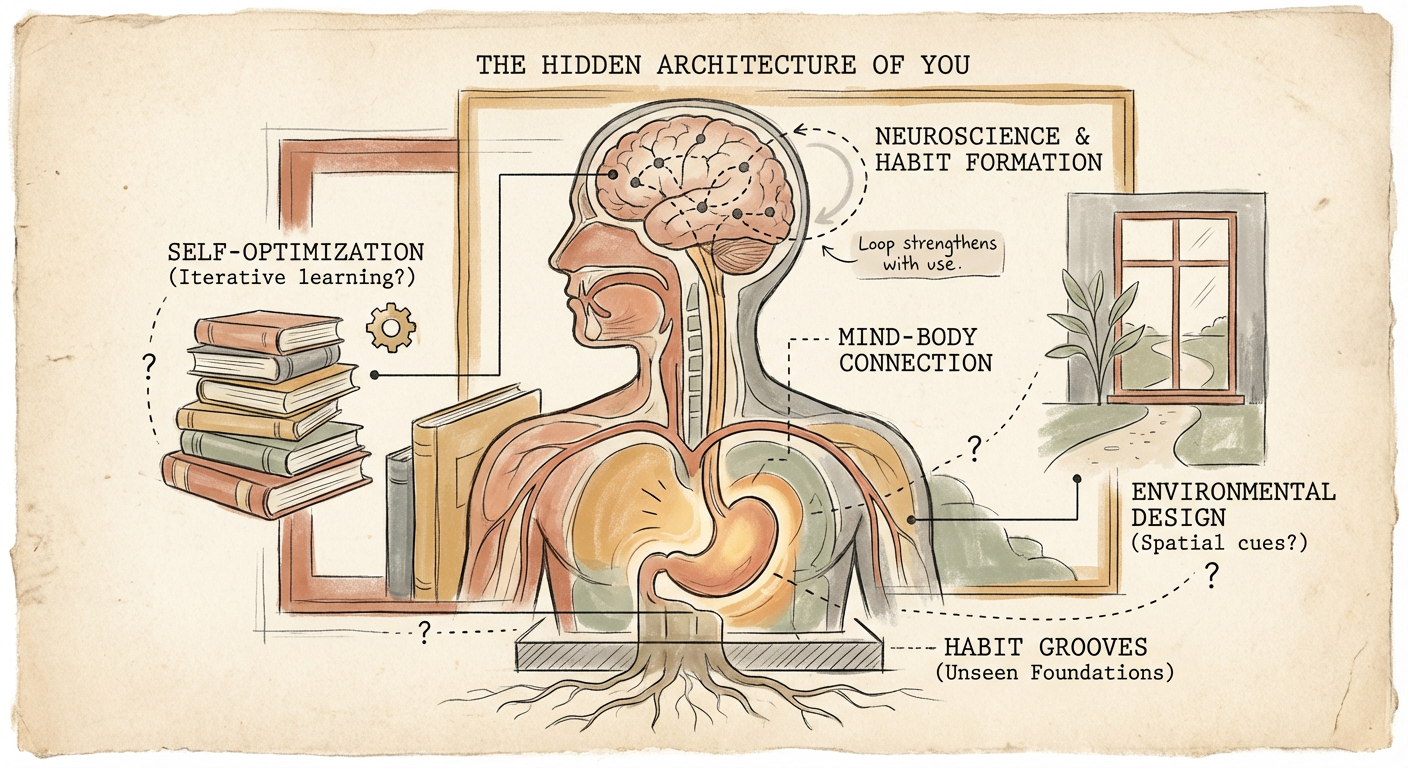
We live in an era obsessed with optimization. Biohacking our cortisol, perfecting morning routines, decluttering our workspaces. But what if our focus on what we're doing is missing the deeper architecture of how we develop, maintain, and even fight ourselves? This week, our deep dive reveals a profound, almost invisible, stratum governing our lives: the subtle, often unconscious systems that dictate our habits, direct our attention, and ultimately determine our trajectory.
The smartest thinkers aren't just giving us hacks; they're revealing a hidden operating system. We're not merely forming habits; we're building identity. We're not just optimizing focus; we're choreographing our cognitive landscape. And when we summon courage, we're not suppressing fear—we're creating the space to choose despite it.
This edition explores the hidden levers that truly change our lives—from the environmental cues that dictate our daily actions to the philosophical questions that reshape our entire understanding of self. What emerges is a powerful, integrated view of self-improvement that goes far beyond surface-level techniques, inviting us to question the very systems that govern our ability to learn, focus, and, ultimately, flourish.
CONVENIENT TRUTHS: THE INSIDIOUS PLEASURE OF AVOIDING SELF-EXAMINATION
Often, we gravitate towards solutions that soothe rather than challenge. This week, a powerful undercurrent revealed itself: the human tendency to avoid deep self-interrogation in favor of quick fixes or external blame. Joe Hudson's journey from a rebellious youth to self-awareness and Stephen Batchelor's call to cultivate doubt both highlight how societal narratives and personal convenience often shield us from uncomfortable truths about ourselves and our systems.
The conventional view is that if something's not working, we need to try harder, optimize more, or find a new "hack." But what if the deepest obstacle isn't a lack of effort, but a reluctance to look inward and scrutinize our own operating principles? Many avoid asking "What is this?" of their own life and beliefs, preferring the certainty of what they already 'know' or the comfortable distraction of external problems.
"I ripped that open when I said, okay, I don't have to be who I think I am. I can die or be. Find out what's underneath this stuff." — Joe Hudson, The Art of Accomplishment
The tension here is profound: society often rewards confident proclamation over humble inquiry. Yet, genuine growth, as Hudson and Batchelor suggest, seems disproportionately linked to embracing uncertainty and tearing down preconceived notions of self. The implication is that true self-improvement isn't about incremental gains within an existing framework, but about courageously dismantling and rebuilding the framework itself, embracing the grief that comes with shedding old identities. This challenges the popular "motivation porn" narrative, suggesting that vulnerability and doubt are far more potent engines for change than relentless positivity.
THE BIOLOGY OF BEHAVIOR: WHY PSYCHOLOGY ISN'T JUST IN YOUR HEAD
The conversation around self-improvement often divorces mind from body, treating psychology as a purely abstract domain. This week, Dr. Andrew Huberman and Arthur Brooks emphatically remind us that "Psychology is biology." Our emotional states, our ability to focus, our sleep quality—these aren't just mental phenomena; they are direct outputs of intricately balanced biological systems, particularly hormonal and environmental ones.
The prevailing notion is that we can think our way out of problems like stress or lack of focus. Huberman, however, foregrounds the critical role of cortisol timing, light exposure, and even physical workspace design in shaping our cognitive and emotional lives. Brooks echoes this, explaining how even complex emotions like grief are rooted in evolutionary biology, and how "the functioning of the limbic system of your brain where you're having positive and negative emotions all day long, that's biology."
"Cortisol's job is to deploy energy sources for your brain and body to be able to react to things, think, and move. Spiking your cortisol in that first hour after waking is so, so important because that negative feedback loop mechanism kicks in about three hours after you've been awake." — Andrew Huberman, Modern Wisdom
This perspective challenges the efficacy of purely cognitive approaches to well-being if they ignore the underlying biology. It's not enough to want to be productive if your cortisol curve is flatlining. It's not enough to try to be happy if your sleep hygiene is destroying your limbic system's regular function. The implication is a paradigm shift: optimize your biology first, and your psychology will follow. This framework also urges us to integrate knowledge across traditionally siloed domains like neuroscience, endocrinology, and environmental psychology for a truly holistic approach to human performance.
COURAGE AS ARCHITECTURE: THE SPACE BETWEEN FEAR AND ACTION
We treat courage like a character trait—something you either have or you don't. Ranjay Gulati, in conversation on Hidden Brain, dismantles this mythology. Courage, he argues, isn't the absence of fear. It's a choice made in the presence of fear. And that choice requires something specific: space.
This connects directly to Batchelor's insight that uncertainty "gives you time to ponder, to reflect, to think." The person who cultivates doubt—who asks "What is this?" rather than rushing to resolution—creates the cognitive and emotional room to act despite fear. The person who demands immediate certainty collapses that space. They conflate feeling scared with being stopped.
"Just because you're scared doesn't mean you do nothing. You can be scared and still courageous." — Ranjay Gulati, Hidden Brain
The architecture of courage, then, isn't about building up reserves of bravery like a battery. It's about designing the pause between stimulus and response—what Viktor Frankl called "the last of the human freedoms." Gulati distinguishes between moral courage (standing up for principles) and practical courage (taking smart risks for growth), but both require the same underlying structure: the capacity to sit with discomfort long enough to choose.
This reframes fear entirely. It's not a stop sign. It's data—a signal that something meaningful is at stake. The question isn't "How do I stop being afraid?" but "What system do I need to make the choice anyway?"
THE SYSTEM IS THE SOLUTION: MOVING BEYOND WILLPOWER AND GOALS
We are culturally conditioned to believe that success comes from willpower, setting big goals, and pushing through. This week, James Clear, author of Atomic Habits, challenges this deeply ingrained belief, arguing that "if you're struggling to improve, the problem isn't you. The problem is your system." He advocates for a profound reframing of how we approach personal growth: from an individualistic struggle of motivation to an environmental engineering challenge.
The conventional wisdom is that we need to force ourselves to adopt good habits and resist bad ones. Clear, however, emphasizes that habits are solutions to recurring problems, and our environment often dictates which solutions we default to. He introduces the "4 Laws of Behavior Change" (make it obvious, attractive, easy, satisfying) as a framework to design environments that make desired behaviors inevitable and undesired ones impossible. His core insight is that small, consistent architectural changes yield compounding returns, making us "37.78 times better" over a year.
"The magic and the importance of starting, mastering that five minute window, or sometimes even like that 30 second window of choosing to start and making it easy to start, that I would say is the sing..." — James Clear, Huberman Lab
This perspective is powerful and counterintuitive for many who've internalized personal failure as a sign of moral weakness rather than systemic friction. It shifts the burden from internal grit to external design, empowering individuals to reshape their world rather than constantly battling their nature. The implication is that our personal and professional development hinges less on heroic self-discipline and more on strategic automation and frictionless environments. It also means that when a goal feels daunting, the path forward isn't to work harder, but to simplify the first action so profoundly that it becomes easier to do than not to do.
THE QUESTION WORTH ASKING
What is the unseen cost of our certainty?
In a world drowning in data, opinions, and instant answers, a powerful thread from this week asks us to cultivate radical doubt. Stephen Batchelor's emphasis on "What is this?" and the recurring theme of uncertainty as a virtue raise a critical question: What are we losing by constantly seeking resolution and certainty, both in our personal lives and our intellectual pursuits?
Gulati's work suggests one answer: we're losing courage. When we demand that fear resolve before we act, we never act. When we require certainty before we inquire, we never learn. The architecture of growth—whether biological, behavioral, or psychological—seems to require tolerance for ambiguity as a load-bearing wall.
Are we unwittingly sacrificing depth, wisdom, and genuine understanding for the comfort of quick conclusions and resolved narratives? The smartest people seem to be quietly wrestling with this—recognizing that the rush to "know" might be blinding us to richer, more complex realities.
IF YOU WANT TO GO DEEPER
📖 Atomic Habits by James Clear — The foundational text for understanding how small, intentional changes to systems, not willpower, drive monumental personal transformation.
📖 The Untethered Soul by Michael A. Singer — Explores how to detach from internal struggles and engage with consciousness on a deeper level, resonating with Joe Hudson's journey of self-discovery.
📖 Why We Sleep by Matthew Walker — A comprehensive guide to the biological imperatives of sleep, complementing Huberman's insights on cortisol and brain optimization.
🎧 "Great Doubt" (2015) by Stephen Batchelor, recorded at Upaya Zen Center — An extended exploration of Batchelor's philosophy, offering deeper context to his conversation with Ezra Klein.
🎧 Hidden Brain: "You 2.0: Cultivating Courage" — The full conversation with Ranjay Gulati on reframing fear as opportunity.
THE CONTRARIAN CORNER
While the self-improvement space often champions self-reliance, the contrarian view emerges from the intersection of habit formation and biological optimization: total dependence on systems. It suggests that rather than strengthening willpower, we should actively remove the need for it by meticulously designing our environments.
The truly subversive idea is that relying less on our conscious effort and more on the invisible architecture of our surroundings is the path to greatest freedom and efficacy. This runs counter to the romanticized ideal of the individual conquering adversity through sheer grit. Even courage—that most personal of virtues—turns out to be less about internal fortitude and more about creating the conditions where choice remains possible.
THE BOTTOM LINE
You are not fighting yourself; you are interacting with a complex biological and environmental system. The truly transformative work isn't about pushing harder, but about understanding the hidden operating principles of your body, your mind, and your surroundings. Courage isn't a trait you summon—it's a space you create. What small, almost imperceptible shift in your system could yield exponential returns?
📚 APPENDIX: EPISODE COVERAGE
1. Hidden Brain: "You 2.0: Cultivating Courage"
Guests: Ranjay Gulati (Behavioral Scientist, Harvard Business School Professor) Runtime: 28 mins | Vibe: Inspiring guide to personal heroism
Key Signals:
- Courage as a Choice: Gulati debunks the notion of courage as an innate trait, emphasizing it as a deliberate choice made in the presence of fear, not its absence. This reframes fear as an opportunity for courageous action rather than a deterrent.
- Moral and Practical Courage: The discussion differentiates between moral courage (standing up for principles) and practical courage (taking smart risks for growth), highlighting how both are essential and can be cultivated through deliberate practice.
- The Power of "Just Because": The episode advocates for pushing past rationalizations and self-doubt, suggesting that often, the only reason needed to act courageously is "just because." This encourages ownership and direct action despite trepidation.
"Just because you're scared doesn't mean you do nothing. You can be scared and still courageous."
2. Modern Wisdom: "#1042 - Dr Andrew Huberman - How to Reclaim Your Brain in 2026"
Guests: Dr. Andrew Huberman (Neuroscientist, Stanford Professor) Runtime: 1:52:00 | Vibe: Biologically-driven optimization blueprint
Key Signals:
- Cortisol's Dual Role: Cortisol is essential for waking energy and stress response, but its timed release (high in morning, low at night) is crucial for optimal function. Incorrect timing leads to burnout and impaired decision-making.
- Morning Light Non-Negotiable: Spiking cortisol in the first hour of waking via bright light exposure sets the body's internal clock and improves sleep, mood, and focus later in the day. This is a foundational biological lever.
- Purposeful Stress: Deliberate, acute stressors (like cold exposure) can be hormetic, strengthening the system, but chronic, unmanaged stress is highly detrimental, particularly on brain health and longevity.
"Cortisol's job is to deploy energy sources for your brain and body to be able to react to things, think, and move."
3. The Art of Accomplishment: "How I Learned To Stop Fighting Myself"
Guests: Joe Hudson (Co-founder, The Art of Accomplishment) Runtime: 51:17 | Vibe: Raw, honest journey of existential transformation
Key Signals:
- Identity Beyond Self-Image: True personal growth involves confronting and dismantling deeply ingrained self-perceptions, recognizing that one's current identity is often a construct that can be outgrown.
- Grief as a Catalyst: Shedding old ways of being or false identities necessitates a period of grief, and engaging with this emotional process is vital for successful transformation rather than fighting it.
- Embodied Exploration: Self-exploration moves beyond intellectual understanding to include embodied practices, recognizing that deep insights and changes often reside in the physical and felt experience.
"I ripped that open when I said, okay, I don't have to be who I think I am. I can die or be. Find out what's underneath this stuff."
4. The Ezra Klein Show: "This Question Can Change Your Life"
Guests: Stephen Batchelor (Buddhist teacher, author) Runtime: 1:17:00 | Vibe: Philosophically profound, subtly disruptive
Key Signals:
- Virtue of Doubt: Instead of seeking definitive answers or clinging to beliefs, actively cultivating doubt and uncertainty opens up space for deeper inquiry, wisdom, and ethical action.
- "What is this?" as a Practice: Repeatedly asking "What is this?" without expectation of an answer is a form of self-inquiry rooted in Buddhist meditation and Socratic questioning, fostering openness and presence.
- Non-Resolution for Flourishing: Embracing existential ambiguity and refusing to prematurely resolve complex questions can lead to a more open, ethical, and flourishing life than one built on rigid certainties.
"Great doubt, great awakening, little doubt, little awakening, no doubt, no awakening."
5. Huberman Lab: "Essentials: Optimizing Workspace for Productivity, Focus & Creativity"
Guests: Andrew Huberman (Neuroscientist, Stanford Professor) Runtime: 1:55:00 | Vibe: Science-backed environmental engineering for peak performance
Key Signals:
- Light and Screen Placement: Strategic placement of screens and managing light exposure throughout the day directly influence alertness, cognitive function, and circadian rhythm, overriding perceived demands of tasks.
- Visual Refresh for Focus: Regular visual breaks incorporating vergence-divergence eye movements (e.g., looking far into the distance) are critical to prevent eye strain and maintain sustained focus, not just screen breaks.
- Environmental Acoustics: Specific sound patterns like 40Hz binaural beats can enhance cognitive performance and memory, while general white noise is often ineffective or even detrimental for concentration.
"For every 45 minutes in which you are focusing on something like a phone or a tablet or a book page or your computer, you want to get into magnocellar panoramic vision for at least five minutes."
6. Modern Wisdom: "#1043 - Arthur Brooks - 14 Habits for an Optimised Morning & Evening Routine"
Guests: Arthur Brooks (Professor at Harvard University, happiness researcher) Runtime: 1:49:00 | Vibe: Insights into happiness, human behavior, and life-changing routines
Key Signals:
- Psychology is Biology: Emotions and psychological states are fundamentally rooted in biological functioning, particularly the limbic system, challenging purely cognitive-centric views of happiness and suffering.
- High Affectivity: Individuals can experience both high positive and high negative emotions, indicating a biological predisposition, rather than a contradiction. Understanding this helps manage emotional volatility.
- Avoiding Worldly Idols: Aquinas's four worldly idols (money, power, pleasure, fame) are discussed as common traps leading to unhappiness, especially for high achievers who mistake these for true fulfillment.
"Psychology is biology. The functioning of the limbic system of your brain where you're having positive and negative emotions all day long, that's biology."
7. Huberman Lab: "Best Ways to Build Better Habits & Break Bad Ones | James Clear"
Guests: James Clear (Author, Atomic Habits) Runtime: 2:10:00 | Vibe: Deep dive into practical habit psychology and environmental design
Key Signals:
- Identity-Based Habits: Lasting habit change is achieved by first identifying with the desired persona (e.g., "I am a runner") rather than solely focusing on the outcome (e.g., running a marathon).
- Environmental Design: Habits are heavily influenced by environmental cues. Designing spaces to make desired actions obvious, attractive, and easy is far more effective than relying on willpower.
- Starting is Key: The most critical moment in habit formation is the "first two minutes" or even shorter. Making the initial step incredibly easy and accessible bypasses mental friction and builds momentum.
"Habits are solutions to the recurring problems in our environment."
8. The Mel Robbins Podcast: "How to Become 37.78 Times Better at Anything"
Guests: James Clear (Author, Atomic Habits) Runtime: 50:00 | Vibe: Empowering, practical, system-focused
Key Signals:
- Compounding of Small Gains: Consistent, minor daily improvements (e.g., 1%) lead to exponential, unintuitive results over time, vastly outperforming rare, large efforts.
- System Over Willpower: The primary obstacle to habit formation isn't a lack of motivation but a poorly designed system; modifying the environment is more effective than relying on sheer willpower.
- Adaptability in Habit Formation: Habits aren't rigid rules but adaptable systems. The "never miss twice" rule emphasizes accepting occasional deviation while preventing complete derailment.
"If you get 1% better each day for a year... you get 37.78 times better by the end of the year."