
🧠 Thinkers' Soup
November 24, 2025
The ideas shaping our world — distilled from the conversations that matter
1. THE BIG PICTURE
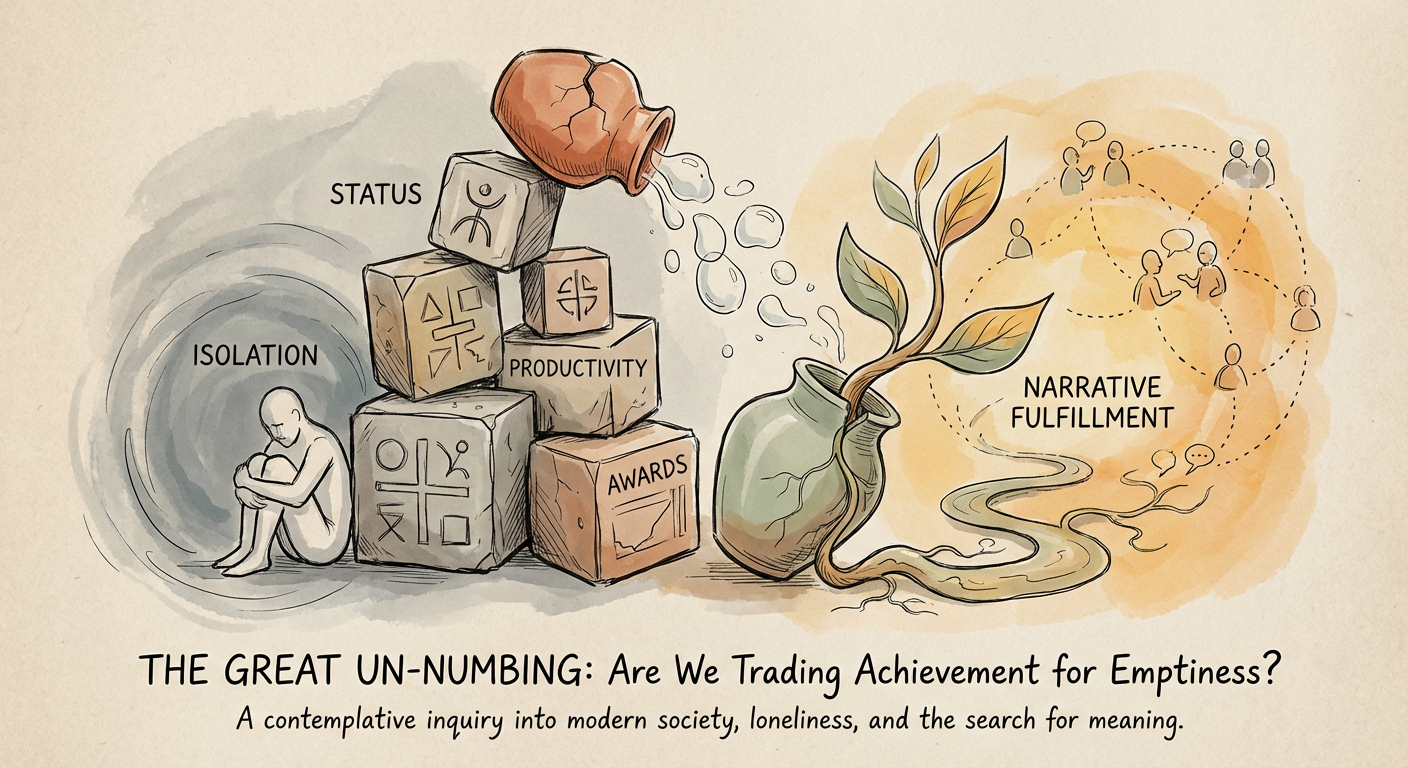
If there is a single scream echoing through this week’s conversations, it is the collision between achievement and emptiness. We are witnessing a fascinating pincer movement on the modern soul. On one flank, we have the high-performers—musician Jon Bellion (on Modern Wisdom) and performance coach Jim Murphy (on The Knowledge Project)—frankly admitting that getting everything you want (fame, money, gold medals) often feels like a funeral for your actual life. They argue that we have mistaken "winning" for "living."
On the other flank, we have the structuralists—guests on Ezra Klein and The Glenn Show—arguing that we have architected a society of profound isolation and coarseness. We built suburbs that killed "hanging out," we created campuses that punished nuance, and we fed a digital beast that rewards profanity over profundity. The collective diagnosis? We are lonely, exhausted perfectionists trying to win games that no longer matter. The prescription? A radical return to the mundane, the relational, and the brave act of rewriting our own internal stories.
2. INDIVIDUAL CONVERSATION DEEP-DIVES
🏆 THE HOLLOW TROPHY
Jim Murphy on The Knowledge Project
The Thesis: The pursuit of extraordinary performance often destroys the performer because they are fueled by "dirty fuel" (fear, ego, trauma) rather than "clean fuel" (love, presence, purpose).
Key Insights:
- Clean vs. Dirty Fuel: Most high achievers run on dirty fuel—the chip on the shoulder, the fear of irrelevance. It works for results, but it burns out the engine (the human). Clean fuel is renewable and comes from being fully present and detached from the outcome.
- The Competitor's Trap: Talented people get addicted to the feedback loop of achievement. They win, get a dopamine hit, and immediately set a higher goal to feel okay again. It is a cycle of "next, next, next" that prevents them from ever feeling fully alive.
- Selfless is Fearless: Fear is fundamentally a self-centered emotion (worrying about my future, my image). To enter a flow state ("the zone"), you must lose the self. You cannot be terrified of losing if you aren't thinking about yourself.
The Uncomfortable Part: Murphy suggests that your ambition might actually be a trauma response. That drive you’re so proud of? It might just be a sophisticated way of screaming that you don't feel like you're enough.
"I realized that what I've always really wanted is to feel fully alive. I had a single story for my life... if you get this American Dream... that's the best possible life... I played five years in the minors and I did not get that life. And I was completely devastated."
👻 THE ARCHITECTURE OF LONELINESS
Sheila Liming on The Ezra Klein Show
The Thesis: Loneliness isn't just a feeling; it is a structural outcome of how we have designed modern housing, labor, and social lives. we have traded the friction of community for the control of isolation.
Key Insights:
- The Loss of "Hanging Out": We have lost the ability to spend time with people without an agenda. "Hanging out" requires daring to do nothing in the company of others. When we schedule everything, we kill the intimacy that comes from boredom and spontaneity.
- The Illusion of Control: We moved into single-family homes and away from communal living because we wanted to control our environments (no dirty dishes in the sink). But we bought that control at the price of isolation.
- Class Migration: The higher your education and income, the farther you likely live from your family. We have normalized a "tracking" existence where we chase career opportunities at the expense of our root systems.
The Uncomfortable Part: We claim we hate loneliness, but we keep choosing short-term convenience over long-term connection. We prefer the certainty of being alone in a clean house to the messy, annoying friction of being in community.
🎤 THE ART OF THE WALK-AWAY
Jon Bellion on Modern Wisdom
The Thesis: True artistic and personal freedom comes from the willingness to "die" to your public persona. You cannot serve two masters—the algorithm and your soul.
Key Insights:
- The Unteachable Lesson: You cannot teach someone that fame and money won't fix their internal brokenness; they have to acquire the wealth and feel the emptiness themselves to believe it.
- Create Like an Artist, Operate Like an Athlete: To sustain creativity, you need the discipline of a 9-to-5. Bellion treats the studio like a job site—clock in, clock out, go home to the kids. This separation prevents his identity from being consumed by his output.
- Fatherhood as the ultimate anchor: Bellion argues that the most counter-cultural thing you can do today is be a present father. It breaks the narcissism loop because you are forced to care for something more than your own reflection.
The Uncomfortable Part: Bellion essentially calls the modern creator economy a prison. If you are constantly posturing for strangers on the internet, you are fostering a form of mental illness. He had to disappear for six years just to remember who he was.
🔫 FREEDOM AT GUNPOINT
Dana Loesch vs. Alan Dershowitz on Honestly
The Thesis: A sharp debate on whether the Second Amendment makes America safer or more dangerous, revealing a fundamental clash between "liberty" and "harm reduction."
Key Insights:
- The Defensive Use Argument (Loesch): Loesch argues the debate ignores the estimated 2.5 million annual defensive gun uses. Disarming the populace punishes law-abiding citizens for the failures of the state to contain criminals.
- The Availability Argument (Dershowitz): Dershowitz counters with the "natural experiment": The US has the most guns and the highest homicide rate among developed nations. He argues easy availability is the primary variable, not inherent American immorality.
- The Liberty-Safety Trade-off: Dershowitz admits he doesn't want to abolish the 2nd Amendment, comparing it to the 4th, 5th, and 6th Amendments—liberties that make us "less safe" (by freeing some criminals) but are essential for a free society.
The Uncomfortable Part: Both sides have to swallow a bitter pill. Loesch has to acknowledge that high gun prevalence correlates with higher lethality in impulsive moments. Dershowitz has to acknowledge that in a world where the police have no legal duty to protect you individually, disarming a grandmother in Chicago leaves her defenseless against the "repeat offenders" he admits the system releases.
🧬 THE PERFECTIONISM PATHOLOGY
Dr. Paul Hewitt on Modern Wisdom
The Thesis: Perfectionism isn't a desire to do well; it is a defensive personality style driven by a deep sense of internal flaw. It is the belief that "if I am perfect, I will finally be enough."
Key Insights:
- Perfectionism is Relational: It stems from an attachment wound—a sense that love or safety is contingent on performance.
- Success Doesn't Cure It: Achievement is the "wrong tool" for the job. You cannot fix a feeling of unworthiness with a gold medal. Success provides temporary relief, but failure confirms the internal bias of worthlessness.
- Three Types:
- Self-Oriented: I demand perfection from myself.
- Other-Oriented: I demand perfection from you (spouse/child).
- Socially-Prescribed: I believe the world demands perfection from me. (This type is most linked to suicide and early death).
Supporting Data: Perfectionism is linked to lower productivity (due to paralysis), relationship failure, and even shorter lifespans due to chronic stress.
3. 💡 THIS WEEK'S SMARTEST TAKE
The Quote:
"Wealth is what you have minus what you want." — Quoted by Chris Williamson during the Jon Bellion interview
The Context: This simple equation explains the bizarre misery of the ultra-successful discussed across these episodes. If your "wants" scale linearly (or exponentially) with your "haves," you remain mathematically broke in terms of satisfaction.
Jim Murphy saw this with gold medalists who felt empty. Paul Hewitt sees this with perfectionists who turn an A+ into a failure because they "had to work too hard for it." The only way to increase psychological wealth is to cap the denominator (wants). As Bellion noted, the "good stuff" turned out to be the minivan and the diapers, not the stadium tours. The moment you stop wanting the stadium tour to validate your soul, the stadium tour becomes just a fun gig, not a life-or-death trial.
4. ⚖️ OVERHYPED OR UNDERHYPED?
The Concept: "Civility" in Public Discourse
The Overhype (8/10): In The Glenn Show, John McWhorter argues that clutching our pearls over the coarseness of modern rhetoric (e.g., Trump, Nick Fuentes) is futile. The expectation that we can return to a world where "certain things aren't said" is a fantasy. The technology of social media has democratized the pulpit, and with that comes the unleashing of the collective id.
The Underhype (9/10): Resilience. Instead of policing language or trying to "deplatform" bad ideas, the underhyped skill is the ability to hear something offensive, categorize it as noise, and move on without an emotional meltdown. Warren Smith (on Conversations with Coleman) demonstrated this perfectly by Socratic questioning a student rather than shutting them down.
The Verdict: We are over-indexing on trying to control what people say (Overhyped) and under-indexing on teaching people how to withstand and dismantle bad ideas (Underhyped).
5. 📡 SIGNAL VS. NOISE
SIGNAL:
- The "Let Them" Theory of Mental Health: From Mel Robbins to Lori Gottlieb, the shift is away from changing others ("If my husband would just...") to changing your own narrative boundaries. The signal is radical responsibility for your own internal story.
- The Return of the "Third Space": Sheila Liming’s work signals a growing desperate awareness that digital connection is failing. Watch for a rise in physical, non-commercial "hangout" spaces.
- Quantum Biology: The discussion on Theories of Everything about T-cubed time dependence in atom interferometry is a massive signal. If gravity collapses quantum wave functions, we are inching closer to understanding the bridge between general relativity and quantum mechanics—the "holy grail" of physics.
NOISE:
- Twitter/X Outrage Cycles: As noted by Sam Harris and Jon Bellion, the digital mob is not real life. Getting "slammed" online has almost zero impact on your actual existence unless you let it.
- The "Safety" Illusion: Whether it's safe spaces on campus (Smith) or avoiding social awkwardness (Liming), the obsession with safety is making us more fragile, not more secure.
6. 📊 WEEK IN NUMBERS
- 2.5 Million: Estimated annual defensive gun uses in the US, according to Dana Loesch.
- 18 Miles: The average distance an American adult lives from their mother (Ezra Klein).
- 79%: Percentage of adults aged 18-24 reporting loneliness (vs. 41% of seniors).
- 10^9: The number of atoms (roughly) needed in a superposition to test Penrose's gravity collapse theory.
- $14 Million: The amount Matthew McConaughey reportedly turned down for a rom-com role to pivot his career—a move paralleled by Jon Bellion walking away from touring.
- 122: The number of people in the waitlist therapy study who saw depression drop just by writing gratitude letters.
7. 🔮 THE THROUGH-LINE
The Great Un-Numbing.
Collectively, these conversations reveal that we have spent the last two decades numbing ourselves. We numbed ourselves with achievement (Murphy/Hewitt), trying to outrun our feelings of inadequacy. We numbed ourselves with convenience and isolation (Klein), trading community for private comfort. We numbed ourselves with cynicism and outrage (McWhorter/Harris), using political anger as a substitute for meaning.
Now, the bill is coming due. The through-line is a waking up to the fact that the "protection" mechanisms we built are actually prisons.
- Lori Gottlieb argues we are trapped by stories we wrote to protect ourselves from pain, but those stories now prevent us from love.
- Jon Bellion realized his protection (fame/money) was keeping him from the raw reality of family life.
- Ezra Klein’s guest argues our protection (private housing/headphones) created an epidemic of sorrow.
The prescription across the board is exposure. Exposure to social friction, exposure to the mundane, exposure to the "uncomfortable" parts of our own psyche, and exposure to opposing views without crumbling. The path forward isn't safer—it's rawer.
8. 📚 READING LIST
- "Inner Excellence" by Jim Murphy — For those who want to win without losing their souls.
- "Hangout" by Sheila Liming — A manifesto for reclaiming social time.
- "Maybe You Should Talk to Someone" by Lori Gottlieb — On rewriting your internal narrative.
- "The Odyssey" (Emily Wilson Translation) — Discussed on Very Bad Wizards, a return to the original hero's journey.
- "The Last Word" by Thomas Nagel — Recommended by Coleman Hughes as a refutation of postmodernism.
9. 🎯 THE BOTTOM LINE
You are writing a story, but you might be using a pen handed to you by your trauma, your parents, or a sick culture. Whether it's the story that "I'm not enough unless I'm perfect" (Hewitt), or "I can't trust anyone" (Gottlieb), or "My political opponents are evil" (Smith), these narratives are shrinking your life.
The most powerful thing you can do this week is an act of narrative rebellion. Write the gratitude letter you don't want to write. Hang out with a friend without an agenda. Walk away from a "winning" situation that feels empty.
As Jon Bellion said, echoing a truth found in every one of these conversations:
"You can't white knuckle creativity [or life]... If the thing bigger than you doesn't come in, you will never have energy... It's the dirt, it's the muck, it's the mistakes... that's the good shit."