THE CRITICAL THINKING DIGEST
THIS WEEK'S INQUIRY
📚 11 conversations with 14 thinkers ⏱️ ~14 hours of intellectual exploration 🎙️ Featuring: Sir Roger Penrose, Sam Harris, Sheila Liming, Jon Bellion, John McWhorter, Glenn Loury, Alan Dershowitz, and more. 📅 Coverage: Recent Releases
The ideas worth your attention. Here's what we're thinking about.
THE HOOK
We are optimizing ourselves into misery.
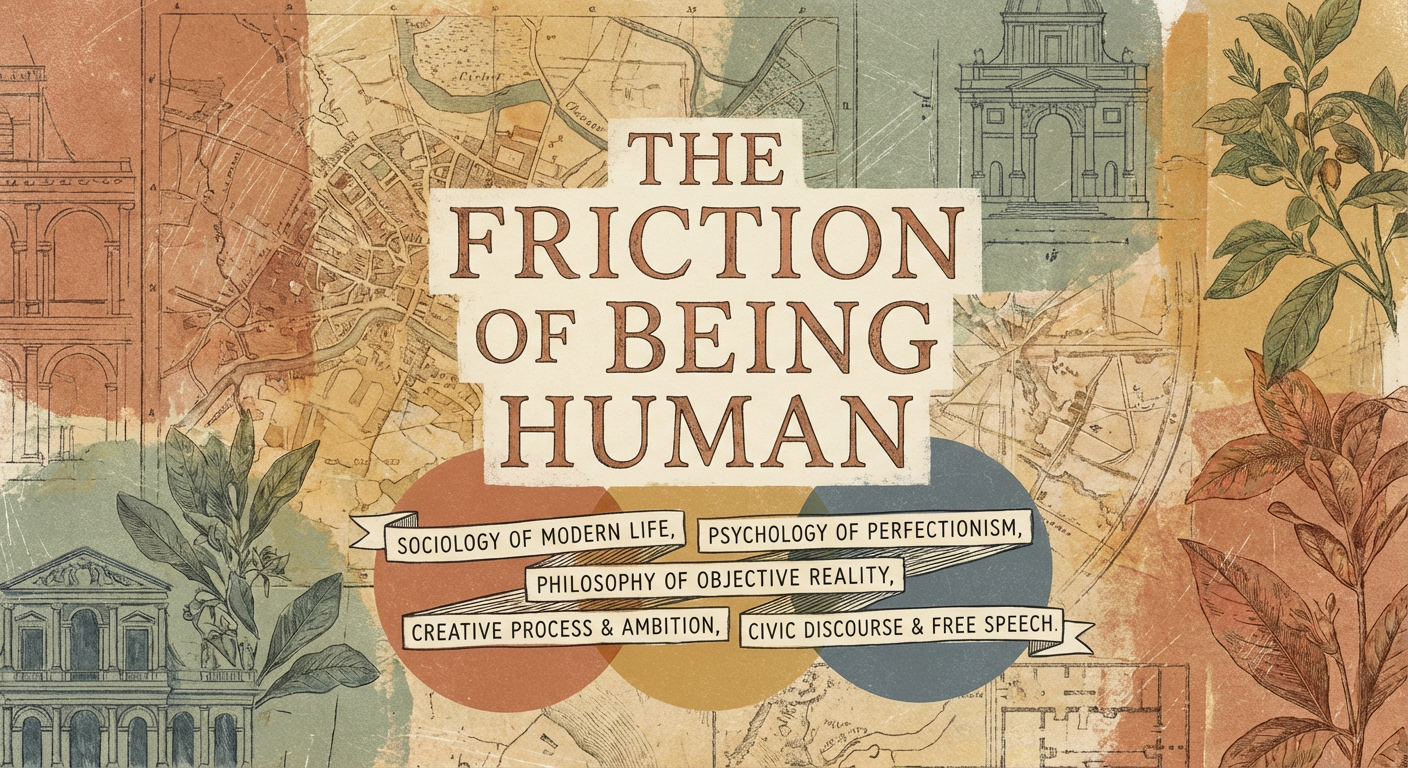
If there is a single thread running through the intellectual landscape this week, it is the tension between friction and efficiency. In economics, technology, and social planning, we are obsessed with removing friction. We want effortless communication, frictionless transactions, and optimized careers.
But a chorus of disparate voices—from a Nobel Prize-winning physicist to a pop music producer to a sociologist—are suggesting that we have made a grave category error. We have mistaken friction for waste, when in reality, friction is often the source of meaning, community, and contact with reality itself.
When we remove the annoyance of roommates, we get the "quiet catastrophe" of loneliness. When we remove the risk of artistic failure, we get "formulaic sludge." When we try to remove the constraints of biological reality through postmodern language games, we lose our tether to truth.
The big idea this week: Stop trying to hack your way out of the mess. The mess is the point.
Here is how the smartest people are breaking it down.
THE IDEAS
1. The "Quiet Catastrophe" of Buying Our Independence
We view autonomy as the ultimate luxury. If you have enough money, you don't need roommates, you don't need to ask favors, and you don't need to deal with other people's dirty dishes. But Sheila Liming proposes that this "freedom" is actually a structural trap.
The conventional view is that loneliness is a personal failing or a mental health issue. Liming argues it is a structural outcome of wealth. We have set the "default mode" of American life to isolation. By using capital to remove the annoyances of other people, we have inadvertently removed the necessity of other people.
"We keep trading off short-term annoyances for long-term meaninglessness... When you begin to remove so much of the friction of life, you end up robbing yourself of experiences that require a fair amount of annoyance to get to something deeper." — Ezra Klein
The Implication: We need to stop viewing social friction (interruptions, obligations, inconveniences) as a bug. It’s a feature. If you want community, you must opt into inefficiency.
2. Perfectionism is Not a Superpower; It’s a Relational Defect
In high-performance circles, perfectionism is often humble-bragged about as "having high standards." Dr. Paul Hewitt completely dismantles this framework. He argues that perfectionism is not about the desire to be great; it is about the desire to correct a defective self.
The argument is that the perfectionist doesn't actually care about the work; they care about concealing their imperfection to secure safety and love. This creates a paradox: the specific behaviors adopted to secure connection (appearing flawless) are the exact behaviors that prevent true intimacy (which requires vulnerability).
"If I am perfect, or if I can appear to others as perfect, then... It will repair this sense of being flawed and defective at the core." — Dr. Paul Hewitt
The Tension: We live in an economy that rewards the output of perfectionists while destroying the people who produce it. The "Steve Jobs model"—where toxicity is excused by outcome—is a survivorship bias trap. Most people who adopt this pathology don't build Apple; they just die early.
3. The "Fabric of Reality" vs. Postmodern Drift
There is a fascinating link between Warren Smith’s critique of woke campus culture and Sir Roger Penrose’s critique of Quantum Mechanics. Both are arguing for the existence of an objective reality that cannot be "narrativized" away.
Smith describes a campus culture (Emerson, Harvard) deeply steeped in postmodernism—the idea that truth, morality, and even biology are purely social constructs and language games. He argues that this is a denial of the "fabric of reality."
Penrose, coming from physics, argues that while Quantum Mechanics allows for things to be in two places at once (superposition), Gravity is the force that eventually forces a decision. You cannot have a massive object in two places at once because gravity enforces a specific reality.
The Synthesis: Whether in sociology or physics, there is a limit to how much we can deconstruct the world. Eventually, gravity kicks in. Eventually, biology kicks in. Reality is the constraint that makes existence possible.
4. "Clean Fuel" vs. "Dirty Fuel"
Performance coach Jim Murphy and musician Jon Bellion both touch on the engine of ambition. The conventional view is that you need a chip on your shoulder—anger, revenge, the need to prove a teacher wrong—to succeed.
Murphy admits this "dirty fuel" is highly effective. It burns hot and gets results. But it produces toxic exhaust (anxiety, hollowness). Bellion, having left the music industry at his peak and returned, argues for "clean fuel"—creating from a place of "taste" and resonance rather than a desperate need for validation.
The Tension: This is the hardest pivot for detailed-oriented founders. The anxiety that drives you to build the company is the same anxiety that will make you miserable once it’s built. "Unteachable lessons" (as termed by Chris Williamson) suggest getting rich won't fix your self-worth, yet everyone insists on learning this the hard way.
THE QUESTION WORTH ASKING
Is "Civility" a sign of weakness or strength?
In a heated discussion on The Glenn Show, John McWhorter and Glenn Loury wrestle with how to handle the "profane" nature of modern discourse (exemplified by provocateurs like Nick Fuentes or Donald Trump).
The question: Does engaging with bad ideas validate them, or does ignoring them allow them to fester?
McWhorter suggests a kind of stoic indifference—treating these figures like bad weather rather than a moral emergency. Loury pushes back, suggesting that beneath the profane rhetoric often lies a genuine grievance that elites are ignoring.
The hard question: In an algorithmically amplified world, is "dignified silence" just a euphemism for "ceding the territory"? Or is it the only way to starve the trolls of the oxygen they need?
THE CONTRARIAN CORNER
Alan Dershowitz on the Second Amendment
In a debate with Dana Loesch, Alan Dershowitz takes a position that infuriates both sides. He hates guns. He believes America would be safer without the Second Amendment. He cites macro-data showing the US is an outlier in gun violence due to availability.
The Twist: He refuses to try to "interpret" the Second Amendment away. He argues that rights make us less safe, and that is a price we agreed to pay. The First Amendment makes us less safe (incitement). The Fourth Amendment makes us less safe (criminals go free on technicalities).
His contrarian stance: Stop pretending gun control is about "safety." It’s about whether we are willing to pay the price of liberty. He admits the price is blood, and he supports the right anyway because he fears the precedent of erasing a Bill of Right more than he fears the violence.
THE READING LIST
IF YOU WANT TO GO DEEPER
📖 "Hangout" by Sheila Liming — A manifesto for reclaiming social time from the jaws of efficiency.
📖 "The Last Word" by Thomas Nagel — Recommended during the Warren Smith conversation as a masterful refutation of postmodernism and a defense of objective truth.
📖 "The Road to Reality" by Roger Penrose — For the brave souls who want to understand the physics of why gravity might be the force that creates objective reality.
🎧 Episode worth returning to: Jon Bellion on Modern Wisdom — A rare, vulnerable look at an artist who walked away from millions to save his soul, only to find that "mediocrity" (normalcy) was the actual paradise.
THE BOTTOM LINE
You cannot optimize for meaning. The things that make life worth living—deep relationships, great art, and contact with reality—are inherently inefficient. They require friction. They require you to be "not enough" sometimes. The goal isn't to build a life smooth enough to slide through without feeling anything; the goal is to build a core strong enough to handle the bumps.
APPENDIX — CONVERSATION BY CONVERSATION
THE KNOWLEDGE PROJECT: Jim MurphyGuest: Jim Murphy, performance coach and author of Inner Excellence. The Conversation: An exploration of the psychology of high performance, moving beyond "grinding" to a state of resonance. Murphy argues that most high achievers run on "dirty fuel" (fear, ego) which works but burns out the engine. Key Ideas:
- Clean vs. Dirty Fuel: Anger and the need to prove people wrong act as powerful motivators but lead to an unhappy "arrival." True longevity comes from "clean fuel" (love of the craft, service).
- The Ego Trap: High performers often equate their self-worth with their last result. Murphy pushes for detaching identity from outcomes.
- Presence over Confidence: Confidence is fragile because it's based on past success or future expectation. Presence is antifragile because it engages with the immediate reality. Notable Passage: "The best life has one foot in joy and one foot in suffering... You can't gain courage by constantly just making yourself more and more comfortable."
MAKING SENSE: Sam HarrisGuest: None (Solo "More From Sam" segment). The Conversation: Harris unloads on the current state of elite accountability and the degradation of political discourse. Key Ideas:
- The Shamelessness of Elites: Harris dissects how figures like Elon Musk and politicians pivot positions (e.g., on Trump) without any reputational cost, signaling a breakdown in social shame mechanisms.
- Moral Luck: A reflection on how we judge the homeless and mentally ill, arguing that none of us "earned" our sanity, and thus our lack of compassion is a failure to understand luck.
- Social Media Detox: Harris doubles down on the immense psychological benefit of leaving Twitter/X, describing it as walking away from a river of digital sludge.
THE EZRA KLEIN SHOW: Sheila LimingGuest: Sheila Liming, author of Hangout. The Conversation: A sociological look at why Americans are so lonely. They trace the problem not to individual failings, but to structural choices that prioritize privacy and control over community. Key Ideas:
- The Default to Isolation: We have engineered our housing and cities so that the "default" state is being alone. Being with people requires effort (scheduling, travel), whereas historically, community was atmospheric.
- Friction is Necessary: We use wealth to buy our way out of friction (cleaning, childcare, roommates), but those frictions are the glue of relationships.
- Work as the Last "Hangout": For many adults, work is the only place they experience unstructured social time, which has been decimated by remote work. Notable Passage: "We keep trading off short-term annoyances for long-term meaninglessness."
HONESTLY: The Gun DebateGuests: Alan Dershowitz (Legal Scholar) vs. Dana Loesch (2A Advocate). The Conversation: A debate on whether America would be safer without the Second Amendment. Key Ideas:
- The Liberty/Safety Trade-off: Dershowitz argues America would be safer without guns, but that the Bill of Rights specifically chooses liberty over safety. He refuses to argue that guns make us safer; he argues the right is worth the danger.
- Defensive Gun Use: Loesch counters that "safety" metrics often ignore the millions of defensive gun uses that prevent crimes without making headlines.
- The Federalism Problem: Gun control fails in cities like Chicago because guns flow freely from states with loose laws; a federal system makes local bans ineffective.
THEORIES OF EVERYTHING: Penrose & FuentesGuests: Sir Roger Penrose (Nobel Laureate) and Yvette Fuentes. The Conversation: A highly technical discussion on a new experiment testing the relationship between quantum mechanics and gravity. Key Ideas:
- Gravity Breaks Quantum Superposition: Penrose argues that quantum rules (things being in two places at once) break down when objects get massive enough because gravity forces them to have a specific location.
- The "Big Stuff": Penrose speculates that physics is missing a theory for the "Big Stuff" (Dark Matter/Gravity) and that our current particle physics is just a perturbation on top of that.
- Active vs. Passive Gravity: The experiment in question tests whether an atom in superposition respects the equivalence principle (it seems to).
MODERN WISDOM: Jon BellionGuest: Jon Bellion, songwriter/producer. The Conversation: A raw look at creativity, the music industry, and the courage to walk away from fame. Key Ideas:
- The Unteachable Lesson: You cannot teach someone that money won't make them happy; they have to get rich and be miserable to learn it.
- The "Birdcage" Feeling: Success comes from opening the "birdcage" in your chest (vulnerability/resonance) rather than chasing trends.
- Creating like an Artist, Executing like an Athlete: The best creatives combine pure taste with rigorous, disciplined execution. Notable Passage: "I’m driving home in the Kia... and I’m like, 'This is the good shit.' Not the stadium. The minivan. The diapers. That's the life."
MODERN WISDOM: Paul HewittGuest: Dr. Paul Hewitt, clinical psychologist. The Conversation: A deep dive into the pathology of perfectionism. Key Ideas:
- Perfectionism is Not Excellence: Excellence is wanting to do well. Perfectionism is wanting to be perfect to repair a defective sense of self.
- The Relational Cost: Perfectionists cannot experience intimacy because they cannot let anyone see their flaws. They continuously uphold a mask, which creates loneliness.
- Success Doesn't Cure It: Achieving a goal doesn't fix the "not enoughness"; the perfectionist just moves the goalpost or discounts the success.
CONVERSATIONS WITH COLEMAN: Warren SmithGuest: Warren Smith, teacher and viral video creator. The Conversation: Smith recounts getting fired for a viral video where he questioned a student's assumptions about J.K. Rowling, and discusses the capture of elite colleges by postmodern ideology. Key Ideas:
- Postmodernism as Anti-Reality: The core of "woke" ideology on campus is a denial of objective truth (morality as superstition, biology as construct).
- The High Cost of Conformity: Smith details how faculty at Emerson College were terrified into submission, altering grades and curriculum based on student identity politics.
- Socratic Method as Antidote: Smith’s viral success came not from debating, but from asking "How do you know that?"—a lost art in education.
THE GLENN SHOW: McWhorter & LouryGuests: John McWhorter and Glenn Loury. The Conversation: A cultural critique of "profane" discourse, specifically focusing on figures like Nick Fuentes and Donald Trump. Key Ideas:
- The Atrophy of Shock: McWhorter argues we must stop clutch pearls at offensive speech because the internet has made it inevitable. Ignoring it is better than "jumping high" every time.
- The Root of the angst: Loury pushes back, suggesting that if we don't acknowledge the grain of truth in some grievances (e.g., urban crime), we cede the ground to racists who will talk about it.
- Fats Waller: A delightful opening segment on McWhorter’s side-career producing obscure musical theater.
VERY BAD WIZARDS: The OdysseyThe Conversation: A literary analysis of the first two books of Homer’s The Odyssey (Emily Wilson translation). Key Ideas:
- The Modernity of Homer: The hosts survive the "ancientness" to find a fast-paced, sarcastic, and psychologically acute story.
- Xenia (Hospitality): The central moral code of the book. The suitors are villains not just because they are rude, but because they violate the sacred host/guest pact.
- Delayed Gratification: The hero (Odysseus) doesn't even appear in the first several books. The story builds anticipation and world-builds through his absence.
THE MEL ROBBINS PODCASTGuest: Mel Robbins. The Conversation: A practical guide to gratitude, moving it from a "soft" concept to a biological tool. Key Ideas:
- The Unsent Letter: Writing a gratitude letter (even if you don't send it) lowers depression/anxiety markers for weeks.
- The 3-Minute Night Journal: Writing 3 wins before bed lowers inflammation and improves Heart Rate Variability (HRV) in heart failure patients.
- Cognitive Reframing: Gratitude isn't ignoring the bad; it's intentionally breaking the "stickiness" of negative inputs to regain cognitive control.