
MARKET SIGNALS — DIGEST
THE OPEN
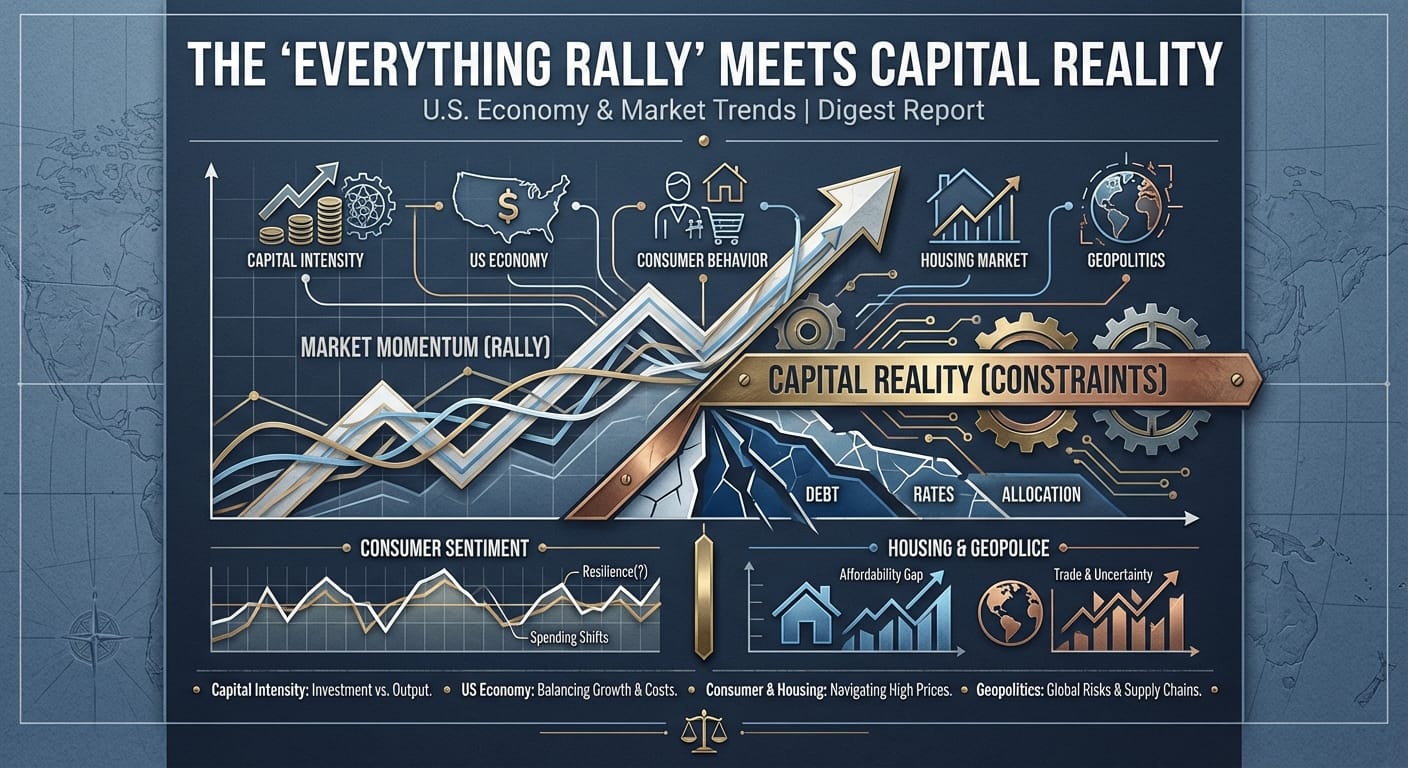
The "Everything Rally" Meets The Reality of Capital Intensity
THIS WEEK'S INTAKE 📊 10 episodes across 8 podcasts ⏱️ ~11 hours of market intelligence 🎙️ Featuring: Palmer Luckey (Anduril), Graham Allison (Harvard), Peter Boockvar (Bleakley), Logan Mohtashami (HousingWire), Max Kettner (HSBC). 📅 Coverage: Nov 20 – Nov 29, 2024
We listened. Here's what matters.
THE HOOK
The markets are currently pricing in a "have your cake and eat it too" scenario: a dovish Fed, robust growth, and an AI revolution that continues to print money without consequence. But if you listen closely to the operators and the macro strategists this week, a diverging reality is forming. We are moving from an era of asset-light scaling to a regime of extreme capital intensity.
Whether it's Meta and Oracle spending 50% of revenue on Capex for AI, the U.S. pivoting to become the "World’s Gun Store" to arm allies, or utilities hiking rates to power data centers, the cost of doing business is structurally shifting. The easy money trade is over; the "deployment" trade is here.
At the same time, the consumer is bifurcating violently. While the wealth effect propels the top 20%, the median borrower is trapped by sticky 23% credit card rates that defy detailed logic and a frozen housing market waiting for a magic number that might not hold. The signal this week isn't about the index hitting highs—it’s about the massive rotation of capital required to sustain the next leg of growth. Here is what you need to know.
THE BRIEFING
1. The New Capex Supercycle
The Setup: The dominant narrative for a decade has been software margins and asset-light businesses. That is over. The Signal: We are witnessing a regime change in capital intensity. Major tech players (Oracle, Meta, Microsoft) are signaling Capex spend at 35-50% of revenue to build AI infrastructure. This isn't just "investing for growth"; it's an arms race that threatens ROE and free cash flow in the medium term. However, the market is rewarding those who demonstrate they can monetize this spend (Google/Alphabet) and punishing those who just spend without clear efficiency gains. The Voice:
"Oracle is expected to spend 52% of their revenue... on capex. It was 10% in 2021. Even Meta... is spending about 35% of revenue." — Peter Boockvar, The Compound and FriendsThe Level: 52% (Oracle's projected Capex/Revenue ratio vs 10% historically). So What: Screen your tech holdings for "Capex efficiency." The trade is shifting from general AI exposure to specific infrastructure winners (power, cooling, chips) and companies with balance sheets robust enough to survive a 3-year cash burn.
2. The U.S. Manufacturing Pivot: "The World’s Gun Store"
The Setup: Geopolitical tensions are rising (Ukraine, Israel, Taiwan), but the American appetite for "boots on the ground" is zero. The Signal: The U.S. strategy is shifting from global policeman to global armorer. This requires a massive re-industrialization of the defense base, moving away from legacy primes (Boeing/Lockheed) toward software-defined hardware (Anduril). The goal is deterrence through manufacturing capacity and autonomous systems, not just troop deployment. The Voice:
"The role of the United States in the future is going to be less being the world police and more like being the world gun store... We're going to build all the things that turn our allies into really prickly porcupines that nobody wants to screw with." — Palmer Luckey, Invest Like the BestThe Level: $1 billion (The revenue milestone Anduril is approaching, signaling the rise of a new Prime). So What: Defense is no longer just a value trade; it’s a growth trade. Look for companies supplying autonomous systems, rocket motors, and AI-integrated defense tech that can bypass the bloated cost-plus contracting model.
3. The Consumer Debt trap: The 23% Floor
The Setup: Everyone expects Fed rate cuts to relieve consumer pressure. The data suggests otherwise. The Signal: Credit card interest rates are hovering near all-time highs despite the Fed easing. This isn't just default risk; it's a "marketing tax." Banks are spending massive amounts on customer acquisition (points, heavy advertising) and passing that cost to revolvers who are surprisingly rate-insensitive. This suggests a floor on consumer borrowing costs that won't drop linearly with the Fed Funds Rate. The Voice:
"If you spend more on operating expenses... [marketing], the higher is the average amount you're able to charge people... People say, 'Why don't they just cut all this marketing out and charge a lower rate?'... Apparently, it doesn't work." — Itamar Drexler, Odd LotsThe Level: 23% (Average credit card interest rate, largely detached from bond market reality). So What: Don't bet on a rapid consumer credit recovery solely based on Fed cuts. The "aspirational luxury" consumer is choked out. Bet on retailers serving the high-end (wealth effect) or the absolute bottom (trade-down staples). The middle is dead.
4. Housing’s "Magic Number"
The Setup: The housing market remains frozen, with volume near historical lows due to the "lock-in effect" of low mortgage rates. The Signal: The market mechanism isn't broken, it's just waiting for a specific threshold. Data indicates that demand and inventory velocity unlock specifically when mortgage rates touch 6%. We are hovering right above this. If the 10-year yield cooperates, we could see a volume explosion in 2025, but price growth will likely be capped by affordability limits. The Voice:
"When mortgage rates get down to 6% every single time since late 2022, housing data gets better." — Logan Mohtashami, Animal SpiritsThe Level: 6.0% (The mortgage rate threshold that unlocks inventory and volume). So What: Watch the 10-year treasury like a hawk. If it stabilizes to allow a 6% mortgage, long residential construction and home improvement retail. If yields spike back up, the freeze deepens.
THE HEAT MAP
WHAT'S GETTING ATTENTION
🔥 Heating Up
- U.S. Oil Production: Production in key basins (Permian/Bakken) is rolling over due to depletion rates. Supply crunch incoming? (Source: The Compound)
- Autonomous Waymo: Expanding faster than expected into winter climates (Minneapolis) and cementing a lead over Tesla. (Source: Motley Fool Money)
- Serial Acquirers (Nordic Model): Decentralized industrial roll-ups (like Lifco/Indutrade) crushing benchmarks via capital efficiency. (Source: We Study Billionaires)
- Small Caps (Russell 2000): Rallying hard on hopes of "Trump deregulation + Fed Cuts." (Source: Fast Money)
🧊 Cooling Off
- Nvidia Monopolies: Shifts in sentiment toward "OpenAI vs. Google" ecosystem suggest Nvidia is no longer the only trade. (Source: The Compound)
- Black Friday Panic: Retailers starting sales Nov 1st indicates desperation, not strength. (Source: Motley Fool Money)
- Legacy Auto: Struggle to compete with software-defined manufacturing and autonomy. (Source: Invest Like the Best)
👀 On Watch
- Physical Crypto Theft: "Wrench attacks" rising as institutional adoption grows. Custody solutions becoming a premium. (Source: Fast Money)
- Obesity Drug Challengers: Amgen’s monthly shot data could disrupt the Lilly/Novo duopoly. (Source: Fast Money)
THE CONTRARIAN BET
Long Oil / Energy Stocks
While the world is obsessed with AI chips and crypto, Peter Boockvar argues that oil at $68-$70 is the cheapest asset on the board. The setup is classic supply-side neglect: U.S. shale production in major basins is naturally rolling over due to high depletion rates, rig counts are down, and global demand is steadier than the "recession" narrative suggests. Everyone is positioned for a glut; the data suggests a squeeze. If oil moves, no one is long, and the chase will be violent.
"My favorite asset class right now... is a barrel of oil at 60 bucks in nominal terms. When it goes, it will go... No one is long." — Peter Boockvar, The Compound
THE BOTTOM LINE
The market is currently trading on a "Goldilocks" narrative, but the plumbing tells a story of high friction: record Capex requirements, persistent consumer credit costs, and geopolitical re-arming. The winning allocators will shift from "passive beta" to "capital efficiency"—owning the companies that control the chokepoints (defense tech, energy, specialized infrastructure) rather than the broad indices dependent on a return to 2019 interest rates. Watch the 10-year yield; if it refuses to drop, the equity valuation argument gets much harder.
THE APPENDIX — EPISODE-BY-EPISODE BREAKDOWN
ANIMAL SPIRITS: "Talk Your Book: The State of the Housing Market"Guest: Logan Mohtashami (Lead Analyst, HousingWire) Runtime: ~45 mins
The Conversation: A data-heavy dismantling of "doomer" housing narratives. Mohtashami argues that housing isn't crashing, it's "stuck," and explains why viral charts about aging buyers are statistically flawed. Key Signals:
- The Survey Problem: The NAR data claiming the median first-time buyer age spiked to 49 is based on a flawed sample (6k responses from 170k sent). Real data puts it at 32-36.
- The 6% Trigger: Historical data from 2022-2024 shows that every time mortgage rates touch 6%, transaction volume recovers. This is the psychological and affordability line in the sand.
- Inventory Reality: We are missing about 1 million mortgage buyers, but inventory isn't exploding because credit standards since 2010 prevented the distress selling seen in 2008. Notable Quote: "The worst talented people we have in America are like housing crash doomer men... They just 24/7 doom porn." — Logan MohtashamiWorth Your Time If: You are allocating to real estate or homebuilders and need to know the exact interest rate level that unfreezes the market.
INVEST LIKE THE BEST: "Palmer Luckey - Inventing the Future of Defense"Guest: Palmer Luckey (Founder, Anduril & Oculus) Runtime: ~75 mins
The Conversation: A fascinating deep dive into modern warfare, incentive structures in the Pentagon, and the future of American power. Luckey explains why "cost-plus" contracting broke the defense industry. Key Signals:
- Incentive Misalignment: Legacy defense primes are incentivized to increase costs and delay timelines because they are paid on a "cost-plus" basis. Anduril takes on R&D risk to sell finished products, aligning incentives with results.
- World Gun Store: The U.S. cannot sustain boots on the ground everywhere. The future strategy is arming allies with autonomous systems ("prickly porcupines") to deter aggression without deploying US troops.
- Energy Arbitrage: Luckey highlights "synthetic long-chain hydrocarbon fuels" as a massive, under-discussed opportunity compared to the over-investment in EV batteries. Notable Quote: "I don't want to be doing Anduril. Not really... I'm doing what I'm doing... because I think that it's important and I think that it's going to be more impactful." — Palmer LuckeyWorth Your Time If: You are interested in the intersection of geopolitics, hard tech, and the secular bull case for defense spending.
ODD LOTS: "This Is Why Credit Card Interest Rates Are So High"Guest: Itamar Drexler (Finance Professor, Wharton) Runtime: ~50 mins
The Conversation: An academic investigation into why credit card APRs are 23% when the Fed Funds rate is 5% and default rates are 5%. It reveals a market broken by marketing costs and consumer irrationality. Key Signals:
- The Marketing Tax: A significant portion of the APR spread isn't profit or default risk—it's the cost of rewards points and customer acquisition. Consumers are effectively paying high interest to fund their own solicitation.
- Rate Insensitivity: Consumers respond to marketing (mailers/points) more than APR. Banks have no incentive to compete on price because lower rates don't attract customers; flashy ads do.
- Sticky Rates: Even as the Fed cuts, credit card rates are unlikely to drop significantly due to these structural OPEX costs. Notable Quote: "You have to think it's crazy for a bank to come to somebody with a medium or lower credit score and say, here, have a line of credit of like $5,000, $10,000 and you can default on it." — Itamar DrexlerWorth Your Time If: You are analyzing consumer credit risk, fintech disruptors (who struggle to compete on CAC), or bank earnings quality.
THE COMPOUND AND FRIENDS: "Why Oil Could Be Next Year’s Gold"Guest: Peter Boockvar (CIO, Bleakley Financial Group) Runtime: ~60 mins
The Conversation: A lively roundtable on the post-election rally, the shifting narratives in Big Tech, and macro opportunities. The tone is bullish but wary of inflation. Key Signals:
- AI Divergence: The market is splitting Big Tech into "OpenAI Infrastructure" (Nvidia, Oracle) vs. "Google Infrastructure." This correlation breakdown offers alpha opportunities.
- The Oil Trade: U.S. shale production in key basins is rolling over due to high depletion rates. With rig counts down and oil at $68, Boockvar sees a massive supply-side squeeze incoming.
- Inflation Vigilance: The Fed may cut, but the "One Big Beautiful Bill" (stimulus) + Tariffs could reignite inflation. The long end of the bond curve is already sniffing this out. Notable Quote: "The 10-year yield... is still 40 basis points above those lows. The belly of the curve is no longer responding to what central banks are doing because it's focused on a bigger risk." — Peter BoockvarWorth Your Time If: You want a pulse on current market sentiment and a strong contrarian argument for energy stocks.
WE STUDY BILLIONAIRES: "How Great Compounders Turn Time Into a Superpower"Guest: Kyle Grieve (Host) covering the book "The Compounders" Runtime: ~55 mins
The Conversation: A breakdown of the "Serial Acquirer" business model, specifically focusing on Nordic industrial compounders (Lifco, Indutrade, Lagercrantz). Key Signals:
- Decentralization is Alpha: The most successful acquirers buy niche businesses and leave them alone (decentralized). Centralizing functions usually destroys value (creates bureaucracy).
- Profit-to-Working-Capital: The "magic metric" used by Bergman & Beving. They demand a 45% ratio, ensuring growth is self-financed and not dependent on debt or equity dilution.
- Serial Acquirer Arbitrage: Buying private companies at 5x EBITDA and trading publicly at 20x EBITDA creates a sustainable arbitrage loop if discipline is maintained. Notable Quote: "People are the only sustainable competitive advantage." — Jan Wallander (via discussion)Worth Your Time If: You are a long-term equity holder looking for "quality" compounders outside the US tech sector.
ODD LOTS: "Graham Allison on the Risks of a US-China War"Guest: Graham Allison (Harvard Professor) Runtime: ~45 mins
The Conversation: A geopolitical reality check. Discussion of the "Thucydides Trap"—the inevitable tension when a rising power (China) threatens a ruling power (US). Key Signals:
- Structural Tension: The rivalry is structural, not just political. It is baked into the GDP and military rise of China. 12 of 16 historical cases like this ended in war.
- Silver Lining: Trump’s transactional nature and fear of nuclear conflict might paradoxically create a more stable "partnership of rivals" than a strictly ideological administration.
- Mutual Assured Economic Destruction: The entanglement of supply chains (rare earths, pharma) provides a buffer against hot war that didn't exist with the Soviet Union. Notable Quote: "China is a meteoric rising power... The US is a colossal ruling power. Never since Rome has a country been so powerful." — Graham AllisonWorth Your Time If: You need to understand the long-term tail risk of the US-China relationship beyond the daily headlines.
MOTLEY FOOL MONEY: "What’s a Waymo Anyway?"Guest: John Quast & Rachel Warren Runtime: ~30 mins
The Conversation: A status check on the autonomous vehicle race. The hosts argue Waymo has taken an insurmountable lead in safety and deployment, leaving Tesla's "vision-only" approach behind. Key Signals:
- Sensor Suite vs. Vision: Waymo’s expensive Lidar/Radar approach is winning regulatory approval and public trust faster than Tesla’s camera-only approach.
- Expansion Speed: Phase 2 of deployment is happening fast—Waymo is moving into hazardous weather climates (Minneapolis) and new cities, proving the tech scales beyond sunny Arizona.
- Rideshare Economics: Uber and Lyft are partnering with Waymo, suggesting the future is fleet management, not individual ownership. Notable Quote: "Waymo puts safety first... Tesla answered the cost question first, but has not answered the tech question." Worth Your Time If: You hold Tesla, Uber, or Alphabet and need a reality check on the robotaxi timeline.
MOTLEY FOOL MONEY: "Black Friday’s Best Stock Gifts"Guest: Asit Sharma & Dan Caplinger Runtime: ~30 mins
The Conversation: A look at the retail landscape. "Black Friday" has diluted into a month-long event due to retailer desperation. Key Signals:
- Retail Bifurcation: The high-end consumer is fine; the low-end is stretched. Retailers are absorbing import costs to keep volumes up, hurting margins.
- AI & GDP: A cited statistic that "90% of incremental GDP growth" is coming from AI build-out (data center construction), highlighting the concentration risk in the broader economy. Notable Quote: "We're seeing the desperation heave... Black Friday started October 31st." Worth Your Time If: You are looking for anecdotal evidence of consumer weakness.
CNBC FAST MONEY: "Special Report: Illegal Drug Imports"Runtime: ~20 mins (Segment)
The Conversation: An investigation into "Alternative Funding Programs" (AFPs) used by employers to import cheaper drugs from Turkey/Canada to avoid US prices. Key Signals:
- Regulatory Risk: Homeland Security is cracking down on these programs. If shut down, it forces employers back to full-price US pharma, a tailwind for companies like Gilead/AbbVie but a cost shock for insurers/employers.
- Pharma Pricing Power: The lengths employers will go (flying employees to the Caymans) to avoid US pricing highlights the extreme inelasticity of demand for specialty drugs. Notable Quote: "What they're doing is illegal and it's putting American lives at risk." Worth Your Time If: You are invested in US Pharma or Health Insurers.
BLOOMBERG SURVEILLANCE: "Stocks Set for Monthly Loss"Guest: Max Kettner (HSBC), Steven Sadove (Mastercard/Saks) Runtime: ~45 mins
The Conversation: A broad market outlook. Kettner remains aggressively bullish on equities, citing fiscal tailwinds. Sadove reinforces the "K-Shaped" consumer thesis. Key Signals:
- Fiscal Tailwind 2026: Analysts are already pricing in the "One Big Beautiful Bill" (Trump Stimulus) as a growth engine for 2025-2026.
- Luxury Prices: Former Saks CEO notes prices for luxury goods (Chanel bags) have tripled, alienating the aspirational buyer. The high-end market is now exclusively for the wealthy, thinning the herd for retailers. Notable Quote: "I question how much a government shutdown really is related to the largest caps... We're almost maximum overweight in equities." — Max KettnerWorth Your Time If: You need a macro bull case to balance the risks.