
PE INTELLIGENCE BRIEFING — VOL. 84
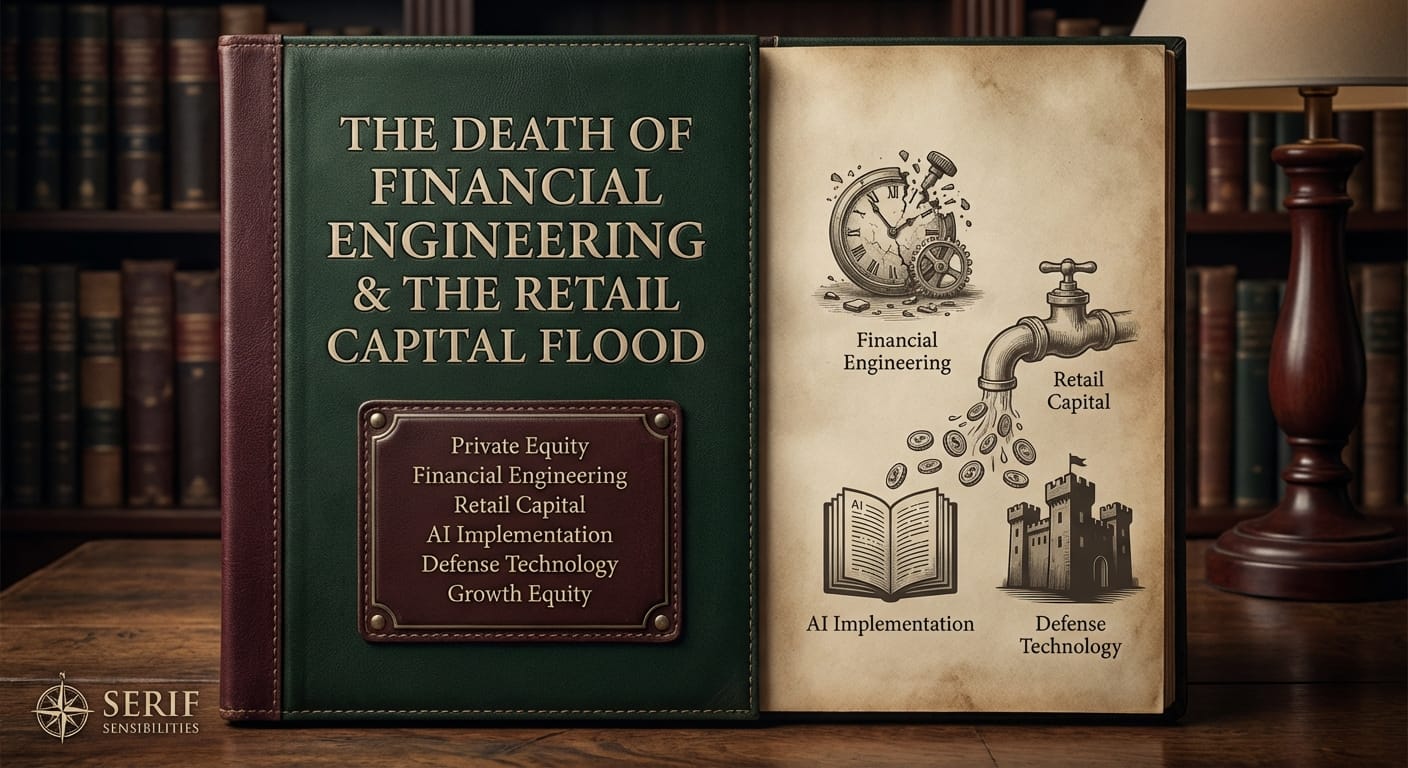
THE DEATH OF FINANCIAL ENGINEERING & THE RETAIL CAPITAL FLOOD
THIS WEEK'S INTELLIGENCE 📊 7 episodes across 6 sources ⏱️ 9.5 hours of conversation with GPs, Founders, and Macro Strategists 🎙️ Featuring: Mike Kelly (Future Standard), Martin Escobari (General Atlantic), Ray Dalio (Bridgewater), Palmer Luckey (Anduril) 📅 Coverage: Nov 2024
The signal from the noise. Here's what matters.
THE BRIEF
The era of levering up a stable asset at 6x, riding multiple expansion, and selling to a strategic three years later is officially over. Mike Kelly (Future Standard) and Martin Escobari (General Atlantic) both flagged a structural shift that the mid-market is already feeling: with cost of debt still elevated and entry multiples in the US sitting at the 97th percentile historically, the math for returns driven by facial engineering has broken.
Consequently, two massive shifts are dictating the playbook for the next 24 months. First, the "alpha" has moved entirely to operational improvements (specifically AI implementation and talent grading) and middle-market aggregation where inefficiencies still exist. Second, the institutional LP well is drying up relative to the flood of private wealth capital entering the market via semi-liquid structures.
If you are still modeling 6-8 turns of leverage to make the IRR work, you are underwriting a fantasy. The new reality is growth equity trading at a 30-40% discount to public comps and a defense sector that is rewriting the rules of government contracting.
Here is what you need to know.
THE BRIEFING
1. Growth Equity: The 2009 Vintage Redux
The Situation: Deal volume has been anemic, exits are frozen, and DPI pressure is mounting on GPs. The Intelligence: We are seeing a dislocation in growth equity that rivals the post-GFC environment. Martin Escobari (General Atlantic) notes that because the IPO window has been shut and strategic M&A paused, high-quality assets (40% growers) are trading at 15x EBITDA, representing a 30-40% discount to public comps. This is a buyers' market for those with dry powder, specifically in the middle market where the bid-ask spread has finally collapsed due to liquidity needs. The Voice:
"Best window into growth equity since 2009... everything’s on sale. There’s so much pressure on GPs to post DPI that we’re getting 40% growers at 15 times EBITDA." — Martin Escobari, General AtlanticThe Implication: If you are sitting on dry powder, stop waiting for the bottom. The "fog" Escobari describes is your cover. Focus on assets with embedded M&A optionality or those forced to market by GPs desperate for liquidity.
2. The Retail Capital Floodgates Are Open
The Situation: Institutional allocations to alternatives are largely saturated. The next tranche of AUM growth is coming from the mass affluent/private wealth channel. The Intelligence: This isn't just about Blackstone and BREIT anymore. Mike Kelly describes a permanent shift where private wealth will be the "fastest growing source of capital" for alts. Innovations in fund structures (interval funds, tender offer funds) are mitigating the liquidity mismatch that terrified risk officers a decade ago. The strategic imperative has shifted from "educating" retail to building dedicated distribution pipes (the "Netflix" model). The Numbers: Private credit alone has arguably $500B+ in retail demand capacity. The Implication: Institutions should stop viewing retail capital as "dumb money" that distorts pricing and start viewing it as a liquidity exit ramp. If your firm doesn't have a private wealth strategy or a partnership with a platform that does, you are fighting for a shrinking piece of the pie.
3. The End of "Better & Cheaper" in Defense Tech
The Situation: Defense tech is hot, but incumbents (Lockheed, Raytheon, Boeing) are entrenched by decades of doctrine and cost-plus contracting. The Intelligence: Palmer Luckey (Anduril) deconstructs the failure mode of most defense PE plays: trying to build a slightly better mousetrap for slightly less money. The DoD incentives (cost-plus) actually punish efficiency. The only way to win is to build systems that do things incumbents cannot do (e.g., autonomous swarm capabilities) rather than iterating on what they already do. The Voice:
"If you’re not that different from those guys, it means they’re going to have an easy time adapting... you’re not competing with what they have today, you’re competing with what they have in three years." — Palmer Luckey, AndurilThe Implication: Scrutinize your defense portfolios. If the thesis relies on efficiency gains disrupting a Prime, mark it down. The Primes will just lobby it to death or clone it. Real value is in net-new capabilities (autonomy, AI-driven kinetics) that have Congressional support, not just Pentagon support.
DEAL FLOW SIGNALS
WHERE THE ACTION IS
🔥 Active: Middle Market Growth. 40% growers trading at 15x EBITDA. The bid-ask spread has snapped. (Source: Invest Like the Best) 🔥 Active: Defense Autonomy. Systems that replace headcount with software (e.g., 1 operator managing 25 drones). Labor shortages in militaries make this non-discretionary spend. (Source: Invest Like the Best) 👀 Emerging: Biomanufacturing/Synthetics. Synthetic long-chain hydrocarbons. A potential hedge against the EV/Battery supply chain bet that governments have over-indexed on. (Source: Invest Like the Best) ⚠️ Stressed: US Large Cap Equities. Trading at 97th percentile valuations with debt-to-GDP at 125%. Risk/reward is asymmetrical to the downside. (Source: Invest Like the Best, Odd Lots) 🧊 Quiet: Commodity SaaS. "Better/Cheaper" software plays against entrenched incumbents are dead money. (Source: Invest Like the Best)
THE OPERATOR'S EDGE
1. The "Enthusiastic Rehire" TestRachel Lockett (Executive Coach) suggests a binary rubric for talent assessment in portfolio companies, a practice used at Stripe and Netflix. Ask the CEO: "Would you enthusiastically rehire this person for the same role today?" If the answer is no, you don't need a performance improvement plan; you need a transition plan. In fast-scaling assets, the team that got you to $50M ARR is rarely the team that gets you to $200M.
2. Manufactured Viral Indifference Dietrich Mateschitz (Red Bull) built a multi-billion dollar empire by weaponizing "indifference." Instead of correcting rumors (e.g., the bull testosterone myth), he let them run to build mystique. For consumer portfolio companies: Indifference is the enemy, not controversy. If the market isn't whispering about your product, you are burning marketing spend on deaf ears.
3. AI as Portfolio Operations, Not Just Product General Atlantic is running 500 operational projects across its portfolio this year; 33% are AI-specific (coding assistants, marketing optimization). This isn't about "AI features" in the product; it's about margin expansion through OpEx reduction. If your PortCo COOs aren't mandating Cursor or similar tools for dev teams, they are bleeding efficiency.
THE CONTRARIAN POSITION
The US is the Wrong Trade. While the consensus view is "long US exceptionalism," Martin Escobari and Ray Dalio argue the opposite. With US markets priced for perfection (26x earnings) and emerging markets like Brazil and components of Europe trading at single-digit multiples (9x-14x), the risk premium has inverted. The contrarian play is aggressive geographic diversification—specifically into markets where inefficiency is high and competition is low (the "lower hanging fruit"). If you can stomach the currency vol and governance risk, the yield differential is undeniable.
THE BOTTOM LINE
The macro environment has shifted from a tailwind to a headwind for pure financial engineering. Returns for the 2024-2025 vintage will be defined by operational alpha (talent density, AI implementation) and structural arbitrage (retail capital flows, middle-market value investing). Ask your IC this week: Are we underwriting this deal based on multiple expansion that likely won't happen, or are we buying a 40% grower at a 40% discount because the seller needs liquidity?
APPENDIX — EPISODE-BY-EPISODE INTELLIGENCE
INVEST LIKE THE BEST: "Martin Escobari - Inside General Atlantic"Guest: Martin Escobari, Co-President, General Atlantic Runtime: 1h 12m
The Conversation: A masterclass on the mechanics of Growth Equity and GA’s unique permanent capital structure. Escobari breaks down why the current vintage is historically attractive and how they use a massive portfolio ops team to de-risk growth.
Key Intelligence:
- The 2009 Vintage Parallel: The freeze in IPOs and M&A has created a buyer's market for growth assets. High-quality companies are trading at 15x EBITDA, a massive discount to historical averages and public comps.
- Spear Fishing: GA’s strategy relies not on chasing every deal, but waiting years for "the big fish" (market leaders) to stumble or need liquidity, then moving aggressively (e.g., sub-2 month closes).
- The US Premium Risk: The premium for "US Exceptionalism" is at an all-time high (97th percentile P/E). GA is actively looking outside the US where P/E ratios are 9x-14x for similar growth profiles.
Notable Quote:
"If we’re not willing to buy a dominant platform at 6 times EBITDA, we should shut down the world."
Relevant For: Deal teams, IC members, Portfolio Operations.
CAPITAL ALLOCATORS: "Mike Kelly - Future Standard"Guest: Mike Kelly, CIO, Future Standard Runtime: 52m
The Conversation: A deep dive into the democratization of alternative assets. Kelly explains the shift from institutions to private wealth as the primary growth engine for PE and Credit, and how the "middle market" offers the only real operational alpha left.
Key Intelligence:
- The Retail Pivot: Institutional allocations are maxed out. The next trillion dollars in PE/Credit will come from private wealth. Firms must build or partner for distribution (the "Netflix" model of pipes + content).
- Financial Engineering is Dead: With debt costs high, you cannot lever your way to returns. Value creation must come from revenue growth and operational sophisticated in fragmented markets (middle market).
- Private Credit Capacity: Despite "bubble" fears, Kelly argues private credit is still under-capitalized relative to the addressable market of private businesses needing debt.
Notable Quote:
"The days of financial engineering your way to higher returns, in my view, are over."
Relevant For: IR, Fundraising, Strategy, Credit teams.
INVEST LIKE THE BEST: "Palmer Luckey - Inventing the Future of Defense"Guest: Palmer Luckey, Founder, Anduril Runtime: 1h 15m
The Conversation: A rogue operator’s view on disrupting the DoD. Luckey explains why traditional VC/PE approaches to defense (SaaS margins, "better UI") fail against the "Primes" and how to actually win government contracts.
Key Intelligence:
- Cost-Plus is the Enemy: The DoD pays incumbents for effort (cost-plus), incentivizing waste. To win, you must offer fixed-price capability that creates political leverage (saving taxpayers billions).
- The "Different" Moat: Do not compete on "better/cheaper." The incumbents will copy you. Compete on "different" (e.g., autonomous hardware vs. manned systems) that incumbents culturally cannot execute.
- Labor Arbitrage via Autonomy: Western militaries are shrinking. The only solution is automation that allows one soldier to control multiple assets. This is the macro tailwind for defense tech.
Notable Quote:
"You’re not competing with what they have today, you’re competing with what they have in three years after they look at what you’ve built."
Relevant For: Defense/GovTech deal teams, Operating Partners.
LENNY'S PODCAST: "Rachel Lockett on High-Trust Teams"Guest: Rachel Lockett, Executive Coach (ex-Stripe/Pinterest) Runtime: 1h 25m
The Conversation: A tactile discussion on human capital in high-growth environments. Lockett provides frameworks for founders and operators to diagnose leadership failure and co-founder conflict.
Key Intelligence:
- The "Enthusiastic Rehire": A litmus test for talent in scaling companies. If you wouldn't rehire them today for the role as it exists now, you must make a change.
- One-Page Operating Plans: Cited Alpine Investors' "People First" operating rhythm. Aligning vision, strategy, and KPIs on a single sheet to reduce organizational drag.
- Zone of Genius: Leaders often burn out doing "competent" work rather than "genius" work. Re-allocating C-level time is a high-ROI exercise for boards.
Notable Quote:
"Would you enthusiastically rehire this person for the same role? And when the answer is no... you have to take action."
Relevant For: Operating Partners, HR/Talent leads.
ODD LOTS: "Ray Dalio on the Five Forces"Guest: Ray Dalio, Founder, Bridgewater Runtime: 45m
The Conversation: Dalio zooms out to the 500-year cycle, discussing debt, internal conflict, and the changing world order. It’s a bear case for US assets and a warning on liquidity.
Key Intelligence:
- The Wealth/Cash Mismatch: "Wealth is not money." Dalio warns of a liquidity crisis where paper wealth (high valuations) cannot be converted to cash due to debt constraints or tax policy changes.
- The Debt Cycle: We are in the late stage of the debt cycle where borrowing becomes constrained. This reinforces the view that leverage-heavy PE models are structurally impaired.
- Diversification: A plea for true diversification (asset class + geography) in a world where the US dollar and equity market are facing secular headwinds.
Notable Quote:
"You can't spend wealth. You have to sell wealth in order to get money to go buy things."
Relevant For: IC Members, Macro Strategists.
FOUNDERS: "Red Bull's Billionaire Maniac Founder"Subject: Dietrich Mateschitz (Red Bull) Runtime: ~1h
The Conversation: A profile of how Mateschitz built a marketing empire disguised as a beverage company. It challenges standard OpEx efficiency narratives by proving that brand is the asset.
Key Intelligence:
- Premium Pricing: Mateschitz refused to compete on price, setting Red Bull well above competitors to create a "new category" rather than a premium soft drink.
- Marketing Conglomerate: Red Bull outsourced everything (production, logistics) to focus 100% on marketing. A lesson in capex-light, high-margin scaling.
- Zero Debt: The company grew entirely from cash flow, refusing bank debt to maintain independence—a stark contrast to the LBO model, but a testament to cash-flow discipline.
Notable Quote:
"The most dangerous thing for a branded product is low interest."
Relevant For: Consumer Deal Teams, Marketing Leads.
ALL-IN: "Molly Bloom Interview"Guest: Molly Bloom Runtime: ~40m
The Conversation: Entertainment-focused, but provides a raw look at risk tolerance, vetting, and the psychology of high-net-worth individuals when they are losing.
Key Intelligence:
- The Psychology of Loss: Bloom notes that HNW individuals often react to loss with fear rather than logic, regardless of their net worth. This "tilt" dynamic is relevant for GPS managing stressed relationships or LPs in a downturn.
- Vetting as Survival: Her downfall came from a lapse in vetting (Russian mob ties). A reminder that KYC/AML isn't just compliance; it's existential risk management.
Notable Quote:
"Even though it doesn't make logical sense compared to someone's net worth, losing money... triggers this fear response."
Relevant For: Junior staff (general interest), IR (psychology of LPs).