
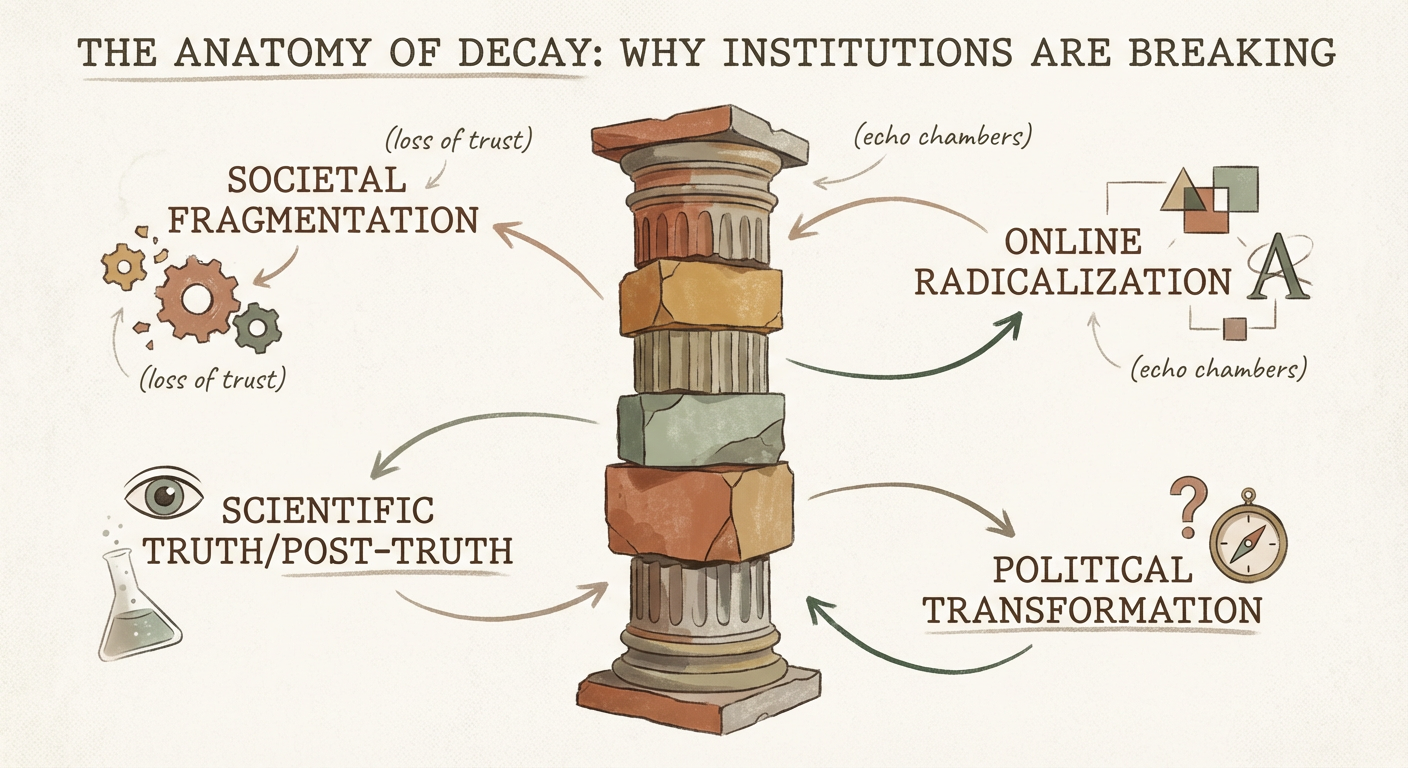
THE ANATOMY OF DECAY: Why Our Institutions Are Breaking (and What Happens Next)
THIS WEEK'S INQUIRY
📚 10 conversations with 12 thinkers
⏱️ ~10 hours of long-form intellectual exploration
🎙️ Featuring: Bas van Fraassen, Irving Finkel, Bernie Marcus, Tim Miller, Elie Hassenfeld, Joshua Citarella, Glenn Loury, Robert Patton-Spruill
The ideas worth your attention. Here's what we're thinking about.
We are living through a peculiar intellectual moment. The topics animating our smartest conversations span from deciphering ancient forgotten languages to game theory for AI, from the very nature of scientific truth to the radicalization pipelines of online politics. Yet, beneath this seemingly disparate array of subjects, a unifying tension emerges: the quiet, and sometimes not-so-quiet, decay of our institutions.
Whether it’s the crumbling trust in science (Bas van Fraassen suggesting science doesn’t aim for reality), the transformation of political parties into unrecognizable forms (Tim Miller on the GOP), the ethical dilemmas of powerful individuals (Glenn Loury on Larry Summers), or the existential risk posed by unanchored technological advancements (Schelling’s legacy applied to AI), there's a growing sense that the scaffolding of our shared world is under immense strain. Traditional systems are failing to adapt, and novel forces are emerging that exploit these vulnerabilities, with consequences we are only beginning to grasp.
This week, we listened for the signals of institutional disruption and the frameworks attempting to make sense of it. What happens when the structures designed to create a coherent society instead produce fragmentation and radicalization? How do we rebuild trust, or perhaps more fundamentally, redefine the aims and mandates of the institutions that govern us? Here's how a diverse set of thinkers are grappling with the anatomy of decay—and what might come next.
THE IDEAS
The Unspoken Aims of Science: Is Truth Optional?
The Setup: Most of us assume science is in pursuit of truth—a direct, unvarnished representation of reality. This foundational belief underpins everything from medical practice to engineering, from policy decisions to our very worldview. Yet, what if this assumption is, at best, incomplete, and at worst, misleading?
The Argument: Philosopher Bas van Fraassen, in a conversation about scientific realism, provocatively suggests that the primary aim of science is not the revelation of fundamental truth, but rather empirical adequacy. A theory is "empirically adequate" if what it says about observable phenomena is true. It means we should accept the observable claims a theory makes, but remain agnostic about its unobservable components, such as quarks or consciousness. The goal, he argues, is to develop theories that successfully account for observable data and predict future observations, not necessarily to assert the existence or truth of unobservable entities the theory posits. This moves science away from being a metaphysical truth-teller and toward being a highly effective predictive and descriptive tool for the observable world.
"If a theory has no empirical implications, very soon they regard it as mere metaphysics." — Bas van Fraassen, Theories of Everything
The Tension: This view directly challenges the common-sense (and often unexamined) "scientific realism" that pervades public discourse, where scientific models are assumed to be literal depictions of reality. If science isn't primarily about fundamental truth, then what happens to our trust in scientific institutions when they speak authoritatively on matters considered "real"? It raises questions about the perceived certainty of scientific claims and the boundaries between scientific inquiry and philosophical interpretation. This perspective could lead to a more nuanced, but potentially less authoritative, public understanding of scientific pronouncements.
The Implication: If empiricism is the true north of science, then the authority of scientific institutions should derive from their predictive power and observational consistency, rather than their claims to absolute truth about unobservables. This might change how we evaluate scientific consensus, especially in areas where direct observation is impossible. It could also force a re-evaluation of how scientific findings are communicated to the public, emphasizing the utility and predictive power of models over their ontological "truth."
From Cuneiform to Crisis: Why The Past Matters More Than We Think
The Setup: In an age of accelerating change, the study of ancient civilizations sometimes feels like a charming but largely irrelevant academic pursuit. The stories of Mesopotamian gods, a flood myth predating Noah, or the painstaking deciphering of cuneiform, might seem distant from the immediate issues of today.
The Argument: Irving Finkel, a curator at the British Museum and a master of ancient languages, makes a compelling case that understanding these ancient texts and cultures is essential not just for historical curiosity, but for comprehending the deep currents of human thought, institutional formation, and narrative patterns that continue to shape us. His work on cuneiform tablets, particularly those containing a flood narrative from circa 1750 BCE, reveals that many "foundational" stories have much older, culturally diverse roots. The very development of writing, he notes, was "probably the greatest invention in human history" — a foundational institution that enabled complex civilization, trade, and governance. These ancient systems weren't just about recording; they were about building societal coherence.
"The development of cuneiform, of these tablets, of written language, is one of the greatest, probably the greatest invention in human history." — Irving Finkel, Lex Fridman Podcast
The Tension: While Finkel’s work enriches our understanding of cultural origins, it also highlights how easily foundational knowledge can be lost and how much effort is required to recover it. In an era where information proliferation often leads to a shallow engagement with history, recognizing the depth and continuity of human cultural institutions — even those we must labor to rediscover — offers a powerful counterpoint to presentism. Are we building on sufficiently robust foundations if we ignore the lessons encoded in deep time, or even lose the "language" to access them?
The Implication: The persistent echoes of millennia-old stories and institutional forms suggest that certain human patterns, needs, and structures are deeply embedded. Ignoring this deep history, or failing to cultivate the intellectual disciplines required to understand it, leaves us vulnerable to repeating old mistakes or misinterpreting current challenges as entirely novel. Moreover, the long, slow work of deciphering ancient texts serves as a stark reminder of the intellectual rigor and patience required to understand complex systems, a quality often lacking in modern, fast-paced discourse.
The Radicals & Refugees: How Online Subcultures Devour and Displace Traditional Politics
The Setup: We often discuss political polarization as an outcome of media echo chambers or ideological hardening. But this perspective overlooks a crucial, accelerating factor: the deliberate, often playful, and increasingly radicalizing currents flowing through online subcultures, particularly among younger demographics.
The Argument: Joshua Citarella outlines how internet subcultures are not merely reflecting but actively shaping political ideology and behavior, creating what he calls "digital refugees" from mainstream politics. He notes that "conservatism is the new punk rock" for many young people, attracted by its anti-establishment veneer and the provocative nature of online right-wing spaces. These online communities function as ideological pipelines, exposing individuals to increasingly radical content, often through gamified or meme-driven engagement. This process isn't just about partisan shifts; it's about a fundamental re-orientation of political identity, where the performative aspects of online subcultures supersede traditional political engagement.
"young people and politics at the moment and why it’s qualitatively different than the past…conservatism is the new punk rock." — Joshua Citarella, Modern Wisdom
The Tension: This analysis challenges the notion that political beliefs primarily stem from deep-seated values or policy preferences. Instead, it suggests a more fluid, identity-driven process where belonging to a subculture—even an ideologically extreme one—might be more significant than any specific policy plank. It also implies that traditional political institutions are ill-equipped to compete with the dynamic, gamified, and often anarchic nature of online radicalization. Mainstream political parties can't easily replicate the appeal of "punk rock" defiance, leading to a growing chasm between offline political structures and online political identities. Tim Miller's observations on the transformation of the Republican Party under Trump seem to be an example of this phenomenon reaching a critical mass, where an entire party becomes susceptible to the logic of online performativity and grievance.
The Implication: We are witnessing a fundamental shift in how political identities are formed and reinforced. Ignoring the power of online subcultures to attract, retain, and radicalize young people means missing a key driver of future political trends. For existing institutions, this suggests a need to understand the underlying psychological and social needs these online spaces fulfill, and to find ways to engage with them, rather than simply dismissing them. The question isn't just what young people believe, but why they affiliate with ideologies that are increasingly presented as defiant and counter-cultural.
The Home Depot Paradox: Rebuilding Institutions from Ground Zero
The Setup: Institutional decay feels inevitable, a slow slide into entropy. Discussions often focus on managing decline or critiquing existing failures. But what about the rare moments of institutional creation and resurgence? What lessons can be drawn from building something enduring and impactful from scratch, especially after facing a personal and professional collapse?
The Argument: Bernie Marcus's story of co-founding Home Depot, after being unceremoniously fired from his previous job, offers a powerful counter-narrative to institutional decline. He and his partners built a retail giant not by optimizing an existing model, but by radically reinventing it. Their success hinged on a fanatical focus on the customer, empowered employees, and a culture of ownership. Marcus’s philosophy – “When a business stops serving the customer and starts serving itself, it dies” – is an axiom of institutional health. His experience, ironically, began with his own personal institutional failure (being fired) that led to an opportunity for radical reinvention. This echoes Glenn Loury's "Moral Necessity of Self-Regard" conversation, where personal recovery from public disgrace (like Loury's own or Larry Summers's experiences) becomes a crucible for understanding institutional resilience.
"You've just been kicked in the ass with a golden horseshoe." — Bernie Marcus, The Knowledge Project
The Tension: The Home Depot story highlights the tension between institutional inertia and entrepreneurial dynamism. Most large institutions struggle to innovate from within; they become "self-serving." The paradox is that true revitalization often requires a complete dismantling and rebuilding of core assumptions, a process that existing institutions are inherently structured to resist. Marcus's "golden horseshoe" moment—being fired—was a catalyst that broke him free from existing constraints and paradigms. This raises the question: do large-scale systemic changes require similar "bottom-up" disruptions, or even catastrophic "failures," to clear the way for new, healthier institutional forms?
The Implication: While not directly applicable to all forms of institutional decay, Marcus’s success underscores that a deep, unwavering commitment to an external mission (serving the customer, in his case; or, for charities like GiveWell, maximizing impact for beneficiaries) is paramount. When institutions turn inward, prioritizing internal politics, protocols, or self-preservation over their stated purpose, they begin to die. Rebuilding requires radical intentionality, a willingness to challenge every assumption, and a fierce focus on delivering genuine value to those they purportedly serve.
THE QUESTION WORTH ASKING
If traditional institutions like political parties, academic bodies, and even scientific establishments are struggling to adapt to a hyper-connected, rapidly changing world, and online subcultures are increasingly filling the void by shaping identities and radicalizing worldviews, what then becomes the primary mechanism for societal coherence? Is it possible for genuinely new, robust institutions to emerge from this fragmented landscape, or are we simply witnessing a phase transition into a permanently more fluid and unstable social order? What would a "healthy" institution look like in an age where "truth" is contested, historical memory is optional, and the most compelling narratives often come from the fringes?
THE READING LIST
📖 Late Admissions: Confessions of a Black Conservative by Glenn Loury — A memoir that offers deep reflections on personal and public disgrace, self-regard, and recovery, providing a parallel to the themes of institutional and personal resilience.
📖 The Structure of Scientific Revolutions by Thomas Kuhn — While not directly referenced, Kuhn's work on paradigm shifts and the non-linear progression of scientific understanding provides a foundational critique of scientific realism that resonates with van Fraassen's arguments.
📖 The Strategy of Conflict by Thomas C. Schelling — The seminal work that inspired discussions about game theory, nuclear strategy, and commitment in the "Doomsday Machines to AI Girlfriends" episode, offering frameworks for understanding strategic interaction.
🎧 Theories of Everything with Curt Jaimungal: Julian Barbour - The End of Time, Shape Dynamics, and Physics without Past or Future — Explores radical ideas in physics that challenge conventional notions of time and reality, offering a deeper dive into the philosophical underpinnings of scientific inquiry.
THE CONTRARIAN CORNER
Tim Miller, a former GOP strategist turned "Never Trump" conservative, offers a sharp counterpoint to the idea of a simple "return to normalcy" in American politics. His perspective is that the Republican Party, and possibly the broader political landscape, has fundamentally and irrevocably transformed. He views the Trump phenomenon not as an aberration, but as the inevitable expression of underlying angers and anxieties that traditional party structures had merely contained. From this view, the "dismantling of traditional guardrails" wasn't an accident but a revelation of their inherent fragility and the pent-up demand for disruption. While many hope for a post-Trump era where politics reverts to some previous state, Miller suggests that this dream is naive and ignores the deep structural changes, particularly the radicalization powered by online subcultures and grievance-based identities, that have reshaped the electorate. In short, the past is truly past, and the future will be something entirely new and likely more volatile.
THE BOTTOM LINE
The conversations this week paint a picture of institutions, both ancient and modern, struggling to define their purpose and maintain their coherence amidst competing truths, rapid technological shifts, and the seductive gravity of online subcultures. The core challenge becomes: how do we build, sustain, and trust the structures that organize our collective lives when the very foundations – from scientific truth to political identity – are in flux? The answer, it seems, lies not in clinging to old forms, but in a radical re-evaluation of aims, an embrace of deep history, and a courageous engagement with the forces shaping the next generation.
📚 APPENDIX: EPISODE COVERAGE
1. Modern Wisdom: "#1034 - 23 Lessons from 2025"
Guests: Chris Willx (Podcast Host)
Runtime: 01:21:00 | Vibe: Introspective self-improvement manifesto
Key Signals:
- Parental Attribution Error: Individuals often attribute their internal "brokenness" to external upbringing, while claiming their strengths as solely their own, demonstrating a biased self-assessment.
- Vulnerability as Rebellion: True strength is not the absence of weakness, but the courage to be vulnerable and open in the face of fear and societal expectations, making it a form of defiance.
- Understanding Predispositions: Applying personal development advice effectively requires deep self-awareness of one's unique biological and psychological predispositions rather than one-size-fits-all solutions.
"We attribute what's broken in us to our upbringings while claiming that what's strong is ours alone. Call it the parental attribution error."
2. Theories of Everything with Curt Jaimungal: "Bas van Fraassen: Why Science Doesn't Reveal Reality"
Guests: Bas van Fraassen (Professor Emeritus of Philosophy, Princeton University)
Runtime: 02:41:00 | Vibe: Philosophical interrogation of scientific truth
Key Signals:
- Empirical Adequacy over Truth: Science primarily aims to produce theories that are empirically adequate (what they say about observables is true), rather than revealing the literal truth of unobservable reality.
- Agnosticism on Unobservables: We can accept the predictive power of scientific theories regarding empirical outcomes, but remain agnostic about the true existence or nature of unobservable entities (e.g., electrons, consciousness) invoked in those theories.
- Self as a Constructed Entity: The concept of the "self" is not a fixed, inherent entity but rather a fluctuating, often metaphorical construct derived from narratives and experiences.
"If a theory has no empirical implications, very soon they regard it as mere metaphysics."
3. Lex Fridman Podcast: "#487 – Irving Finkel: Deciphering Secrets of Ancient Civilizations & Flood Myths"
Guests: Irving Finkel (Curator, British Museum; Assyriologist)
Runtime: 02:40:00 | Vibe: Journey into the deep past through ancient texts
Key Signals:
- The Power of Cuneiform: The invention and development of cuneiform writing was a monumental human achievement, enabling complex civilization, record-keeping, and the transmission of knowledge across millennia.
- Continuity of Narrative: Ancient flood myths, such as those found on Babylonian tablets predating biblical accounts, highlight the deep and persistent human need to explain catastrophic events and societal origins through shared stories.
- Historical Reconstruction Through Language: Deciphering ancient languages and texts allows for an unparalleled reconstruction of historical events, cultural beliefs, and even daily life from civilizations otherwise lost to time.
"The development of cuneiform, of these tablets, of written language, is one of the greatest, probably the greatest invention in human history."
4. The Knowledge Project: "Bernie Marcus: The Home Depot Story [Outliers]"
Guests: Bernie Marcus (Co-founder, Home Depot)
Runtime: 01:13:00 | Vibe: Entrepreneurial spirit forged in adversity
Key Signals:
- Transformative Adversity: Being fired from a previous role proved to be a "golden horseshoe," forcing the entrepreneur to innovate and create a new industry-defining venture.
- Customer-Centric Revolution: Disrupting an industry requires an unwavering focus on the customer, empowering employees to serve them, and moving away from self-serving corporate practices.
- Culture as Competitive Advantage: Building a strong, values-driven company culture where employees feel valued and empowered is crucial for sustainable growth and outcompeting established players.
"When a business stops serving the customer and starts serving itself, it dies."
5. Theories of Everything with Curt Jaimungal: "I’m Giving Away $5,000 to Explain Hard Physics (and AI)"
Guests: Curt Jaimungal (Podcast Host)
Runtime: 00:09:00 | Vibe: Call to elevate science communication
Key Signals:
- Incentivizing Advanced Communication: The CORE1 competition aims to raise the bar for specialized science communication by funding high-quality video explanations of complex theoretical physics and AI topics.
- Bridging the Knowledge Gap: The initiative focuses on technical, graduate-level foundational material that practitioners often skip, emphasizing the importance of deep theoretical understanding for practical fields.
- Promoting Rigorous Explanation: The competition encourages participants to create clear, in-depth, and accurate explanations that delve into the intellectual underpinnings of complex scientific and philosophical concepts.
"The goal of CORE is straightforward: to encourage the creation of outstanding video explanations on advanced topics and to hopefully raise the bar for specialized science communication online."
6. Conversations With Coleman: "What Happens After Trump?: Why Tim Miller Thinks Politics Can’t Go Back"
Guests: Tim Miller (Former RNC Communications Director, "Never Trump" conservative)
Runtime: 01:21:00 | Vibe: Disillusioned conservative's political autopsy
Key Signals:
- Irreversible Political Transformation: The Trump era represents a fundamental, non-revertible shift in the Republican Party and American politics, driven by deeper currents of anger and conspiratorial thinking.
- Impact of Personal Authenticity: Hiding one's true identity (e.g., being in the closet) cultivates a habit of lying that can extend to other areas of life and contribute to broader societal dishonesty.
- Dismantling of Traditional Guardrails: The rise of figures like Trump exposed the fragility of traditional institutional norms and the underlying populist forces that establishment politics had previously suppressed.
"Being in the closet makes you a liar. You lie all the time, and so it makes other types of lies easy."
7. The Ezra Klein Show: "The Simplest Way to Save Lives With Your Money"
Guests: Elie Hassenfeld (Co-founder and CEO, GiveWell)
Runtime: 01:03:00 | Vibe: Data-driven philanthropy advocacy
Key Signals:
- Effective Altruism in Practice: GiveWell's approach exemplifies effective altruism by rigorously evaluating charities to identify those that offer the most verifiable, cost-effective ways to save or improve lives.
- Demand for Quantifiable Impact: A critical gap exists in the charitable sector for organizations that prioritize and transparently measure the impact of their interventions, rather than simply focusing on feel-good narratives.
- Focus on Neglected Problems: Significant impact can be achieved by directing resources towards highly neglected, high-impact interventions (e.g., preventing treatable diseases in low-income countries) that mainstream philanthropy often overlooks.
"This lightbulb went off that almost no one was asking these questions."
8. The Glenn Show: "TGS Live: From Doomsday Machines to AI Girlfriends"
Guests: Glenn Loury (Professor of Economics, Brown University), Robert Patton-Spruill (Independent Scholar)
Runtime: 01:09:00 | Vibe: Applying Cold War wisdom to 21st-century threats
Key Signals:
- Schelling's Enduring Relevance: Thomas Schelling's work on game theory, commitment, and signaling remains highly pertinent for understanding contemporary strategic challenges, from international conflicts to emerging AI ethics.
- Nuclear Taboo as a Strategic Norm: Schelling's insights into the development and maintenance of the "nuclear taboo" offer lessons for managing other potentially existential technologies like AI, emphasizing the role of shared understanding and self-imposed constraints.
- AI as a Game-Theoretic Problem: Future AI development presents classic Schelling-esque problems, requiring careful consideration of commitment, signaling, and the potential for unintended consequences in complex strategic interactions.
"What would Tom think?"
9. Modern Wisdom: "#1032 - Joshua Citarella - The Dark Subcultures of Online Politics"
Guests: Joshua Citarella (Researcher, Author on internet subcultures)
Runtime: 01:08:00 | Vibe: Ethnographic dive into digital political youth
Key Signals:
- Online Radicalization Pipelines: Internet subcultures, particularly among young people, act as potent pipelines for ideological radicalization, often utilizing gamified and meme-driven content.
- "Conservatism as New Punk Rock": For Gen Z, right-wing populism and conservative ideas often appeal as a form of anti-establishment defiance, offering an identity that challenges mainstream norms.
- Identity-Driven Political Engagement: Political participation in these online spaces is often more about constructing and performing an identity within a subculture than about traditional policy alignment.
"conservatism is the new punk rock"
10. The Glenn Show: "TGS Live: The Moral Necessity of Self-Regard"
Guests: Glenn Loury (Professor of Economics, Brown University), Robert Patton-Spruill (Independent Scholar)
Runtime: 01:04:00 | Vibe: Personal and professional redemption in the public eye
Key Signals:
- Recovery from Public Disgrace: Navigating and recovering from academic or public disgrace is a profound spiritual and psychological journey that involves accepting responsibility and confronting personal failures.
- The "Master of the Universe" Mindset: An unchecked sense of self-importance or infallibility can lead to significant personal and professional downfalls, highlighting the fragility of ego in positions of power.
- Self-Regard vs. Guilt: True recovery involves a complex interplay of self-regard (reaffirming one's worth) and genuine acceptance of guilt for past actions, a process often misunderstood in public discourse.
"If you're a true master of the universe, do you not feel guilt at all? Yeah, I talk about this in the memoir, Late Admissions. Confessions of a Black Conservative is the name of the book. And no, you..."