The Unseen Algorithms: From Brain Chemistry to Brand Perception
The Intake
Friday thinking. The frameworks, tensions, and questions worth pondering going into the weekend.
This week's exploration:
📊 10 conversations across 10 podcasts
⏱️ 798 minutes of long-form intellectual exploration
🎙️ The thinkers: Dr. Read Montague, Andrew Huberman, Richard Shotton, Michael Ovitz, Leslie John, Daniel Coyle, Laura Vanderkam, Priya Parker, Javier Farfan
💡 20 reframes that might change how you see something
The Big Idea
Dopamine as a Prediction Engine: The Unseen Algorithm Driving Our Lives (and AI)
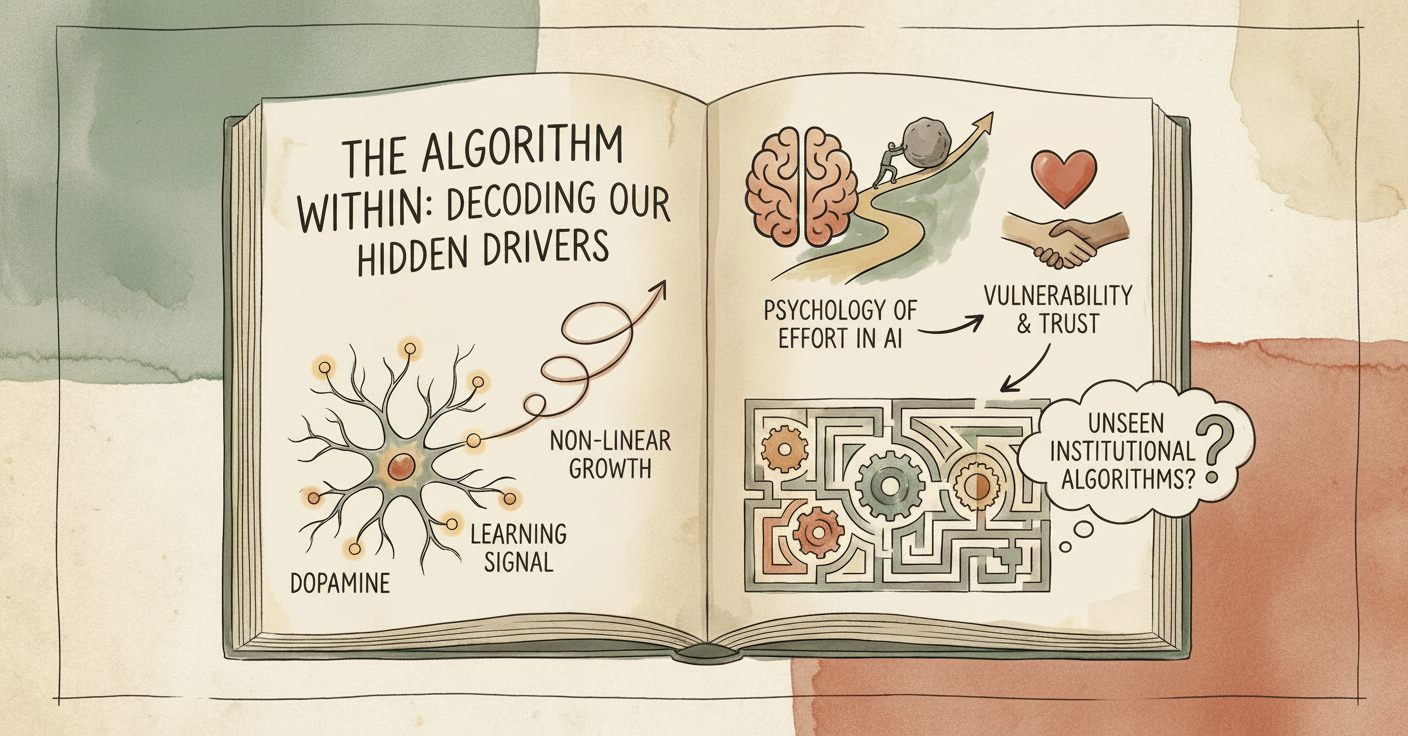
Conventional wisdom often reduces dopamine to a simple 'reward chemical'—a fleeting hit of pleasure. This week, Dr. Read Montague (Virginia Tech's Fralin Biomedical Research Institute) radically reframes this understanding, revealing dopamine as a sophisticated learning signal, akin to the core algorithms driving advanced AI. It's not just about the expectation or the outcome, but the continuous updating of predictions based on new information, constantly pushing us toward new goals. This dynamic, never-satiated learning mechanism is hardwired into our biology, ensuring continuous adaptation and survival by preventing us from idling in complacency.
"Dopamine is a central player in the algorithms that your brain runs. All kinds of learning tasks associated with the animal are associated with dopamine fluctuations in your brain."
— Dr. Read Montague, Professor and Director of the Center for Human Neuroscience Research at Virginia Tech's Fralin Biomedical Research Institute
Why it matters for leaders: Understanding dopamine as a "prediction error" signal, rather than just a pleasure metric, offers a profound framework for motivating teams, designing products, and even analyzing market behavior. If our brains are constantly updating expectations, then strategies that foster continuous learning, adaptive goal-setting, and incremental progress will inherently tap into this fundamental biological drive. For product development, it suggests designing experiences that offer continuous feedback and novelty to keep users in a "foraging mode," much like social media platforms exploit.
The tension: This sophisticated view of dopamine challenges the prevalent "dopamine detox" narrative. If dopamine's primary role is learning and continuous adaptation, completely suppressing it might disrupt fundamental biological processes rather than merely resetting reward thresholds.
Ideas in Brief
① The Illusion of Effort: Why 'Made with AI' Still Falls Short
The human brain places an intrinsic, often irrational, value on perceived effort. Richard Shotton (Astroten) points out that AI-generated content, even if objectively superior, was perceived as 61% less valuable in purchase intent than human-created equivalents in a study. This "illusion of effort" means brands and creators who transparently invest effort, or at least strategically signal it, will likely continue to outperform those relying solely on algorithmic efficiency. (Richard Shotton on Modern Wisdom)
- The implication: When strategizing new product launches or marketing campaigns, understanding the psychological premium humans place on perceived effort is crucial. Transparent narratives about craft, human ingenuity, or even thoughtful storytelling around process can generate more value than perfect, but soulless, output.
② The Psychological Cost of Hiding: Revelations as a Trust Signal
Concealing information, even what seems trivial, exacts a heavy psychological toll and silently erodes trust. Leslie John (Harvard University) argues that people consistently prefer individuals who openly admit to past wrongdoings or negative experiences over those who overtly hide information. This counterintuitive preference for "revealment" over "concealment" even when negative, highlights that vulnerability can be a powerful trust signal. (Leslie John on Hidden Brain)
- The implication: For leaders, fostering a culture of transparency, accountability, and even vulnerability can build deeper trust and psychological safety within teams. Suppressing mistakes or challenges internally might seem protective in the short term, but risks long-term erosion of relational capital.
③ Flourishing as a Squiggly Line: Embracing Unplanned Growth
True flourishing isn't a linear process; it's joyful, meaningful growth achieved via unpredictable detours. Daniel Coyle (Author of The Culture Code) introduces the "yellow doors" concept, where unexpected paths, not meticulously planned ones, often lead to the most profound personal and organizational growth. This challenges the modern obsession with hyper-optimization and straight-line efficiency. (Daniel Coyle on EconTalk)
- The implication: Leaders should cultivate an "adaptive strategy" mindset, favoring experimentation and iterating based on emergent opportunities over rigid, long-term plans. Creating space for unexpected collaborations, client insights, or employee-led initiatives can unlock untapped innovation and growth previously unseen by traditional roadmaps.
④ The 72-Hour Dividend: Reclaiming Discretionary Time
Many leaders feel perpetually time-starved, but this is often a misperception. Laura Vanderkam (NYT Bestselling Author) reveals that even with a full-time job and adequate sleep, most individuals have 72 discretionary hours per week. The challenge isn't a lack of time, but a lack of intentionality in allocating it to "want-to-do" activities. Consistent habits like a "bedtime" and Friday planning can unlock this hidden capacity. (Laura Vanderkam on The Mel Robbins Podcast)
- The implication: For leaders constantly battling overwhelm, this framework offers a powerful reframe: the problem isn't often capacity, but clarity and conscious choice. Encouraging teams to identify and intentionally allocate their 72-hour dividend could significantly boost well-being, innovation, and strategic thinking by creating space for what truly matters beyond urgent tasks.
The Tension
Is the "Awakened" State a Destination or a Dysfunction?
The concept of "awakening" is often viewed as a pinnacle of personal growth, a state of profound clarity and peace. This week's conversations reveal a deeper, more nuanced, and potentially unsettling perspective.
🔵 One view: Awakening as an Ongoing, Disruptive Process
"When people wake up, it is like one line of evolution. It's not all the lines of evolution. And so it can actually get people quite stuck. They've told themselves that this is a finish line and then they hit it and they think they're done, but they're not done."
— Joe Hudson, The Art of Accomplishment
- The argument: Joe Hudson and Brett Kistler (The Art of Accomplishment) contend that awakening is not a fixed state but a continuous evolutionary process requiring constant integration. They argue that pursuing awakening as a final goal can paradoxically lead to dysfunctionality, as individuals might suppress emotions or neglect other areas of personal growth, mistaking a deconstruction of identity for a final, perfect state.
🔴 The counter: The Value of Structured Practice for Self-Management
"You can spend a decade... using meditation to manage myself, which was hell. It wasn't joyful, amazing thing that is now meditation in my mind, which is far more like hanging out on a beach and enjoying a nice breeze."
— Munyi Kelly, The Art of Accomplishment
- The argument: While Munyi Kelly cautions against rigid self-management through meditation, the underlying tension lies in the practical application. While the goal isn't to control, many seekers still utilize structured practices (like meditation) with the intention of managing cognitive and emotional states, even if the ultimate aim is beyond control. The question remains whether these self-management tools, if misapplied or misinterpreted as ends in themselves, truly hinder deeper "awakening," or if they are necessary, albeit imperfect, steps along the way.
What's at stake: For leaders, this tension matters profoundly in how we approach personal development and cultural initiatives. Is the aim a fixed, optimized state for employees (e.g., "mindfulness" programs as a panacea)? Or is it creating environments that support ongoing, sometimes disruptive, personal evolution, recognizing that genuine growth is messy and may surface new challenges rather than eradicating them?
The Question
What is the unseen 'optimization function' currently driving our institutions, and how can we name it to consciously choose a better one?
If, as implied by several conversations this week, our systems (from brain chemistry to brand strategy) are constantly optimizing for something, what is that "something" in our current societal and organizational structures? Is it pure extraction, short-term gain, or maintaining the status quo, even at the cost of true flourishing? What frameworks would help us identify these implicit objectives, and what deliberate choices would be required to shift them towards more desirable, explicitly chosen ends? These are the questions leaders must engage with to truly shape the future.
📚 The Bookshelf
- The Culture Code by Daniel Coyle — This book explains how successful groups build cohesion and trust, providing frameworks relevant to flourishing through shared growth.
- The Underrated Power of Oversharing by Leslie John — Explores the counterintuitive benefits of self-disclosure and the psychological costs of concealment within relationships and organizations.
- The Five Regrets of the Dying by Bronnie Ware — A profound meditation on long-term regrets, emphasizing missed opportunities and 'sins of omission,' relevant to decisions about time allocation and vulnerability.
- How Dopamine and Serotonin Shape Decisions, Motivation & Learning (Huberman Lab) — This particular episode is a deep dive into the neurological underpinnings of motivation and learning, crucial for understanding human behavior beyond simplistic models.
The Bottom Line
This week's exploration reveals that fundamental algorithms, from our neurochemistry to our social structures, are constantly at play, shaping our decisions and perceptions. For leaders, the challenge isn't merely to react to surface-level events, but to discern these unseen forces—whether they're the predictive engines of dopamine or the hidden costs of concealment—and consciously steer them towards outcomes aligned with true flourishing and genuine connection instead of defaulting to unconscious optimization.
What We Listened To
Huberman Lab: "How Dopamine & Serotonin Shape Decisions, Motivation & Learning | Dr. Read Montague"
Runtime: 161 min
Featuring: Dr. Read Montague (Professor and Director of the Center for Human Neuroscience Research, Virginia Tech's Flin Biomedical Research Institute), Andrew Huberman (Professor of Neurobiology and Ophthalmology, Stanford School of Medicine), Scicomm Media (Host, Scicomm Media), Read Montague (Professor of Neuroscience, Virginia Tech Carilion Research Institute)
This episode challenges the simplistic view of dopamine as just a reward chemical, reframing it as a crucial learning signal for continuously updating predictions, mirroring AI algorithms. It delves into the neurological basis of motivation, learning, and challenges of scientific research. It fundamentally alters our understanding of continuous learning and goal pursuit.
"Dopamine is a central player in the algorithms that your brain runs. All kinds of learning tasks associated with the animal are associated with dopamine fluctuations in your brain."
— Dr. Read Montague, Professor and Director of the Center for Human Neuroscience Research at Virginia Tech's Fralin Biomedical Research Institute
Connects to: The psychology of consumer behavior and time management, both influenced by the brain's prediction-updating mechanisms.
Modern Wisdom: "#1053 - Richard Shotton - 11 Psychology Tricks From the World’s Best Brands"
Runtime: 94 min
Featuring: Chris Williamson (Host, Modern Wisdom), Richard Shotton (Behavioural Scientist and Author, Astroten)
This conversation unpacks how brands leverage deep psychological principles like the "illusion of effort," "goal dilution," and "price relativity" to influence consumer behavior. It provides actionable insights into how seemingly irrational human biases drive market success.
"People who, who saw the hand drawn label, they rate that poster better than the group who saw the AI powered label. And the scale is quite surprising. Now, when it comes to purchase intent, there is a 61% difference."
— Richard Shotton, Behavioural Scientist and Author at Astroten
Connects to: The way our brains process information and assign value, linking to the dopamine discussion on continuous expectation updates.
Hidden Brain: "Keeping Secrets"
Runtime: 50 min
Featuring: Shankar Vedantam (Host, Hidden Brain), Leslie John (Psychologist, Harvard University), John Gabris (Host of Staying Alive), Adam Pally (Host of Staying Alive)
This episode explores the hidden costs of self-concealment and the psychological benefits of self-disclosure, arguing that sharing truths, even negative ones, often builds more trust than withholding information. It reveals the long-term regrets of omission.
"When you keep a secret, one of the tricky things is that your mind is very active. Keeping a secret is not an inner activity, it's not a neutral thing... it can be an incredibly active process."
— Leslie John, Psychologist at Harvard Business School
Connects to: The importance of transparency in leadership and the psychological underpinnings of relational health.
The Knowledge Project: "Michael Ovitz: The Business of Relationships"
Runtime: 96 min
Featuring: Michael Ovitz (Co-founder, Creative Artists Agency (CAA)), Shane Parrish (Host, The Knowledge Project)
Michael Ovitz, co-founder of CAA, shares his foundational principles for unprecedented success: ruthless truth-telling, multidisciplinary expertise, unwavering loyalty, and the ability to "package" ideas. This episode highlights the surprising parallels between Hollywood and tech.
"Don't lie. If you don't have an answer... I'm going to get back to you because I don't know the answer to that question, but I'm going to find out."
— Michael Ovitz, Co-founder of CAA
Connects to: The importance of authentic connections and clear communication in an intellectually honest organization.
Making Sense with Sam Harris: "#456 — American Fascism"
Runtime: 21 min
Featuring: Sam Harris (Host, Making Sense with Sam Harris), Jonathan Rauch (Author, The Atlantic)
Sam Harris and Jonathan Rauch discuss the uncomfortable emergence of fascistic properties in American politics, moving beyond initial reluctance to apply the term. They discuss the "demolition of norms" and the "glorification of violence" as key tactics.
"It has been the case historically that fascist figures present certainly before they achieve their aims. They present as comical. I mean, they present as clowns, they present as easy targets of ridicule... But in these cases where they succeed, the satire proves ineffectual."
— Sam Harris, Host of Making Sense with Sam Harris
Connects to: The broader discussion about societal structures, the evolution of political ideas, and understanding underlying drivers of collective behavior.
EconTalk: "How to Flourish (with Daniel Coyle)"
Runtime: 75 min
Featuring: Russ Roberts (Host, Shalem College and Stanford University's Hoover Institution), Daniel Coyle (Author and Consultant, The Culture Code)
Daniel Coyle redefines flourishing as joyful, meaningful, and interdependent growth that happens in unexpected "yellow door" detours, challenging linear, optimized approaches to life. He emphasizes "relational attention" for deeper connections.
"The problem that you're facing is not one that the world has. The world's filled with yellow doors. The problem is that the model you have in your head is a straight line model in a squiggly world."
— Daniel Coyle, Author of The Culture Code
Connects to: The non-linear nature of personal and organizational growth, contrasting with rigid time management and goal-setting.
The Mel Robbins Podcast: "How to Take Control of Your Time: 9 Proven Strategies That Work (Even When You Have No Time)"
Runtime: 86 min
Featuring: Mel Robbins (Host, The Mel Robbins Podcast), Laura Vanderkam (New York Times Bestselling Author, Researcher, Time Management Expert, Laura Vanderkam)
This episode debunks the myth of "no free time," revealing that individuals often have 72 discretionary hours weekly. It offers research-backed strategies for intentional time management, encouraging leaders to redefine their relationship with time.
"There's a big difference between not as much as I want and none. When people say, 'I have no free time whatsoever,' they mean 'I don't have as much free time as I want.'"
— Laura Vanderkam, New York Times Bestselling Author, Researcher, Time Management Expert
Connects to: The practical application of intentionality and planning in achieving personal and professional goals, acknowledging the psychological factors of time perception.
The Art of Accomplishment: "Awakening: Why We Waited 150 Episodes to Talk About It"
Runtime: 48 min
Featuring: Joe Hudson (Host, The Art of Accomplishment), Brett Kistler (Host, The Art of Accomplishment), Joe Hudson Munyi Kelly (Host, The Art of Accomplishment)
Joe and Brett discuss "awakening" not as a destination, but an ongoing evolutionary process, distinguishing between head, heart, and gut awakenings. They caution against pursuing it as a goal, which can lead to dysfunctionality if other aspects of growth are neglected.
"When people wake up, it is like one line of evolution. It's not all the lines of evolution. And so it can actually get people quite stuck. They've told themselves that this is a finish line and then they hit it and they think they're done, but they're not done."
— Joe Hudson, Host of The Art of Accomplishment
Connects to: The complexities of personal growth and the potential pitfalls of rigid self-improvement frameworks, similar to the nonlinear path of flourishing.
From The Culture: "S1, E5 - The Easy Part About Making Hard Decisions"
Runtime: 76 min
Featuring: Marcus Collins (Host, From The Culture), Amanda Slavin (Host, From The Culture), Javier Farfan (Professor at Syracuse, Consultant at J. Wolf Advisors, Special Consultant for the NFL, Syracuse University, J. Wolf Advisors, NFL)
This episode delves into the "iceberg effect" of leadership, highlighting that truly hard decisions often feel easy when backed by shared values and cultural understanding. Using examples like Nike's support for Colin Kaepernick and NFL's Super Bowl strategy, it discusses how clarity of conviction simplifies complex choices.
"It wasn't a hard decision at all to do the Colin Kaepernick act. It's like it was a hard decision at all. Say we stand with athletes. He's an athlete, so we're going to stand with him. Easy peasy. Their shared imagination makes these decisions that seem difficult in the moment, seem obvious after the moment actually actionable."
— Marcus Collins, Host of From The Culture
Connects to: The strategic implementation of core values and cultural insights in decision-making, which can paradoxically make "hard" decisions feel natural.
The Ezra Klein Show: "Is Your Social Life Missing Something? This Is For You."
Runtime: 91 min
Featuring: Ezra Klein (Host, New York Times Opinion), Priya Parker (Author of 'The Art of Gathering' and 'Group Life' Substack, Conflict Resolution Facilitator)
Ezra Klein and Priya Parker explore the tension between individual privacy and communal connection, arguing that "late-stage individualism" leads to loneliness. They discuss how intentional gathering, even with "disputable purpose," fosters deeper relationships and democratic skills.
"We are using therapy to draw boundaries over bridges. We are using therapy, the excuse of therapy, to focus on separation rather than connection."
— Priya Parker, Author of 'The Art of Gathering' and 'Group Life' Substack, Conflict Resolution Facilitator
Connects to: The broader societal implications of emphasizing individual optimization over collective well-being, tying into discussions of flourishing and systemic incentives.