
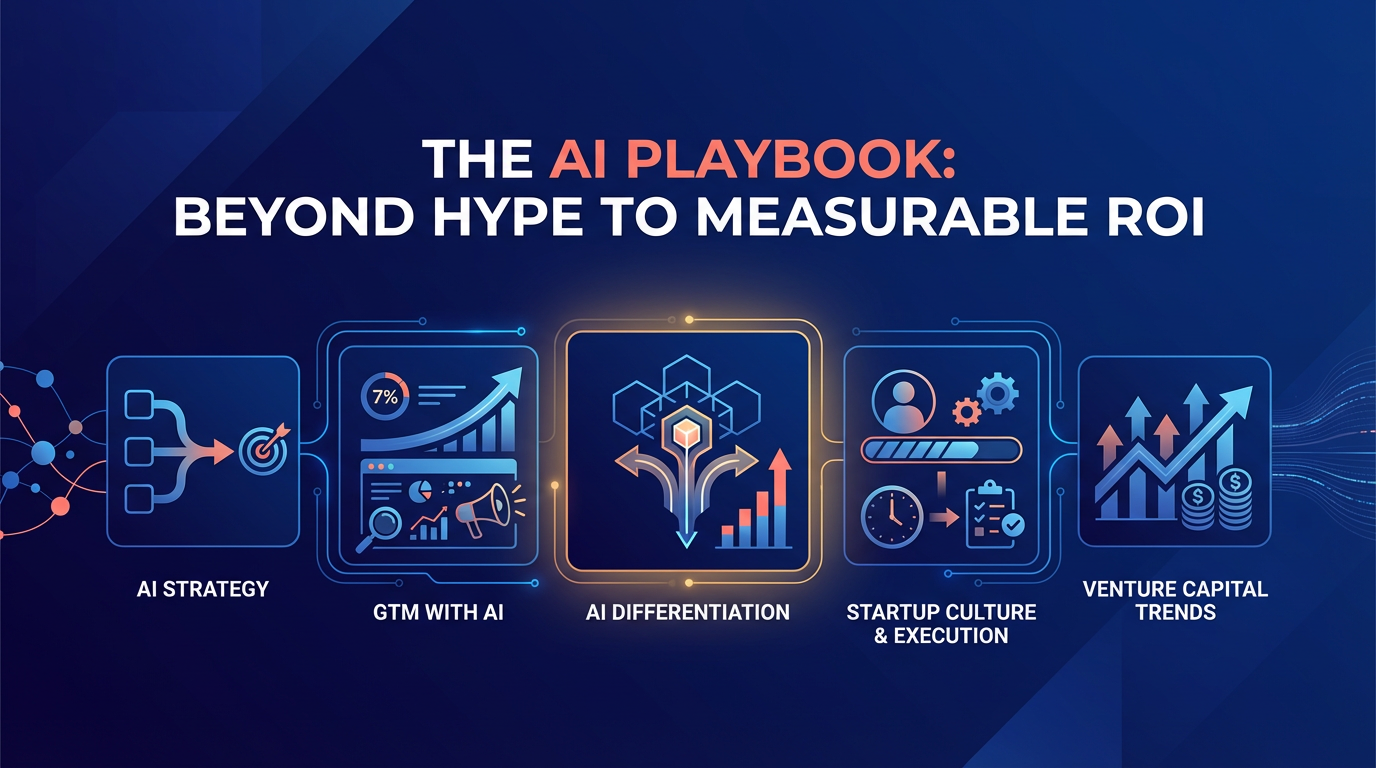
The Post-Hype AI Playbook: From Models to Measurable ROI
THIS WEEK'S INTELLIGENCE
📊 11 episodes across 4 sources
⏱️ ~10 hours of conversation with GPs, founders, and LPs
🎙️ Featuring: Marc Andreessen, Jason Lemkin, Dylan Field, Vanessa Larco
The signal from the noise. Here's what's actually happening.
The AI conversation is shifting. While the foundational model race continues, smart money and savvy operators are looking beyond the hype cycle to where AI actually delivers measurable ROI. This week's intelligence reveals a market increasingly focused on utility over novelty, with a stark reality emerging: "good enough" AI will soon be mediocre. The imperative is clear for founders and investors alike: either build for true differentiation and a defensible moat, or integrate AI to achieve unprecedented operational efficiency and GTM velocity. The market is rewarding speed, extreme work ethic, and a strategic, rather than reactive, approach to AI adoption.
Here's what you need to know about where capital is flowing and what strategies are actually landing.
The New Efficiency Imperative: AI-Powered GTM Becomes a Table Stake
The days of simply "having an AI feature" are over. The cutting edge for B2B now involves fundamentally re-architecting go-to-market (GTM) motions around AI, not just layering it on. Jason Lemkin, the founder of SaaStr, delivered a seismic signal on this front, revealing his own experience replacing a 10-person sales team with 20 AI agents managed by just 1.2 humans, maintaining similar performance. This isn't just about cost savings; it's about shifting human capital to higher-leverage activities and scaling beyond traditional headcount constraints.
The Intelligence: Personio, a late-stage HR and payroll platform, offers a playbook for this transformation, leveraging a cross-functional AI working group and Jobs-to-be-Done (JTBD) framework to prioritize AI initiatives. Their custom-built "Expansion SDR Assistant" cut research time from two hours to 15 minutes, directly impacting pipeline generation. This isn't theoretical; it's in-market, proven efficiency.
The Voice:
"We're done with hiring humans in sales. We are going to push the limits with agents." — Jason Lemkin, SaaStr (Lenny's Podcast)
The Numbers: Personio saw a material reduction in sales cycle time and improved conversion rates by enabling SDRs to focus on high-value interactions. Mercor, a $10 billion startup, is facilitating this shift, connecting AI labs with top-tier contractors to create training data, paying out $1.5 million a day, demonstrating the massive market for human-in-the-loop AI training.
The Implication: For founders, integrating AI into core GTM functions isn't an option; it's becoming a competitive necessity. For investors, look for companies that can demonstrate significant operational leverage and a clear GTM advantage derived from sophisticated AI integration, beyond just the product itself. Those who don't embrace this will be left behind.
Beyond Generative: The Rise of "Concierge-Like" Consumer AI and Defensible Moats
While large language models grab headlines, the next wave of consumer AI innovation is less about general intelligence and more about specific, high-value problem-solving in areas where OpenAI won't compete directly. Vanessa Larco of Equity coined it perfectly: "I invest in stuff that OpenAI isn't going to want to kill." This means focusing on "concierge-like" AI services that manage real-world assets and human logistics – think scheduling, asset management, or complex task orchestration rather than pure content generation.
The Intelligence: True differentiation in the AI era, according to Figma's Dylan Field, will come from design, craft, point of view, and branding. As AI closes technical gaps and accelerates development, the human element—the "why" behind the "what"—becomes paramount. Startups are encouraged to think about "disposable software" akin to word documents for single-purpose AI apps, implying a future where software is contextual and ephemeral, built on top of larger AI capabilities.
The Voice:
"Good enough is going to be mediocre and you're going to need to differentiate through design, through craft, through point of view, through brand, through storytelling and marketing." — Dylan Field, Figma (The a16z Show)
The Implication: Founders need to build explicit defensibility from day one. This isn't just about algorithms; it's about proprietary data sets, unique GTM, brand, and integrating deeply with real-world operations that would be too unwieldy for horizontal AI giants. Investors should prioritize startups with strong defensible moats beyond just "better tech" and that can articulate clear paths to monetizing beyond traditional SaaS models.
The Return of the Extreme Work Ethic: Building in the AI Era
In an environment where capital is concentrated and "efficient growth" is the mantra, the competitive bar for founders is rising dramatically. Alan Chang, co-founder of Fuse Energy and former early Revolut employee, pulls no punches: building a generational company requires an "extreme ownership" mentality and a willingness to work weekends. This isn't just startup lore; it's the operational reality for those achieving hyper-growth (>$260M in 3 years).
The Intelligence: Chang's "Revolut Playbook" emphasizes speed, urgency, and zero excuses. While acknowledging the demanding nature, he argues this relentless pursuit is the only way to build disruptive companies in today's landscape. This ethos pushes against the popular narrative of "work-life balance" for founders, suggesting that true breakthroughs are still the domain of those willing to make extraordinary sacrifices.
The Voice:
"There's nothing wrong with wanting work life balance, but I think the only way to build a generational company is like, very, very strong work ethic. I just don't see any other way to do it." — Alan Chang, Fuse Energy (20VC)
The Implication: This isn't about promoting burnout, but recognizing what it actually takes to move at the speed and scale required to compete now. For founders, self-selection is key: are you truly built for this? For investors, look for founders who demonstrate this level of conviction and operational intensity, balanced with strategic foresight. The market is rewarding ambitious, execution-biased teams.
LPs Tighten, VCs Consolidate, and The Techno-Optimist Bet
The macro shifts continue to shape capital allocation. Venture capital funding is consolidating, with half of all VC dollars going into just four deals. This concentration means fewer, larger bets on perceived winners, making it harder for undifferentiated companies to raise. Amidst this, Marc Andreessen and Ben Horowitz continue to champion a "Techno-Optimist" manifesto, arguing that technology, particularly AI, will save the world and that fears of societal collapse are misdirected.
The Intelligence: The Techno-Optimist narrative posits that AI will dramatically amplify human potential, drive down costs, and expand access, improving quality of life across the board. This philosophy underpins the significant bets being made on AI infrastructure and applications, often with a long-term view that prioritizes transformational impact over short-term returns. The rapid pace of AI development and unprecedented revenue growth rates of AI companies bolster this bullish perspective.
The Voice:
"This is the biggest technological revolution of my life. The comps on this are things like the microprocessor and the steam engine and electricity." — Marc Andreessen (The a16z Show)
The Implication: LPs are becoming even more selective, favoring established managers with strong track records or highly differentiated new funds that align with techno-optimist theses. For founders, raising capital means navigating a concentrated landscape – requiring not just a compelling product, but a clear, defensible path to market leadership and a story that resonates with this deep conviction in technology's transformative power.
CAPITAL SIGNALS
WHERE THE MONEY'S GOING
🔥 Hot: AI-powered GTM solutions for B2B (Source: SaaStr), "Concierge-like" consumer AI (Source: Equity), Companies with extreme work ethic & speed (Source: 20VC)
🧊 Cooling: Pure "AI features" without deep integration or defensibility (Source: SaaStr), Generic consumer apps (Source: Equity), Companies with slow execution (Source: 20VC)
👀 Emerging: AI training data platforms (Source: Equity), Custom-built AI agents for operational efficiency (Source: SaaStr), Platforms enabling "disposable software" (Source: Equity)
⚠️ Crowded: Foundational AI models (Source: a16z), Basic SaaS tools without significant AI differentiation (Source: SaaStr)
THE FOUNDER'S PLAYBOOK
- AI-Native GTM from Day One: Don't just add AI; rebuild your sales, marketing, and customer service around AI agents and tools. As Personio implemented, establish cross-functional AI working groups and prioritize initiatives using 'Jobs-to-be-Done' frameworks, targeting a 5-10x efficiency gain, not just 10-20%. This frees up humans for high-leverage activities. (Source: SaaStr)
- Differentiate Through Craft & Point of View: As AI democratizes access to "good enough" technology, your defensibility will come from non-replicable assets: brand, user experience, unique design, and a strong editorial perspective. Figma's Dylan Field emphasizes this as the key to standing out when AI is closing feature gaps. (Source: a16z)
- Embrace Extreme Ownership: Rapid scaling (e.g., $0-$260M in 3 years for Fuse Energy) is predicated on an "always-on" mentality, urgent execution, and zero excuses. While controversial, this mindset from leaders like Alan Chang is directly linked to the speed required to capitalize on new market windows in the AI era. (Source: 20VC)
THE LP LENS
LPs are operating in a highly concentrated environment. The top managers and funds with strong track records, particularly those leaning into the broad AI thesis rooted in techno-optimism, are securing the lion's share of allocations. There's a clear preference for managers capable of making big, conviction-driven bets in a market where half the capital is flowing to a handful of deals. LPs are scrutinizing operational efficiency within portfolio companies, seeking evidence that their managers are backing founders who are fundamentally rethinking GTM and product development with AI. Funds that cannot demonstrate this deep integration of AI into their investment thesis and portfolio strategy are likely to struggle for re-ups and new allocations. The focus is on managers who can clearly articulate how their portfolio companies will re-accelerate growth by 2025-2026, or risk being seen as "D" performers.
THE CONTRARIAN POSITION
The pervasive "AI will kill jobs" narrative, particularly for middle-tier administrative or sales roles, is being reframed as AI "displacing the jobs people don't want to do today" and the "mid-pack and the mediocre." Jason Lemkin explicitly states that AI agents are taking over tasks humans find undesirable or inefficient, allowing human talent to redeploy to higher-value, more strategic functions. This suggests that the future of work isn't about job destruction, but about a significant upskilling and re-allocation of human capital, demanding adaptability from individuals rather than mass unemployment.
THE BOTTOM LINE
Successfully navigating the current venture landscape means understanding that the AI era isn't just about building AI models, but fundamentally reorganizing business operations and product differentiation around them. For founders, this demands an unprecedented level of execution, strategic GTM overhauls, and a clear, defensible value proposition. For investors, it means backing teams with this extreme ownership mentality and a credible plan to deliver measurable ROI, rather than merely chasing AI hype. The window for easy wins is closing; only those who build with urgency, craft, and an unwavering commitment to efficiency will capture outsized returns.
📚 APPENDIX: EPISODE COVERAGE
1. The Twenty Minute VC (20VC): "$0-$260M in Revenue in Three Years: How We Did It | You Need to Work Weekends to Win — Most Founders Aren't Ambitious Enough | The Revolut Playbook: Speed, Urgency, Extreme Ownership, and Zero Excuses with Alan Chang @ Fuse Energy"
Guests: Alan Chang (Co-founder & CEO, Fuse Energy) Runtime: 59:02 | Vibe: Unapologetically demanding, high-performance playbook
Key Signals:
- Extreme Ownership & Work Ethic: Chang, drawing from his Revolut experience, asserts that building a generational company requires an "always-on," extreme work ethic, dismissing the idea of work-life balance for founders seeking hyper-growth.
- Revolut Playbook Principles: Core tenets include speed of execution, unwavering urgency, and zero excuses, emphasizing the leader's responsibility for outcomes regardless of external factors.
- Valuation & Capital Efficiency: Rapid scaling to $260M in three years showcases the intense capital efficiency and operational velocity achievable with this demanding approach.
"There's nothing wrong with wanting work life balance, but I think the only way to build a generational company is like, very, very strong work ethic. I just don't see any other way to do it."
2. Equity: "Investing in the consumer AI products OpenAI ‘won’t want to kill’"
Guests: Vanessa Larco (Partner, Andreessen Horowitz) Runtime: 15:37 | Vibe: Strategically contrarian, forward-looking consumer AI insights
Key Signals:
- Defensible Consumer AI: Larco advocates investing in "concierge-like" consumer AI that manages real-world assets and human logistics (e.g., managing homes, coordinating physical services), areas OpenAI is unlikely to enter due to complexity.
- "Disposable Software" Trend: Predicts the rise of single-purpose, ephemeral AI apps, similar to word documents, where the experience is generated on demand rather than residing in persistent, complex applications.
- Shift to Voice-First Interfaces: Highlights the impending transition from screen-first to voice-first user experiences as a critical design challenge and opportunity for consumer AI.
"I want to make my tagline, I invest in stuff that OpenAI isn't going to want to kill."
3. The a16z Show: "Figma’s Dylan Field on the Future of Design"
Guests: Dylan Field (Co-founder & CEO, Figma) Runtime: 49:03 | Vibe: Thought-provoking, design-centric view of AI's impact
Key Signals:
- Differentiation Through Design in AI Era: Field argues that as AI levels the playing field in speed and capability, true differentiation will increasingly come from design, craft, point of view, branding, and storytelling.
- AI as an Enabler, Not a Replacement: AI accelerates software development and expands markets by closing gaps, but it doesn't diminish the need for human creativity and strategic thinking in design.
- The "Good Enough" Plateau: Emphasizes that basic usability will become mediocre, forcing a higher standard for craft and user experience to stand out in an AI-augmented world.
"Good enough is going to be mediocre and you're going to need to differentiate through design, through craft, through point of view, through brand, through storytelling and marketing."
4. The a16z Show: "AI Will Save The World with Marc Andreessen and Martin Casado"
Guests: Marc Andreessen (Co-founder & General Partner, Andreessen Horowitz), Martin Casado (General Partner, Andreessen Horowitz) Runtime: 1:04:15 | Vibe: Boldly optimistic, philosophical AI defense
Key Signals:
- AI as a Force for Good: Andreessen argues strongly against AI existential dread, positioning AI as a powerful amplifier of human potential that will drive unprecedented societal progress and economic growth.
- Open Markets for AI Development: Emphasizes the importance of open, competitive markets in shaping AI development, believing this will lead to the most beneficial outcomes for humanity.
- Historical Context of Technological Progress: Draws parallels between AI and past transformative technologies (e.g., electricity, steam engine), reframing current fears as typical reactions to radical innovation.
"Rather than destroying the world, he argues, AI may help save it."
5. Lenny's Podcast: Product | Career | Growth: "We replaced our sales team with 20 AI agents—here’s what happened | Jason Lemkin (SaaStr)"
Guests: Jason Lemkin (Founder, SaaStr) Runtime: 39:21 | Vibe: Provocative, actionable, GTM paradigm shift
Key Signals:
- AI Agents Displacing Sales Roles: Lemkin's team successfully replaced a 10-person sales team with 20 AI agents and 1.2 human managers, demonstrating how AI can maintain or improve GTM efficiency with reduced human headcount.
- Focus on Unwanted Tasks: AI is currently displacing "mid-pack" and "mediocre" human roles, particularly tasks that humans find undesirable, repetitive, or inefficient within sales.
- Founding AI-First GTM: Advises companies to train AI agents with their best sales strategies from the outset, rather than adapting existing human-centric processes, to maximize impact.
"We're done with hiring humans in sales. We are going to push the limits with agents."
6. The Official SaaStr Podcast: SaaS | Founders | Investors: "SaaStr 835: AI + B2B in 2026: Find the Tailwinds or Get Left Behind with SaaStr CEO and Founder Jason Lemkin"
Guests: Jason Lemkin (CEO & Founder, SaaStr) Runtime: 25:10 | Vibe: Direct, urgent call to action for B2B SaaS
Key Signals:
- Concentrated VC Funding: Half of all VC dollars are currently flowing into just four deals, indicating a highly consolidated and selective funding environment, particularly for B2B AI.
- The "D" Grade for Stagnation: B2B companies that fail to re-accelerate growth by 2025-2026 due to lack of AI adoption will be considered failures, underscoring the urgency for AI integration.
- AI for TAM Expansion, Not Just Features: Successful B2B AI strategies focus on expanding Total Addressable Market (TAM) or fundamentally replacing human effort, rather than simply adding "copilot" features.
"If you didn't reaccelerate growth in 2025, you get a D. You can't get a D in 2026."
7. The a16z Show: "The Techno-Optimist Manifesto with Marc Andreessen and Ben Horowitz"
Guests: Marc Andreessen (Co-founder & General Partner, Andreessen Horowitz), Ben Horowitz (Co-founder & General Partner, Andreessen Horowitz) Runtime: 59:34 | Vibe: Ideological rallying cry for technological progress
Key Signals:
- Tech as a Catalyst for Progress: Reaffirms the core message of the "Techno-Optimist Manifesto," advocating for technology, free markets, and innovation as the primary drivers of human advancement and improved quality of life.
- Challenging Pessimistic Narratives: Directly confronts and refutes common criticisms of technology as inherently harmful, instead framing it as a tool for empowerment and societal problem-solving.
- Free Markets and Innovation: Highlights how competitive markets and relentless innovation lead to lower prices, increased access, and broader prosperity, especially for lower-income individuals.
"Technology is a weapon of war. Technology is something that has unanticipated negative consequences. Markets have winners and losers. And so you just kind of have to decide where you go in."
8. The Official SaaStr Podcast: SaaS | Founders | Investors: "SaaStr 836: The Step-By-Step Playbook for Building AI-Powered GTM Teams with Personio's CRO"
Guests: Philip Lacor (CRO, Personio) Runtime: 29:32 | Vibe: Practical, detailed guide to AI implementation in GTM
Key Signals:
- AI-Powered Sales Efficiency: Personio reduced Expansion SDR research time from two hours to 15 minutes using a custom AI assistant, resulting in a significant boost in pipeline generation and efficiency.
- Structured AI Adoption Playbook: Successful AI integration involves a cross-functional AI working group, Jobs-to-be-Done (JTBD) prioritization, and a top-down and bottom-up approach to foster an AI-first culture.
- Careful AI Guardrails: Early AI agents sometimes generated inappropriate content (e.g., legal advice, competitor bashing), underscoring the need for dedicated human oversight and clear brand guidelines for AI deployments.
"The research time that an ESDR spends on this work went from two hours a day to 15 minutes. Not only that, you see here the pipeline that an ECR is adding with this assistant and basically the pipelin..."
9. Equity: "How AI is reshaping work and who gets to do it, according to Mercor's CEO"
Guests: Mercor's CEO Runtime: 15:37 | Vibe: Explores the economic impact and operational mechanics of AI data
Key Signals:
- The AI Training Data Economy: Mercor, a $10B startup, functions as a critical middleman, connecting AI labs (like OpenAI) with high-skilled contractors to create essential training data for AI models.
- High-Value Gig Economy: Mercor's contractors earn an average of $95/hour, with the company paying out $1.5 million daily, demonstrating the rapid growth and economic incentive within the AI data labeling market.
- Structural Efficiency of AI: The core hypothesis is that training an AI agent to automate an activity is structurally more efficient than having humans perform it redundantly, driving the demand for Mercor's services.
"Our average pay rate right now is $95 an hour. We're paying out $1.5 million a day just, you know, 18 months after really finding this market."
10. The a16z Show: "Marc Andreessen's 2026 Outlook: AI Timelines, US vs. China, and The Price of AI"
Guests: Marc Andreessen (Co-founder & General Partner, Andreessen Horowitz) Runtime: 35:50 | Vibe: Macro-level, speculative AI future
Key Signals:
- AI as a Generational Revolution: Andreessen views AI as the most significant technological shift of his lifetime, comparable to the microprocessor or steam engine in its transformative potential.
- Unprecedented AI Revenue Growth: AI companies are experiencing revenue growth rates that are "absolutely unprecedented," driven by actual customer demand translating directly into dollars.
- Rapid Price Declines in AI: The cost of AI is falling faster than Moore's Law, leading to rapid democratization and widespread access to leading AI models, fostering innovation across the ecosystem.
"This is the biggest technological revolution of my life. The comps on this are things like the microprocessor and the steam engine and electricity."
11. My First Million: "The best stuff we’ve read in the last 12 months"
Guests: Sam Parr, Shaan Puri Runtime: 49:58 | Vibe: Inspiring, eclectic, personal growth-oriented
Key Signals:
- Importance of Meaning and Narrative: Leaders have the power to elevate the meaning and importance of work, shaping how individuals perceive their contributions and experiences, which impacts motivation and outcomes.
- Avoiding Delayed Gratification Traps: The hosts emphasize the danger of indefinite delayed gratification, advocating for making impactful decisions and experiencing life fully rather than perpetually pushing off rewards.
- Strategic Decision-Making: The conversation implicitly encourages listeners to choose their path wisely, whether in business or life, emphasizing the consequences of inaction or poor alignment.
"The leader can elevate the importance and what this means because the meaning, it is what it is. What you tell yourself it means is what you will actually what you'll actually feel about it."