
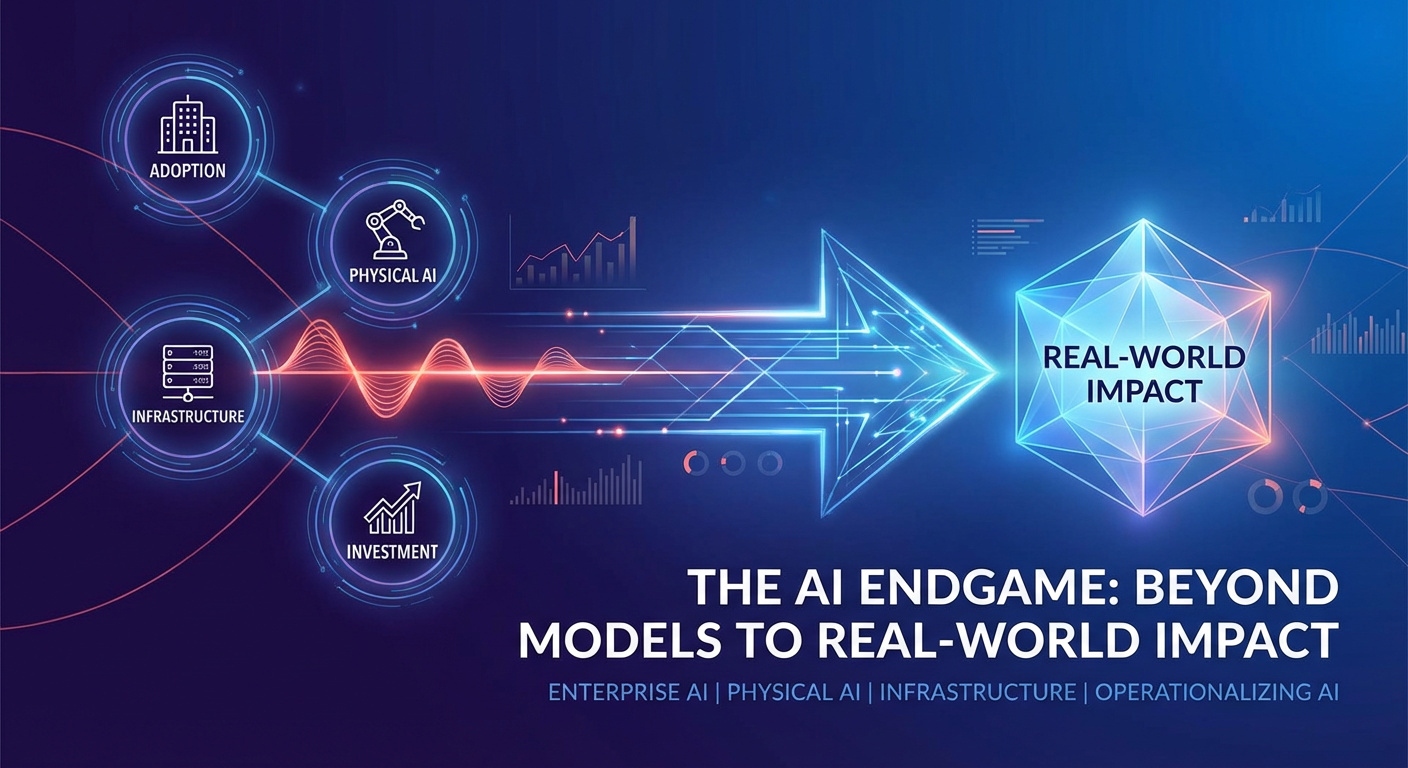
The AI Endgame: Enterprise Adoption, Physical AI, and the New Infrastructure Primitives
THIS WEEK'S INTELLIGENCE
📊 11 episodes across 5 sources
⏱️ 6.5 hours of conversation with GPs, founders, and LPs
🎙️ Featuring: Martin Casado (a16z), Brad Jacobs (XPO, United Rentals), David George (a16z), Matt MacInnis (Rippling), Matt Fitzpatrick (Invisible Technologies)
The signal from the noise. Here's what's actually happening.
THE BRIEF
The AI gold rush is shifting. While consumer AI models have seen exponential adoption, the real frontier — and the next wave of outsized returns — lies in enterprise integration and the physical economy. Smart money is moving beyond foundational models, focusing on the infrastructure primitives needed for AI to impact factories, science, and finance. The market is increasingly rewarding companies that can bridge the gap between model performance and real-world application, often requiring "forward-deployed" engineering teams and a "factory-first" mindset. For founders, this means understanding that a compelling AI product now demands deep operational hooks and a clear path to generating trust and return on investment within existing enterprise workflows. For GPs, the edge is in identifying non-consensus market opportunities driven by these underlying shifts, rather than chasing crowded, high-valuation plays in pure software AI.
This week, we dig into the operational realities of AI adoption, the emergence of physical AI, and the new infrastructure primitives enabling the next wave of category creation. Here's what you need to know.
THE BRIEFING
Enterprise AI: The Last Mile Problem and the Rise of Forward-Deployed Engineers
The Situation: Despite leaps in AI model performance and ubiquitous consumer adoption, enterprise integration of AI remains stubbornly difficult. There's a chasm between the promise of AI and its practical, scaled deployment within complex organizational structures.
The Intelligence: The core issue isn't technology; it's the operational lift required. Enterprises grapple with data infrastructure, workflow redesign, and, critically, trust. Matt Fitzpatrick, CEO of Invisible Technologies, argues compellingly that "it is BS that enterprises can adopt AI without Forward-Deployed Engineers." The winners in enterprise AI won't just build great models; they'll build the human-in-the-loop, bespoke integration teams that translate cutting-edge AI into measurable business outcomes within legacy systems. This implies a higher cost of sale and deployment than pure SaaS, but also much stickier, higher-value contracts.
The Voice:
"There's a gap or a chasm between model performance and adoption. Models have increased 40 to 60% in performance over the last two years. And consumer adoption has been also exponential. But the enterp... [is lagging]." — Matt Fitzpatrick, Invisible Technologies (20VC)
The Numbers: Fitzpatrick observes that despite significant performance gains in AI models, enterprise adoption has not followed suit proportionally, indicating a bottleneck not in AI capability but in integration and trust.
The Implication: For founders, relying solely on API-first or self-service models for enterprise AI is premature. Building a forward-deployed engineering muscle or partnering with systems integrators early will be crucial. For investors, evaluate enterprise AI startups not just on model performance or feature sets, but on their ability to manage the "last mile" deployment and earn operational trust, which often means higher gross margins on services or a deeply integrated product that requires significant upfront work.
Physical AI: The Electro-Industrial Stack and the Factory Floor
The Situation: The discourse around AI has largely centered on software applications and data centers. However, a significant shift is underway, moving AI's impact into the physical, industrial economy.
The Intelligence: a16z's "Big Ideas 2026" series highlights the emergence of "Physical AI" applied to factories, construction, and critical infrastructure. This isn't just about automation; it's about an "electro-industrial stack" that combines AI with electric vehicles, drones, and advanced manufacturing. The key drivers are reliability, real-world constraints, and end-to-end systems. This requires a "factory-first" mindset, deep physical observability, and robust data collection directly from physical assets. Winning companies will be those that build AI-native systems preserving privacy and interoperability while earning public trust.
The Voice:
"The next industrial evolution won't just happen in factories, but inside the machines that power them. This is the rise of the electro industrial sac. Combined tech that powers electric vehicles, dron..." — The a16z Show (Big Ideas 2026: Physical AI and the Industrial Stack)
The Numbers: While specific valuations weren't cited, a16z partners emphasize the potential for multi-trillion dollar markets in physical AI, suggesting a significant reallocation of capital towards these capital-intensive, but ultimately infrastructure-critical, businesses.
The Implication: This is a call to action for founders to build in "unsexy" but critical sectors. Industrial AI, robotics, and advanced manufacturing are not merely niche markets; they are where the next wave of fundamental innovation and value creation will occur. Investors should look for teams with deep physical domain expertise alongside AI talent, seeking non-consensus views on TAM where the market typically undervalues industrial shifts. The capital requirements might be higher, but the defensibility and potential market size are substantial.
New Infrastructure Primitives: Programmable Money, Autonomous Labs, and AI-Native Distribution
The Situation: Fundamental shifts are creating entirely new rails for building new markets, driven by advancements that enable systems to emerge, compound, and scale in unprecedented ways.
The Intelligence: The "Big Ideas 2026: New Infrastructure Primitives" episode reveals three distinct but interconnected areas:
- Programmable Money: Beyond stablecoins, this involves on-chain credit and synthetic products, scaling traditional asset representations on-chain.
- Autonomous Labs: AI and robotics are converging to automate scientific research, moving from manual experimentation to fully autonomous discovery.
- AI-Native Distribution: Early-stage AI startups are finding traction by selling directly to other nascent AI companies, reducing CAC and building network effects.
These shifts are creating new categories and re-rating existing ones, suggesting that some of the most profound impacts of current technological advancements aren't in applications directly, but in the underlying operating layers.
The Voice:
"New infrastructure primitives are creating entirely new rails for building." — The a16z Show (Big Ideas 2026: New Infrastructure Primitives)
The Numbers: The concept of "AI-native distribution" specifically hints at significantly lower customer acquisition costs (CAC) for companies targeting other early-stage AI firms, implying more efficient capital deployment.
The Implication: For founders, these primitives represent powerful new wedges to build defensible businesses. Entering early on a new primitive can lead to massive network effects and category dominance. For investors, identifying these foundational shifts before they become mainstream is where outsized returns are made. Look specifically for companies enabling the primitives, not just those building on top of them. This requires looking beyond current market sizes and projecting future compound growth created by these new "rails."
CAPITAL SIGNALS
WHERE THE MONEY'S GOING
🔥 Hot: Enterprise AI integration & last-mile solutions (Source: 20VC), Physical AI & Electro-industrial stack (Source: a16z), On-chain credit & programmable money (Source: a16z)
🧊 Cooling: Pure play consumer LLM assistants (winner-take-most trend consolidating market share) (Source: a16z), Generic dev tools without clear ROI (Source: GP sentiment)
👀 Emerging: Autonomous scientific labs (Source: a16z), AI-native distribution models (Source: a16z), Hardware-enabled AI (robotics, specialized chips for physical AI) (Source: Pivot)
⚠️ Crowded: Foundational AI models (OpenAI, Anthropic dominance) (Source: Equity), Software-only AI without deep operational ties (Source: 20VC)
THE FOUNDER'S PLAYBOOK
- "Extraordinary Results Demand Extraordinary Efforts" (Matt MacInnis, Rippling): High-performing founders are deliberately understaffing projects to avoid political overhead and maintain team intensity. This isn't about frugalism for its own sake, but about driving focus and preventing organizational entropy. The implication: resource scarcity, when managed effectively, can be a forcing function for extreme discipline and faster execution. (Source: Lenny's Podcast)
- Build Your Own "Forward-Deployed" Engine: For enterprise AI, waiting for customers to figure out integration is a death sentence. Founders are building bespoke integration teams or deeply technical customer success functions to ensure their AI isn't just purchased, but successfully deployed to create measurable value. This involves hands-on engineering to adapt the AI to existing customer workflows and data infrastructure. (Source: 20VC)
- Adopt a "Market-First" Investment Philosophy: Martin Casado (a16z) advocates for building companies by identifying nascent, expanding markets first, rather than starting with a product idea. This involves observing where the underlying technological shifts are creating new opportunities for value creation and then designing a company to fill that void. This contrasts with a product-centric approach and suggests a more opportunistic, data-driven strategy for company formation. (Source: a16z Show)
THE LP LENS
LPs are increasingly savvy about where VC returns will come from in the current cycle, particularly as the AI boom matures. While enthusiasm for AI remains high, there's a growing understanding that "AI" as a broad category isn't enough. LPs are looking for managers who can identify the specific market opportunities within AI (e.g., physical AI, enterprise integration, new infrastructure primitives) and demonstrate a clear thesis for navigating crowded segments. There's a flight to quality and a focus on managers with deep sector expertise who can deploy capital into less obvious but fundamentally valuable areas. Funds that can show how they're enabling enterprise AI adoption beyond just "another model" or facilitating the shift to the physical economy are likely to attract significant allocations. The emphasis is on long-term, foundational shifts rather than short-term hype cycles.
THE CONTRARIAN POSITION
While much of the market is fixated on the competitive landscape of large language models and foundation AI, Brad Jacobs (serial billionaire entrepreneur) focuses on the enduring fundamentals of business building: rigorous financial management, intentional organizational design, and maintaining a positive mindset. He argues that creating shareholder value isn't just financial, but about bringing something "extraordinary into existence from absolutely nothing." This suggests that even amidst technological revolutions, the core principles of disciplined execution and operational excellence remain paramount, often overlooked when chasing shiny new objects.
THE BOTTOM LINE
The AI boom is far from over, but the nature of opportunity is evolving. Capital is flowing towards the difficult, operational problems of integrating AI into the enterprise and extending its reach into the physical world. Founders who can navigate these complexities, build for new infrastructure primitives, and embrace disciplined, intense execution will be disproportionately rewarded. For investors, the edge is in identifying non-obvious market opportunities driven by these shifts, prioritizing teams with deep domain expertise over general AI talent. The next wave of value creation in AI will be built where computation meets the real world and where technology is deeply embedded into operational workflows.
📚 APPENDIX: EPISODE COVERAGE
1. Lenny's Podcast: "10 contrarian leadership truths every leader needs to hear | Matt MacInnis (Rippling)"
Guests: Matt MacInnis (CPO, Rippling)
Runtime: 1 hr 20 min | Vibe: Unflinchingly candid
Key Signals:
- Deliberate Understaffing for Efficiency: MacInnis advocates for intentionally understaffing projects to foster speed, accountability, and prevent organizational politics, arguing that "extraordinary results demand extraordinary efforts."
- High Alpha, Low Beta Framework: This framework helps evaluate different business aspects, distinguishing between high-impact, unique ideas ("high alpha") and commodity parts ("low beta"), reinforcing where resources and intellectual capital should be focused.
- Feedback as a Moral Imperative: He posits that withholding essential feedback is "the most selfish thing you can do," underscoring the importance of direct and honest communication for growth and organizational health.
"Your job as a leader is to preserve that intensity at its highest possible level."
2. The Twenty Minute VC (20VC): "Enterprises Will Not Adopt AI without Forward-Deployed Engineers | Who Wins the Data Labelling Race: How Does it Shake Out? | How Synthetic Data Threatens the Future of Human-Generated Data with Matt Fitzpatrick, CEO of Invisible Technologies"
Guests: Matt Fitzpatrick (CEO, Invisible Technologies)
Runtime: 45 min | Vibe: Pragmatically disruptive
Key Signals:
- Enterprise AI Adoption Chasm: There’s a significant gap between the exponential performance growth of AI models and actual enterprise adoption, primarily due to the complexity of integration into existing workflows and data infrastructure.
- Necessity of Forward-Deployed Engineers: Enterprises cannot effectively adopt AI without dedicated "forward-deployed engineers" who can bridge the gap between AI models and real-world operational needs, translating to higher, stickier revenue for vendors.
- Shifting Data Labeling Landscape: With advances in synthetic data generation, the data labeling market is evolving, moving towards expertise-driven human-in-the-loop services for edge cases rather than commoditized bulk labeling.
"It is BS That Enterprises Can Adopt AI Without Forward-Deployed Engineers"
3. The a16z Show: "Big Ideas 2026: Physical AI and the Industrial Stack"
Guests: Sarah Catanzaro, Frank Chen, Justin Kelleher (a16z)
Runtime: 30 min | Vibe: Grand industrial vision
Key Signals:
- AI's Move to the Physical Economy: AI is extending beyond software to profoundly impact physical industries like manufacturing, construction, and infrastructure, requiring a "factory-first" approach.
- Rise of the Electro-Industrial Stack: This new stack combines AI with electric, autonomous, and connected systems (e.g., EVs, drones) to power a new generation of industrial processes and machines.
- Importance of Physical Observability: For physical AI to succeed, robust data collection and "physical observability" are crucial, creating a new sensor-driven infrastructure for real-world operations.
"The next industrial evolution won't just happen in factories, but inside the machines that power them. This is the rise of the electro industrial sac."
4. The a16z Show: "Where Does Consumer AI Stand at the End of 2025?"
Guests: Zoran Basich, Justine Moore, Danyal Shah, David George (a16z)
Runtime: 35 min | Vibe: Retrospective and predictive
Key Signals:
- Multimodal AI Dominance: Image and video AI models showed the most significant viral growth among consumers, indicating a shift towards more diverse and engaging AI interactions beyond text.
- Winner-Take-Most in Core LLM Assistants: The general LLM assistant space is trending towards a "winner-take-all" or "winner-take-most" dynamic, with few dominant players capturing most market share.
- Subtlety in Product Design: Successful consumer AI products are characterized by subtle product design that integrates AI seamlessly, offering utility without being overtly "AI-first."
"I think there's some early signs that the general LLM assistant space might be trending towards winner take all..."
5. Equity: "Equity's 2026 Predictions: AI Agents, Blockbuster IPOs, and the Future of VC"
Guests: Mary Ann Azevedo, Kirsten Korosec, Alex Wilhelm (Equity Podcast Hosts)
Runtime: 40 min | Vibe: Speculative and informed
Key Signals:
- Emergence of AI Agents and World Models: 2026 is predicted to be the year of AI agents, with "world models" (AI systems understanding and creating environments with physics awareness) becoming a significant trend.
- VC Liquidity Crisis Persists: Alternative funding remains prominent as traditional VC struggles with exits and tightened capital, pushing startups towards more creative financing options.
- Big AI IPOs on the Horizon: Major AI players like OpenAI and Anthropic are expected to go public, signaling potential liquidity for early investors and a maturing of the AI market.
"I think this year is going to be the year of the AI agents because we have this thing called MCP, so Anthropic, like about a year ago came out with Model Context Protocol."
6. Founders: "#408 How to Make a Few MORE Billion Dollars: Brad Jacobs"
Guests: Brad Jacobs (Serial entrepreneur, author)
Runtime: 1 hr | Vibe: Masterclass in scaling
Key Signals:
- Entrepreneurial Discipline is Key: Jacobs emphasizes rigorous financial management, meticulous organizational design, and unwavering mental resilience as core tenets for building multi-billion dollar companies.
- Value Creation Beyond Finance: True shareholder value is about bringing something "extraordinary into existence from absolutely nothing," rather than purely financial engineering.
- Mindset as a Business Tool: Maintaining a positive and focused mindset is crucial for navigating the extreme highs and lows of entrepreneurship, highlighting emotional intelligence as a core business skill.
"For me, creating shareholder value isn't just financial. It's about bringing something extraordinary into existence from absolutely nothing."
7. Pivot: "Pivot Predictions: Scott’s Big Tech Stock Pick, The Next Bailout, and President JD Vance?"
Guests: Kara Swisher (Journalist), Scott Galloway (Professor)
Runtime: 40 min | Vibe: Incisive and provocative
Key Signals:
- AI Dumping from China: Prediction of "AI dumping" from China with cheaper, lower-power open-weight models impacting global markets and potentially creating geopolitical tensions.
- Amazon's AI & Robotics Advantage: Amazon is singled out as a top tech stock pick due to its underappreciated investments and leadership in AI and robotics, particularly in manufacturing and logistics.
- Convergence of AI and Robotics: The combination of AI and robotics is poised for massive untapped potential in various industries, leading to significant efficiencies and new applications.
"China is going to engage in what I refer to as AI dumping, and that is these open, open weight models. These models are just much cheaper, lower power consumption."
8. The a16z Show: "The Inside Story of Growth Investing at a16z"
Guests: David George (General Partner, a16z)
Runtime: 35 min | Vibe: Strategic and analytical
Key Signals:
- Non-Consensus TAM Views are Edge: Successful growth investing is less about business models (which are "table stakes") and more about identifying non-consensus views on Total Addressable Market that the market fundamentally misunderstands or lags in seeing.
- Conviction in Competitive Markets: In high-valuation, competitive markets, conviction driven by proprietary insights into market dynamics or unit economics is paramount for making winning investments.
- Evolution of Investment Strategy: The episode highlights a shift from focusing solely on product-market fit to deeply understanding market-product fit and the underlying growth drivers.
"Business models are just table stakes in growth investing. They're not actually in my experience what gives you edge in making great growth investments."
9. The a16z Show: "Big Ideas 2026: New Infrastructure Primitives"
Guests: Jeff Amico, Scott Kupor, Alex Rampell (a16z)
Runtime: 30 min | Vibe: Foundational innovation
Key Signals:
- New Rails for Programmable Money: The evolution of programmable money is moving beyond stablecoins to on-chain credit and synthetic financial products, creating entirely new financial systems.
- Autonomous Labs for Scientific Discovery: AI and robotics are converging to create fully automated scientific labs, accelerating discovery by orders of magnitude through autonomous experimentation.
- AI-Native Distribution Models: Early-stage AI startups are discovering a new distribution primitive by successfully selling to other nascent AI companies, fostering network effects and reducing CAC.
"New infrastructure primitives are creating entirely new rails for building."
10. This Week in Startups: "THE 2025 TWISTY AWARDS! Biggest Trends, Best Guests, Top Name Drops, and more | E2229"
Guests: Jason Calacanis, Molly Wood (Hosts)
Runtime: 1 hr 20 min | Vibe: Enthusiastic and retrospective
Key Signals:
- AI's Impact on Labor: Ongoing discussions and predictions around AI-driven job displacement and the emergence of new roles, indicating a deep structural shift in the labor market.
- Rise of Humanoid Robotics: Continued speculation and excitement around humanoid robots, particularly Optimus, as potentially revolutionary products with widespread impacts.
- M&A Trends in Tech: The awards highlight key M&A activities and discussions, indicating consolidation and strategic acquisitions shaping the technology landscape.
"I believe Optimus is going to be the greatest product ever created by humanity, including the wheel in this."
11. The a16z Show: "Why a16z's Martin Casado Believes the AI Boom Still Has Years to Run"
Guests: Martin Casado (General Partner, a16z)
Runtime: 35 min | Vibe: Confidently bullish
Key Signals:
- AI Boom in Early Innings: Casado asserts the current AI boom is comparable to 1996 in the dot-com era, implying significant runway for growth and value creation, rejecting "bubble" narratives.
- AI Coding as Multi-Trillion Market: AI's unexpected prowess in coding is identified as a massive, multi-trillion dollar market opportunity, reshaping software development paradigms.
- Market-First Investment Philosophy: Casado advocates for an investment philosophy centered on identifying and understanding nascent markets before building companies to serve them, recognizing that markets create companies.
"I used to think from company out, I've stopped that now. I think only from markets in the reality is the market creates the company in most cases, not the other way around."