What if "Meaningful" is the Wrong Question?
The Intake
Friday thinking. The frameworks, tensions, and questions worth pondering going into the weekend.
This week's exploration:
📊 10 conversations across 8 podcasts
⏱️ 739 minutes of long-form intellectual exploration
🎙️ The thinkers: Paul Rosolie, David Eagleman, Ocean Vuong, Donald Robertson, Andrew Huberman, Michael Shermer, Dan Coyle, Adam Grant, Glenn Loury, Tariq Hassan
💡 20 reframes that might change how you see something
The Big Idea
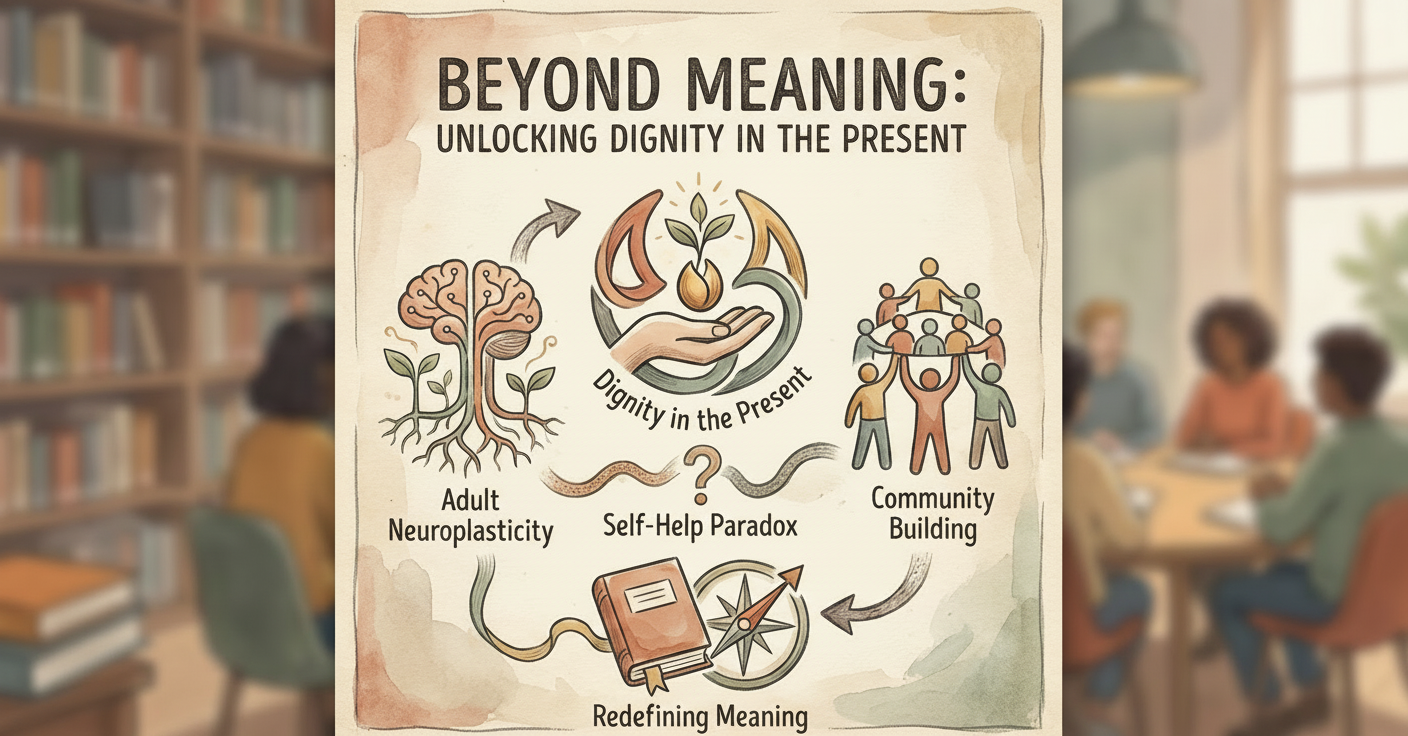
Redefining Life's Pursuit: From Proving Value to Unlocking Dignity in the Present
The conventional wisdom dictates that a meaningful life is achieved through aspiration, striving, and proving one's worth through accomplishments. We're conditioned to believe that our value is derived from future successes or external validation, leading to a constant pursuit of "more" or "better." This narrative often overshadows the intrinsic worth of our current circumstances, fostering a sense of inadequacy if we're not actively climbing a defined ladder.
However, a provocative counter-perspective suggests this striving can be a trap. Ocean Vuong, author and professor, argues that "a meaningful life is not a life that you use to prove to yourself or others that you are valuable. A meaningful life is finding the power and the value where you are." This radically shifts the focus from external achievement to internal recognition, encouraging us to find dignity and worth in our present state, regardless of societal metrics of success. This isn't about complacency, but about acknowledging an inherent value that doesn't need to be earned or proven.
"I hope people realize that if they don't already, that a meaningful life is not a life that you use to prove to yourself or others that you are valuable. A meaningful life is finding the power and the value where you are." — Ocean Vuong, Author and Professor of Creative Writing at NYU on The Mel Robbins Podcast
Why it matters for leaders: For leaders who are constantly driven to achieve and measure progress, this framework encourages a pause. It suggests that fostering a culture where individuals already feel valued—rather than only valuing future outputs or achievements—can unlock deeper engagement and authenticity. It also asks leaders to critically examine how their organizational language inadvertently creates conditions of shame or inadequacy, hindering true innovation and well-being.
The tension: This idea meets resistance from the ingrained belief that progress and ambition are inherently good and necessary. Is this perspective a radical acceptance, or does it risk dampening the very drive that leads to personal and societal advancement? Is "finding value where you are" a path to contentment, or a potential rationalization for stagnation?
Ideas in Brief
① The self-help paradox: More content, more anxiety.
Despite an explosion in self-help literature and personal development content, society is experiencing escalating rates of anxiety and depression. Donald Robertson, a cognitive-behavioral psychotherapist, highlights that this paradox suggests current self-help approaches might be misapplied, misunderstood, or even maladaptive if they encourage avoidance or superficial coping mechanisms rather than deeper cognitive restructuring. He notes that "There's no evidence that people on the whole, culturally are being improved by self help and self improvement content... rates of depression, anxiety, mental health problems in general escalating every year." (Donald Robertson on Modern Wisdom)
• The implication: Leaders should be wary of quick-fix solutions for team well-being or individual performance. Genuine transformation requires confronting underlying beliefs and systemic issues, not just consuming more information or tools. Understanding the failure of ubiquitous self-help to improve mental health means leaders need to rethink their approach to fostering resilience and reducing stress within their organizations.
② Play isn't just for kids; it's essential for adult neuroplasticity.
We often dismiss play as childish, but it's a profound mechanism for brain development and adaptability throughout life. Andrew Huberman explains that play, particularly activities involving novel movement and role-playing, triggers endogenous opioid release in the brain, allowing the prefrontal cortex to explore new possibilities in low-stakes environments. This expands our "catalog of potential outcomes" and fundamentally improves cognitive flexibility. (Andrew Huberman on Huberman Lab)
• The implication: Strategic leaders should integrate "play" into their leadership and team-building frameworks. This means creating environments that encourage experimentation, curiosity, and low-stakes exploration of ideas, fostering a culture where novel approaches can emerge without the default pressure of immediate, high-consequence outcomes. It's not about being unserious, but about accessing the brain's optimal state for innovation and problem-solving.
③ True community is awakened, not built, through shared vulnerability.
Traditional approaches to community building often focus on structured programs or events. However, Dan Coyle suggests that community isn't something we construct, but something we "awaken" that already exists within human connection, especially through shared experiences and even vulnerability. This perspective emphasizes that genuine bonds emerge when individuals are willing to be open and navigate challenges together. (Dan Coyle on Worklife with Adam Grant)
• The implication: For leaders looking to foster stronger teams or organizational cultures, the focus should shift from dictating interactions to creating conditions that allow for authentic human connection and mutual support. This might involve relinquishing control, encouraging transparent communication, and allowing moments of shared difficulty to forge deeper collective identity, rather than isolating individuals to solve problems alone.
④ Defining yourself, even positively, can be a limiting belief.
Most personal development advice encourages crafting a strong self-identity. However, Joe Hudson argues that "Any way you define yourself limits you." He explains that rigid self-definitions, even positive ones like "I am smart" or "I am successful," create a fixed identity that must be defended, preventing flexibility, growth, and the ability to embrace contradictory truths. This binary thinking often stems from fear. (Joe Hudson on The Art of Accomplishment)
• The implication: Leaders should cultivate a culture of open-mindedness and intellectual humility, questioning how deeply ingrained self and organizational narratives might be limiting adaptability and innovation. Encouraging a fluid sense of identity—both personally and collectively—can unlock a greater capacity to learn, change, and embrace new strategies without the fear of compromising a fixed self-concept.
The Question
How do we navigate an institutional landscape where credibility is eroded, and truth is contested, without succumbing to cynicism or dogma?
This is hard because trust in major institutions, from universities to media to government agencies, is demonstrably declining. When information sources are viewed through filters of bias—whether real or perceived—discerning genuine facts from narratives becomes a constant, exhausting task. Making progress requires not just better information, but a renewed commitment to intellectual honesty and transparency from institutions, coupled with a more sophisticated approach to interpreting complex data from individuals. Michael Shermer's call for institutions to be "more Bayesian" suggests a path, but the operationalization of that in a politicized environment is far from clear.
📚 The Bookshelf
- 'The Emperor of Gladness' by Ocean Vuong — A poignant exploration of grief, love, and identity that reframes what it means to lead a meaningful life, mentioned by Mel Robbins.
- 'Flourish' by Dan Coyle — Explores the nature of community and how it's built and sustained through shared experiences, providing counter-intuitive insights into cultural cohesion.
- 'A Skeptic's Guide to the Universe' by Michael Shermer — A classic text that helps readers dissect claims and discern truth in a world rife with misinformation and cognitive biases.
- Huberman Lab: "Science & Tools of Learning & Memory | Dr. David Eagleman" — A deep dive into neuroplasticity, memory, and practical strategies for enhancing brain function, perfect for anyone looking to optimize their learning.
The Bottom Line
This week's conversations illuminate a shared underlying question: What constitutes genuine progress, both personally and organizationally? Our frameworks for success—from individual purpose to institutional credibility to team function—are being challenged and reshaped. The opportunity for leaders is to re-evaluate deeply held assumptions about what drives value, connection, and growth, opening the door for more adaptive and authentic approaches to the future.
📚 APPENDIX: EPISODE COVERAGE
1. Modern Wisdom: "#1052 - Paul Rosolie - Uncontacted Tribes, Jungle Warfare & Being Eaten Alive"
Guests: Paul Rosolie (Naturalist, Author, Wildlife Filmmaker, Jungle Keepers), Chris Williamson (Host, Modern Wisdom) Runtime: 133 min | Vibe: A raw and passionate exploration of extreme conservation, personal failure, and the Amazon's hidden power.
Key Signals:
- The Value of Failure: Paul Rosolie's career-damaging "Eaten Alive" stunt, initially seen as a catastrophic failure, ultimately strengthened his resolve and expertise in legitimate conservation, suggesting that sometimes significant setbacks are pivots to deeper commitment.
- Indigenous Wisdom: Indigenous Amazonian remedies for severe injuries like stingray bites are highlighted as superior to Western medical approaches for preventing long-term damage, underscoring the efficacy of traditional knowledge.
- Selfish Conservation: Rosolie advocates for a "selfish" motivation for conservation – protecting the Amazon fundamentally benefits human interests by securing life-sustaining conditions – reframing environmentalism from altruism to self-preservation.
"It's those failures that teach you. The successes are easy. And then you become confident because you've survived." — Paul Rosolie, Naturalist, Author, Wildlife Filmmaker at Jungle Keepers
2. Huberman Lab: "Science & Tools of Learning & Memory | Dr. David Eagleman"
Guests: Andrew Huberman (Professor of Neurobiology and Ophthalmology, Stanford School of Medicine), David Eagleman (Neuroscientist, Bestselling Author, and Professor, Stanford University) Runtime: 144 min | Vibe: A deep dive into the brain's incredible capacity to rewire itself for lifelong learning and adaptation.
Key Signals:
- Lifelong Plasticity: The brain actively reconfigures itself throughout life, but continuous novelty and challenges are necessary to maintain this plasticity, meaning older brains need new experiences more than ever to stay adaptable.
- The Amateur's Edge: The most active and plastic brains often belong to amateurs, as experts have streamlined neural pathways, implying that staying a 'beginner' in new domains is crucial for continued brain growth.
- Neuromodulator Synergy: Boosting almost any major neuromodulator (dopamine, acetylcholine, norepinephrine, serotonin) can open 'windows of plasticity,' suggesting a complex, interconnected system governing brain change rather than a single master key.
"The whole game, is you gotta continually challenge the brain. And this is something that, as we get older, is more important than ever. It's finding new things that we haven't done before." — David Eagleman, Adjunct Professor of Psychiatry & Behavioral Sciences at Stanford University
3. The Mel Robbins Podcast: "If You Feel Lost in Life, Listen to This One Conversation to Find Purpose & Meaning"
Guests: Mel Robbins (Host, The Mel Robbins Podcast), Ocean Vuong (Author and Professor of Creative Writing, NYU) Runtime: 88 min | Vibe: A lyrical and profound conversation on purpose, shame, and finding dignity in unexpected places.
Key Signals:
- Meaning in the Present: A truly meaningful life is about finding value and dignity in one's current circumstances, rather than constantly striving to prove worth to oneself or others through future achievements.
- Language as Control: Societal language can be "captured to humiliate us" and control narratives, emphasizing the need to reclaim and redefine terms to foster personal growth and disrupt self-defeating stories.
- The Imposter Immune System: The feeling of being an "imposter" in institutional powerful contexts can serve as a protective mechanism, preserving creativity and critical perspective rather than being a pathology to overcome.
"So much of language in our world and our culture has been captured to humiliate us... Language is a strategy that has always been historically used to control people." — Ocean Vuong, Author and Professor of Creative Writing at NYU
4. Worklife with Adam Grant: "ReThinking: The keys to a flourishing community with Dan"
Guests: Adam Grant (Host, Worklife with Adam Grant), Dan Coyle (Journalist and Author), Dan (Guest, Unknown) Runtime: 35 min | Vibe: An insightful exploration into how genuine, thriving communities are fostered through unexpected dynamics.
Key Signals:
- Awakening Community: Effective community building isn't about creating something new, but "awakening" existing human connections and group flow that are already present, waiting for the right conditions to emerge.
- Shared Suffering as Glue: Within limits, shared adversity or "suffering" can be a foundational element for building deeper, more resilient communal bonds, as it compels people to reach out and collaborate.
- Leaders Relinquish Control: For leaders, giving up control is often critical for growth and empowering others. Over-preparation and over-structuring can hinder rather than help, suggesting that trust and autonomy are more potent.
"We always use the phrase building community, but actually what they're doing is awakening community. It was there all along waiting for someone to create group flow." — Dan Coyle, Journalist and Author
5. The Glenn Show: "Michael Shermer – A Skeptic's Guide to 2026"
Guests: Glenn Loury (Emeritus Professor & Host, Brown University), Michael Shermer (Founding Publisher & Host of The Michael Shermer Show, Skeptic Magazine) Runtime: 65 min | Vibe: A sober examination of institutional trust, media bias, and the persistence of conspiracy theories.
Key Signals:
- Crisis of Credibility: The erosion of public trust in institutions stems from a lack of transparency and an inability to voice dissenting opinions, leading to a "crisis of belief" and "crisis of speech."
- Bayesian Institutions: Institutions should adopt a "Bayesian approach" by providing probabilistic figures or ranges in their communications, even when exact values are unknown, to rebuild credibility and manage uncertainty.
- Conspiracy Theory Motives: Jeffrey Epstein's alleged activities, rather than solely being linked to sexual blackmail, could be plausibly explained by financial motivations, highlighting a less explored dimension of how these theories form.
"The institutions themselves need to be more Bayesian in their approach. That is that they need to put probability figures, even if they can't literally do it." — Michael Shermer, Founding Publisher & Host of The Michael Shermer Show at Skeptic Magazine
6. Modern Wisdom: "#1050 - Donald Robertson - Practical Tools for a Less Anxious Life"
Guests: Donald Robertson (Cognitive-Behavioral Psychotherapist & Author, Self), Chris Williamson (Host, Modern Wisdom) Runtime: 114 min | Vibe: A practical, evidence-based guide to understanding and overcoming anxiety, challenging popular self-help notions.
Key Signals:
- Worry as Avoidance: Pathological worrying often functions as a form of avoidance, preventing individuals from confronting concrete problems and maintaining anxiety at a moderate, tolerable level rather than resolving it.
- Self-Help Paradox: Despite the proliferation of self-help content, rates of anxiety and depression continue to rise, suggesting that many popular approaches are ineffective or maladaptive, sometimes reinforcing issues through avoidance.
- Low Arousal Worriers: Pathological worriers often exhibit surprisingly low physiological arousal during worry episodes, distinguishing them from other anxiety disorders where physical symptoms are pronounced.
"The main thing people should know about treating anxiety... is exposure therapy. It's the most robustly established technique in the entire field of psychotherapy research... basically it adds the most reliable type of therapy that we have." — Donald Robertson, Cognitive-Behavioral Psychotherapist & Author
7. Huberman Lab: "Essentials: Using Play to Rewire & Improve Your Brain"
Guests: Andrew Huberman (Professor of Neurobiology and Ophthalmology, Stanford School of Medicine), Huberman Lab (Host, Huberman Lab) Runtime: 35 min | Vibe: A concise scientific breakdown of how play is a superpower for cognitive function and brain health.
Key Signals:
- Play Requires Low Adrenaline: The brain's ability to benefit from play—enhancing prefrontal cortex function and neuroplasticity—is optimized under conditions of low adrenaline, promoting exploration over stress-induced rigidity.
- Role-Playing for Neuroplasticity: Games that encourage adopting multiple identities or roles, like chess, are particularly effective for fostering neuroplasticity compared to activities where one maintains a single avatar.
- Play as Performance Enhancer: A playful mindset is crucial for optimal performance, as it allows for the exploration of novel behaviors and interactions, rather than a rigid focus on outcomes that can limit adaptability.
"Play is powerful at making your prefrontal cortex more plastic, more able to change in response to experience, but not just during the period of play, but in all scenarios, because you get one prefrontal cortex." — Andrew Huberman, Professor of Neurobiology and Ophthalmology at Stanford School of Medicine
8. The Knowledge Project: "How McDonald’s Took Over America | Ray Kroc [Outliers]"
Guests: Shane Parrish (Host, The Knowledge Project) Runtime: 50 min | Vibe: A compelling narrative on entrepreneurial tenacity, unconventional strategy, and the origins of a global empire.
Key Signals:
- Late-Stage Entrepreneurship: Ray Kroc's journey to building McDonald's started at 52, challenging the common narrative that significant entrepreneurial success is exclusively for the young.
- Real Estate as Core Business: McDonald's financial success was fundamentally rooted in its real estate holdings, with revenue from land ownership eclipsing profit from food sales, making them a real estate company first.
- Opportunity Blindness: Ray Kroc's initial employers, facing a new opportunity (milkshake multi-mixers), saw only distraction, while Kroc saw the future, highlighting how established mindsets can miss breakthrough innovations.
"We are not basically in the food business, harry liked to say. We're in the real estate business. And this confused people. But he was right. The franchise fee was small. The royalty on sales was thin. What made McDonald's wealthy was owning or controlling the land under every restaurant." — Shane Parrish, Host of The Knowledge Project
9. From The Culture: "S1, EP4 - Navigating The Ghost of Cultures Past"
Guests: Marcus Collins (Host), Amanda Slavin (Host), Tariq Hassan (Marketing Leader, McDonald's USA), Tarik (Guest, Petco/McDonalds (former roles)), Marcus (Host, From The Culture), Amanda (Host, From The Culture) Runtime: 67 min | Vibe: An intimate discussion on self-knowledge, cultural transformation, and the evolution of leadership in dynamic environments.
Key Signals:
- Self-Knowledge for Decision Making: In an era of rapid career shifts and dynamic work environments, knowing oneself—values, intuition—is paramount for navigating high-stakes personal and professional decisions.
- Dyslexia as Superpower: Tariq Hassan views his dyslexia as an "absolute superpower" for leadership, transforming a perceived challenge into a unique strength for understanding and communicating.
- Celebrating 'Amazing Almosts': Initiatives that celebrate "Amazing Almosts"—learning from well-intentioned but unsuccessful efforts—can foster a culture of calculated risk-taking and learning without the fear of failure.
"When the stakes are high because you care, deciding if it's the right thing can be a challenge. You just got to follow what feels right. That requires knowing who you are, how you see the world, what is meaningful for you." — Marcus Collins, Host
10. The Art of Accomplishment: "Bite-Sized Teaching Series: How To Break Free From Beliefs That Keep You Small"
Guests: Joe Hudson (Coach) Runtime: 8 min | Vibe: A concise and challenging perspective on rigid self-identity and the freedom found in embracing contradictions.
Key Signals:
- Limiting Self-Definitions: Even positive self-definitions (e.g., "I am successful") can be limiting, creating an identity that must be defended and preventing flexibility and growth, reducing one's potential.
- Binary Thinking as Fear: The inability to see merit in contradictory beliefs indicates "binary thinking," which stems from a fear-based rigidity rather than intellectual openness.
- Oceanic Self-Identity: Shifting from a rigid, "rock-like" sense of self to an expansive, "ocean-like" identity allows one to be fluid, un-triggered by external judgments, and free from the need to defend who you think you are.
"Any way you define yourself limits you. ... And there's some benefit to them. But if you're using them as a pep talk, what you're saying is you need a pep talk to be that if I, if I tell you enough times that you're good enough, then you'll act like you're good enough. Which is basically saying you don't think you're good enough." — Joe Hudson, Coach