
📊 12 episodes across 6 podcasts
⏱ 605 minutes of intelligence analyzed
🎙 Featuring: Paul Sweeney (Bloomberg), Tyler Kendall (Bloomberg News), June Grasso (Bloomberg Law), Henrietta Treyz (Veda Partners)
The Big Shift
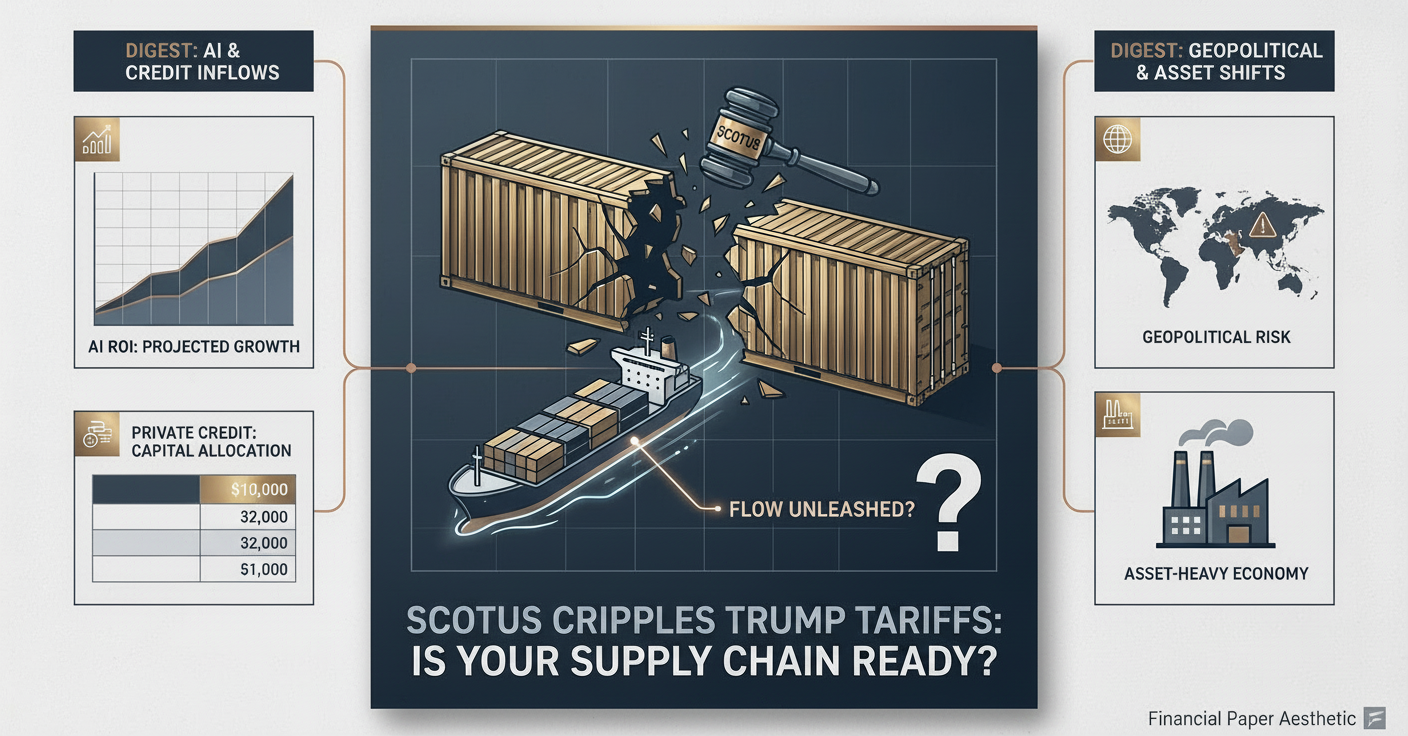
The Supreme Court's decisive ruling against Trump-era tariffs under the International Emergency Economic Powers Act (IEPA) is a landmark legal defeat, but it's far from the end of weaponized trade policy. While the decision is a clear win for the Constitution and importers, the underlying signal is that geopolitical risk will remain a persistent, costly factor for businesses. Rather than retreating from tariffs, the consensus among policy analysts is that future administrations, regardless of party, will simply seek alternative legal authorities to impose them. This means companies must prepare for a landscape where trade policy remains a significant and unpredictable variable, shifting from one legal framework to another.
As Douglas Irwin, Professor of Economics at Dartmouth College, pointed out on Bloomberg Surveillance, "The Supreme Court gave him a, did him a favor by trying to put these tariffs on pause. But of course, the president has just reimposed the similar tariffs using different authority." This underscores that the legal mechanism may change, but the impulse to use tariffs as a tool of economic and foreign policy will not. Businesses should therefore view this as a clarification of the legal boundaries, not a retreat from the strategy itself. The implication is a higher baseline for trade-related uncertainty, requiring adaptive supply chain planning and constant monitoring of evolving legal and political pathways that could trigger new import barriers. The critical level to watch is how quickly and broadly new authorities are invoked, signaling the true cost of operating in a perpetually tariff-exposed global economy.
"This is in my opinion the largest and most impactful macroeconomic ruling the courts have ever delivered. It's really an exhilarating day, an incredible day for the Constitution."
— Henrietta Treyz, Managing Partner and Director of Economic Policy at Veda Partners on Bloomberg Surveillance
The Rundown
① AI Investment Faces a 12-Month Showdown. Big Tech companies are pouring capital into AI, leading to declining operating profit margins and asset efficiency, and are now on a tight clock to prove these investments are worthwhile. (Nick Colas on The Compound and Friends)
→ Why it matters: CFOs and investors need to scrutinize AI ROI now more than ever. If Big Tech can't demonstrate tangible benefits by year-end, capital will likely reallocate to non-US equities or other sectors, affecting funding and valuation benchmarks for all AI-focused ventures. Jessica Rabe noted that "If AI doesn't look like it's going to pan out, people are going to look elsewhere and they're going to go to non US equities because of big tech has such an outsized large weighting in the S&P 500."
② Private Credit's Stealth Correction. While headlines might hint at systemic risk, the consensus suggests that the private credit market faces a 'stealth correction' with individual losers, but no systemic contagion. (Paul Horvath on CNBC's "Fast Money")
→ Investment Signal: This bifurcation highlights the importance of rigorous due diligence. There are still opportunities for savvy investors to find "good" private credit, but avoiding the "losers" is paramount. Paul Horvath emphasized, "In private credit, you don't need to pick the winners, you need to avoid the losers. But I don't see a systemic risk."
③ The Economy's Asset-Heavy Renaissance. The US economy is subtly shifting from an asset-light, software-driven model back to an asset-heavy, tangible asset-focused structure, supported by global CAPEX and sector rotation. (Anastasia Amoroso on Bloomberg Surveillance)
→ Strategic Pivot: Operators should assess their capital allocation strategy. Businesses leveraging physical assets and tangible infrastructure may find themselves in a more favorable capital environment than pure software plays, as investor preference shifts towards this emerging regime. This could impact M&A valuations and financing terms in asset-intensive industries.
④ The Illusion of Prediction in Investing. Despite vast data and expert opinions, successful investing hinges more on temperament and humility than on an ability to accurately predict the future. (Howard Marks on We Study Billionaires - The Investor’s Podcast Network)
→ Decision Insight: Executives should focus on robust decision-making frameworks that account for uncertainty rather than chasing consensus forecasts. This means prioritizing resilience, managing risk, and maintaining flexibility in capital allocation, rather than betting on a single predicted outcome. Howard Marks argued, "To be a successful investor, you have to have tremendous respect for uncertainty. You need to recognize the fact that we really don't know that much about the future."
⑤ Prediction Markets Face Regulatory Onslaught. The CFTC is asserting its exclusive jurisdiction over prediction markets, sparking a regulatory battle with states and highlighting a broader debate over their role as truth-finding mechanisms vs. unregulated gambling. (Mike Selig on Bankless)
→ Innovation Risk: Companies involved in data analytics, AI, or even internal strategic forecasting should monitor this battle closely. The outcome will set precedents for how novel truth-finding mechanisms powered by collective intelligence and AI are regulated, directly impacting nascent markets for information. This is a critical development for early-stage crypto investors as well.
The Heat Map
🔥 HEATING UP
• Non-US Equities: Expected to outperform if Big Tech AI investments underperform, driven by better diversification and less concentration risk than the S&P 500. (Jessica Rabe on The Compound and Friends)
• Global CAPEX: Strong consumer spending and German fiscal stimulus are driving increased global capital expenditures, especially in asset-heavy sectors. (Anastasia Amoroso on Bloomberg Surveillance)
• Private Credit (Good): Despite broader jitters, rigorously vetted, sponsor-backed, secular growth private credits show low default rates and solid fundamentals, attracting investor interest. (Anastasia Amoroso on Bloomberg Surveillance)
👀 ON WATCH
• US Trade Policy Frameworks: The Supreme Court ruling on IEPA tariffs means future administrations will seek new, untested legal avenues to impose tariffs, creating persistent uncertainty. (Douglas Irwin on Bloomberg Surveillance)
• AI Profitability Metrics 🆕: Big Tech's declining operating margins and asset efficiency due to AI investments are under intense scrutiny; 12 months grace period to prove ROI. (Nick Colas on The Compound and Friends)
• Institutional Investor Short-Termism 🆕: Institutional flows are driving market momentum, sometimes at odds with long-term value, evidenced by selling in Constellation Software due to AI fears. (Clay Finck on We Study Billionaires - The Investor’s Podcast Network)
🧊 COOLING OFF
• Big Tech Asset Efficiency: Once highly capital-efficient, major tech companies are showing lower asset efficiency due to massive AI capital expenditures. (Nick Colas on The Compound and Friends)
• Software Stock Valuations: A broad market shift from asset-light software models to asset-heavy economies is impacting valuations, with some software companies experiencing significant sell-offs. (Anastasia Amoroso on Bloomberg Surveillance)
• Trump Era IEPA Tariffs: Struck down by the Supreme Court, ending a key avenue for presidential trade action and potentially triggering class-action lawsuits for refunds. (Henrietta Treyz on Bloomberg Surveillance)
The Debate
The Battle Over Private Credit Risk
🐂 The Bull Case: Systemic Risk is Overblown. Analysts like Paul Horvath (Orchard Global) argue that while there will be winners and losers in private credit, the risk is not systemic due to significant deleveraging since 2008 and credit growth not exceeding GDP. He stated on CNBC's "Fast Money", "There are going to be winners and losers in private credit, but the systemic risk that would worry the regulators in 08 and 09, I just don't see a systemic risk."
🐻 The Bear Case: A Stealth Crisis is Brewing. Others express concerns about the lack of transparency, diligence, and rapid capital deployment in private credit, particularly in software. Michael Batnick (The Compound and Friends) indirectly highlights the 'stealth correction' theme where "devastation in two or three really important parts of the market" might be masked by broad index strength, implying private credit could be one such lurking area.
Our read: The market is clearly distinguishing between well-underwritten private credit (often asset-heavy projects) and more speculative, often software-related, lending. Due diligence on underlying assets and borrower fundamentals separates healthy lending from increasing risk.
The Bottom Line
Despite legal setbacks for prior trade-war tactics, political imperatives will ensure perpetual tariff risk, fundamentally altering how capital allocates in a world shifting from asset-light to asset-heavy bets.
Your Move: Actions for the Week Ahead
• Quantify your business's exposure to potential new tariff regimes, identifying alternative sourcing or sales channels, and assessing the cost implications of trade policy shifts. (Trump Tariff Defeat Throws Trade Deals Into Doubt, Bloomberg Surveillance)
• Evaluate the ROI runway for current or planned AI investments, setting clear, measurable performance benchmarks that Big Tech is now being held accountable to by investors over the next 12 months. (Big Tech Has Til Year-End…or Else., The Compound and Friends)
• Stress-test your private credit counterparties and portfolio exposures for underlying asset quality, focusing on differentiating "good" credit fundamentals from "challenged" areas, given the ongoing 'stealth correction.' (Tariffs, Banks & Private Credit Jitters… And Crypto Below $65K 2/23/26, CNBC's "Fast Money")
• Assess your balance sheet and capital allocation strategy for a potential shift to an "asset-heavy" economy, considering if investments in tangible assets now offer a better risk/reward than asset-light models. (US Eco Data in Focus as Iran Tensions Simmer, Bloomberg Surveillance)
• Review strategic decision-making processes to ensure they prioritize resilience and flexibility over optimistic forecasts, recognizing that true investing success comes from temperament and humility in the face of uncertainty. (Essential Truths w/ Howard Marks, Nima Shayegh & William Green, We Study Billionaires - The Investor’s Podcast Network)
📖 Want the full episode breakdowns, guest details, and listen links?
Quick Appendix
Bloomberg Surveillance: "Stocks Seek Cautious Recovery as Tariff Uncertainty Lingers" · 35 min · Featuring Douglas Irwin ▶ Listen
Bloomberg Surveillance: "Instant Reaction: Trump's Global Tariffs Struck Down By Supreme Court" · 29 min · Featuring Tyler Kendall ▶ Listen
Bloomberg Surveillance: "Trump Tariff Defeat Throws Trade Deals Into Doubt" · 34 min · Featuring Eswar Prasad ▶ Listen
Bloomberg Surveillance: "Bloomberg Surveillance TV: February 20th, 2026" · 25 min · Featuring Stephen Kirk ▶ Listen
Bloomberg Surveillance: "US Eco Data in Focus as Iran Tensions Simmer" · 35 min · Featuring Anastasia Amoroso ▶ Listen
Bankless: "ROLLUP: Prediction Market War | Base Leaves Optimism | Tomasz Exits EF | Clarity Act Lives | Harvard Buys ETH" · 69 min · Featuring Ryan ▶ Listen
CNBC's "Fast Money": "Tariffs, Banks & Private Credit Jitters… And Crypto Below $65K 2/23/26" · 44 min · Featuring Mike Santoli ▶ Listen
The Compound and Friends: "Big Tech Has Til Year-End…or Else." · 27 min · Featuring Josh Brown ▶ Listen
The Compound and Friends: "Looks Like a Bull Market, Feels Like a Crash" · 69 min · Featuring Michael Batnick ▶ Listen
The Intrinsic Value Podcast - The Investor’s Podcast Network: "TIVP060: Constellation Software (CSU): Historic Drawdown, Historic Buying Opportunity w/ Daniel Mahncke & Shawn O’Malley" · 87 min · Featuring Daniel Mahncke ▶ Listen
We Study Billionaires - The Investor’s Podcast Network: "TIP793: Thinking Fast & Slow by Daniel Kahneman w/ Clay Finck" · 60 min · Featuring Clay Finck ▶ Listen
We Study Billionaires - The Investor’s Podcast Network: "RWH066: Essential Truths w/ Howard Marks, Nima Shayegh & William Green" · 91 min · Featuring William Green ▶ Listen