
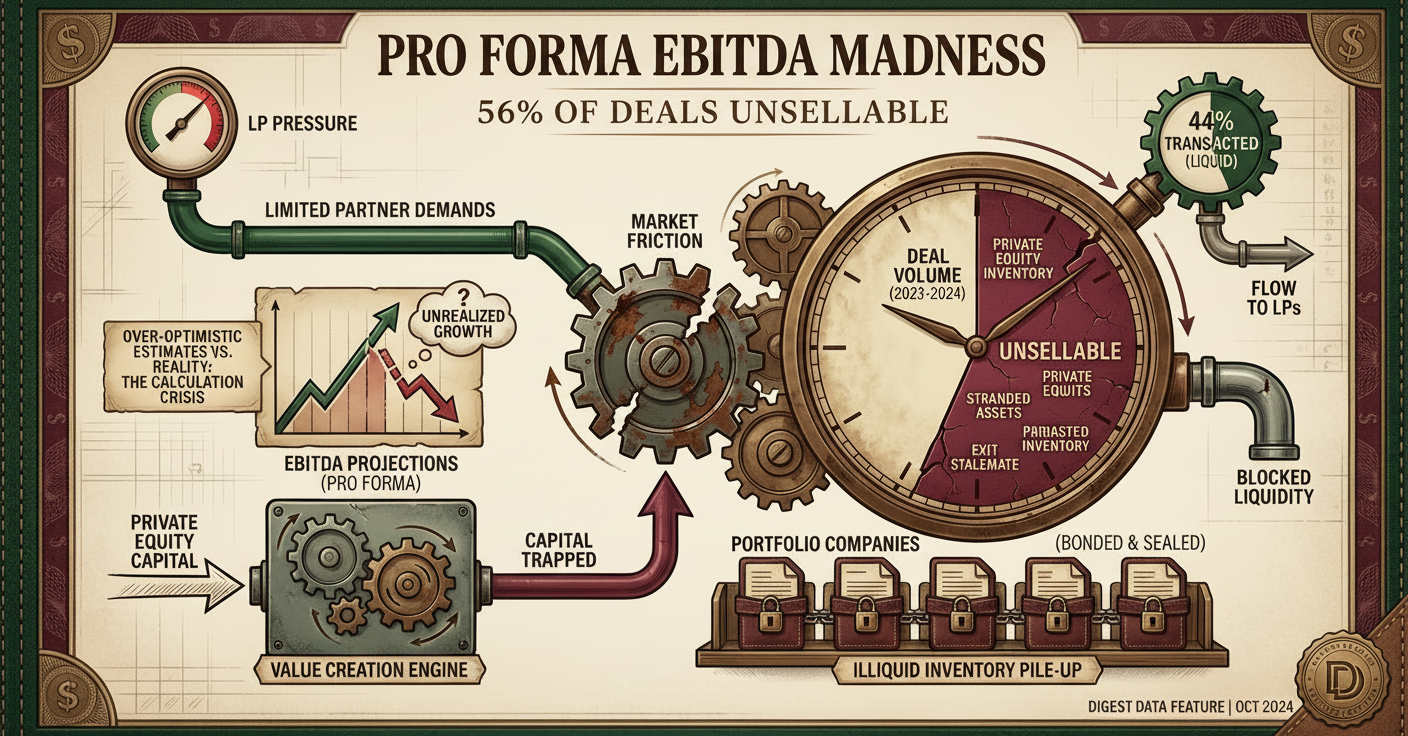
The exit window isn't just selective—it's forcing LPs to pressure GPs, and that pressure is revealing a new definition of "unsellable."
The Intake
The deals, the dynamics, the debates. What GPs, operators, and allocators are actually talking about.
This week's intelligence:
- 📊 11 episodes across 10 podcasts
- ⏱️ 474 minutes with dealmakers and operators
- 🎙️ At the table: Jeff Berman (Host, WaitWhat), Eric Yuan (Founder and CEO, Zoom), Heidi Crebo-Rediker (Senior Fellow, Council on Foreign Relations), Jon Stein (Founder and Chair, Betterment)
The Big Shift
The 'Unsellables' Problem Is Not Multiples—It's Pro Forma EBITDA
The private equity market is facing an unprecedented liquidity drought, and it's not simply a function of high valuation multiples. According to David Andrews (Founder and Co-CEO, Gryphon Investors), the real culprit behind the growing number of "unsellable" companies is "pro forma EBITDA madness." Deals are being underwritten on overly aggressive, often unrealistic, forward-looking earnings projections, creating a significant mismatch between expected performance and reality. This results in low Distributions to Paid-In Capital (DPIs), leaving LPs increasingly frustrated and putting pressure on GPs. This dynamic has led to a situation where, for the last three years, 56-58% of companies brought to market failed to sell, an unprecedented level of market friction (David Andrews on Dry Powder: The Private Equity Podcast).
Why it matters: This isn't just a market cycle; it's a structural challenge. GPs can't simply wait for multiples to recover. They need to scrutinize portfolio company EBITDA projections with extreme skepticism and focus on real, defensible earnings if they want to exit. LPs need to question the underwriting assumptions more rigorously.
"The biggest problem out there, everybody right now, is not the valuation multiple. You're thinking of the price, it's the E. And the E is pro forma EBITDA madness is what I labeled it."
— David Andrews, Founder and Co-CEO of Gryphon Investors on Dry Powder: The Private Equity Podcast
The move: Re-underwrite your portfolio on actual EBITDA, not pro forma. Identify companies heavily reliant on "pro forma growth" and develop operational plans to convert those projections into verifiable earnings.
The Rundown
- US Rare Earths Strategy Demands a Leapfrog, Not a Fight. The US cannot out-mine or out-process China in rare earth metals using traditional methods. The strategy needs to shift to innovation—protein robots extracting rare earths from waste, and rare earth-free magnets—to bypass China's ecosystem (Heidi Crebo-Rediker on Odd Lots).
- • Why it matters: This is a blueprint for strategic resource independence, sidestepping direct geopolitical resource competition with technological advantage.
- High-Stakes AI Talent War: $100M+ for Top Researchers. The demand for elite AI researchers is so high that salaries of $100 million to $1 billion are being rationalized due to extreme scarcity (Ben Horowitz on Invest Like the Best with Patrick O'Shaughnessy).
- • The signal: The immediate economic value of cutting-edge AI talent is profound, indicating the scale of investment and expected returns in the nascent AI supercycle.
- • What to watch: This case study highlights the enduring importance of core infrastructure and culture in navigating rapid, unpredictable growth—lessons applicable far beyond tech.
- Australia's Future Fund Bypasses Large Buyouts for VC/Growth Equity. Australia's AUZ$145 billion sovereign wealth fund completely avoids large buyout private equity, viewing it as "levered equity" with high fees. Instead, they prioritize venture and growth equity with managers demonstrating strong operational improvement skills (Raphael Arndt on Capital Allocators – Inside the Institutional Investment Industry).
- • Why it matters: This is a clear signal from a significant LP that not all private equity is created equal; operational value creation and lower fees are increasingly driving allocation decisions.
- 1% Financial Advisor Fees Devour Returns. A seemingly small 1% financial advisor fee can reduce total investment returns by a third over a 30-year period (Scott Galloway on The Prof G Pod with Scott Galloway).
- • The signal: For LPs and individuals, understanding the corrosive impact of fees, even "small" ones, is critical for long-term capital compounding lessons.
Zoom's 30x Hyper-Growth Driven by Scalable Architecture, Not Just Demand. During COVID-19, Zoom scaled from 10 million to over 300 million daily meeting participants in months, largely due to a pre-existing scalable architecture and a strong organizational culture that prevented employee burnout (Eric Yuan on Masters of Scale).
"If you do not have a great culture, you really cannot scale your business... you are going to hit the wall because you do not have great culture."
— Eric Yuan, Founder and CEO of Zoom on Masters of Scale
Deal Flow Signals
🔥 ACTIVE
- • Biotech Mineral Extraction: New protein robot technologies are enabling cleaner, more efficient extraction of rare earths from waste materials, creating new avenues for domestic supply. (Heidi Crebo-Rediker on Odd Lots)
- • AI-Optimized Workflows: Companies are developing internal AI agents, like "Ultron," to integrate SaaS tools and automate tasks, streamlining operations and potentially reducing human workload. (Jason on All-In with Chamath, Jason, Sacks & Friedberg)
👀 EMERGING
- • 🆕 Agentic AI in Investment Research: Early experiments show AI's capability in triaging data, identifying management guidance credibility, and potentially predicting market futures, moving beyond mere info processing. (David Plon on Business Breakdowns)
- • 🆕 AI Talent Compensation: Salaries for top AI researchers are hitting $100M-$1B, signaling extreme scarcity and the immense value assigned to foundational AI development. (Ben Horowitz on Invest Like the Best with Patrick O'Shaughnessy)
🧊 QUIET
- • Large Buyout Private Equity: Australia's Future Fund avoids traditional large buyouts, labeling them "levered equity" with fees that erode skill, diverting capital to growth and venture. (Raphael Arndt on Capital Allocators – Inside the Institutional Investment Industry)
⚠️ STRESSED
- • "Pro Forma EBITDA Madness": Aggressive forward-looking earnings projections are leading to a high percentage of unsellable companies and low DPIs across the private equity market. (David Andrews on Dry Powder: The Private Equity Podcast)
- • SaaS Profit Pools: The agentic AI layer is threatening traditional SaaS revenue models, as software functionality shifts towards deliverable "services," potentially devaluing per-seat licenses. (Jason on All-In with Chamath, Jason, Sacks & Friedberg)
The Debate
Is the "SaaSpocalypse" an existential threat or a re-evaluation of profit pools?
🐂 The bull case:
"I think the tech sector is very, very healthy. America's competitiveness is very, very good. The entrepreneurship culture is outstanding and that's the main thing I look at from my lens."
— Ben Horowitz, Co-founder of Andreessen Horowitz on Invest Like the Best with Patrick O'Shaughnessy
🐻 The bear case:
"The profit pool available to software is decreasing and the profit pool available to the agentic layer is increasing. And when that happens, the discount rate, that terminal value of those software companies plummets."
— Jason, Host on All-In with Chamath, Jason, Sacks & Friedberg
Our read: The conversation around SaaS is clearly bifurcated. While some, like Horowitz, maintain broad optimism for the tech sector's health and entrepreneurship, specific concerns about SaaS profit pools are mounting. The rise of agentic AI is forcing a re-evaluation of where value accrues in the software stack. It's less about SaaS dying and more about its profit centers shifting, demanding new business models and sharper operational focus.
The Bottom Line
The market is demanding real EBITDA and operational value creation; anything less will be stuck in the "unsellable" category, increasing LP pressure and extending hold periods.
🎯 Your Move
- Re-underwrite your portfolio with a critical eye on pro forma EBITDA projections: Identify where "projected" growth needs to become "realized" growth to avoid getting caught in the "unsellables" trap. Flag this in your next IC.
- Stress-test your SaaS investments against the "agentic layer" risk: Understand if your portfolio companies' per-seat licensing models are defensible against AI agents that transform software into automated services.
- Evaluate your strategic resource independence: Look for "leapfrog" opportunities in critical industries (e.g., rare earths) where technology, rather than brute force, can offer a competitive advantage and unlock new value.
📚 APPENDIX: EPISODE COVERAGE
1. How I Built This with Guy Raz: "Advice Line with Jon Stein of Betterment"
Guests: Guy Raz (Host, Wondery), Jon Stein (Founder and Chair, Betterment), Dan Criss (Co-founder, Heretic Yerba), Mike Smith (Owner and Founder, MTS Woodworking), Guy (Host, How I Built This), Maggie McDonald (Founder, Floof Ball)
Runtime: 46 min | Vibe: Practical, tactical growth strategies for founder-led businesses
Key Signals:
- Focused Growth: Jon Stein emphasizes picking one growth channel and going deep, arguing that too many simultaneous paths dilute focus and resources, even if all seem promising.
- Strategic B2B Scaling: For a pet accessory company, leveraging Chewy as a B2B marketing channel to acquire direct customers, and pursuing professional club partnerships, can offer better margins and sustainable growth than expensive direct-to-consumer marketing.
- Raising Prices vs. Scaling for Craftsmen: For custom manufacturers, options include dramatically raising prices for a niche, high-demand product, or standardizing offerings to enable hiring and fewer custom projects.
"Too many simultaneous growth paths can dilute focus, even if they're all promising... I always advise founders to pick one thing and go deep on it personally for a while." — Jon Stein, Founder and Chair of Betterment
2. Masters of Scale: "How Zoom grew 30x almost overnight"
Guests: Jeff Berman (Host, WaitWhat), Eric Yuan (Founder and CEO, Zoom)
Runtime: 28 min | Vibe: An in-depth look at hyper-growth and culture from a founder's perspective
Key Signals:
- Culture as Scalability Engine: Zoom's 30x growth during the pandemic was less about luck and more about a pre-existing scalable architecture and a strong company culture that motivated employees to work harder without complaint.
- Post-COVID Evolution: Zoom is actively exploring how to remain dominant post-pandemic through an open ecosystem approach, despite challenges like over-hiring and subsequent layoffs.
- Immigration's Impact on Innovation: Eric Yuan highlights the criticality of an "inclusive culture" and the "American dream" narrative in attracting global talent, which was foundational to Silicon Valley's success and Zoom's innovative spirit.
"If you do not have a great culture, you really cannot scale your business. You can grow your business to a level and very soon you are going to hit the wall because you do not have great culture." — Eric Yuan, Founder and CEO of Zoom
3. Odd Lots: "This Is How The US Can Become a Player in Rare Earth Metals"
Guests: Heidi Crebo-Rediker (Senior Fellow, Center for Geoeconomics Studies, Council on Foreign Relations), Joe Weisenthal (Host, Bloomberg), Tracy Alloway (Host, Bloomberg), Heidi Kriz (Author of a report on rare earths)
Runtime: 42 min | Vibe: Geopolitical strategy meets clean tech innovation
Key Signals:
- Leapfrogging China's Dominance: The US cannot out-mine or out-process China in rare earths but can achieve independence through innovative biotechnologies like protein robots for extraction from waste, and developing rare earth-free magnet technologies.
- Industrial Policy via Innovation: Historical precedents like the WWII synthetic rubber effort showcase how government-led industrial policy, focusing on cutting-edge solutions, can rapidly achieve strategic resource independence.
- Clean Biotech Mining: Rio Tinto's use of proprietary microbes for copper extraction demonstrates a clean, cost-effective biotech solution that can revolutionize mineral extraction and challenge traditional, environmentally problematic methods.
"We can't actually out mine, out process and outspend China. Certainly not at scale and not in a cost effective way." — Heidi Crebo-Rediker, Senior Fellow at the Council on Foreign Relations
4. Capital Allocators – Inside the Institutional Investment Industry: "[REPLAY] Raphael Arndt – Australia's Sovereign Wealth Fund CIO (Capital Allocators, Episode 70)"
Guests: Ted Seides (Host, Capital Allocators), Raphael Arndt (Chief Investment Officer, Future Fund)
Runtime: 86 min | Vibe: Deep dive into sovereign wealth fund strategy for LPs and GPs
Key Signals:
- External Management Focus: Despite its AUZ$145 billion size, Australia's Future Fund manages no assets internally, relying entirely on external managers for implementation – challenging conventional wisdom for large allocators.
- Avoidance of Large Buyout PE: The fund explicitly avoids large buyout private equity, deeming it "levered equity" with fees that erode potential skill, instead concentrating private market allocations in venture and growth equity.
- "Option Value of Flexibility": The fund maintains a substantial cash position (over 15%) not just for liquidity, but as an explicit strategic tool to acquire assets cheaply during market dislocations, a concept beyond traditional portfolio theory.
"If you want a car, you don't go out and buy the best steering wheel, the best seat, the best windscreen and hope that you get a good car, you actually have a plan for A car and buy the parts that suit the car you want." — Raphael Arndt, CIO of Australia's Sovereign Wealth Fund
5. Dry Powder: The Private Equity Podcast: "Spotting the Downturn Early and Coming Out Ahead w/ Gryphon's David Andrews"
Guests: David Andrews (Founder and Co-CEO, Gryphon Investors), Hugh MacArthur (Chairman of Bain's global private equity practice, Bain & Company)
Runtime: 14 min | Vibe: A blunt take on current PE market stress
Key Signals:
- "Pro Forma EBITDA Madness": The biggest problem in private equity liquidity is not high valuation multiples but overly optimistic "pro forma EBITDA" projections, leading to many unsellable companies and low DPIs.
- Unprecedented Liquidity Drought: The PE market has experienced three years of significantly below-average liquidity, with 56-58% of companies brought to market failing to sell, signaling structural issues beyond typical market cycles.
- LP Pressure for Cash: Growing pressure from LPs for cash returns is expected to spur a potential rebound in deal-making by 2026, but only if GPs can address the underlying EBITDA disconnect.
"The biggest problem out there, everybody right now, is not the valuation multiple. You're thinking of the price, it's the E. And the E is pro forma EBITDA madness is what I labeled it." — David Andrews, Founder and Co-CEO of Gryphon Investors
6. Odd Lots: "Lots More With Charlie McElligott on This Week's SaaSpocalypse"
Guests: Charlie McElligott (Cross-Asset Macro Strategist, Nomura), Bloomberg (Host, Bloomberg)
Runtime: 33 min | Vibe: Macro strategist's deep dive into market dislocations
Key Signals:
- SaaSpocalypse Root Cause: The market turmoil in software, crypto, and gold is attributed to "crowded positioning" and outsized gross exposures in hedge funds and systematic strategies, rather than fundamental value shifts.
- Bitcoin Trading Like SaaS: Unexpectedly, Bitcoin correlated with software stocks during the recent downturn, signaling a shift from its traditional role as a debasement hedge.
- Leverage & Volatility Feedback Loop: Lower market volume forces systematic traders to add leverage to meet target volatility, inadvertently amplifying downside moves and contributing to market crashes.
"Bitcoin is trading like software, it's trading like SaaS, which is going through an existential crisis right now for really justified reasons, especially with regards to valuation." — Charlie McElligott, Cross-Asset Macro Strategist at Nomura
7. The Prof G Pod with Scott Galloway: "Is Reddit Still a Buy? Democratic Strategy and Rethinking Financial Advisors"
Guests: Scott Galloway (Host, Vox Media Podcast Network), Derek (Private Chef)
Runtime: 19 min | Vibe: Unvarnished takes on tech, politics, and personal finance
Key Signals:
- Reddit's Monetization Opportunity: Reddit is currently "under-monetized" relative to user engagement compared to other platforms, presenting a significant opportunity for growth, likely through data licensing.
- Erosion by 1% Advisor Fees: A 1% financial advisor fee can reduce total investment returns by a third over 30 years, highlighting the critical importance of low-cost index funds and self-directed investing.
- Political Leadership Vacuum: Scott Galloway criticizes current Democratic leadership, advocating for a new generation to address national issues more effectively and beyond just electoral tactics.
"At 1%, compounding literally takes away a third of your returns. You should be able to get 9% in the market over the long term. Invest in low cost diversified index and ETFs. Do your own work here and pay yourself." — Scott Galloway
8. Invest Like the Best with Patrick O'Shaughnessy: "Ben Horowitz - Backing America’s Future - [Invest Like the Best, EP.457]"
Guests: Ben Horowitz (Co-founder, Andreessen Horowitz), Patrick O'Shaughnessy (Host, Colossus | Investing & Business Podcasts), Colossus | Investing & Business Podcasts (Host, Colossus | Investing & Business Podcasts)
Runtime: 56 min | Vibe: Venture capital philosophy meets societal impact
Key Signals:
- Tech Over Policy: Ben Horowitz argues that technology, particularly AI, is the primary solution to major societal problems, and that America's technological competitiveness and entrepreneurial culture are strong.
- Extreme AI Talent Scarcity: The "bananas" salaries for top AI researchers ($100M-$1B) are rationalized by their extreme scarcity (potentially only 40 globally), reflecting immense value in foundational AI development.
- Entrepreneur-Centric VC: Andreessen Horowitz was founded with a unique approach to venture capital, viewing entrepreneurs as the "product" and aiming to provide unmatched support, fundamentally shifting the traditional VC-founder dynamic.
"I think the tech sector is very, very healthy. America's competitiveness is very, very good. The entrepreneurship culture is outstanding and that's the main thing I look at from my lens." — Ben Horowitz
9. All-In with Chamath, Jason, Sacks & Friedberg: "Epstein Files, Is SaaS Dead?, Moltbook Panic, SpaceX xAI Merger, Trump's Fed Pick"
Guests: Brad Gerstner (Founder/CEO, Altimeter), Jason Calacanis (Host, LAUNCH), David Sacks (Partner/Host, Craft Ventures), Friedberg (Host, Ohalo Dream), Chamath (Host), Jason (Host), Chamath Palihapitiya (CEO, Social Capital), David Friedberg (Founder & CEO, The Production Board)
Runtime: 79 min | Vibe: High-energy, unfiltered debate on tech and macro trends
Key Signals:
- AI Threat to SaaS Profit Pools: The rise of AI agents is transforming software into "services," shifting value capture from per-seat SaaS licenses to an "agentic layer," potentially significantly devaluing existing SaaS companies.
- AI-Driven Workforce Consolidation: AI agents are expected to allow one person to perform 3-4 jobs, dramatically boosting corporate profitability through reduced headcount, exemplified by future companies like Amazon.
- SaaS as a Service Economy: The long-term evolution of software implies companies providing full project completion (e.g., drug discovery) powered by AI, rather than clients just licensing software.
"The profit pool available to software is decreasing and the profit pool available to the agentic layer is increasing. And when that happens, the discount rate, that terminal value of those software companies plummets." — Jason, Host
10. Business Breakdowns: "How Investors are using AI - [Business Breakdowns, EP.240]"
Guests: Colossus | Investing & Business Podcasts (Host, Colossus | Investing & Business Podcasts), Matt Russell (Host, Colossus | Investing & Business Podcasts), David Plon (Founder, Portrait Analytics)
Runtime: 49 min | Vibe: Practical applications of AI for institutional investors
Key Signals:
- AI for Information Triage: AI models are most useful for investors not in finding *new* information, but in efficiently triaging vast amounts of data and surfacing nuanced patterns, like management's guidance credibility, that were previously manual.
- Prompt Engineering for Scepticism: Effective AI use in investment research requires careful prompt engineering, including explicit instructions to the AI model to maintain a skeptical eye on biased sources like management commentary.
- AI's Evolving Capability Frontier: The rapid pace of AI development necessitates continuous experimentation, with investors advised to dedicate 15% of their time to exploring new model capabilities due to the constantly shifting frontier.
"High level information processing to help triage new data points, broadly speaking, are the types of things where AI can be really useful and we can get into some specific applications of that." — David Plon, Founder of Portrait Analytics
11. The Private Equity Podcast, by Raw Selection: "Emerging markets investing in the consumer & retail sector"
Guests: Giovanni Zangani (Managing Partner, Maestro Equity Partners), Alex Rawlings (Host, Raw Selection)
Runtime: 22 min | Vibe: On-the-ground reality of private equity in Vietnam
Key Signals:
- Cultural Nuance Over Macros: While Vietnam shows macroeconomic growth, private equity success hinges on understanding micro-level cultural specifics—like local entrepreneur trust and business practices—often overlooked by investors biased by Western frameworks.
- Hands-On in Emerging Markets: Investing in markets like Vietnam demands an entrepreneurial, direct involvement in legal, operational, and strategic aspects, as local founders often lack understanding of Western legal terms and compliance.
- Bridging Compliance Gaps: Many family businesses in Vietnam are not fully compliant, requiring foreign investors to actively guide them towards compliance and value creation, shifting from a "lifestyle business" to an asset-building mindset.
"One is in term of deal selection. Usually investor they have they a bit biased comparing what resonate with that. So I can see typically they come here, they go to DC1 which is the, you know, the city center of Ho Chi Minh City, which is the, you know, the wealthiest area of the Vilna. They go in, visit a business, let's say a restaurant, a coffee shop and they like it. And they think that because they had a good experience, this could be potentially a good investment. And it is a huge mistake because Vietnam GDP is still below $4,000 per year." — Giovanni Zangani, Managing Partner at Maestro Equity Partners