
The biggest leverage point for any leader isn't what they execute, but what they believe is possible. This week's conversations reveal a profound re-evaluation of fundamental assumptions across science, society, and strategy—the kind that changes the bounds of possibility.
The Intake
📊 10 episodes across 8 podcasts
⏱ 846 minutes of intelligence analyzed
🎙 Featuring: J. Willard Marriott (Founder, Marriott Corporation), Nir Lahav (Physicist, Lahavnir.com), Hanno Sauer (Philosopher and Author, University of Utrecht)
The Big Shift
The very nature of reality and consciousness is undergoing a profound re-evaluation, moving from absolute, brain-centric models to relational, observer-dependent frameworks. This isn't just academic; it challenges how we define existence, perception, and even how we build advanced AI systems operating on human models.
The new framework: Physicist Nir Lahav (Lahavnir.com) champions a 🆕 Relativistic Theory of Consciousness, positing that consciousness is a physical process, relative to the observer and emerging from relations within a cognitive system's internal simulation. He argues against the common assumption that the brain simply generates consciousness, highlighting an "explanatory gap" between neural patterns and subjective experience. This model suggests consciousness isn't an absolute property but rather an emergent, measured phenomenon within a 🆕 cognitive frame of reference. (Nir Lahav on Theories of Everything with Curt Jaimungal)
"What actually is happening here is a physical process, and not only computational process, because of relativity, that from the outside we can measure neural patterns, and from the inside we measure a new physical entity which we call consciousness."
— Nir Lahav, Physicist on Theories of Everything with Curt Jaimungal
Why it matters for leaders: If consciousness itself is relational rather than absolute, it changes the fundamental premises for building truly advanced AI. It questions whether current computational models, which treat consciousness as an output of algorithms, are missing a crucial, relativistic component. Understanding this shift impacts how we design AI, how we define its limitations, and even how we might one day approach "alignment" or ethical considerations if consciousness is tied to the observer's frame of reference.
The broader implication: This re-framing extends beyond consciousness, mirroring a similar challenge to absolutist thinking in fundamental physics, where John Donoghue argues against the bias towards "unification" as a necessary outcome for physics theories. Both suggest that our deepest scientific assumptions might be preconceptions that obscure a more complex, relational reality. If our current frameworks for progress, whether scientific or strategic, are built on flawed foundational assumptions, it’s not just a matter of optimization, but of paradigm shift.
The Rundown
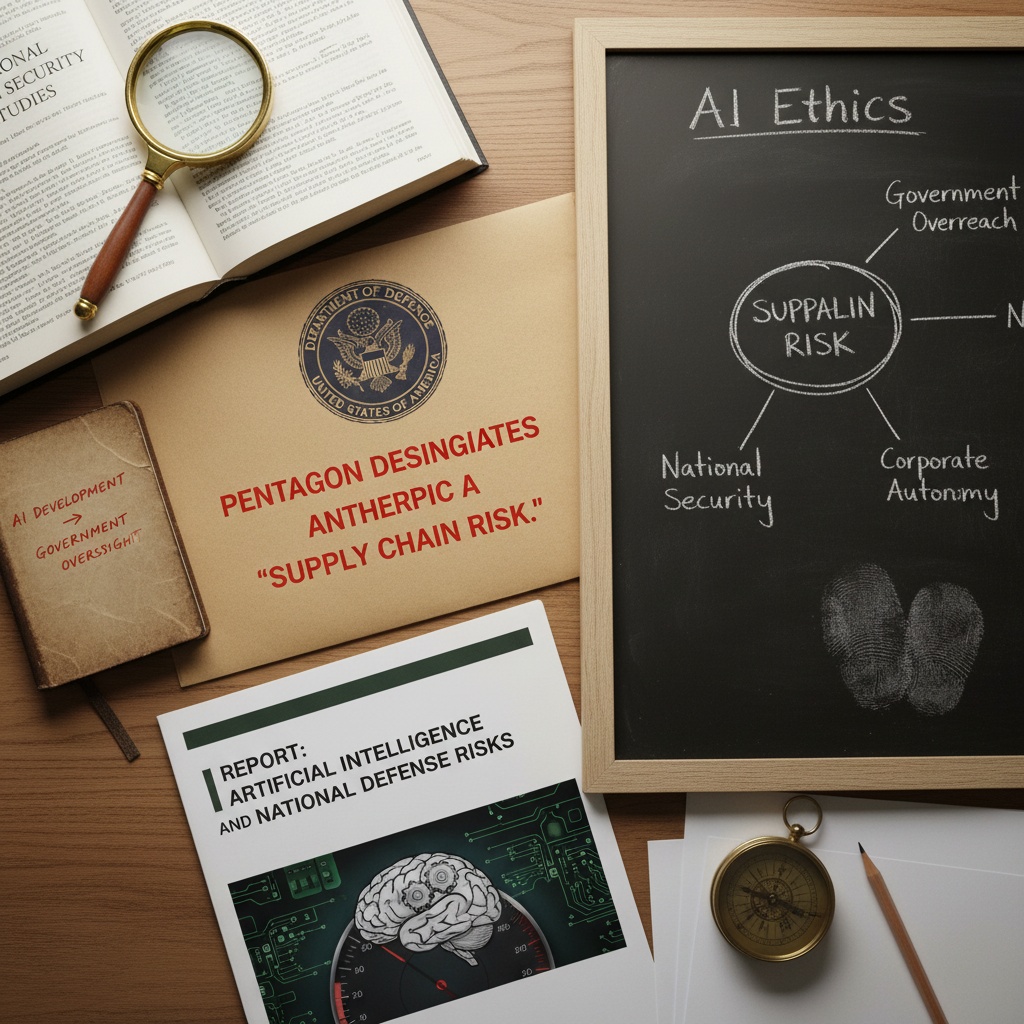
① The Pentagon is using "supply chain risk" to pressure a U.S. AI company. The U.S. Department of War is reportedly designating Anthropic, a leading American AI firm, as a "supply chain risk" because the company refuses to allow the government to use its Claude AI for domestic mass surveillance. This designation, usually reserved for foreign adversaries, is unprecedented for a domestic company. (Dean Ball on The Ezra Klein Show)
→ The urgency: This move highlights profound tensions between national security demands and ethical AI development, potentially setting a dangerous precedent for governmental overreach into corporate R&D, especially if AI capabilities enable "perfect surveillance" by providing an "infinitely scalable workforce."
② Human morality may have evolved from "delighting in cruelty." Evolutionary philosopher Hanno Sauer (University of Utrecht) posits that delighting in cruelty was once a significant "moral development" in human history, serving to enforce social norms and stabilize cooperation within groups. This practice, while now considered an "evolutionary hangover," was crucial before more sophisticated social sanctions developed. (Hanno Sauer on EconTalk)
→ The re-framing: This counter-intuitive idea forces a re-evaluation of the origins of our moral intuitions and suggests that what we consider "good" or "evil" today has a complex, context-dependent evolutionary history. For leaders, it hints at the deep, often uncomfortable, roots of human behavior, even in modern organizations.
③ Western Civilization scholarship was abolished, leading to societal uncivilizedness.James Hankins (Renaissance Historian, Hamilton School) left Harvard after nearly four decades because he believes the study of Western civilization has been largely abolished in American education, leading to a profound "historical amnesia" and a lack of civility. He advocates for understanding, rather than triumphalist teaching, to foster inclusive participation. (James Hankins on Conversations With Coleman)
→ The consequence: The absence of foundational historical context can create vacuums where critical thinking might otherwise develop, leading to vulnerability to simplistic narratives. For organizations, it stresses the importance of shared foundational knowledge and values to foster cohesion and effective problem-solving.
④ The "hard problem" of consciousness is misframed as an absolute instead of a relative issue.Nir Lahav (Physicist) argues that the "hard problem" of consciousness—the difficulty in explaining subjective experience—arises from incorrectly treating consciousness as an absolute property. His 🆕 Relativistic Theory of Consciousness suggests that consciousness is a physical property that emerges from relationships measured within a "cognitive frame of reference," making it relative. (Nir Lahav on Theories of Everything with Curt Jaimungal)
→ The theoretical shift: This insight suggests that some seemingly intractable problems might be a result of flawed initial assumptions rather than inherent complexity. Applying this to business strategy, leaders might ask if their "hard problems" are absolutes or if a relational re-framing could reveal new solutions. The host, Curt Jaimungal, noted that "The principle of relativity is like the principle of everything."
⑤ Emotional eating isn't a willpower issue but a call for mindful pause.Dr. Rachel Goldman (Clinical Psychologist, NYU) explains that emotional eating, which is eating to soothe any emotion, is not inherently problematic but becomes an issue when accompanied by guilt or shame. She emphasizes that it isn't about a lack of willpower, but a need to create a pause and tune inward rather than react impulsively. (Dr. Rachel Goldman on The Mel Robbins Podcast)
→ The practical application: This insight challenges stigmatized views of a common behavior, offering a more compassionate, actionable approach to self-regulation. Leaders applying this could foster environments where self-awareness and mindful responses are valued over rigid, guilt-driven controls, applicable to everything from personal habits to organizational decision-making under stress.
Signal Board
🔥 Heating Up
• Relativistic Theory of Consciousness: Proposing consciousness is a physical process relative to the observer, emerging from relations within a cognitive system's internal simulation, challenging absolute assumptions. (Nir Lahav on Theories of Everything with Curt Jaimungal)
• CAR T-cell therapy 🆕: Advancing as a precise and effective immunotherapy for cancer, using genetically modified T-cells to specifically target and destroy cancer cells. (Dr. Alex Marson on Huberman Lab)
• Flexible Realism: The Trump administration's foreign policy approach, prioritizing national interests and decisive action, even without broad consensus, in response to perceived threats like Iran's nuclear program. (Nadia Schadlow on The Ezra Klein Show)
👀 On Watch
• Supply Chain Risk Designation for Anthropic 🆕: The U.S. government's unprecedented use of this designation against a domestic AI company due to its ethical restrictions on government use of its technology. (Dean Ball on The Ezra Klein Show)
• CRISPR 🆕: Accelerating genetic engineering, enabling precise interventions in disease at root causes, revolutionizing research capabilities, and treatment development. (Dr. Alex Marson on Huberman Lab)
• Marriott 🆕: A case study in diversification and entrepreneurial adaptation, building an empire without a master plan by focusing on customer needs and employee welfare. (J. Willard Marriott on The Knowledge Project)
❄️ Cooling Off
• Monolithic AI Alignment: The idea that AI can be perfectly "aligned" with human values without first determining "which humans, which values, and who decides," is seen as a philosophical and political problem. (Ezra Klein on The Ezra Klein Show)
• Unification in Physics as a Bias 🆕: The idea that the common drive for unification in physics might be a preconception rather than a necessity, potentially obscuring more accurate theories. (John Donoghue on Theories of Everything with Curt Jaimungal)
The Tension
This week, a philosophical tension emerged surrounding the notion of "unification" in science, particularly within physics.
🔵 Unification as an inherent bias:John Donoghue, a physicist, argues that the common drive towards unification in physics might be a bias rather than an observed phenomenon. He notes the lack of evidence for gauge unification and the LHC’s findings against low-energy supersymmetry, which was meant to protect grand unified theories. This suggests that the universe might not be fundamentally unified in the way physicists historically assume. (John Donoghue on Theories of Everything with Curt Jaimungal)
🔴 Unification as a guiding principle: Counter-intuitively, the very idea of a 🆕 Principle of Relativity is presented by Nir Lahav as "the principle of everything," a guiding light towards a "theory of everything," despite his arguments against treating consciousness as an absolute. This suggests a desire for universal explanatory power, even if it's based on a relativistic framework. (Nir Lahav on Theories of Everything with Curt Jaimungal)
What's at stake: This tension highlights whether scientific progress is best achieved by seeking grand, unifying theories, or by accepting and exploring the relative, context-dependent nature of phenomena. For leaders, this mirrors the strategic question of whether to pursue all-encompassing frameworks or to focus on robust, adaptable approaches to discrete, complex problems.
The Bookshelf
The Knowledge Machine: How an Unreasonable Idea Created Modern Science by Michael Strevens
Cited for its argument that the modern nation-state is a technological contingency, implying its existence is not inherently guaranteed. (Dean Ball on The Ezra Klein Show)
War and the Art of Governing by Nadia Schadlow
A book by Nadia Schadlow, reflecting on the historical interplay between military strategy and political governance. (Nadia Schadlow on The Ezra Klein Show)
America in the World by Robert Zoellick
Recommended for understanding different approaches to American foreign policy and its global role. (Nadia Schadlow on The Ezra Klein Show)
The Mystery of Capital by Hernando de Soto
Discussed for its insights into economic development and the role of formalized property rights in wealth creation. (Nadia Schadlow on The Ezra Klein Show)
📖 Want the full episode breakdowns, guest details, and listen links?
Episode Guide (Web Version)
1. EconTalk — "How We Tamed Ourselves and Invented Good and Evil (with Hanno Sauer)"
Runtime: 74 min | Host: Russ Roberts | Guest: Hanno Sauer (Philosopher and Author, University of Utrecht)
For the Strategic Moralist: This episode provides an evolutionary lens on the origins of human cooperation and morality, challenging conventional wisdom and offering a deeper understanding of our innate tendencies.
Russ Roberts and Hanno Sauer explore the deep historical roots of human cooperation, self-domestication, and the surprising role of cruelty in enforcing early social norms. They dissect the ongoing debate about the efficacy of punishment and reflect on Adam Smith's insights into reputation and authentic virtue.
"One of humanity's greatest moral developments was delighting in cruelty. It was all the more difficult to unlearn this lust for cruelty after it had fulfilled its purpose."
— Hanno Sauer, Philosopher and Author on EconTalk
2. The Ezra Klein Show — "Why the Pentagon Wants to Destroy Anthropic"
Runtime: 70 min | Host: Ezra Klein | Guest: Dean Ball (Senior Fellow and Author of Hyperdimensional Newsletter, Foundation for American Innovation)
For the AI Strategist: Essential listening for anyone navigating the complex and often conflicting demands between ethical AI development and national security imperatives.
Ezra Klein and Dean Ball discuss the Pentagon's unprecedented "supply chain risk" designation for Anthropic over its refusal to allow domestic mass surveillance via AI. The conversation delves into the challenge of AI alignment, the impact on governmental power, and the philosophical implications of instilling "virtuous" principles into AI systems.
"The entire institutional complex is going to break in ways that we cannot quite predict... AI policy today, is way too focused on what object level regulations will we apply to the AI systems... Instead of thinking about this broader question of, wow, there are all these assumptions we made that are now broken."
— Dean Ball, Senior Fellow at Foundation for American Innovation on The Ezra Klein Show
3. Conversations With Coleman — "He Wanted to Teach Western Civilization. So He Quit Harvard."
Runtime: 82 min | Host: Coleman Hughes | Guest: James Hankins (Renaissance Historian and Professor, Hamilton School (formerly Harvard University))
For the Cultural Leader: This episode offers a critical perspective on the decline of foundational historical education and its repercussions on societal cohesion and civility.
James Hankins, a former Harvard professor, discusses his departure due to the perceived abolition of Western civilization studies in American academia. He explores the complex origins of liberal values, the role of Judeo-Christian thought, and the importance of understanding historical narratives for an inclusive society.
"If you don't teach civilization, people become uncivilized."
— James Hankins, Renaissance Historian and Professor at Hamilton School on Conversations With Coleman
4. Theories of Everything with Curt Jaimungal — "John Donoghue: The Physicist Who Says We've Already Quantized Gravity"
Runtime: 67 min | Host: Curt Jaimungal | Guest: John Donoghue (Professor, University of Massachusetts Amherst (implied, per previous episodes))
For the Paradigm Shifter: A mind-bending discussion for leaders who appreciate how fundamental scientific debates can reveal biases even in bedrock assumptions.
Professor John Donoghue challenges the notion that quantum physics and gravity are incompatible, positing that general relativity is an effective field theory. He critiques the bias towards "unification" in physics and explains higher derivative theories that could redefine our understanding of causality at high energies.
"I think the popular phrasing is totally wrong, that quantum physics and gravity go perfectly well as well as any other theory that we know about."
— John Donoghue on Theories of Everything with Curt Jaimungal
5. The Mel Robbins Podcast — "#1 Body Image Expert: How to Repair Your Relationship with Your Body & Food"
Runtime: 82 min | Host: Mel Robbins | Guest: Dr. Rachel Goldman (Clinical Psychologist and Professor, NYU)
For the Mindful Leader: This episode provides deeply practical tools for understanding and managing emotional eating and disordered patterns, improving personal well-being.
Mel Robbins and Dr. Rachel Goldman delve into emotional eating, distinguishing it from physiological hunger and emphasizing the role of guilt and shame. They introduce the "10-minute rule" for mindful consumption and discuss how stress impacts eating habits, as well as the nuances between disordered eating and clinical eating disorders.
"If it's causing distress, if you're feeling guilt or shame, that's a problem. And again, that comes back to the thoughts. So what I often say is, it's not the behavior itself that matters, it's the thought that follows the behavior."
— Dr. Rachel Goldman, Clinical Psychologist and Professor at NYU on The Mel Robbins Podcast
6. Theories of Everything with Curt Jaimungal — "This Physicist Has A "Relativistic Theory of Consciousness""
Runtime: 189 min | Host: Curt Jaimungal | Guest: Nir Lahav (Physicist, Lahavnir.com)
For the Futurists and AI Ethicists: Essential for anyone grappling with the fundamental nature of consciousness and its implications for philosophy, AI, and understanding reality itself.
Nir Lahav presents his "relativistic theory of consciousness," arguing that consciousness is a physical, relative process emerging from internal simulations within a cognitive system. He challenges the brain-centric view, drawing parallels to Einstein's relativity to bridge the "explanatory gap" between neural activity and subjective experience.
"The deeper layer is to understand that we cannot identify between the neural patterns and the computations with the experience just because they are very different from each other. They have even opposite properties."
— Nir Lahav, Physicist on Theories of Everything with Curt Jaimungal
7. The Ezra Klein Show — "I Asked a Former Trump Official to Justify This War"
Runtime: 61 min | Host: Ezra Klein | Guest: Nadia Schadlow (Senior Fellow and Former Deputy National Security Advisor, Hudson Institute)
For the Geopolitical Strategist: This conversation offers direct insight into the foreign policy doctrines and decision-making dilemmas of a recent U.S. administration, particularly concerning military actions.
Ezra Klein questions former Trump official Nadia Schadlow on the administration's foreign policy shift regarding Iran. They discuss "flexible realism," the constitutional role of Congress in military action, and the trade-offs between globalist approaches and state-first priorities in international relations.
"realism essentially means that you look at the world the way it is, not as you wish it to be. And I think Donald Trump is someone who sees the world in a particular way. It's a world that's competitive. It's a world in which power matters. It's a world in which nation states matter, interests matter."
— Nadia Schadlow, Senior Fellow at Hudson Institute on The Ezra Klein Show
8. Worklife with Adam Grant — "ReThinking: How to spot psychopaths and narcissists, with Leanne ten Brinke"
Runtime: 35 min | Host: Adam Grant | Guest: Leanne ten Brinke (Social Psychologist, University of British Columbia)
For the Organizational Psychologist: Offers actionable strategies for identifying and managing individuals with dark personality traits in professional settings, crucial for fostering healthy team dynamics.
Adam Grant and Leanne ten Brinke explore the "Dark Tetrad" (psychopathy, Machiavellianism, narcissism, sadism), debunking myths and explaining how these traits manifest in leadership. They provide practical advice on setting boundaries and navigating interactions with difficult personalities in the workplace.
"Our best estimate is that 1% of the general population would have that same level of psychopathy. Now, among CEOs, about 3% of them would have clinical levels, so extremely high levels of psychopathy."
— Leanne ten Brinke, Social Psychologist at University of British Columbia on Worklife with Adam Grant
9. The Knowledge Project — "[Outliers] J.W. Marriott: Building an Empire Without a Master Plan"
Runtime: 39 min | Host: Shane Parrish | Guest: J. Willard Marriott (Founder, Marriott Corporation)
For the Entrepreneurial Innovator: An inspiring case study in entrepreneurial ingenuity, diversification, and adaptive strategy from a legendary business builder.
Shane Parrish narrates the foundational story of J. Willard Marriott, detailing his journey from a root beer stand to a diversified business empire. The episode highlights his unconventional approach to challenges, focus on employee welfare, and the pivotal (and initially resisted) shift into the hotel business that defined his legacy.
"If a job is too big for one person, don't work harder. Find the right incentive and let other people help you carry it."
— J. Willard Marriott, Founder of Marriott Corporation on The Knowledge Project
10. Huberman Lab — "Avoiding, Treating & Curing Cancer With the Immune System | Dr. Alex Marson"
Runtime: 147 min | Host: Dr. Andrew Huberman | Guest: Dr. Alex Marson (Senior Investigator and Professor of Medicine, Gladstone Institutes and University of California, San Francisco)
For the Biotechnology Investor & Health Innovator: Essential viewing for anyone tracking the cutting edge of immunotherapy, genetic engineering, and their application to disease treatment.
Dr. Andrew Huberman and Dr. Alex Marson discuss the current revolution in biology and medicine, particularly in cancer treatment. They explore the convergence of genetic engineering and AI in accelerating research and explain how the immune system works, focusing on breakthroughs like CAR T-cell therapy.
"Something is materially different right now. And there is a convergence of so many different ways of understanding biology, but then not having that stop at understanding, but to actually intervene at the root causes of disease."
— Dr. Alex Marson, Senior Investigator and Professor of Medicine at Gladstone Institutes and University of California, San Francisco on Huberman Lab