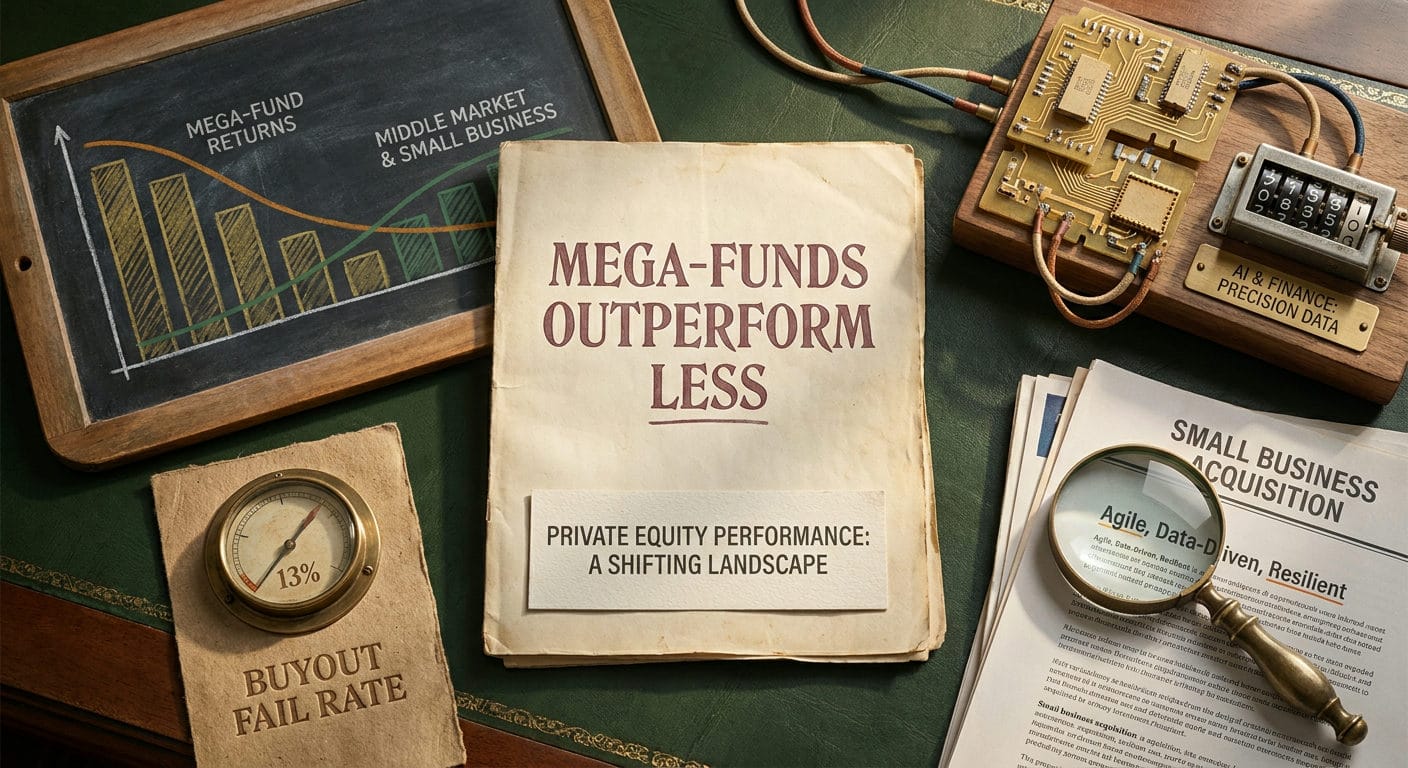
The market is sending a clear signal: the era of simply scaling PE funds and hoping for multiple expansion is over; real alpha now demands intense operational rigor and a strategic re-evaluation of where genuine value is created, whether by acquiring an existing business or building AI 'harnesses' that deliver audited outcomes.
The Intake
📊 11 episodes across 8 podcasts
⏱ 576 minutes of intelligence analyzed
🎙 Featuring: Patrick O'Shaughnessy, Gabe Stengel, Scott Galloway, Claire
|

The Big Shift
The long-standing belief in private equity that bigger means better, or even just equally good, is now squarely challenged. Performance data indicates a clear inverse relationship: mega buyout funds are not just underperforming smaller funds; their returns are degrading as they scale. This isn't just about market dynamics; it's a fundamental tension between LP demand for scale and the actual mechanics of value creation.
"The biggest buyout funds are getting worse as they get bigger."
— Devin Mathews, Host on Private Equity Funcast
Why it matters: This is forcing a brutal reckoning. Much of what was previously attributed to "operational alpha" is now revealed to be primarily sector bets, leverage, and multiple expansion. As those levers become less effective or accessible, the middle market, with its inherent agility and capacity for true operational improvement, is positioned for outperformance. LPs continuing to chase mega-funds for 'safety' are accepting increasingly mediocre returns, while GPs must fundamentally re-think how to deploy large capital efficiently without sacrificing real value.
"Most of what we call operational alpha really is just sector picking, multiple expansion and debt."
— Devin Mathews, Host on Private Equity Funcast
The move: Prioritize deep, operational diligence in the middle market. Challenge large fund exposure, and look for managers with a proven playbook for value creation beyond financial engineering. For GPs, this means a ruthless focus on true operational levers, not just capital deployment, and potentially re-evaluating fund size strategies.
The Rundown
① Betting on Buyouts: The Middle Market Outperforms.
Mega buyout funds are exhibiting diminishing returns to scale, with their performance degrading relative to smaller funds, especially in recent vintages. (Andrew Akers on Private Equity Funcast)
→ The Signal: The long-held belief in "manager persistence" for top-quartile PE funds is being debunked, making manager selection for large funds less impactful, and suggesting LPs should scrutinize mega-fund allocations more closely. Andrew Akers noted that "The persistence factor is not as high as you would think. Just using past performance to make your manager selection in private markets is certainly not foolproof, if helpful at all."
② AI 'Harnesses' Drive Value, Not Just Raw Models.
In vertical AI applications like finance, the "harness" or infrastructure built around frontier models is more critical than the raw model intelligence itself, particularly for auditability and workflow integration in regulated industries. (Gabe Stengel on Invest Like the Best)
→ Why it matters: This isn't a race to build the best LLM, but to build the most effective solutions that integrate AI into complex workflows, like automating deal markups for bankers in 20 minutes instead of two days. Gabe Stengel emphasized that "You want to build things that are perpendicular to what they [frontier labs] want to build... the labs are never going to build that we need to build for finance or for any other vertical."
③ Buy, Don't Build: Lower Failure Rates in Acquisitions.
Buying an existing small business has a significantly lower failure rate (under 13%) compared to starting a new venture (90%), making it a more reliable path to wealth creation. (Codie Sanchez on Masters of Scale)
→ The Opportunity: For aspiring entrepreneurs and even smaller PE players, the risk-reward profile of acquiring established, profitable businesses in sectors like manufacturing, home services, and skilled trades is now more compelling than ever, with less reliance on "cowboying" and more on implementing rigorous systems. Codie Sanchez pointed out, "The SBA's failure rate right now is like less than 13%. So you go get a loan on a small business, it gets SBA approved, you have a 13% failure rate over a 10 year period, as opposed to in startups, a 90% failure rate."
④ Zuckerberg's Imperial Ambition: A Model for Sustained Dominance.
Mark Zuckerberg's relentless drive and "imperial tendency" to control his platform, inspired by Roman emperors, highlights a strategic blueprint for maintaining power and overcoming existential threats in tech. (David Senra on Founders)
→ The Playbook: This "Roman spirit animal" approach—aggressive commoditization of AI, massive capital expenditure, and unwavering commitment to "building things"—offers a contrarian view on how to sustain dominance against well-funded competitors like OpenAI and Anthropic, emphasizing internal control and strategic resource deployment. David Senra noted that "Meta's capital expenditure this year will exceed the military budget of every country on Earth except the United States, China, and Russia."
Signal Board
🔥 Heating Up
• Middle market PE fund outperformance prediction: Predictions are solidifying that the middle market will continue to outperform larger funds, especially as mega-funds face diminishing returns. (Andrew Akers on Private Equity Funcast)
• AI software business models (seat vs. token consumption): The debate and evolution of AI pricing models, with a shift towards outcome-based pricing, are gaining traction. (Gabe Stengel on Invest Like the Best)
• High protein and fiber trend: Consumer demand for high-protein, high-fiber products is surging, creating new market opportunities, especially for the GLP-1 demographic. (Danny Meyer on How I Built This)
• Creating perceived bidding wars for business sales: Tactical strategies to maximize valuation during an acquisition by creating the illusion of multiple suitors are becoming critical. (Scott Galloway on The Prof G Pod)
🆕 On Watch
• Situated Mindset (environmental influence on behavior): Angela Duckworth's new work on how designing one's environment significantly impacts behavior and goal achievement is gaining attention. (Angela Duckworth on Dare to Lead with Brené Brown)
• Buying a small business vs. starting one: The contrarian view that acquiring an existing small business is a less risky, more reliable path to wealth is moving into the mainstream. (Codie Sanchez on Masters of Scale)
• Zuckerberg's Imperial Ambition / Roman Empire Fascination: Mark Zuckerberg's deep-seated historical inspirations are seen as a key to understanding his long-term strategy for Meta. (David Senra on Founders)
• Golden State Valkyries: The rapid growth and unique strategy behind the WNBA team is a case study for building a billion-dollar sports franchise from scratch. (Jess Smith on Masters of Scale)
• Boost Koose: This high-protein, high-fiber couscous alternative is emerging as a strong player in the health-conscious food market. (Barb Bruhis on How I Built This)
❄️ Cooling Off
• Willpower is fallible and exhausting, not a muscle: The traditional emphasis on willpower for behavior change is being challenged, with a focus shifting to environmental design. (Angela Duckworth on Dare to Lead with Brené Brown)
• Persistence of private equity fund performance is not high: The data shows past top-quartile performance is not a reliable predictor of future success, challenging LP allocation strategies. (Andrew Akers on Private Equity Funcast)
• AI advice for small businesses is often generic and unhelpful: Generic AI tools often provide superficial advice, highlighting the need for specific, context-aware applications. (Codie Sanchez on Masters of Scale)
• California government incompetence and regulations: Political and economic decay in California, driven by high taxes and regulations, continues to be a bearish signal for business. (Steve Hilton on All-In with Chamath, Jason, Sacks & Friedberg)
The Bottom Line
The smartest capital is no longer chasing outsized multiples or relying on past PE performance, but strategically deploying into operationally rich middle-market opportunities and deeply integrated AI solutions that solve real business problems, rather than just abstractly leveraging new models.
Episode Guide (Web Version)
Invest Like the Best with Patrick O'Shaughnessy — "Gabe Stengel - Building Investing Superintelligence - [Invest Like the Best, EP.492]"
Runtime: 64 min | Host: Patrick O'Shaughnessy | Guest: Gabe Stengel (Co-founder and CEO, Rogo)
For the AI-forward investor: This episode provides a deep dive into the practical application of AI in finance, moving beyond hype to discuss the critical infrastructure needed for real-world impact and competitive advantage.
Patrick O'Shaughnessy and Gabe Stengel discuss how Rogo, an AI platform for finance, is shifting the paradigm by emphasizing the "harness" around AI models for financial workflows. Stengel outlines Rogo Finance's enterprise software business model, which currently charges per seat, contrasting it with token consumption models prevalent in other AI software. He predicts a future where AI agents facilitate transactions and automate risk pricing, making capital markets more efficient.
"The models just became capable of basically anything a junior investment professional or junior banker was doing, as long as you gave it the right instructions and context."
— Gabe Stengel, Co-founder and CEO of Rogo
The Prof G Pod with Scott Galloway — "Protecting Your Portfolio in a Bubble, and Is a Move to America Worth the Money?"
Runtime: 34 min | Host: Scott Galloway | Guest: Claire (Social Producer, The Prof G Pod)
For the growth-oriented executive: This is a pragmatic take on navigating an overvalued market and making career-defining geographical moves, with practical advice on maximizing business valuation.
Scott Galloway advises on navigating an overvalued stock market by diversifying and staying invested, while reducing personal leverage. He also addresses the financial upside of moving to the U.S. for career growth versus Europe's social benefits. Galloway highlights strategies for maximizing company valuation during an acquisition by creating a competitive bidding environment.
"The US is the best place in the world to make money and Europe is the best place to spend it. It sounds as if you're still in the making money part of your life. So if you have the opportunity and the currency and the offer, do it."
— Scott Galloway, Professor of Marketing at New York University Stern School of Business
Private Equity Funcast — "Diminishing Returns to Scale in Private Equity (w/ Andrew Akers, PitchBook)"
Runtime: 70 min | Host: Devin Mathews | Guest: Andrew Akers (Associate Director of Quantitative Research at PitchBook)
For the discerning LP or fund manager: This episode uncovers critical insights into PE performance trends, challenging conventional wisdom around large funds and the nature of "operational alpha."
Devin and Andrew Akers discuss diminishing returns to scale in private equity, particularly how mega buyout funds are showing declining performance relative to smaller funds. Akers explains that much of PE's perceived "operational alpha" comes from sector bets, leverage, and multiple expansion rather than true operational improvements. They highlight the middle market's outperformance and LPs' behavioral biases favoring large funds.
"Most of what we call operational alpha really is just sector picking, multiple expansion and debt."
— Devin Mathews, Host of Private Equity Funcast
How I Built This with Guy Raz — "Seventh Generation: Alan Newman and Jeffrey Hollender. A Partnership that Flourished—until it Failed. (2021)"
Runtime: 91 min | Host: Guy Raz | Guest: Alan Newman (Co-founder, Seventh Generation)
For the founder navigating partnership dynamics: This historical case study offers a raw look at co-founder relationships, the challenges of ethical business, and critical strategic pivots in early-stage growth.
Guy Raz delves into the story of Seventh Generation, an eco-friendly cleaning product company, focusing on the dramatic partnership and eventual fallout between co-founders Alan Newman and Jeffrey Hollender. The episode details their early struggles, unique culture, and Alan Newman's forced departure during a recession, followed by Jeffrey Hollender's strategic pivot to wholesale retail, which fueled significant growth.
"What I learned was that the greatest obstacle to success was fear. Fear of people that they didn't know what they were doing and somebody was going to find out. And so what I discovered was that if I could get people to share their fears and realize that we're all in this together and that it's better to ask for help, that that created a much more productive and successful business."
— Alan Newman, Co-founder of Seventh Generation
All-In with Chamath, Jason, Sacks & Friedberg — "Steve Hilton & Spencer Pratt: Fixing California, Cheaper Gas, Ballot Fraud & CA Republicans"
Runtime: 56 min | Host: Jason Calacanis | Guest: Steve Hilton (Republican candidate for Governor of California, Self-employed)
For the politically astute investor: This provides an unfiltered, critical perspective on the political and economic environment of California, offering insights into regulatory burdens and their impact on business.
Steve Hilton, a Republican candidate for California Governor, criticizes the state's one-party rule, citing high taxes, poverty, and a poor business climate. Spencer Pratt, a media entrepreneur, joins to describe California politics as a "corrupt criminal mafia cartel," highlighting issues like widespread drug use and alleged voter fraud, and advocates for common sense solutions.
"We've had 16 years of one party in control. Today in California, we have the highest poverty rate in the country, the highest unemployment rate, the highest cost of living by far."
— Steve Hilton, Republican candidate for Governor of California
Masters of Scale — "Rapid Response: Stop creating businesses. Buy one instead, with Codie Sanchez"
Runtime: 33 min | Host: Bob Safian | Guest: Codie Sanchez (Founder and CEO, Contrarian Thinking)
For the aspiring entrepreneur or small business investor: This episode makes a strong case for acquisition over startup creation, emphasizing tangible strategies for wealth building and operational excellence.
Codie Sanchez argues that buying an existing small business is a more reliable path to wealth than starting one from scratch, citing lower failure rates for acquisitions. She emphasizes implementing rigorous systems over "cowboying" and cautions against relying on generic AI advice. Sanchez highlights manufacturing, home services, and skilled trades as top opportunities.
"Nobody's going to die from trying to start a business or buy a business and it not working out. You're going to learn, you're going to go through difficulty. It might be really hard, you might fail, but you probably won't stand at your grave at the end of the day and say, thank God I took no risk. I stayed in a job I hated."
— Codie Sanchez, Founder and CEO of Contrarian Thinking
The Prof G Pod with Scott Galloway — "What the U.S. Can Learn from Canada's Safety Net + The Real Cost of Private Schools and Clubs"
Runtime: 44 min | Host: Scott Galloway | Guest: Zohran Mamdani (Mayor)
For the board member concerned with macro societal trends: This discussion offers a critical look at social safety nets, wealth inequality, and the impact of private institutions on public welfare, relevant for understanding long-term economic stability.
Scott Galloway discusses trade-offs between the US and Canadian social safety nets, advocating for wealth redistribution in the US. He criticizes private schools and clubs for segregating the wealthy and reducing investment in public institutions, suggesting taxing private schools to fund public education. Galloway also addresses the affordability crisis and critiques populist economic policies.
"What happens when wealthy people increasingly opt out of shared institutions? Do you care that 40% of third graders can't read or write when your kid goes to a school that on average private schools spend $75,000 per student?"
— Scott Galloway, Host at Vox Media Podcast Network
Dare to Lead with Brené Brown — "Why Grit Isn’t Always Enough with Angela Duckworth"
Runtime: 64 min | Host: Brené Brown | Guest: Angela Duckworth (Psychologist and Professor, University of Pennsylvania)
For the leader focused on team performance and personal development: This episode redefines "grit" by emphasizing situational design over sheer willpower, offering practical strategies for fostering desired behaviors in oneself and teams.
Brené Brown, Adam Grant, and Angela Duckworth discuss how 'situations' profoundly shape human behavior, motivation, and goal achievement, challenging the sole reliance on individual 'grit.' Duckworth introduces situational awareness and agency, arguing that individuals can and should actively design their environments to foster desired behaviors and reduce friction, reducing the need for constant willpower.
"I think the provocative concept that I'm trying to champion here is that agency isn't just controlling your own thoughts, feelings and actions. I think there is agency in changing the situation."
— Angela Duckworth, Psychologist and Professor at University of Pennsylvania
Masters of Scale — "How to build a billion-dollar sports team from scratch, with Golden State Valkyries’ Jess Smith"
Runtime: 37 min | Host: Jeff Berman | Guest: Jess Smith (President, Golden State Valkyries)
For the growth-minded executive in niche markets: This offers a masterclass in building a high-growth brand from the ground up, highlighting the critical roles of capital, people, and media in an underserved market.
Jess Smith, President of the Golden State Valkyries, discusses the rapid growth and unique strategy behind building the WNBA team. She emphasizes the importance of capital, people, and media in women's sports, focusing on building for an underserved audience with a distinct brand identity. Smith shares lessons on aggressive early hiring and the significance of supportive investors.
"You have to have capital. You can think you're gonna do great things, you can have all these great ideas, and if you don't have capital to actually build that out in the simplest of forms like hiring staff and good people to run your product, then you're gonna miss the mark."
— Jess Smith, President of Golden State Valkyries
Founders — "#435 Mark Zuckerberg's Empire"
Runtime: 41 min | Host: David Senra | Guest: Mark Zuckerberg (CEO, Meta)
For the long-term strategist and competitor: This episode dissects Mark Zuckerberg's unique approach to empire-building and sustained dominance, offering a deep psychological and strategic analysis relevant for understanding market power.
This segment explores Mark Zuckerberg's "imperial tendency" and relentless drive, drawing parallels to Roman emperors. It highlights his early fascination with empire-building, strategic moves to control his platform, and superhuman resilience in overcoming crises. The discussion delves into Zuckerberg's pursuit of AI dominance, comparing his resilience to a "Roman spirit animal" and his intrinsic drive to "build things."
"There have been too many things that I've tried to build and then have been told, 'Nah, you can't really build that,' by the platform provider. At some level, I'm just like, 'Nah, fuck that.'"
— Mark Zuckerberg, CEO of Meta
How I Built This with Guy Raz — "Advice Line with Danny Meyer of Shake Shack"
Runtime: 42 min | Host: Guy Raz | Guest: Danny Meyer (Executive Chairman, Union Square Hospitality Group)
For the food and beverage investor or entrepreneur: Danny Meyer's practical advice on hospitality, brand building, and market entry strategy for perishable goods offers invaluable lessons for the sector.
Guy Raz and Danny Meyer provide business advice to three early-stage founders. Danny Meyer emphasizes building company culture around "expected behaviors" over "family values" and leveraging a "day one mentality" for continuous improvement. He advises on direct-to-consumer expansion for perishable food via platforms like Goldbelly and outlines market entry strategies for B2B food service, suggesting starting with smaller partners.
"Our culture is ultimately all of the wanted behaviors that we celebrate actively, minus all of the unwanted behaviors that we tolerate."
— Danny Meyer, Executive Chairman of Union Square Hospitality Group