
MARKET SIGNALS — DIGEST 042
THE SOFT LANDING NARRATIVE IS BORING. THE "MAG SEVEN" BREAKUP IS REAL.
THIS WEEK'S INTAKE 📊 14 episodes across 9 podcasts ⏱️ ~12 hours of market intelligence 🎙️ Featuring: Palmer Luckey, Elizabeth Economy, Peter Boockvar, J.L. Collins 📅 Coverage: Nov 24 – Nov 26, 2025
We listened. Here's what matters.
The "buy the basket" trade is dying. For the last 18 months, the winning strategy was intellectually lazy: buy the Magnificent Seven, go to the beach, and check the QQQ at Christmas.
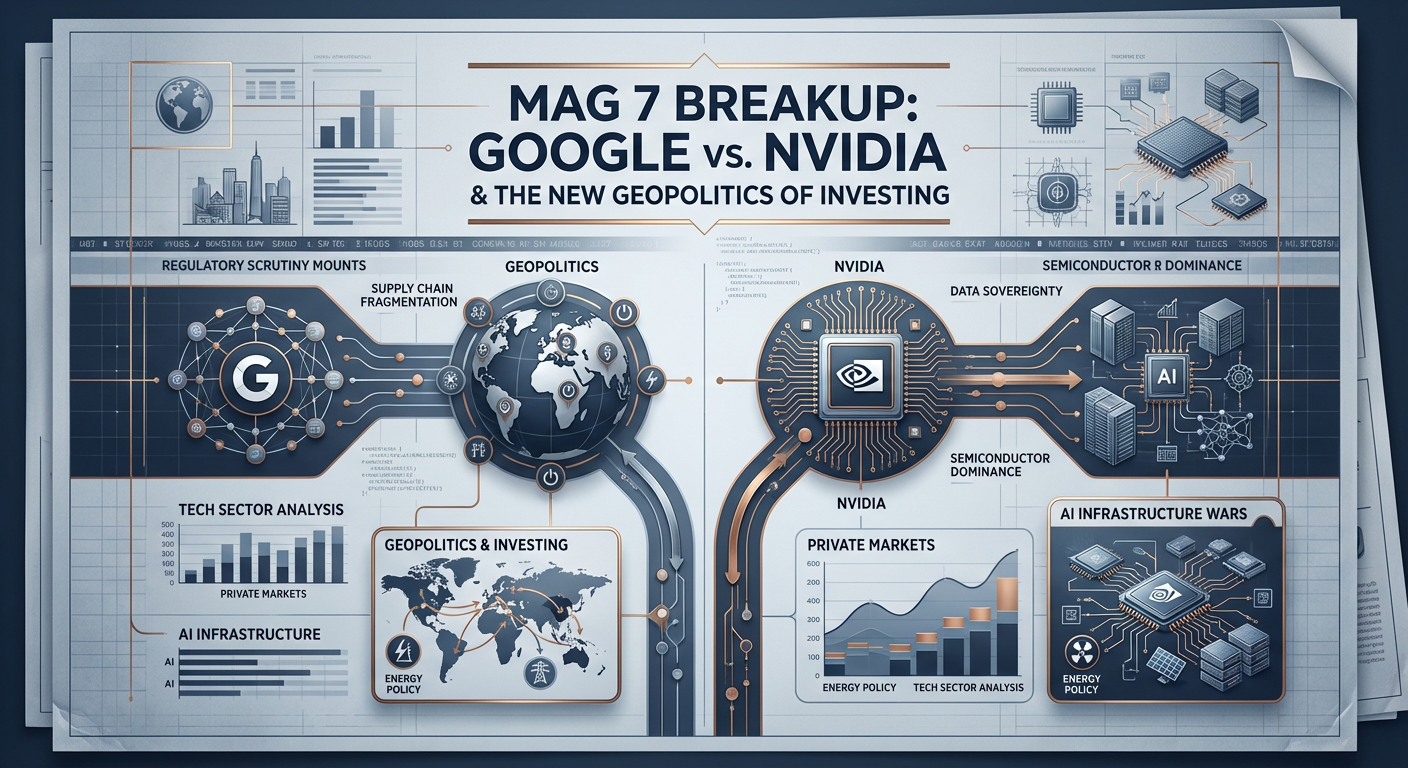
That monolithic block is fracturing. We just watched a week where Alphabet (Google) ripped higher on the Gemini 3 release, while Nvidia faced genuine institutional skepticism for the first time in ages. The smart money isn't asking "Tech or Value?" anymore. They are asking: "Who owns the silicon infrastructure if the hyperscalers build it themselves?"
Simultaneously, a quiet pivot is happening in industrial policy. "ESG" is out. "Production for Security" is in. From Palmer Luckey's defense tech manifesto to the sudden pragmatism on energy, the market is pricing in a world where national security is the sustainability metric.
The signal is clear: The easy index returns are behind us. The alpha is now in the divergence.
THE BRIEFING
THE "INFRA" COUP: GOOGLE VS. NVIDIA
The Setup: Alphabet shares hit record highs this week following the Gemini 3 announcement, diverging sharply from the rest of widespread tech sentiment.
The Signal: The narrative that "Nvidia owns AI" is showing hairline cracks. The market is waking up to the reality that the biggest customers (Google, Amazon via AWS) are relentlessly building their own silicon to reduce reliance on Jensen Huang. The quiet winner here isn't just Google—it's Broadcom, the "general contractor" helping Google design the chips that allowed them to unleash Gemini 3 without paying the Nvidia tax.
The Voice:
"Google built Gemini on the backbone, not of Nvidia, but on a proprietary chip designed with Broadcom." — Fast Money Panelist
The Trade: Watch the AVGO/NVDA ratio. If hyperscalers succeed in decoupling their AI models from Nvidia hardware, the premium drains out of Nvidia and flows into the custom silicon designers (Broadcom) and the software owners (Google).
So What: The "Mag Seven" correlation is reaching 0. You can no longer own them as a block. You have to pick the infrastructure winner (Broadcom) over the vulnerable incumbent (Nvidia).
THE NEW MORALITY: PRODUCTION FOR SECURITY
The Setup: Geopolitical risk is back on the dashboard, with Xi Jinping reaffirming the 2027 military readiness goal for Taiwan.
The Signal: The era of ESG (Environmental, Social, Governance) is being replaced by "Production for Security." Capital allocators are realizing that without a credible defense industrial base, sustainability mandates are irrelevant. This is shifting capital toward defense tech (Anduril) and domestic manufacturing. It’s also reshaping energy policy—synthetic fuels and hydrocarbons are being viewed not as "dirty" but as strategic assets for resilience.
The Voice:
"I really believe this kind of concept of production for security is going to replace kind of ESG. When we're thinking about sustainability, it's going to be much more like: what do we need at the base?" — Bloomberg Surveillance Guest
The Level: 2027. That is the hard date being circulated by Elizabeth Economy regarding Xi’s instruction to the PLA. It’s not an invasion date, but a "readiness" date.
So What: Defense stocks are no longer a "sin" sector; they are becoming a "safety" sector. Expect valuation multiples in the defense industrial base to expand as they get re-rated from "government contractors" to "sovereignty insurance."
THE PRIVATE MARKETS "TAKE-PRIVATE" TRAP
The Setup: The IPO window remains finicky, and wealthy clients are being pushed into private credit and private equity funds.
The Signal: We are seeing a structural shift where wealth creation happens before the IPO. By the time a company hits the NYSE, the 100x growth has already been harvested by private equity. Public market investors are increasingly becoming "exit liquidity" for private funds. The smart money is trying to get upstream, but there's a warning flag waving over private credit risks as rates fluctuate.
The Voice:
"Companies are staying private longer and the wealth creation is happening before a company goes public... we want our clients to participate in that growth and we are putting them in private markets." — Fast Money Panelist
So What: If your portfolio is 100% public equities, you are playing a game of diminishing returns. However, chasing the private market now—late in the cycle—risks buying into the "private credit" bubble just as defaults might tick up.
THE HEAT MAP
WHAT'S GETTING ATTENTION
🔥 Heating Up
- Broadcom (AVGO): Viewed as the "arms dealer" for hyperscalers building anti-Nvidia chips. (Source: Fast Money)
- Waymo: Winning the "deployment" war while Tesla fights the "cost" war. Safety data is becoming undeniable. (Source: Motley Fool Money)
- "Touch and Feel" Retail: Best Buy surging because high-ticket buyers want physical experiences again. (Source: Mad Money)
- Defense Tech: Moving from niche VC bet to sovereign necessity. (Source: Invest Like the Best)
🧊 Cooling Off
- The "Mag Seven" Bundle: The correlation is breaking. Google is decoupling from the pack.
- Nvidia (Sentiment): Skepticism is creeping in regarding moat durability against proprietary chips. (Source: Fast Money)
- ESG: Replaced by national security mandates.
👀 On Watch
- Synthetic Fuels: Palmer Luckey suggests cheap long-chain hydrocarbons could render EV investments obsolete. (Source: Invest Like the Best)
- Xi's 2027 Deadline: The PLA preparedness date is the new geopolitical anchor for risk models. (Source: Bloomberg Surveillance)
THE CONTRARIAN BET
The Source: Palmer Luckey (Founder, Anduril/Oculus)
The Bet: Short the "Battery/Hydrogen Monoculture." Long Synthetic Fuels.
While the world pours trillions into batteries and hydrogen infrastructure, Luckey argues we are ignoring a physics-based reality: if you can manufacture synthetic long-chain hydrocarbon fuels cheaply enough (using captured carbon and energy), the entire EV/Hydrogen infrastructure becomes a waste of capital. The existing combustion engine infrastructure is massive and functional; we just need a carbon-neutral fuel for it.
"If you can make synthetic long chain hydrocarbon fuels cheaply enough, then all of these trillions of dollars in investment into battery electric vehicles and hydrogen electric vehicles become a waste of money."
THE BOTTOM LINE
The market is rotating from "GenAI Hype" to "GenAI Infrastructure Wars." The Google/Broadcom axis is the most important signal to watch this month. If Google sustains this breakout, it confirms that the hyperscalers can successfully bypass Nvidia.
Simultaneously, check your geopolitical hedges. 2027 is the new 2008—the date everyone is looking at but nobody knows how to price.
📚 APPENDIX: EPISODES COVERED
1. MOTLEY FOOL MONEY: "What’s a Waymo Anyway?"Runtime: ~45 mins The Conversation: A deep dive into the AV wars, specifically contrasting Waymo’s safety/LiDAR-heavy approach vs. Tesla’s camera/cost-focused approach. Key Signals:
- Waymo has an insurmountable lead in deployment and safety data.
- The risk to the sector is economic: "What is the point of being first in an industry with airline-style economics?"
- International markets with clear reg frameworks (like China) may scale faster than the US. Notable Quote: "Tesla answered the cost question first, but has not answered the tech question."
2. CNBC FAST MONEY: "11/24/25"Runtime: ~45 mins The Conversation: The crew breaks down the Google breakout following the Gemini 3 release and contrasting it with broader tech faltering. Key Signals:
- Broadcom is the hidden winner in Google's surge ("General Contractor" for the chips).
- Consumer spending is viewed as "strapped" heading into holidays despite market highs.
- Biotech M&A is forecasted to have its "second best year ever" next year. Notable Quote: "Anything that brings geopolitical tensions down is a positive for markets."
3. CNBC FAST MONEY: "11/25/25"Runtime: ~45 mins The Conversation: Focused on the bifurcated consumer. Walmart and Target are telling two different stories about the American wallet. Key Signals:
- High-income shoppers are trading down to Walmart for value, driving their growth.
- Data Centers are facing power/cooling bottlenecks that are becoming the primary constraint on AI scaling. Notable Quote: "Never underestimate the U.S. consumers' want to spend. They'll spend under just about every circumstance."
4. INVEST LIKE THE BEST: "Palmer Luckey - Inventing the Future"Runtime: ~80 mins The Conversation: A masterclass on the "Defense Industrial Base." Luckey argues for a Silicon Valley mindset applied to kinetic warfare. Key Signals:
- Synthetic Fuels: The sleeper technology that could disrupt the EV transition.
- Education: The US should subsidize degrees that serve national interest (engineering/physics) over others.
- World Gun Store: The US role is shifting from "World Police" to strategic arsenal supplier. Notable Quote: "The role of the United States in the future is going to be less being the world police and more like being the world gun store."
5. COMPOUND AND FRIENDS: "Why Oil Could Be Next Year’s Gold"Runtime: ~75 mins The Conversation: Peter Boockvar joins to discuss the "AI Bubble," inflation, and why commodities (oil) might be undervalued. Key Signals:
- The "Bubble" is in the infrastructure build-out, not necessarily the use case yet.
- Market seasonality: Soft Sept/Oct usually setups a "chase higher" into year-end. Notable Quote: "The use case is not the bubble, it's the actual infrastructure behind it."
6. ANIMAL SPIRITS: "Wait, Are We in a Recession???"Runtime: ~50 mins The Conversation: Batnick and Carlson grapple with the divergence between "vibes" (which feel recessionary) and data (which isn't). Key Signals:
- The Fed Divergence: The Fed is cutting rates into a bubble, a historical anomaly.
- Signal Failure: When markets don't rise on good news (like Nvidia earnings), the trend is exhausted. Notable Quote: "The likelihood of a recession is inversely correlated to how many people are predicting one."
7. BLOOMBERG SURVEILLANCE: "November 25th, 2025"Runtime: ~60 mins The Conversation: A macro-heavy episode focusing on the "End of Free Money" and trade tensions with the EU. Key Signals:
- Moral Hazard: The Fed/Admin cannot allow the market to crater due to wealth-effect dependency.
- Trade Deals: Deep skepticism on the durability of US-EU trade relations under new geopolitical stresses. Notable Quote: "It is going to be morally hazardous for either this administration or the Federal Reserve to allow this market to crater."
8. BLOOMBERG SURVEILLANCE: "Single Best Idea - Elizabeth Economy"Runtime: ~30 mins The Conversation: A focused interview on China/Taiwan. Elizabeth Economy provides the framework for understanding Xi's timeline. Key Signals:
- 2027: The year Xi wants the military capable of taking Taiwan (not necessarily the invasion date).
- Trump Factor: China views Trump as unpredictable but transactionally open, creating a dangerous "opening." Notable Quote: "Xi Jinping has said he wants the Chinese military to be prepared to take action by 2027."
9. MOTLEY FOOL MONEY: "Interview With J.L. Collins"Runtime: ~45 mins The Conversation: The "Godfather of FI" discusses wealth psychology. Less market mechanics, more mindset. Key Signals:
- VTI is the Alpha: Most complexity is marketing. Broad index funds remain the mathematical winner.
- FU Money: The intermediate stage of wealth that allows for risk-taking in careers. Notable Quote: "Personally, there is nothing I'd rather buy or own than FU money."
10. MAD MONEY W/ JIM CRAMER: "11/24/25"Runtime: ~45 mins The Conversation: Cramer analyzes the "Mag Seven" rally and risks to the bull market. Key Signals:
- Supply Glut: The biggest risk to the bull market is a flood of IPOs/Secondaries overwhelming demand.
- Gemini Reaction: Bullish on Google's ability to catch up to OpenAI. Notable Quote: "One factor that could put this bull market in jeopardy is supply and demand."
11. DAILY STOCK PICKS: "TrendSpider Giveaway & Analysis"Runtime: ~20 mins The Conversation: A tactical/technical episode focused on chart structures for the holidays. Key Signals:
- Black Friday: Viewing the trading week as a low-volume "setup" week for 2024 positioning.
- Reaction Function: "Any reaction in the market is an overreaction" (Trading the fade). Notable Quote: "Grab the best Black Friday sale—never pay more and get technical edge for 2024!"
12. BLOOMBERG SURVEILLANCE: "Trump Moves to Preserve Xi Truce"Runtime: ~60 mins The Conversation: Geopolitics meets crypto. Discussion moves from Taiwan tensions to Bitcoin's "intrinsic value." Key Signals:
- Bitcoin Bear Case: Richard Whalen arguing Bitcoin is "electronic poker chips" with zero intrinsic value.
- Fannie/Freddie: They are never leaving conservatorship; the personnel isn't there. Notable Quote: "Bitcoin has no intrinsic value. Electronic poker chips that people have decided to bid up."
13. CNBC FAST MONEY: "11/26/25"Runtime: ~45 mins The Conversation: Pre-Thanksgiving setup. The "Year-End Rally" thesis and the private market shift. Key Signals:
- Private Markets: Wealth advisors are moving clients to private equity/credit because "companies stay private longer."
- Holiday Rally: Fund managers need to "dress up" portfolios by buying the winners into year-end ($NVDA, $GOOGL dumping is unlikely). Notable Quote: "Companies are staying private longer and the wealth creation is happening before a company goes public."
14. MAD MONEY W/ JIM CRAMER: "11/25/25"Runtime: ~45 mins The Conversation: Cramer pushes diversification away from Tech. Best Buy and Disney as "trust" plays. Key Signals:
- Trust Alpha: Companies that have earned consumer trust (Costco, Best Buy) are commanding premiums.
- Sector Rotation: Explicit call to own "four stocks that aren't tech." Notable Quote: "Don't trade the stock of Nvidia first. Historically it's been a bad idea to dump any of the Magic seven out of fear."