
The exit backlog isn't opening, it's being forced—and the price for that flexibility is shifting dramatically.
The Big Shift
The M&A Landscape is Undergoing a Stealth Transformation
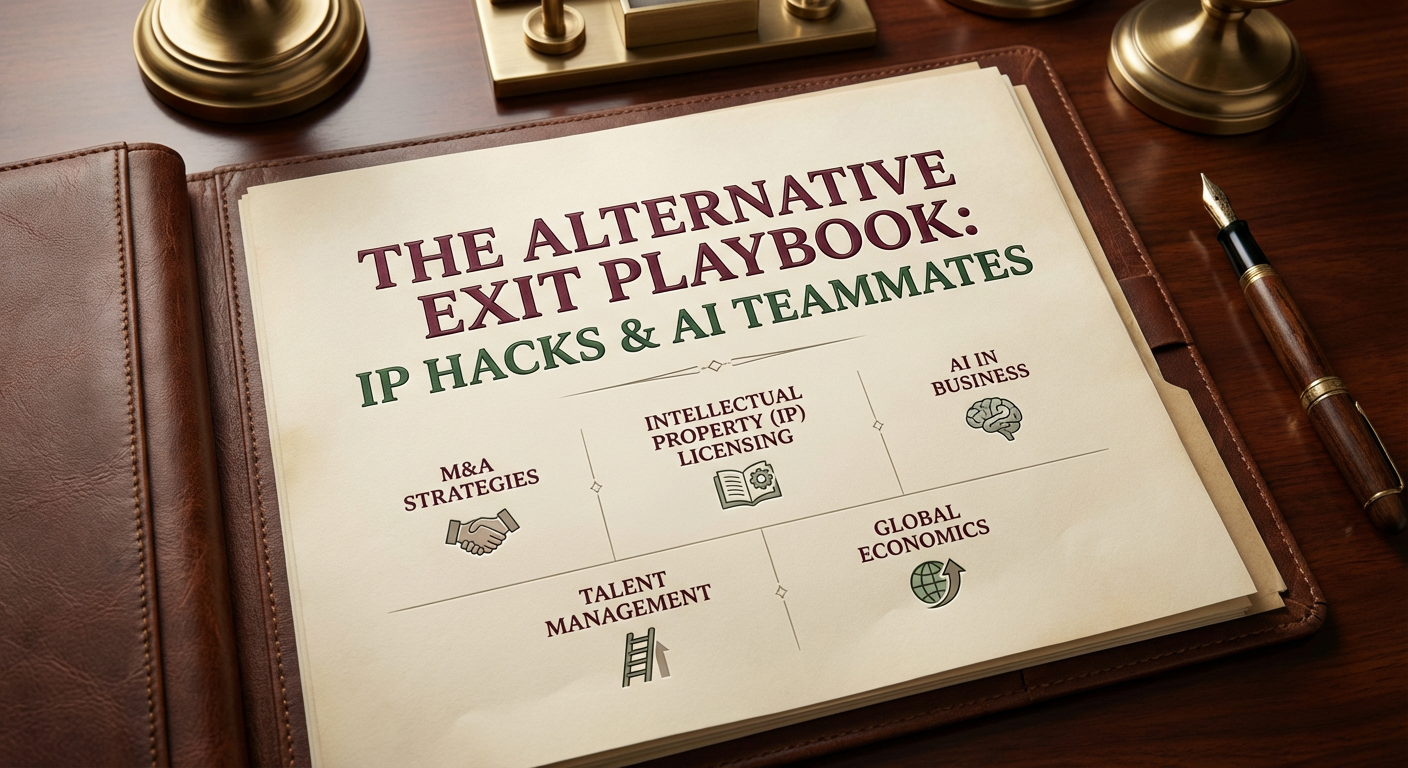
The traditional exit playbook is being re-written in real-time, moving beyond direct sale to financial or strategic buyers. GPs and founders are increasingly looking at non-traditional monetization strategies, including continuation funds, dividend recaps, and now, even IP licensing as an M&A workaround. This shift is driven by a combination of high interest rates, valuation disparities, and a competitive market for quality assets that makes outright sales challenging. Strategic maneuvers like General Catalyst's acquisition of incumbent businesses to serve as AI transformation platforms for their startups, rather than just optimizing them as private equity, signal a broadening of how value is created and realized. The market is adapting, and those who can navigate these new structures will find paths to liquidity where others see gridlock.
Why it matters: The old "buy-and-hold-for-a-sale" model is evolving. Dealmakers need to understand how to leverage intellectual property, strategic partnerships, and even temporary acquisitions to unlock value, rather than waiting for a perfect exit window that may never fully open.
"This is not about trying to be PE, this is about acquiring businesses in PE that actually have declining value but have important customers that need to be served and help them get to that AI transformation..." — All-In with Chamath, Jason, Sacks & Friedberg
The move: Evaluate your portfolio for alternative monetization pathways—could a strategic IP license or a phased partnership unlock value without a full exit right now?
The Rundown
Databricks' Dual-Track Domination. Databricks, a $130B private company, showcases the power of a hybrid model, successfully navigating both open source and proprietary offerings. Their data warehouse product scaled to $1 billion in revenue, exceeding Snowflake's analogous efforts, by addressing core data engineering and data science personas, then expanding to traditional SQL workloads. (Alan Tu on Business Breakdowns)
• Why it matters: This case study highlights that a strong technical foundation combined with strategic market expansion and clever product positioning ("lakehouse" architecture) can create immense value, even in crowded markets.
China's 'Chaos-to-Prowess' Economic Blueprint. China’s economic strategy leverages government-subsidized overproduction and strategic dumping of goods below cost in foreign markets. This isn't just about market share; it's about transforming internal economic chaos into international leverage by putting competitors out of business globally. (Howard Lutnick on All-In)
• The signal: This underscores the need for businesses, especially those in manufacturing and tech, to understand the geopolitical undercurrents shaping global supply chains and competitive landscapes.
The "Talent Density" Imperative at Netflix. Reed Hastings' "talent density" model at Netflix, involving a 20% first-year attrition rate, is a critical, albeit unconventional, strategy for cultural performance. This approach fosters a culture of radical honesty and high performance by quickly culling underperformers and continuously raising the bar. (Reed Hastings on Invest Like the Best with Patrick O'Shaughnessy)
• What to watch: While extreme, the underlying philosophy—prioritizing top talent and challenging complacency—is increasingly relevant as firms face pressure to maximize efficiency and innovation in competitive environments.
"Easy Breakthrough" in Creator Economy. Jack Conte from Patreon challenges the common wisdom that it's harder to break through in today's saturated creator market. He argues that the internet has shifted to an interest-based discovery model, making initial breakthroughs easier due to platforms prioritizing content virality over follower count for new creators. (Jack Conte on How I Built This with Guy Raz)
• Why it matters: For companies engaging with creators or building platform businesses, understanding this shift means optimizing for shareability and discovery algorithms, not just traditional influencer marketing.
Deal Flow Signals
🔥 ACTIVE
• Data Unification: The demand for platforms that integrate and process structured and unstructured data for analytics and machine learning is extremely high. (Databricks on Business Breakdowns)
• Infrastructure Investing: Japan is actively financing US infrastructure projects (e.g., nuclear plants) in exchange for reduced tariffs, signaling a new model for international capital deployment. (Howard Lutnick on All-In with Chamath, Jason, Sacks & Friedberg)
👀 EMERGING
• 🆕 IP Licensing as M&A Alternative: Companies are exploring IP licensing to circumvent valuation gaps and traditional M&A challenges, especially after an IPO resurgence. (All-In with Chamath, Jason, Sacks & Friedberg)
• 🆕 Copper Demand: Driven by national security needs and its essential role in data centers, chips, and weapon systems, copper is predicted to see a parabolic rise. (Chamath Palihapitiya on All-In)
🧊 QUIET
• Traditional Open Source Monetization: The difficulty of building successful businesses solely on open-source support remains a significant hurdle, pushing companies towards hybrid or proprietary models. (Alan Tu on Business Breakdowns)
• Wealth Taxes: Proposals for California's billionaire wealth tax are gaining political traction but face significant economic challenges and historical failures in other regions. (The Prof G Pod with Scott Galloway & All-In with Chamath, Jason, Sacks & Friedberg)
⚠️ STRESSED
• Rare Earth Supply Chain: US strategic vulnerability due to heavy reliance on China for rare earth elements creates a critical defense and technology risk. (George Hahn on The Prof G Pod with Scott Galloway)
• Character AI Ethics: Rapid ethical concerns are emerging around "synthetic relationships" between minors and AI personas, leading to calls for age-gating and highlighting unknown societal risks. (Scott Galloway on The Prof G Pod with Scott Galloway)
The Debate
Is AI a job creator or a job destroyer in knowledge work?
🐂 The bull case:
"Contrary to popular belief, AI will increase demand for knowledge workers due to Jevons Paradox, as seen in radiology where AI efficiency leads to more scans and demand for doctors." — David Sacks on All-In
🐻 The bear case:
"The biggest challenge in corporate America is they're taking out the bottom two or three rungs and automating stuff and we really need to develop young people so that they have a path to take the CEO jobs eventually." — Jason Calacanis on All-In
Our read: While AI undeniably automates junior-level tasks, the consensus among forward-looking operators is that it redefines roles rather than eliminating them entirely. The focus shifts to higher-order problem-solving and unique human skills, but this requires significant re-skilling and new talent development pathways that don't yet fully exist.
The Bottom Line
The global business landscape is being reshaped by geopolitical leverage, AI's disruptive speed, and alternative liquidity strategies—adapt your deal sourcing and value creation playbooks now, or get left behind.
🎯 Your Move
- Audit your portfolio's IP strategy: Assess whether intellectual property is adequately protected and if licensing or strategic partnerships could unlock value without immediate full exits, especially for companies with strong tech assets.
- Pressure-test China supply chain exposure: Evaluate portfolio companies for critical dependencies on Chinese rare earth elements or components, and develop contingency plans amidst escalating geopolitical tensions and weaponized trade.
- Implement an "AI Teammate" strategy: Mandate a pilot program for integrating AI agents across all departments in a key portfolio company, specifically focusing on how these tools can augment existing human talent rather than just replacing tasks.
What We Listened To
This week: 15 episodes across 6 podcasts
11h 22min of conversation with GPs, operators, and allocators
1. Business Breakdowns: "Databricks: From Data to Decisions - [Business Breakdowns, EP.238]"
Guests: Alan Tu | WCM investor Runtime: 75 min | Vibe: Dissecting the evolution of a $130B private tech giant.
Key Signals:
- Lakehouse Architecture Dominance: Databricks successfully commercialized its "lakehouse" architecture, merging data lakes and data warehouses, to expand its total addressable market beyond data engineers to include traditional data warehouse workloads.
- Open Source Commercialization Challenges: Despite open source's role in its foundation, Databricks' commercial success stemmed from a proprietary, higher-performing Spark implementation, highlighting the challenge of monetizing open source support alone.
- Private Fundraising Dynamics: Large private company fundraises are increasingly driven by employee stock compensation and tax bills, allowing companies like Databricks to remain private longer and retain talent.
"There are actually not very many examples of successful businesses that have been built on top of open source... you need to hit two home runs. The first home run, which is to develop an open source technology that gets mainstream adoption. But what a lot folks don't think about is the second home run, which is how do you actually build a business on top of it." — Alan Tu
2. Invest Like the Best with Patrick O'Shaughnessy: "Reed Hastings - Building Netflix - [Invest Like the Best, EP.453]"
Guests: Reed Hastings Runtime: 62 min | Vibe: A masterclass in culture, strategy, and scaling a category king.
Key Signals:
- Radical Talent Density: Netflix intentionally maintains a high attrition rate to preserve "talent density," viewing it as a necessary cost for fostering a high-performing culture of radical honesty and creative excellence.
- Board's Evolving Role: Reed Hastings views the primary role of a board member as an "insurance layer" for CEO succession rather than an active value-adder, signaling a shift in governance philosophy for maturing companies.
- Single Core Focus: Netflix's strategy of focusing on a single, expansive core model (streaming) rather than diversifying into unrelated ventures, contrasts with other tech giants and points to the power of deep vertical scale.
"Board members are an insurance layer. If the company falls apart, I will step in and be part of replacing the CEO. That's basically the entire job." — Reed Hastings on the primary role of board members.
3. Founders: "#409 The Creative Genius of Rick Rubin"
Guests: David Perell Runtime: 43 min | Vibe: Unlocking creative potential through meticulous habit formation.
Key Signals:
- Habit-Driven Creativity: Rick Rubin's philosophy emphasizes that meticulous habit formation and focusing on "how to be" (e.g., cultivating mental space) are more crucial for sustained great work than solely focusing on "what to do."
- Ideas as Independent Entities: The concept that ideas have their own time and will find another "maker" if not brought to life, suggesting a need for founders to act decisively on inspiration.
- Productive Distraction: True creative "distraction" involves creating mental space for subconscious insights, contrasting it with procrastination and highlighting a strategic approach to overcoming creative blocks.
"Just one habit, at the top of any field, can be enough to give an edge over the competition." — Rick Rubin
4. Masters of Scale: "Business world predictions for 2026"
Guests: Bob Safian Runtime: 27 min | Vibe: Provocative predictions for the near-future business landscape.
Key Signals:
- AI's Unproven Value: Expect a potential stalling of tech stocks in 2026 as AI's tangible value to end-users remains unproven, suggesting a market correction for AI-inflated valuations.
- Cyber Warfare Escalation: Cyber hacks are predicted to reach crisis levels, impacting small and mid-sized businesses at an increased rate due to accessibility of AI for bad actors.
- AI as a Layoff Excuse: Companies will increasingly use AI as a forward-looking excuse for layoffs, even if AI isn't the primary driver, highlighting a shift in corporate communication strategy.
"AI will be an excuse for layoffs more than a cause for them." — Bob Safian's prediction that companies will attribute layoffs to AI as a forward-looking excuse
5. The Prof G Pod with Scott Galloway: "No Mercy / No Malice: Rare Earths"
Guests: George Hahn Runtime: 17 min | Vibe: Urgent geopolitical analysis of critical resource dependency.
Key Signals:
- Rare Earth Vulnerability: The US faces critical strategic vulnerability due to its heavy reliance on China for rare earth elements, which are essential for modern technology and defense.
- Weaponized Dominance: China has historically and currently weaponized its rare earth dominance through export restrictions, posing a significant geopolitical threat that mirrors past oil embargoes.
- Long-Term Strategic Gap: The US faces a 29-year average lead time from rare earth discovery to operational mining, significantly hindering its ability to counter China's current market stranglehold.
"If rare earths are the new oil, China is the new OPEC." — George Hahn
6. The Prof G Pod with Scott Galloway: "Raging Moderates: Can Democrats Criticize Trump’s Invasion Without Defending Maduro?"
Guests: Ben Meiselas, Jessica Tarlov Runtime: 58 min | Vibe: Navigating the complexities of political messaging and populist narratives.
Key Signals:
- Unauthorized Military Actions: Questions arise about the legality and motives of unauthorized military operations, as seen with Trump's Venezuela intervention, lacking congressional approval and creating political dilemmas for opposing parties.
- Wealth Tax Failures: Major countries have discarded wealth taxes due to administration difficulties and insufficient revenue, providing a cautionary tale for current US wealth tax debates.
- Empathy Against Populism: Defeating populist narratives requires a framework of empathy, actively listening to constituents' economic anxieties, and showing care, rather than offering easy answers.
"Does our Constitution require that there be congressional authorization? When I see Chinooks and our soldiers in a foreign country, you absolutely require congressional authorization. Therefore, it's an invasion that is unlawful." — Ben Meiselas of Meidas Touch
7. Masters of Scale: "How Baby2Baby stepped up as LA wildfires raged"
Guests: Nora Weinstein, Kelly Sawyer Patricof Runtime: 37 min | Vibe: Non-profit agility in the face of local disaster and national advocacy.
Key Signals:
- Local Disaster Agility: Baby2Baby, experienced in national disaster relief, found local LA wildfires uniquely challenging, demanding agile adaptation and leveraging strong community networks for rapid response.
- Maternal Health Expansion: The discovery that mental health is the leading cause of maternal mortality prompted Baby2Baby to expand its mission into maternal health kits, highlighting critical gaps in existing support systems.
- Impact of Diaper Need: Diapers are the fourth highest expenditure for low-income families, with lack of access impacting maternal employment and daycare attendance, driving Baby2Baby's successful advocacy to repeal the "diaper tax."
"Mental health is now the number one leading cause of maternal mortality. And so as soon as that was brought to our attention... we have to do something about it." — Baby2Baby on expanding their mission to include maternal health.
8. Masters of Scale: "The $800M exit that started with a single muffin"
Guests: Katlin Smith Runtime: 33 min | Vibe: The founder's journey from bootstrapping to a successful exit.
Key Signals:
- Unconventional Bootstrapping: Katlin Smith's parents mortgaging their home for $200,000 provided a critical bridge to her first professional funding round, highlighting extreme founder conviction and a unique bootstrapping path.
- Exit as Continuation: A successful acquisition is not a finish line but a new starting point, accelerating demands on leadership to leverage new capabilities and manage growth without burnout.
- Culture as Adaptability Engine: Maintaining a strong company culture focused on adaptability and proactive measures (e.g., achieving 96% fill rates during COVID) was crucial for a premium brand to maintain growth amidst supply chain disruptions.
"I didn't found this company to make money. I squarely remember points in our history where I was like, well, I could lose all of my money and this would still be worth it." — Simple Mills founder on intrinsic motivation beyond financial gain.
9. All-In with Chamath, Jason, Sacks & Friedberg: "All-In's 2026 Predictions"
Guests: Chamath Palihapitiya, Jason Calacanis, David Sacks, Friedberg Runtime: 91 min | Vibe: Speculative forecasts from tech's contrarian quartet.
Key Signals:
- California Wealth Tax Impact: The proposed California wealth tax could disproportionately impact individuals with super voting shares and trigger an exodus of wealthy individuals, jeopardizing state budgets.
- IPO Resurgence: A major resurgence in IPOs is predicted for 2026, with trillions of dollars in new market cap for public companies, signaling a potential shift in liquidity for private investments.
- Copper as a Strategic Asset: Copper is identified as a critical asset poised for parabolic growth due to increasing national security demands and its pervasive use in data centers, chips, and weapon systems.
"If your company goes to zero the next year, which can totally happen with private companies, you still owe the tax bill." — Highlighting a major flaw in the proposed California asset tax on illiquid stock.
10. The Private Equity Podcast, by Raw Selection: "The journey from $140M to a $1Bn Valuation and a stage 4 cancer victory"
Guests: Marc Adams Runtime: 43 min | Vibe: Resilience, value creation, and overcoming life's biggest challenges.
Key Signals:
- "Double and Keep It" Framework: Marc Adams' framework helps business owners double company value in less than 12 months without using their own capital, offering a tactical approach to accelerated growth and tax-efficient exits.
- People as Business Value: Private equity firms must prioritize retaining key talent and engaging operating teams, as "if you lose the people, you've lost the business," emphasizing human capital's role in value creation.
- Value Beyond Capital: The episode highlights how founders identify and unlock value in businesses, often through operational efficiencies and strategic talent management, rather than solely through financial engineering.
"If you lose the people, you've lost the business." — Marc emphasizes that private equity firms must prioritize retaining key talent and engaging with operating teams to create true value.
11. The Prof G Pod with Scott Galloway: "The Biggest Global Risks for 2026 — with Ian Bremmer"
Guests: Ian Bremmer Runtime: 59 min | Vibe: Illuminating the geopolitical fault lines of the near future.
Key Signals:
- Trump's "Donroe Doctrine": Trump's foreign policy prioritizes perceived domestic political opponents over traditional adversaries, and actively seeks a fragmented Europe to facilitate bullying tactics rather than engagement.
- Political System Dysfunction: The US political system is deemed the most dysfunctional among advanced industrial economies, leading to significant global uncertainty and acting as a powerful accelerant for pre-existing systemic issues.
- Misguided Energy Strategy: Washington asks the world to buy 20th-century energy while Beijing offers 21st-century infrastructure, highlighting the US's misaligned strategy in renewable energy compared to China.
"Washington is asking the world to buy 20th century energy, while Beijing offers 21st century infrastructure." — Speaker discussing the misguided US energy strategy compared to China.
12. All-In with Chamath, Jason, Sacks & Friedberg: "Howard Lutnick: How America Can Hit 6% GDP Growth in 2026"
Guests: Howard Lutnick Runtime: 87 min | Vibe: A deep dive into policy levers for economic revitalization.
Key Signals:
- Strategic Tariff Model: The Trump administration's trade strategy involves nuanced, country-specific deals (e.g., Japan financing US nuclear plants for reduced tariffs) to rebalance trade deficits, moving beyond universal tariffs.
- "Most Favored Nation" Drug Pricing: The US leveraged threats of significant tariffs on pharma imports to force "Most Favored Nation" pricing and reshore manufacturing, demonstrating a aggressive tactic for lower drug costs.
- "Trump Card" Immigration: A proposed immigration policy requires a $1 million investment for entry, aiming to attract high-earning individuals and shift the tax burden, bypassing traditional immigration routes.
"The Chinese economy is one of overproduction... they turn that overcapacity into an asset... We're going to dump that overcapacity into America or into Europe... we'll turn our economic chaos into international prowess and leverage." — Howard Lutnick describing China's economic strategy
13. All-In with Chamath, Jason, Sacks & Friedberg: "Why AI will dwarf every tech revolution before it: robots, manufacturing, AR glasses from CES 2026"
Guests: Hemant Taneja, Bob Sternfels Runtime: 51 min | Vibe: The staggering pace and potential of AI's societal transformation.
Key Signals:
- VC Acquires Incumbents: General Catalyst's novel strategy involves acquiring incumbent businesses with 'declining value' to serve as AI transformation platforms for their startups, rather than solely optimizing them for PE returns.
- AI Redefines Workforce: McKinsey is simultaneously growing client-facing staff while shrinking non-client-facing roles through AI augmentation, signaling a fundamental shift in operational models for knowledge-based firms.
- Urgency of AI Teammates: Companies not integrating AI agents across all departments are deemed unprepared for the next business phase, reflecting intense pressure to adapt and create "AI teammates" rather than just tools.
"If you are not making AI teammates for every department, you are not preparing yourself for this next phase." — Speaker emphasizing the necessity of integrating AI agents across all business departments.
14. How I Built This with Guy Raz: "Advice Line with Jack Conte of Patreon (December 2024)"
Guests: Jack Conte, Zach Parsons, Rowena Shara Runtime: 54 min | Vibe: Actionable advice for early-stage entrepreneurs.
Key Signals:
- Community Requires Intentionality: Building a successful community, whether as a founder or a creator, requires deliberate effort and intentionality rather than simply assuming it will spontaneously form.
- "Speed of Iteration" for PMF: For niche products and new ventures, "no strategy at all" but rather rapid iteration and testing is the most effective approach to finding product-market fit, prioritizing learning from mistakes.
- B2B Through Bottom-Up Adoption: Companies can effectively break into B2B markets by fostering bottom-up adoption through individual users within target organizations, creating internal demand rather than relying solely on top-down sales.
"The right strategy for finding product market fit is actually no strategy at all. It's speed of iteration. Like, your intuition is actually going to be right in some areas and wrong in some areas. And what matters most is getting through the mistakes." — Jack Conte advising Zach on product market fit
15. The Prof G Pod with Scott Galloway: "Why Scott Shut Down His AI Persona, His Daily Routine, and When to Give Kids Money"
Guests: Scott Galloway Runtime: 16 min | Vibe: A candid reflection on tech ethics and personal boundaries.
Key Signals:
- AI Persona Ethical Concerns: Scott Galloway rapidly reversed his AI persona experiment due to ethical discomfort with minors forming "synthetic relationships" with AI, highlighting unforeseen societal risks of character AI.
- Age-Gating for AI: There's an emerging call for age-gating AI interactions, particularly for character AIs, to prevent potential unhealthy psychological impacts on young users.
- Unknown AI Downsides: The incident underscores that the full societal downsides of character AI and "synthetic relationships" are still largely unknown, prompting caution among early adopters.
"I was just so uncomfortable with the idea of contributing to the sequestration of young men from their parents, their mentors and their friends." — Scott Galloway on why he shut down his AI persona.