
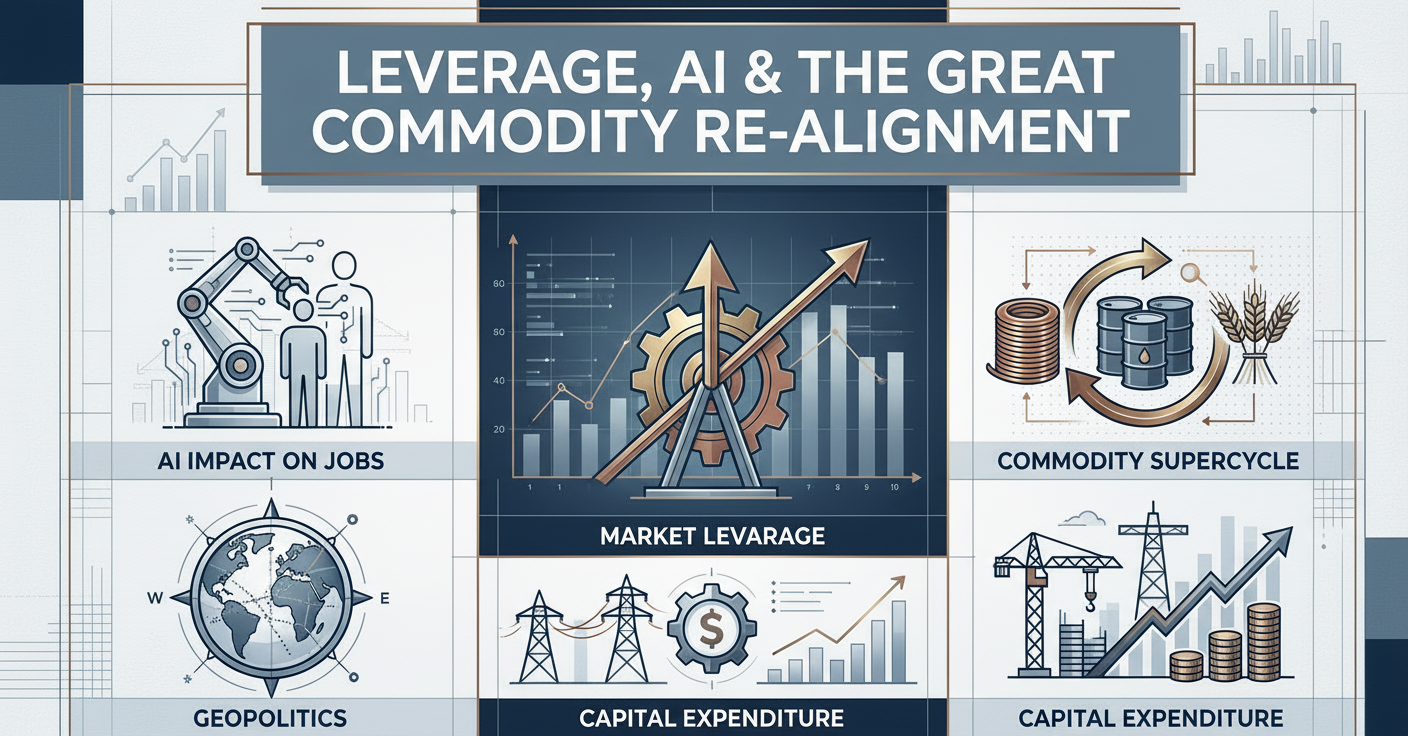
The Market's "Indestructible" Narrative Meets a Hardening Reality
This week, the market continued to act "indestructible" despite a flurry of "black swan" events, yet beneath the surface, cracks in the soft landing narrative are appearing. Record margin debt, a new Fed Chair nominee poised for lower rates, and a commodity supercycle entering a global capex boom point to a far more complex capital landscape.
The Intake
Midweek macro. The patterns, levels, and positioning calls that the market is talking about.
This week's signal:
📊 9 episodes across 8 podcasts
⏱️ 442 minutes of market intelligence
🎙️ On the record: Jeff Currie, Joe Weisenthal, Tracy Alloway, Michael Batnick, Tom Lee, Matthew Bartolini
📈 20 non-consensus calls surfaced
The Big Shift
The Commodity Supercycle is Here to Stay, Driven by Geopolitics and Policy, Not Just Green Energy
While headlines often link the commodity surge to green initiatives, this week's signal is much deeper: a policy-driven, global capital expenditure boom, amplified by geopolitical realignment, is creating a commodity supercycle with years to run. Jeff Currie (Partner, Carlyle) argues this isn't just about decarbonization, but also deglobalization and the "war on income inequality," which disproportionately increases demand for physical goods. Countries are "hoarding" critical minerals due to availability concerns, and emerging market central banks are diversifying away from Western bonds, driving demand for gold and other metals. This isn't just a cyclical bounce; it's a structural shift.
Why it matters: Your capital allocation models built on a low-inflation, asset-light economy are likely outdated. Businesses should assess input costs for raw materials and energy, and consider the inflationary pressures driven by physical goods rather than services. This impacts everything from CapEx planning to pricing strategies.
"When we talk about a commodity super cycle, the S word, which by the way is nothing other than a commodity capex cycle or a big global capex cycle and we're seeing that... This is a world scale capex boom we're now entering." — Jeff Currie, Partner at Carlyle on Odd Lots
The level: This global capex cycle is pushing asset-light hyperscalers into asset-heavy infrastructure, a collision that will make this supercycle "more violent and sustainable than previous ones."
The Rundown
① Record Margin Debt Fueling Market Resilience. The stock market has absorbed multiple "black swan" events since late 2019, seemingly "indestructible," yet this resilience is increasingly (and precariously) fueled by record-high margin debt, now at $1.2 trillion. The year-over-year change in margin debt is nearing a historically dangerous 38% threshold. (Tom Lee on The Compound and Friends)
• Why it matters: While the market appears robust, this leverage suggests gains are increasingly vulnerable. Companies planning a liquidity event or refinancing should monitor this metric as a leading indicator for market fragility and potential sudden pullbacks.
② AI's Surprising Impact on Human Capital. Contrary to the common narrative of AI displacing jobs, Palantir's CEO Alex Karp highlighted that their AI applications are actively creating more manufacturing jobs through upskilling. (Alex Karp, CEO of Palantir Technology on CNBC's "Fast Money")
• The signal: AI is less about raw job destruction and more about job transformation. Businesses should be thinking about AI as a tool for upskilling and improving human efficiency, not just replacement, potentially unlocking new productivity gains.
③ The 'Dark GPU' Problem: AI Compute Outpacing Energy Infrastructure. Despite the frantic pace of AI development, the energy infrastructure globally is struggling to keep up. GPUs are being manufactured faster than the power grids can supply energy, leading to "dark GPUs" (unpowered compute).
"The energy thing is super critical because there is that direct correlation between energy in and intelligence out. And the companies that are most equipped to leverage this to get to multiple gigawatts to terawatts of AI compute and training, they're going to be the ones that win." — Bankless on Bankless
• The level: Wattage, not just capital, is becoming the ultimate bottleneck and currency in the AI race. Companies reliant on massive compute should assess regional energy grid capacity and related costs.
④ The Bonus Depreciation Window Driving CapEx Surge. The significant jump in the ISM manufacturing index, particularly new orders, is largely attributed to a bonus depreciation window that opened in mid-January. (Andreas Steno on Real Vision: Finance & Investing)
• Why it matters: This explains some of the unexpected CapEx strength but signals it could be a temporary boost rather than an organic, sustained increase. Businesses should factor the sunsetting of such incentives into their investment strategies.
⑤ Fed Chair Nominee Kevin Warsh: Hawkish Past, Dovish Future? Kevin Warsh, a potential Fed Chair nominee, despite a previous hawkish stance, is expected to bring interest rates lower due to strong connections within the Trump administration. Marc Short further clarifies that Trump's primary motivation for a Fed Chair "is better for exporting and for manufacturing base if the dollar is depreciated and I think he knows the impact on equity markets when rates are lower." (Marc Short on Bloomberg Surveillance)
• The signal: The Fed's independence may be further compromised, with political pressure prioritizing lower rates regardless of economic fundamentals. This suggests a potentially more volatile monetary policy outlook that operators need to factor into their long-term capital planning.
The Heat Map
🔥 HEATING UP
• Commodity Capex Supercycle: Global policy and geopolitics are driving a massive, long-term capex boom in physical goods. (Jeff Currie on Odd Lots)
• AI in Manufacturing: AI is unexpectedly creating, not just displacing, manufacturing jobs through upskilling. (Alex Karp on CNBC's "Fast Money")
• Energy Grid Limitations: Power supply is now a critical bottleneck for AI compute and data center expansion. (Bankless on Bankless)
👀 ON WATCH
• 🆕 Quantum Vulnerability in Bitcoin: Aproximately one-third of Bitcoin wallets are not quantum resistant or upgradable, posing a future risk. (Tom Lee on The Compound and Friends)
• Dividend vs. Buyback Valuation: Dividend yield is becoming a less useful valuation metric as buybacks dominate capital return strategies. (Matthew Bartolini on Animal Spirits Podcast)
🧊 COOLING OFF
• Tech Co-movements: The historical correlation between big tech stocks, once highly synchronized, is breaking down dramatically. (Tom Lee on The Compound and Friends)
• Software Market Sentiment: Sentiment in the software sector is "extraordinarily terrible," with 38% of companies oversold. (Dan Ives on CNBC's "Fast Money")
The Debate
Is the current market 'indestructible,' or are we setting up for a significant correction?
🐂 The bull case:
"I kind of think we just threw six black swans at it and it's still the same. Do you think the stock market is indestructible? I know not forever, but is that how you feel? It is acting more indestructible than many people appreciate." — Tom Lee, Co-founder, CIO, Head of Research at Fundstrat Global Advisors
🐻 The bear case:
"If you look at the year over year change, it's actually positive for stocks until the percentage gain exceeds 38%. The percentage gain of the margin debt itself. Yeah, we're there. Actually it's at 36 right now. So it's almost there because what it means is most of the gain is now being fueled by the consumption of leverage to drive the gains. So in that top deciles in the last 30 years, the forward returns go from 70% positivity to 40%." — Tom Lee, Managing Partner at Fundstrat Global Advisors
Our read: While market resilience has been impressive, the underlying drivers are shifting from fundamental strength to leverage. Operators should recognize this increasing fragility and avoid aggressive financing or CapEx plans based on current market highs, particularly if their businesses are sensitive to equity market sentiment. This leverage can unwind quickly.
The Bottom Line
The market narrative of "indestructible" growth is clashing with record margin debt and unprecedented CapEx shifts, meaning businesses should de-risk balance sheets and prepare for increased volatility.
🎯 Your Move
- Stress-test your balance sheet for a 20-30% market drawdown: With record margin debt approaching historic warning levels, prepare for a rapid unwinding of market gains, impacting fundraising and exit valuations.
- Audit your supply chain for commodity and energy exposure: The sustained commodity supercycle, driven by policy shifts, will likely mean higher and more volatile input costs for physical goods and energy.
- Re-evaluate your AI investment strategy beyond job displacement: Consider AI's potential for upskilling and creating new jobs within your workforce, focusing on productivity gains over pure cost cutting.
📚 APPENDIX: EPISODE COVERAGE
1. What Tom Lee's Worried About in 2026
Guests: Michael Batnick (Co-host, Ritholtz Wealth Management), Downtown Josh Brown (Co-host, Ritholtz Wealth Management), Tom Lee (Co-founder, CIO, Head of Research, Fundstrat Global Advisors) Runtime: 77 min | Vibe: Data-driven deep dive into market resilience and hidden risks
Key Signals:
- Market Resilience vs. Margin Debt: The stock market has been "indestructible" through multiple 'black swans' but is now propped up by record margin debt, nearing thresholds that historically precede lower forward returns.
- AI's Impact on Software: AI is actively a headwind for the software sector, erasing market cap for some players, rather than acting as a universal tailwind as widely perceived.
- Quantum Vulnerability in Bitcoin: A significant portion (one-third) of Bitcoin wallets are quantum vulnerable and not upgradable, posing a long-term security risk if quantum computing advances.
"A drawdown of 30% intraday is unheard of. It compares to the Hunt Brothers silver crash in 1980. This is absolutely bizarre." — Andreas Steno, Co-host at Steno Research
2. Oil, Metals, and More Geopolitical Risk | Macro Mondays: Feb. 2, 2026
Guests: Mikkel Rosenvold (Host, Steno Research), Andreas Steno (Co-host, Steno Research), Real Vision Podcast Network (Host, Real Vision) Runtime: 33 min | Vibe: Geopolitical and commodity-focused macro update
Key Signals:
- CapEx Boost from Bonus Depreciation: A significant jump in the ISM manufacturing index, especially new orders, is largely due to a bonus depreciation window, suggesting a temporary CapEx impulse.
- Unprecedented Silver Volatility: The silver market experienced an almost unprecedented 27% single-day drawdown, comparable to the 1980 Hunt Brothers crash, highlighting extreme volatility in metals.
- Politicized Fed Chair Nominee: Kevin Walsh, a potential Fed Chair, is expected to drive interest rates lower due to strong political ties, prioritizing a depreciated dollar and lower rates over traditional monetary policy.
"The ISM manufacturing index came in at 52.6, new orders came in at 57.1, which is almost up 10 index points since a month ago. The very obvious trigger is this bonus depreciation window which opened up, I think it was on the 19th of January." — Andreas Steno, Co-host at Steno Research
3. The Latest AI Investments From Tech Giants… And A Bull Case Still In Place
Guests: Melissa Lee (Host, CNBC), Tim Seymour (On-Air Contributor, CNBC), Dan Nathan (On-Air Contributor, CNBC), Guy Adami (On-Air Contributor, CNBC), Mike Koh (On-Air Contributor, CNBC), Stephanie Huang (Host of 'Where the Internet Lives' podcast, Google and Latitude Studios), Eamon Javors (White House Correspondent, CNBC), Dan Ives (Managing Director, Senior Equity Analyst, Wedbush), Mackenzie Segalos (Correspondent, CNBC), Morgan Brennan (Reporter, CNBC), Alex Karp (CEO, Palantir), Julian Emanuel (Senior Managing Director, Evercore ISI), Mike B. (Panelist, Fast Money), Tim B. (Panelist, Fast Money), Christina Parks Neville (Reporter, CNBC) Runtime: 43 min | Vibe: Fast-paced discussion on AI investments and tech sector outlook
Key Signals:
- Palantir's AI as Job Creator: Palantir's CEO argues AI applications are creating manufacturing jobs through upskilling, challenging the narrative of AI solely displacing labor.
- Tech Bull Market's Overhang: Oracle's $50B AI funding plan is important for broader tech confidence, but concerns about Nvidia's commitment to OpenAI and overall sector sentiment create an overhang.
- Software Sentiment "Terrible": Despite innovation, the software sector is experiencing "extraordinarily terrible" sentiment with 38% of companies trading oversold on a 14-day RSI.
"I actually think it's important, not just for Oracle, but for the tech trade show the 45, 50 billion that you're going to raise." — Dan Ives, Managing Director, Senior Equity Analyst at Wedbush
4. Talk Your Book: Investing in a Concentrated Stock Market
Guests: Michael Batnick (Host, Ritholtz Wealth Management), Ben Carlson (Host, Ritholtz Wealth Management), Matthew Bartolini (Managing Director, Head of SPDR Americas Research, State Street Global Advisors) Runtime: 32 min | Vibe: Conversation on market concentration and valuation metrics
Key Signals:
- Small Cap Outperformance as Bullish Signal: Small caps have outperformed large caps by 13% since late July, suggesting broader market participation beyond "Mag 7" and a bullish signal for the economy.
- Dividend Yield Losing Value as Metric: Dividend yield is becoming less relevant for valuation as many large companies prioritize share buybacks over dividends.
- Tech Firms as "Industrials": Tech giants are making massive capital outlays for AI infrastructure, effectively transforming them into industrials and increasing utility sector investment.
"Small caps have outperformed large caps by 13% since the end of July. So you started to see that breakout. So I'd say that's bullish for the broader economy where you're not just having seven, six stocks driving all of the market action." — Matthew Bartolini, Managing Director, Head of SPDR Americas Research at State State Global Advisors
5. Bloomberg Surveillance TV: February 2nd, 2026
Guests: Marc Short (Former Chief of Staff to Former US Vice President Mike Pence), Andrew Hollenhorst (Chief US Economist, Citigroup Global Markets), Henrietta Treyz (Co-Founder, Veda Partners), Bloomberg Surveillance TV (Host, Bloomberg) Runtime: 25 min | Vibe: Discussion on political influence on Fed policy and labor market dynamics
Key Signals:
- Presidential Pressure on Fed Rates: President Trump's priority for a Fed Chair is ensuring lower interest rates for export and manufacturing benefits, overriding traditional monetary policy.
- Lagging Labor Market Data: Despite economic growth, the labor market remains sluggish, potentially due to AI-related investments that are not generating many new jobs.
- Optics-Driven Fed Policy: Some Fed officials may prioritize appearing tough on inflation by reacting to current rates, rather than acting on forecasts indicating future disinflation.
"I think most people assume the investigation, Jerome Powell, is less on the merits and more an effort to pressure the Fed to lower rates." — Marc Short, Former Chief of Staff to Former US Vice President Mike Pence
6. Jeff Currie on the Crazy Surge in Metals, And Why The Supercycle Has Years to Run
Guests: Jeff Currie (Partner, Carlyle), Joe Weisenthal (Host, Bloomberg), Tracy Alloway (Host, Bloomberg) Runtime: 40 min | Vibe: In-depth analysis of the commodity supercycle drivers.
Key Signals:
- Policy-Driven Commodity Supercycle: The current commodity supercycle is driven by "war on free trade," decarbonization, and efforts to address income inequality, leading to a long-lasting global capex boom.
- Hoarding and Dedollarization Driving Demand: Critical mineral availability concerns and emerging market central banks diversifying from Western bonds are driving significant hoarding demand across all metals.
- Asset-Light to Asset-Heavy Collision: Hyperscalers (asset-light) moving into physical infrastructure (asset-heavy) will make this commodity supercycle more "violent and sustainable."
"What's going on in the metal space is hoarding, given the concerns over having availability of these critical minerals. And you threw out the idea of debasement. And I want to throw in three other Ds de dollarization and diversity to your debasement." — Jeff Currie, Partner at Carlyle
7. Capitalism’s Endgame: The Last Companies That Will Ever Exist
Guests: Bankless (Host, Bankless), Josh Kale (Co-host, Limitless) Runtime: 90 min | Vibe: Speculative discussion on the future of capitalism and AI monopolies
Key Signals:
- "Infinity Gauntlet of Capitalism": A framework suggesting a future where a few entrenched companies monopolize intelligence, energy, capital, and labor, fundamentally altering the capitalist landscape.
- Energy as AI Bottleneck: The current energy grid cannot keep up with GPU manufacturing, leading to "dark GPUs" and making wattage, not just capital, a critical input for AI.
- Space-Based AI Data Centers: The concept of AI data centers in space, leveraging vacuum cooling and perpetual solar, could make terrestrial data centers economically unviable for large-scale AI training.
"If you capture all four, then the number gets reduced down to three because you won't need capital anymore because it will be so abundant." — Bankless
8. Where Do We Go From Here? | Michael Nadeau
Guests: Ryan (Host, Bankless), Michael Nadeau (Founder, The DeFi Report) Runtime: 60 min | Vibe: Deep dive into crypto market cycles and investment strategy
Key Signals:
- Political Impact on Crypto Liquidity: Kevin Warsh's potential Fed Chair policies, focused on balance sheet reduction and avoiding yield curve control, could lead to tighter liquidity detrimental for crypto.
- Bitcoin's Macro Low Not Yet Here: Despite recent drops, key bottom signals like capitulation and apathy are not yet present, suggesting a macro low for Bitcoin is still to come.
- Crypto Rails for Traditional Finance: The long-term bullish thesis for crypto includes the entire financial system eventually migrating onto "crypto rails," highlighting market disillusionment as an opportunity.
"I'm not ready to say we're hitting a macro low for, for the cycle just yet. When, when we do go there, you know, I expect that it will take some time, right?" — Michael Nadeau, Founder at The DeFi Report
9. Can Elon Musk Form a Super-Company?
Guests: Travis Hoium (Host, Motley Fool), Lou Whiteman (Guest, Motley Fool), Emily Flippen (Guest, Motley Fool) Runtime: 42 min | Vibe: Discussion on tech giants, AI capex, and investment opportunities
Key Signals:
- Musk's Super-Company Strategy: Elon Musk's possible merger of SpaceX and xAI is seen as a strategy to attract equity markets with a combined offering, and a way to channel funds for capital-intensive projects.
- AI Drives Operating Margin Improvement: C.H. Robinson used AI to automate freight brokerage, improving operating margin by 490 basis points year-over-year despite revenue decline.
- Big Tech's AI Capex vs. Market Reaction: Meta is spending more on CapEx than it lost in Reality Labs, yet Microsoft's recent gains suggest a contrasting investor reaction to AI-related capital expenditures across big tech.
"If there are two publicly traded stocks that are both, you can invest in Elon. One of them is a car and energy company and one is a space and AI company. You can see the imagination pulling away from Tesla or at the very least in, you know, all the stock price is, is the number of buyers and the number of sellers." — Lou Whiteman, Guest at Motley Fool