
The SaaS market isn't dead—it's just got a new price model, and the cost of AI is not what you think.
The Intake
Where capital is flowing. What's getting funded. Insight from operators in the trenches.
This week's pattern recognition:
- 📊 11 episodes across 7 podcasts
- ⏱️ 753 minutes with GPs, founders, and LPs
- 🎙️ The voices: Harry Stebbings (Host, 20VC), Mike Cannon Brooks (Co-founder, Atlassian), Anish Acharya (General Partner, a16z), Sebastian Siemiatkowski (Co-founder and CEO, Klarna)
The Big Shift
The Cost of AI? It's Decreasing, Not Soaring.
Contrary to popular belief, the narrative of soaring AI inference costs is being challenged. Atlassian's Co-founder Mike Cannon Brooks revealed that some of their AI features have seen a thousand-fold decrease in inference costs (The Twenty Minute VC). This efficiency gain is disrupting traditional SaaS cost structures and making AI deployment more economically viable for incumbents.
Why it matters: This signal suggests that the economic models for AI-driven products are still in flux, favoring those who can deeply optimize inference. It also lowers the barrier for new entrants, intensifying competition for less differentiated SaaS products.
"Our inference costs are going down and we're very good at adopting new models... Some of our features are a thousand times cheaper to run than when we introduce them today."
— Mike Cannon Brooks, Co-founder and Co-CEO of Atlassian on The Twenty Minute VC (20VC)
The move: Review your portfolio companies' AI strategy—are they optimizing for cost reduction, or are they still assuming high, fixed inference costs that might erode future margins?
The Rundown
- AI is the new 'Sales & Marketing' for top SaaS. Inference costs are becoming the new Customer Acquisition Cost (CAC), allowing elite companies to use AI-driven productivity to acquire and serve customers more effectively. This redefines traditional gross margins. (The a16z Show)
- Why it matters: Founders should re-evaluate their GTM and sales team structures, understanding that AI agents will reshape how customers interact with and adopt products.
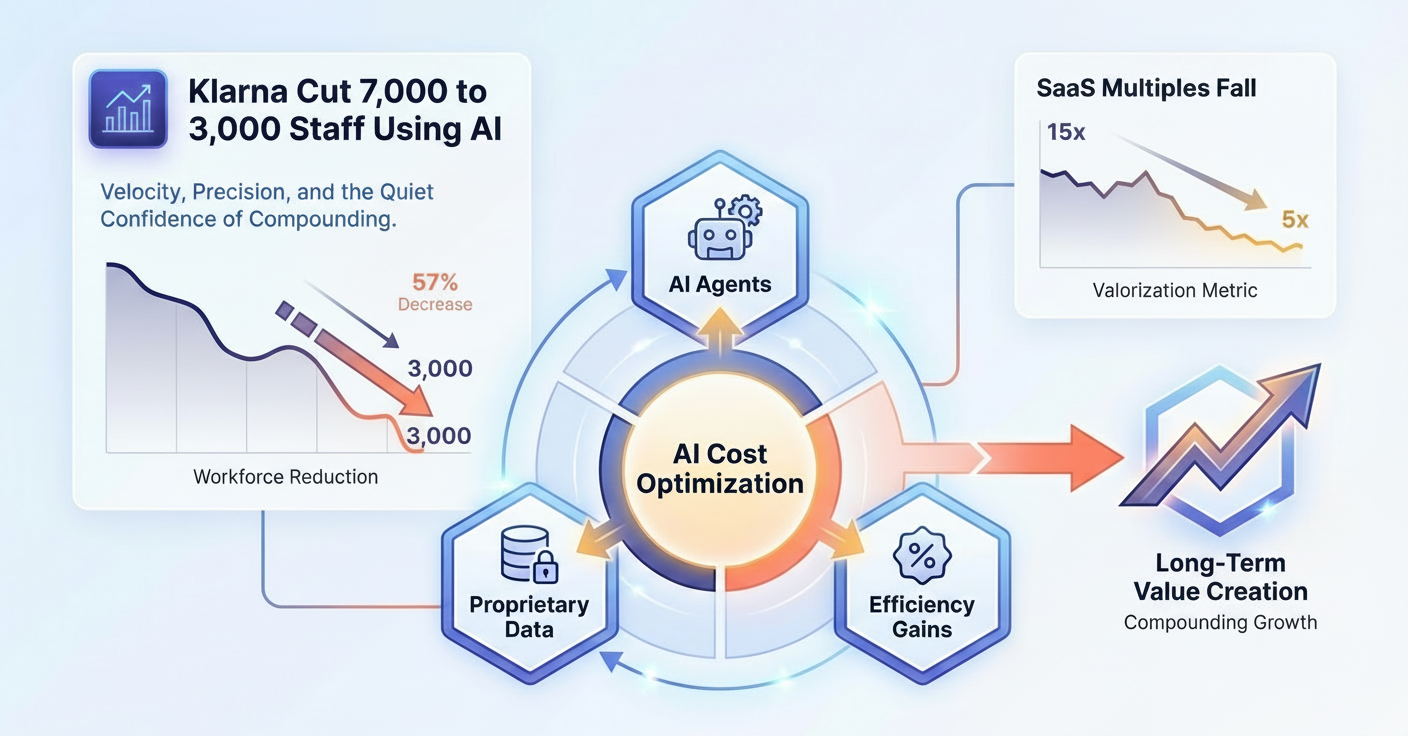
- SaaS is not dead, but its multiples are in question. While the 'death of SaaS' narrative is oversold, the cost of software creation is decreasing. This could drive valuation multiples for undifferentiated SaaS products from 20-30x down to 1-2x, akin to utility companies. (The Twenty Minute VC)
- The signal: Investors should re-underwrite SaaS valuations based on true defensibility beyond just 'being software,' focusing on proprietary live data and application-layer value.
- What to watch: Look for founders leveraging AI for extreme capital efficiency, retaining more equity, and potentially skipping traditional funding rounds.
- AI-driven efficiency leads to massive headcount reduction. Klarna reduced its workforce from 7,000 to under 3,000 using AI, predominantly through natural attrition due to efficiency gains. This showcases a significant and immediate shift in operational models. (The Twenty Minute VC)
- Why it matters: This is a strong signal for LPs and GPs valuing operational efficiency over brute-force scaling, and for founders planning their growth trajectories.
- AI is making engineers into "sorcerers" and widening the productivity gap. Engineers using AI tools like Codex open 70% more PRs and are significantly more productive, acting as "tech leads" managing fleets of AI agents. The gap between AI-fluent and non-AI-fluent engineers is widening rapidly. (Lenny's Podcast)
- The signal: The talent market for engineers is bifurcation. Investors should assess technical teams not just on raw talent, but on their ability to leverage AI as a force multiplier.
The rise of the "one-person billion-dollar startup" is real. AI agents like Eywa (Open Claw agent) and Codex are drastically reducing startup costs and democratizing app development, enabling small teams to achieve disproportionate output and even bootstrap longer. (This Week in Startups, Lenny's Podcast)
"If it's easy for a person to create a one person billion dollar startup, it also means it's way easier for people to just create startups in general."
— Sherwin Wu, Head of Product at OpenAI on Lenny's Podcast
Capital Signals
🔥 HOT
- AI in Business Process Automation: High demand for AI solutions that automate email, bug fixing, and internal operations. (Presh Dineshkumar on This Week in Startups)
- Proprietary Live Data: A powerful moat for sustaining SaaS value in the AI era. (Anish Acharya on The a16z Show)
👀 EMERGING
- Open Claw: An open-source agentic platform that reduces startup costs and democratizes app development. (Jason Calacanis on This Week in Startups)
- 🆕 Epstein files revelations about Silicon Valley dealmaking: Shedding light on opaque funding sources and unsavory connections from a decade ago, indicating a need for greater transparency. (Sean O'Kane on Equity)
- AI in Customer Support: Significant workforce reductions driving demand for AI-powered agentic solutions. (Mike Cannon Brooks on The Twenty Minute VC)
🧊 COOLING
- Big Company Hires in Startups: High attrition rates due to impedance mismatch, making them suboptimal for scaling. (Brian Halligan on Lenny's Podcast)
- Undifferentiated SaaS Valuations: Risk of multiples falling to utility-level (1-2x) due to decreasing software creation costs. (Sebastian Siemiatkowski on The Twenty Minute VC)
⚠️ CROWDED
- Humanoid Robotics: Experiencing a strong hype cycle with massive funding but questionable practical applications in manufacturing. (Sean O'Kane on Equity)
- Front-End AI Application Layer: High competition, making it harder to sustain long-term value against foundation models. (Anish Acharya on The a16z Show)
The Debate
Is the AI market currently in a bubble, or is demand fundamentally outstripping supply?
🐂 The bull case:
"I think there's no bubble in AI because demand for inference capacity consistently outstrips supply... new capacity is being 100% spoken for upon release, and customer prices for AI services are rising, not compressing."
— Anish Acharya, General Partner at a16z on The a16z Show
🐻 The bear case:
"The current hype cycle for AI is reminiscent of past tech booms, with massive investments and speculative funding (Apptronic's $935M round) despite unresolved practical applications, leading to potential burnout."
— Sean O'Kane, Senior Reporter and Host at TechCrunch on Equity
Our read: The market remains bifurcated. While foundational model capacity is genuinely constrained and highly valued, applications built on top of that infrastructure, especially those without proprietary data or deep defensibility, may face a reckoning as competition stiffens and the 'cost of software creation' falls. Investors should differentiate between enabling infrastructure and commoditized application layers.
The Bottom Line
The true disruption of AI is not in replacing SaaS, but in redefining its cost structures and demanding a new level of operational efficiency and defensibility around proprietary data.
🎯 Your Move
- Audit AI utilization internally: Determine if your engineering and operational teams are leveraging AI to reduce costs and increase productivity. The gap between AI-fluent and non-AI-fluent talent is widening significantly.
- Re-evaluate SaaS valuation models: For portfolio companies or future investments, rigorously assess defensibility beyond just "being SaaS." Focus on proprietary live data moats and the ability to optimize inference costs as key value drivers, adjusting multiples accordingly.
- Pressure-test your GTM strategy against AI agents: Consider how AI-driven tools will change customer acquisition and service. Founders should explore integrating AI for sales, marketing, and support to achieve 10x productivity gains that redefine traditional CAC.
What We Listened To
1. My First Million: "This AI agent completes your To-Do list (plus 4 AI tools that’ll blow you away)"
Guests: Sam Parr (Host, My First Million), Shaan Puri (Host, My First Million), Garrett (Founder, Pipe Dream / Do Anything)
Runtime: 57 min
Vibe: Enthusiastic deep dive into immediate AI productivity hacks
Key Signals:
- Autonomous AI Agents: AI agents like "Do Anything" are automating mundane tasks, from YouTube analysis to content planning, significantly boosting individual productivity.
- Mass Personalization: AI is enabling bespoke solutions for everyday problems, from personalized clothing recommendations based on body measurements to AI-generated music.
- "Founder Therapy" via AI: AI tools can analyze historical biographies to extract lessons and apply them to personal challenges, offering a unique form of self-improvement.
"Typing is a pretty slow thing to do. It actually requires a lot of energy and you don't, you don't really realize it until you're able to just like stop doing it."
— Shaan Puri, Host of My First Million
2. The Twenty Minute VC (20VC): Venture Capital | Startup Funding | The Pitch: "20VC: Anthropic's Superbowl Ad: Who Won - Who Lost | Harvey Raises $200M at $11BN Valuation | Sierra Hits $150M in ARR: Is Customer Support Too Crowded"
Guests: Harry Stebbings (Host, The Twenty Minute VC (20VC)), Mike Cannon Brooks (Co-founder, Atlassian), Rory (Guest Analyst), Jason (Guest Analyst), Mike (Head of Engineering, Atlassian), Mike Cannon-Brookes (Co-Founder and Co-CEO, Atlassian)
Runtime: 82 min
Vibe: Incisive analysis of AI's competitive impact on software and venture
Key Signals:
- AI Inference Cost Optimization: Atlassian's experience shows AI inference costs can decrease a thousandfold, challenging the narrative of high AI operational expenses and enabling significant cost savings.
- Public Market Dynamics: The lack of new, high-growth software IPOs is due to aggressive private equity and big tech acquisitions, leading to a survivor bias in public markets.
- Customer Support Decimation: AI is rapidly reallocating capital in customer support, leading to dramatic reductions in hiring for traditional roles.
"Our inference costs are going down and we're very good at adopting new models... Some of our features are a thousand times cheaper to run than when we introduce them today."
— Mike Cannon Brooks, Co-founder and Co-CEO of Atlassian
3. The a16z Show: "Balaji and Dan Wang: The Engineering State vs Lawyerly State"
Guests: Balaji Srinivasan (Host, The a16z Show), Dan Wang (Author, Breakneck)
Runtime: 64 min
Vibe: Provocative geopolitical and economic futurism
Key Signals:
- "Fake Economy" Thesis: Balaji Srinivasan argues the US economy is artificially sustained by financial engineering rather than industrial production, contrasting with China's manufacturing prowess.
- China's Digital Sovereignty: China's "Great Firewall" and avoidance of the "Plaza Accords" are seen as long-sighted decisions to preserve digital and economic sovereignty.
- Asymmetric Geopolitical Struggle: The 21st-century contest is framed as vertically integrated "China" versus the decentralized "Internet," implying Bitcoin could be an alternative to state control.
"In my view the US is actually a fake economy. A Keynesian economy."
— Balaji Srinivasan, Host of The a16z Show
4. Lenny's Podcast: Product | Career | Growth: "Sequoia CEO coach: Why it’s never been easier to start a company, and never been harder to scale one | Brian Halligan (co-founder, HubSpot)"
Guests: Brian Halligan (CEO Coach, Sequoia Capital), Lenny Rachitsky (Host, Lenny's Podcast), Lenny (Host)
Runtime: 75 min
Vibe: Actionable advice for scaling and GTM strategies
Key Signals:
- Scaling is Harder Than Starting: While starting a company is easier with modern tools, scaling a "durable, high-impact organization" is significantly more challenging due to market competition and distribution needs.
- Spiky Hires vs. Big Company Hires: Hiring "spiky" candidates with specific strengths, even with some weaknesses, yields better results than talent from large corporations, which often have high attrition rates in startups.
- AI-Driven Go-To-Market: Brian Halligan predicts a shift to AI-powered avatars for initial customer interaction, transforming the top of the sales funnel.
"Starting a company has never been easier. Scaling one into a durable, high impact organization has never been harder."
— Brian Halligan, CEO Coach at Sequoia Capital
5. The Twenty Minute VC (20VC): Venture Capital | Startup Funding | The Pitch: "20VC: SaaS is Dead: Why Systems of Record Will Die in an Agentic World | What Revenue Multiple Will Software Companies Trade At? | From 7,000 to 3,000: We Need Less People Than Ever with Sebastian Siemiatkowski"
Guests: Sebastian Siemiatkowski (Co-founder and CEO, Klarna), Harry Stebbings (Host, The Twenty Minute VC (20VC))
Runtime: 88 min
Vibe: Candid, future-forward discussion on AI's impact on business models and staffing
Key Signals:
- AI-Driven Headcount Reduction: Klarna reduced its workforce from 7,000 to under 3,000 mainly through AI-driven efficiency, demonstrating AI's immediate impact on staffing.
- SaaS Valuation Multiples at Risk: Sebastian Siemiatkowski suggests that undifferentiated SaaS companies could see their valuation multiples drop to 1-2x, similar to utility companies, as AI reduces software creation costs.
- Agentic Data Migration: AI agents will dramatically lower data switching costs, empowering customers and reducing vendor lock-in for SaaS.
"If the cost of software creation is going down, how do we determine which businesses have sustaining value versus which do not? So the key thing right now is so far the only thing that's gone down to or not to zero yet, but become extremely much cheaper is the generation of software."
— Sebastian Siemiatkowski, Co-founder and CEO of Klarna
6. Pivot: "Google Nest's Surveillance Secret, Bondi's Epstein Meltdown, Meta & YouTube in Court"
Guests: Kara Swisher (Host, New York Magazine), Scott Galloway (Professor of Marketing, New York University Stern School of Business)
Runtime: 66 min
Vibe: Sharp, opinionated commentary on tech, media, and politics
Key Signals:
- The "Unsubscribing" Economic Impact: The economic fallout of users abandoning tech platforms is significant (e.g., T-Mobile, OpenAI's potential market cap hit), highlighting consumer sensitivity to perceived missteps.
- Google Nest Surveillance: Despite user deletion requests, Google Nest uploads and retains footage on Google Cloud, raising alarm about data retention and user control.
- AI Talent "Musical Chairs": The AI industry is experiencing rapid talent shifts and ethical conflicts (e.g., OpenAI executive firing over erotica features), driven by financial incentives and safety concerns.
"It's usually not the infraction itself. It's the cover-up."
— Scott Galloway
7. Lenny's Podcast: Product | Career | Growth: "“Engineers are becoming sorcerers” | The future of software development with OpenAI’s Sherwin Wu"
Guests: Sherwin Wu (Head of Engineering for API and Developer Platform, OpenAI), Lenny Rachitsky (Host), Lenny (Host, Lenny's Podcast)
Runtime: 80 min
Vibe: Optimistic but pragmatic look at AI's engineering revolution
Key Signals:
- Engineers as "Sorcerers": AI is transforming software engineering, with OpenAI engineers using Codex to review 100% of code and opening 70% more PRs, widening the productivity gap for those not adopting AI.
- AI Models Eat Scaffolding: The rapid advancement of AI models means much of the technical "scaffolding" built around them quickly becomes obsolete, challenging traditional customer feedback loops.
- One-Person Billion-Dollar Startups: The ease of software creation through AI suggests a boom in specialized B2B SaaS companies and the potential for founders to achieve outsized value with minimal teams.
"95% of engineers use Codex. 100% of our PRs are reviewed by Codex daily as well. So basically any code that goes into production that's merged in Codex has its eyes on and suggests improvements, suggests changes in the PRs."
— Sherwin Wu, Head of Engineering for API and Developer Platform at OpenAI
8. Equity: "AI burnout, billion-dollar bets, and Silicon Valley's Epstein problem"
Guests: Kirsten Korosec (Transportation Editor and Host, TechCrunch), Anthony Ha (Weekend Editor and Host, TechCrunch), Sean O'Kane (Senior Reporter and Host, TechCrunch)
Runtime: 39 min
Vibe: Critical and investigative tech journalism
Key Signals:
- Speculative Deep Tech Funding: Massive funding rounds for humanoid robotics and fusion energy (e.g., Apptronic's $935M) indicate investor hunger for "physical AI," despite unproven practical applications.
- Epstein Files in Silicon Valley: Renewed scrutiny on figures who maintained financially connected ties to Jeffrey Epstein, highlighting historical opaque deal-making in the Valley's early EV days.
- Musk's "True Believer" Talent Strategy: Elon Musk's companies foster a culture of intense commitment, leading to high turnover but also attracting self-selecting "true believers" for ambitious projects.
"My big question there though is I don't think we've seen a really convincing, I guess, application of humanoids in an automotive manufacturing facility of kind of any kind."
— Sean O'Kane, Senior Reporter and Host at TechCrunch
9. This Week in Startups: "How These 3 Founders are building on Open Claw | E2248"
Guests: Presh Dineshkumar (Co-founder & CEO, The Wellness Company), Sean Liu (Engineer, Meta), Vishnu (Founder, Agent37.com), Jason Calacanis (Host, Launch), Presh (Guest, Unknown), Sean (Entrepreneur and Founder, Unknown)
Runtime: 45 min
Vibe: Practical, founder-focused exploration of agentic AI capabilities
Key Signals:
- Democratizing App Development with AI Agents: 🆕Open Claw and similar agentic AI tools drastically reduce startup costs and development timelines, enabling small teams to build and test multiple products simultaneously.
- Visual AI Integration with Smart Glasses: Connecting AI to hardware like Meta Ray-Bans allows for real-time visual understanding and delegation of tasks, revolutionizing field operations and retail management.
- Bootstrapping and Equity Retention: AI enables founders to bootstrap longer and potentially forgo traditional funding rounds, retaining more equity by achieving significant milestones with fewer resources.
"LLMs have gotten really smart. But they have been powerless. They've been sandboxed, they've been kept essentially in a corner... Now you let the AI out of the dungeon and you say, here's the keys to the kingdom. I want to trust you to go do things. And it goes and it does things."
— Jason Calacanis, Host, Launch
10. The Twenty Minute VC (20VC): Venture Capital | Startup Funding | The Pitch: "20Sales: Inside ElevenLabs $330M ARR Sales Machine | The 20x Sales Comp Plan Reps Must Hit | How to Land and Expand in a World of AI | Why Product-Market-Fit is BS, Reps Should Not Be in the Office and Outbound is King with Carles Reina"
Guests: Carles Reina (VP of Sales, ElevenLabs), Harry Stebbings (Host, The Twenty Minute VC (20VC))
Runtime: 75 min
Vibe: Unvarnished, results-driven sales and GTM strategies
Key Signals:
- Ruthless 20x Sales Quota: 🆕ElevenLabs implements a 20x base salary quota, demonstrating an aggressive, performance-driven sales culture that filters for elite reps.
- Outbound Sales Dominance: Despite AI, outbound sales are king, with 🆕ElevenLabs aiming for a 50/50 inbound/outbound split, achieved through platforms like Lemlist and LinkedIn for direct outreach.
- Public Accountability in Sales: The "praise in public, criticize in private" adage is dismissed in favor of rigorous, public pipeline reviews to foster improvement and transparency.
"We ask everyone to bring 20 times their base salary. That's your quota, Right? So if I pay you 100k a year, your quota is $2 million. If you don't achieve your quota, then you're going to be out. Right. And we are ruthless on that end."
— Carles Reina, VP of Sales at ElevenLabs
11. The a16z Show: "Anish Acharya: Is SaaS Dead in a World of AI?"
Guests: Harry Stebbings (Host, 20VC), Anish Acharya (General Partner, a16z)
Runtime: 82 min
Vibe: Pragmatic and nuanced take on AI's impact on software investments
Key Signals:
- SaaS is Not Dead, Just Changing Price Models: The narrative of SaaS's demise is oversold; incumbents are raising prices and have strong defensibility, especially those with proprietary live data.
- Inference as the New Sales & Marketing: For the best companies, AI inference becomes a core function for customer acquisition and retention, redefining traditional GTM spend and efficiency.
- AI Market Not a Bubble: The AI market is not a bubble because demand for inference capacity consistently outstrips supply, and customer prices for AI services are rising.
"The general story that we're going to vibe code everything is flat wrong and the whole market is oversold software."
— Anish Acharya, General Partner at a16z