
What if "Stuck" Isn't a State, But a Strategy?
The Intake
Friday thinking. The frameworks, tensions, and questions worth pondering going into the weekend.
This week's exploration:
📊 9 conversations across 8 podcasts
⏱️ 669 minutes of long-form intellectual exploration
🎙️ The thinkers: Timothy Williamson, Joe Hudson, Dr. Wendy Suzuki, Rebecca Newberger Goldstein
💡 20 signals that might change how you see something
The Big Idea
The Pervasive Illusion of "Stuckness"
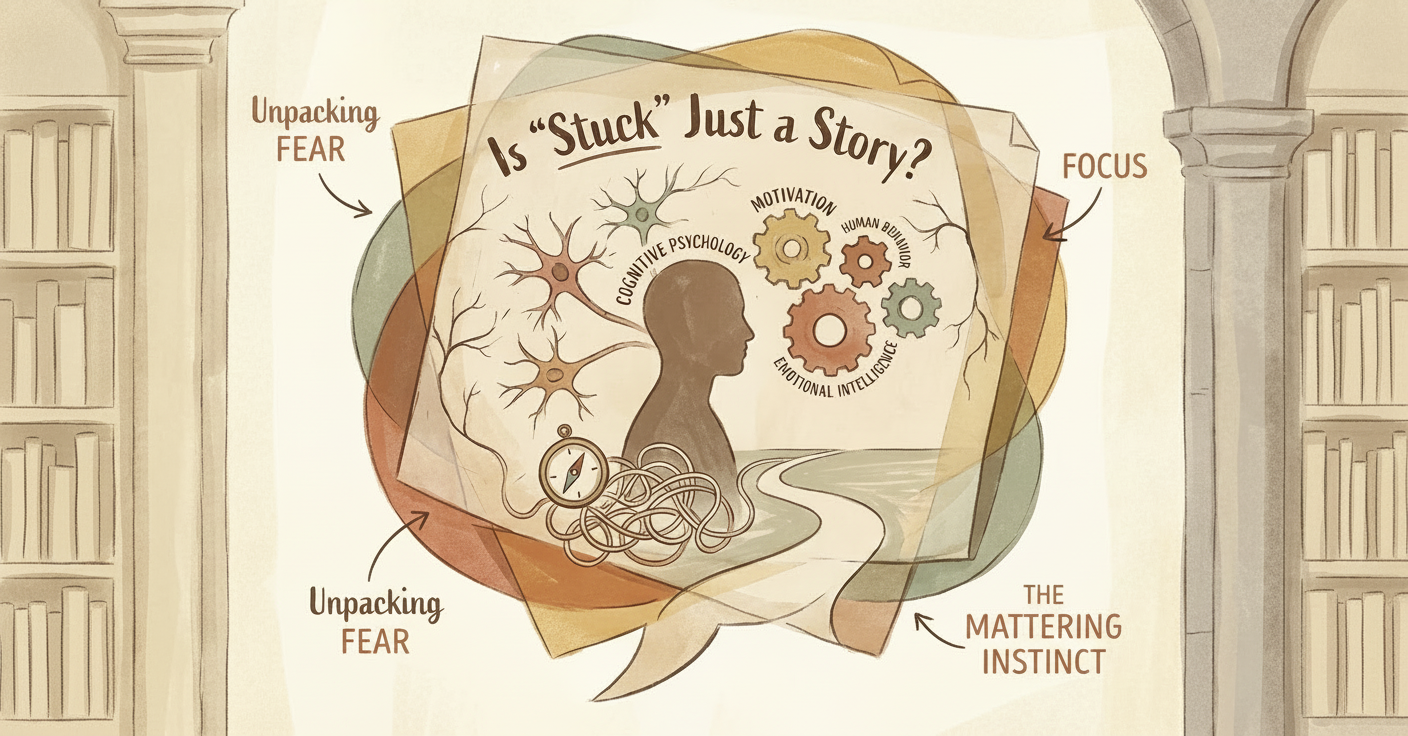
We all feel "stuck" at times, whether in our careers, creative projects, or personal lives. The conventional wisdom treats "stuckness" as a genuine failure of willpower or direction—a block that needs to be 'pushed through.' But what if this perception is fundamentally flawed? What if the feeling of being stuck isn't a fixed state, but an emotional and cognitive strategy our brains employ to avoid perceived negative consequences?
Two thinkers this week, Joe Hudson on The Art of Accomplishment and Adam Alter on Hidden Brain, converged on a radical reframe: the feeling of being stuck is often a misinterpretation of fear or a miscalibration of motivation. Hudson argues that "you feel stuck because you do not like the potential consequences of the ways that you see to get unstuck." This isn't a reality—it's an emotional response that limits our perception to binary, unappealing options. Alter, meanwhile, highlights the "goal gradient effect," where our motivation wanes dramatically in the middle of a task, making it feel like we're stuck, even if our progress is linear. Both suggest that this perceived stagnation is less about actual inability and more about our brain's internal signaling, which can be re-interpreted or circumvented.
"You feel stuck because you do not like the potential consequences of the ways that you see to get unstuck."
— Joe Hudson, Host at The Art of Accomplishment
Why it matters for leaders: Recognizing "stuckness" as a potential strategy or a cognitive illusion, rather than an intractable problem, fundamentally changes how leaders can approach challenges in their organizations. Instead of demanding more effort or pushing harder, the focus shifts to understanding the underlying fears, re-framing potential consequences, or restructuring projects to leverage inherent motivational biases. This framework suggests that the solution to being 'stuck' isn't always brute force, but often a more nuanced understanding of human psychology, leading to more effective interventions for teams and individuals.
The tension: While acknowledging the psychological roots of "stuckness" is powerful, it risks downplaying genuine systemic or external barriers. The question remains as to where psychological reframing ends and real-world structural challenges begin.
Ideas in Brief
① The "Mattering Instinct" Drives Human Action More Than Material Reward. Philosopher Rebecca Newberger Goldstein introduces the "mattering instinct," arguing that humans possess a fundamental, often overlooked, desire to matter, rooted in our biological imperative to resist entropy and justify our intense self-awareness. This longing isn't just about belonging; it's about making a verifiable impact. This instinct manifests in four core strategies: transcendent (e.g., spiritual), social (e.g., family), heroic striving (e.g., achievement), and competitive (e.g., dominance). Economists often neglect this intrinsic drive, focusing instead on financial incentives, but an unfulfilled need to matter can lead to broader societal issues like extremism or malaise. (The Mattering Instinct (with Rebecca Newberger Goldstein) on EconTalk)
- The implication: For leaders, understanding that employees, customers, and even competitors are often driven by a deep need to matter—beyond salary or superficial recognition—offers a powerful lens. Connecting work to a larger purpose, fostering genuine belonging, and creating opportunities for high-impact contributions can be far more motivating and fulfilling than transactional rewards, addressing a crisis of meaning in otherwise materially wealthy societies.
② Your Heartbreak is an Invitation to Expand Your Capacity to Love. Joe Hudson challenges the conventional aversion to heartbreak, asserting that "every time your heart breaks open, it increases your capacity to love." He reframes emotional pain, particularly in relationships, not as something to be avoided or resisted, but as a catalyst for deeper emotional expansion and healing. This perspective suggests that resisting pain, especially in states like depression, prevents true healing, while leaning into and understanding difficult emotions, often accelerated by unconditional love, leads to growth. (Joe Hudson on Modern Wisdom)
"Every time your heart breaks open, it increases your capacity to love."
— Joe Hudson, Coach, Entrepreneur, Podcast Host
- The implication: In leadership, this reframe encourages a more resilient approach to setbacks, failures, and interpersonal conflict. Instead of viewing organizational disappointments or personal challenges as definitive losses, leaders can cultivate a mindset where these experiences are seen as opportunities to build greater empathy, foster deeper connections, and genuinely expand their capacity to lead with an open heart.
③ Multidisciplinary Thinking: The Specialists Miss the Connections. Peter D. Kaufman champions multidisciplinary thinking, arguing that gaining a broad understanding across diverse fields allows one to identify crucial connections that specialists often overlook. He emphasizes a principle of 'mirrored reciprocation' as universal across nature and human interaction, and advocates for 'dogged, incremental constant progress' as the most powerful force for compounding achievements. Kaufman asserts that true leadership hinges on cultivating win-win relationships with all stakeholders and prioritizing simple, understandable principles for a fulfilling life and business. (Peter D. Kaufman on The Knowledge Project)
- The implication: CEOs and investors operate at the intersection of countless disciplines. This framework highlights the critical competitive advantage of cultivating a wide intellectual aperture. Leaders who deliberately cross-pollinate ideas from seemingly disparate fields—like biology, psychology, economics, and history—are better equipped to anticipate trends, solve complex problems, and innovate in ways that narrow specialists cannot.
④ Exercise as a Core Tool for Cognitive Enhancement. Dr. Wendy Suzuki highlights that regular exercise is not just for physical health but is a potent tool for boosting attention and memory. She explains that every time you move your body, you release neurochemicals, including Brain-Derived Neurotrophic Factor (BDNF), which promotes neurogenesis in the hippocampus—a key area for learning and memory. Even minimal activity can significantly enhance brain function, with optimal benefits derived from morning cardio sessions and cumulative effects showing improvement in mood and hippocampal memory with increased frequency, even up to seven times a week. (Dr. Wendy Suzuki on Huberman Lab)
- The implication: For executives and high performers, whose demands require peak cognitive function, integrating deliberate and frequent exercise is not merely a lifestyle choice but a strategic imperative. This suggests that "time off for exercise" isn't a luxury but an investment that directly fuels mental acuity, reduces stress, and enhances decision-making capabilities, making it a non-negotiable element of executive well-being and performance.
The Question
What truly constitutes "proof of mattering" in a world increasingly saturated with digital validation, and how do leaders create mechanisms for their teams to experience genuine mattering that is resilient to external validation cycles?
This is hard because the innate desire to matter, while fundamental, can be easily misdirected or superficially satisfied by metrics that don't reflect true impact or lasting value. We'd need to understand the difference between fleeting psychological gratification and deep, sustained fulfillment from contributing meaningfully. This question is being explored by thinkers in the realms of organizational psychology and philosophy, but often remains untranslated into actionable leadership strategies.
📚 The Bookshelf
- Poor Charlie's Almanack by Charlie Munger — Peter Kaufman, a contributor to the book, discusses its core principles, especially multidisciplinary thinking and mirrored reciprocation.
- The Mattering Instinct: A Novel by Rebecca Newberger Goldstein — This novel and essay collection explores the philosophical underpinnings of the human longing to matter; a key idea from this week's EconTalk.
- The Power of Bad: How the Negativity Effect Rules Us and How We Can Triumph Over It by John Tierney and Roy Baumeister — For further reading on why negative experiences, like fear, disproportionately impact motivation and behavior.
- The Knowledge Project: The Multidisciplinary Approach to Thinking | Peter D. Kaufman [Outliers] — A recommended listen for those looking to apply broad thinking to business and life, and to hear more from this week's featured guest.
The Bottom Line
The feeling of being "stuck" is a strategic crossroads, not a dead end. By understanding the psychology of fear, motivation, and our innate desire to matter, leaders can re-engineer their approach to problems, cultivate greater resilience, and design environments where true progress—and human flourishing—can genuinely compound.
What We Listened To
Timothy Williamson: Philosophy’s Most Formidable Living Mind
Runtime: 117 min
Featuring: Timothy Williamson (Wickham Professor of Logic, University of Oxford), Curt Jaimungal (Host, Theories of Everything)
This conversation is a masterclass in rigorous philosophical inquiry, challenging conventional wisdom on topics from vagueness to physicalism. Williamson's approach emphasizes realism and accuracy, revealing how seemingly abstract philosophical debates underpin our understanding of reality, knowledge, and even consciousness. It’s an exercise in intellectual muscle-flexing and identifying the hidden assumptions in common thought.
"I'm a realist in the sense that I tend to think that in our cognitive lives we're dealing with realities that are mostly more or less independent of our will and independent of what we think about them, and that we are capable of gaining knowledge about the world around us and not, not simply about the way it looks to us, but the way things actually are."
— Timothy Williamson, Wickham Professor of Logic at University of Oxford
Connects to: The broader theme of discerning underlying realities versus subjective appearances discussed in EconTalk. ▶ Listen
#1046 - Russ - Can Ambitious People Ever Have Balance?
Runtime: 133 min
Featuring: Russ (Rapper, Singer, Songwriter, Producer), Chris Williamson (Host, Modern Wisdom)
Russ and Chris Williamson explore the existential challenges high achievers face post-success, moving beyond external validation to an internal recalibration of ambition. They unpack the "Parental Attribution Error" and the societal pressures that shape self-perception, offering insights into how an internal landscape shifts once traditional goals are met. This episode challenges listeners to consider the true drivers of their relentless ambition.
"External accolades won't fill internal voids. Right. And the prevalence of it, the fact it's so ubiquitous and so many people. Yeah. Arrive at this and then go, oh fuck, so many of my problems are still here."
— Chris Williamson, Host of Modern Wisdom
Connects to: The "Mattering Instinct" and the search for intrinsic purpose beyond material success. ▶ Listen
Bite-Sized Teaching Series: How To Break Free From Beliefs That Keep You Small
Runtime: 9 min
Featuring: Joe Hudson (Host, The Art of Accomplishment)
Joe Hudson offers a concise but potent reframing of feeling "stuck," arguing that it's an emotional response rather than a fixed reality. By dissecting the neurology of fear and excitement, he provides a practical framework for understanding how perceived consequences limit options and how continuous iteration, rather than stagnation, fosters genuine safety and growth. This is a powerful, bite-sized intervention for anyone feeling constrained.
"You feel stuck because you do not like the potential consequences of the ways that you see to get unstuck."
— Joe Hudson, Host at The Art of Accomplishment
Connects to: Hidden Brain's discussion of "stuckness" and the psychology of overcoming obstacles. ▶ Listen
You 2.0: How to Get Out of a Rut
Runtime: 98 min
Featuring: Shankar Vedantam (Host, Hidden Brain), Adam Alter (Psychologist, New York University), George Bonanno (Professor of Clinical Psychology, Columbia University)
This episode delves into the psychology behind why people get "stuck," exploring concepts like the "goal gradient effect" and "pluralistic ignorance." It reveals how both the non-linear perception of progress and the deceptive glamour of social media contribute to feelings of stagnation. The discussion offers practical strategies for breaking down large goals, embracing failure, and leveraging cultural perspectives on change to foster continuous improvement.
"Perfectionism is paralyzing because what it basically does is it signals to you that unless you're producing perfection, you're failing."
— Adam Alter, Psychologist at New York University
Connects to: The Art of Accomplishment's framework for overcoming the feeling of being stuck, focusing on cognitive recalibration. ▶ Listen
Essentials: Tools to Boost Attention & Memory | Dr. Wendy Suzuki
Runtime: 41 min
Featuring: Andrew Huberman (Professor of Neurobiology and Ophthalmology, Stanford School of Medicine), Dr. Wendy Suzuki (Professor of Neural Science and Psychology, New York University), Huberman Lab (Host, Huberman Lab)
Dr. Wendy Suzuki illuminates the profound impact of physical exercise on brain function, specifically attention and memory. She details how even minimal movement releases neurotrophic factors that promote neurogenesis in the hippocampus, a critical area for cognitive health. The episode translates neuroscience into actionable strategies, emphasizing exercise, meditation, and sleep as foundational tools for enhancing mental performance and mood regulation.
"Every single time you move your body, you are releasing a whole bunch of neurochemicals... The thing that gets released also, particularly with aerobic exercise, is a growth factor called brain derived neurotrophic factor, or bdnf."
— Dr. Wendy Suzuki, Professor of Neural Science and Psychology at New York University
Connects to: The broader discussion of optimizing cognitive function for leaders and high-performers, particularly in relation to the demands of multidisciplinary thinking. ▶ Listen
The Mattering Instinct (with Rebecca Newberger Goldstein)
Runtime: 65 min
Featuring: Rebecca Newberger Goldstein (Philosopher and Author), Russ Roberts (Host, Shalem College in Jerusalem and Stanford University's Hoover Institution)
Rebecca Newberger Goldstein introduces her "Mattering Instinct" theory, arguing that the human desire to matter is a fundamental, often overlooked, drive rooted in our resistance to entropy. The discussion highlights how this instinct underpins human striving, shapes societal structures, and, if unfulfilled, can lead to widespread malaise even in affluent societies. It's a critical lens for understanding motivation beyond traditional economic incentives.
"I would define us, our. Our species as creatures of matter who long to matter."
— Rebecca Newberger Goldstein, Philosopher and Author
Connects to: Modern Wisdom's discussion of what motivates high achievers once material goals are fulfilled. ▶ Listen
The Multidisciplinary Approach to Thinking | Peter D. Kaufman [Outliers]
Runtime: 26 min
Featuring: Shane Parrish (Host, The Knowledge Project), Peter D. Kaufman (Chairman and CEO, GlenAir)
Peter D. Kaufman outlines the profound advantages of multidisciplinary thinking, emphasizing how a broad intellectual canvas allows for the identification of connections and insights missed by specialists. He champions "mirrored reciprocation" and "dogged, incremental constant progress" as universal principles for success in both life and business, underscoring the importance of consistency over intensity and win-win relationships.
"The person who understands the big ideas is more likely to see the connections that the specialists miss."
— Peter D. Kaufman, Chairman and CEO of GlenAir
Connects to: Timothy Williamson's call for philosophical rigor and insight, and the value of wide intellectual curiosity. ▶ Listen
Niall Ferguson: What Happens Next in Iran Will Change the Middle East Forever
Runtime: 67 min
Featuring: Niall Ferguson (Milbank Family Senior Fellow & Historian, Hoover Institution), Coleman Hughes (Host, The Free Press)
Niall Ferguson offers a historical and geopolitical analysis of the ongoing anti-regime protests in Iran, contrasting them with past US interventions in the Middle East. He explores the potential downstream consequences of a regime change for regional power dynamics, global alliances, and the ripple effects on issues like the China-Taiwan conflict. The conversation provides a nuanced look at the complexities of geopolitical forecasting and the weight of historical context.
"There is a crisis of legitimacy of the regime itself, which has led so many people to take to the streets. They're not just taking to the streets to say, we have a cost of living crisis. They're taking to the streets to call for the overthrow of the dictator."
— Niall Ferguson, Milbank Family Senior Fellow & Historian at Hoover Institution
Connects to: The broader understanding of societal "stuckness" and the deep-seated motivations behind calls for fundamental change. ▶ Listen
#1045 - Joe Hudson - How to Take Control of Your Emotions
Runtime: 113 min
Featuring: Joe Hudson (Coach, Entrepreneur, Podcast Host), Chris Williamson (Host of Modern Wisdom Podcast, Modern Wisdom)
Joe Hudson unpacks the intricate relationship between emotions, pain, and personal growth, particularly in the context of maintaining an "open heart" amidst life's challenges. He explores how resisting pain, especially in situations like depression, obstructs healing, and argues for leaning into difficult emotions to increase one's capacity for genuine love. The discussion also delves into the nature of boundaries, emphasizing self-responsibility and the often-misunderstood reasons people transmute anger into sadness.
"Because if Esme, the older daughter, if I get pissed, she just hits me. But if I get sad, she does what I want her to do. Bro. I don't think I've ever heard a better explanation of why people transmute anger into sadness."
— Joe Hudson, Guest
Connects to: The discussion in The Art of Accomplishment on reframing fear and the emotional dimensions of being "stuck." ▶ Listen