
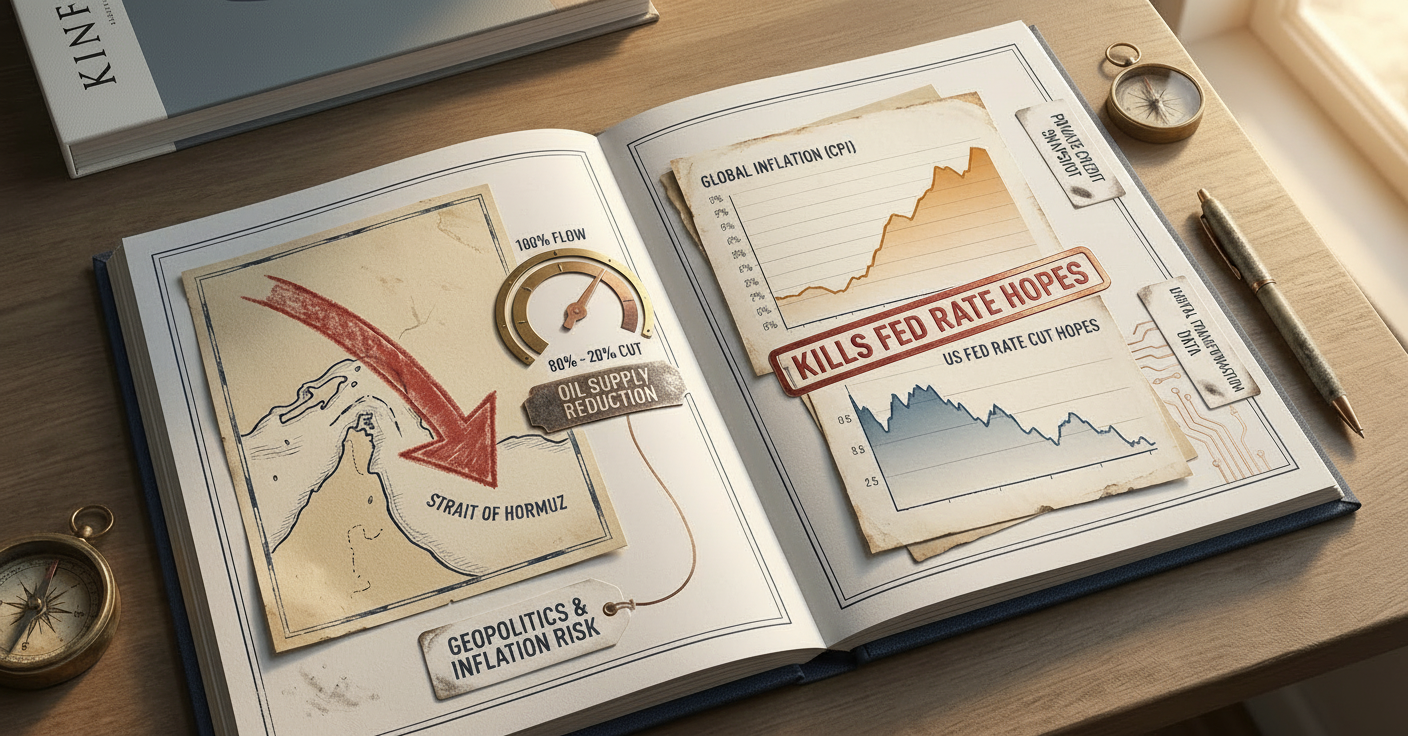
The geopolitical chokepoints of global energy supply and their ripple effects through inflation, interest rates, and private credit are driving unprecedented market reactions.
The Intake
📊 12 episodes across 8 podcasts
⏱ 531 minutes of intelligence analyzed
🎙 Featuring: Tom Keene, Edward Morse, Audrey Childe-Freeman, Melissa Lee, Tim Seymour, Bono
The Big Shift
The Strait of Hormuz is not just another chokepoint; its criticality to global oil supply has triggered a reassessment of inflation and interest rate policy that few saw coming. Geopolitical tensions, particularly involving Iran, have laid bare the structural vulnerabilities of global energy logistics, setting off a chain reaction that impacts everything from central bank policy to the stability of private credit markets.
The Level: Edward Morse, Dean of Oil Analysis at Hartree Partners, starkly noted, "The upwards of 16-18 million barrels a day that was coming through the Strait of Hormuz is now down to 10." This reduction of 6-8 million barrels per day represents a 20% cut to global oil supplies, a massive shock due to the lack of viable alternatives for Middle Eastern energy transport.
"You lose 20% of supplies, you get a multiplier of four. That's an 80% increase in prices from a pre war price of around $60 per barrel. That takes you to $108 per barrel."
— Ziad Daoud, Chief Emerging Markets Economist for Bloomberg Economics
The Implication: This surge in energy prices acts as a direct tax on consumers and erodes earnings per share (EPS) outlooks across industries. Gita Gopinath, Professor of Economics at Harvard University, highlighted that if oil averages $85 for the year due to this, it shaves 0.3-0.4 percentage points off global growth and adds 50-60 basis points to global inflation. Critically, Jim Bianco, Founder of Bianco Research, argued that such high inflation fundamentally restricts the Fed's ability to cut rates. "If you print [money], what you're trying to say is the economy's wobbling... But in this environment, if you do that, then you're saying to bond traders, we don't care about your real returns," Bianco said on Macro Voices. This suggests that the market is now pricing out expected rate cuts, fearing that Fed action to ease conditions could backfire, tightening bond markets and driving rates higher.
The Ripple: This energy shock is directly flowing into private credit markets. Michael Nierenberg, CEO of Rithm Capital, acknowledged the headlines around private credit concerns, highlighting that issues are concentrated in retail distribution where "larger asset managers... have put up gates." This context suggests a liquidity mismatch rather than a systemic credit quality issue, but the sudden gating of withdrawals, as discussed on CNBC's "Fast Money", poses significant reputational risk to the sector.
The Rundown
① Gen Z is challenging retirement norms. Robinhood CEO Vlad Tenev reports that Gen Z is opening retirement accounts at an average age of 19, making them the most retirement-savvy generation to date. (Vlad Tenev on Bankless)
→ Why it matters: This counters prevailing narratives about youth financial irresponsibility and signals a demographic shift in long-term investing behavior, which could have implications for asset managers and financial product development.
② Atlassian's layoffs hint at AI as a cover for over-hiring. While officially attributed to AI-driven efficiency, analysts suggest Atlassian's 10% workforce reduction is less than their headcount increase in the prior year. (Matt Frankel on Motley Fool Money)
→ Why it matters: This signals that some AI-driven efficiency claims from SaaS companies might be masking aggressive over-hiring during the boom years, which has implications for sector-wide employment trends and investor scrutiny.
③ Crypto demonstrates surprising resilience amid geopolitical turmoil. Bitcoin has held up better than traditional stocks and gold during the Iran conflict, indicating its potential as a portable sovereign wealth solution. (Sergio Silva on Real Vision: Finance & Investing)
→ Why it matters: This suggests a growing perception of crypto as a safe haven or a reliable asset during geopolitical stress, challenging traditional asset class correlations and highlighting its appeal for 24/7 global trading.
④ The 351 rule is under scrutiny for promoting tax arbitrage. Experts discuss how the 351 ETF conversion rule, designed to lower capital costs, can be exploited for tax-free diversification, potentially contradicting its public policy intent by disincentivizing true diversification. (Wes Gray on The Meb Faber Show - Better Investing)
→ Why it matters: This points to an ongoing "tax alpha arms race" where sophisticated financial engineering can create regulatory arbitrage, suggesting future IRS or legislative action to close perceived loopholes and ensure equitable tax treatment.
⑤ Prediction markets are evolving, but not for everyday transaction platforms. Rick Wurster, CEO of Charles Schwab, emphasized prediction markets as a growth area for financial insight but dismissed platforms focused on transactional gambling, preferring Schwab's "outcomes business" model. (Rick Wurster on The Compound and Friends)
→ Why it matters: This highlights a strategic distinction in the fintech landscape: while some aim for high-frequency trading and speculative volume, established players are doubling down on long-term wealth building, influencing how financial innovation is deployed and regulated.
Signal Board
🔥 HEATING UP
• Geopolitical tensions and oil prices: Crude oil prices are surging due to the Strait of Hormuz conflict, with severe implications for global inflation and economic growth. (Gita Gopinath on Bloomberg Surveillance)
• US Dollar dominance through stablecoins 🆕: Jim Bianco notes that dollar-backed stablecoins are gaining traction in vulnerable economies, serving as a frictionless alternative to traditional banking and reinforcing dollar dominance. (Jim Bianco on Macro Voices)
• AI for business scaling: IBM's CEO Arvind Krishna advocates for applying AI to scalable business functions like HR and software development for significant productivity gains. (Arvind Krishna on Bloomberg Surveillance)
👀 ON WATCH
• Private credit market liquidity 🆕: Concerns about private credit are rising due to redemption requests and gated withdrawals, particularly in assets distributed to retail investors. (Michael Nierenberg on Bloomberg Surveillance)
• NVIDIA GTC conference expectations 🆕: Anticipation for NVIDIA's GTC conference and its potential announcements on custom silicon competition and AI advancements. (Gene Munster on CNBC's "Fast Money")
• Meta AI model delays 🆕: Despite massive investment, Meta's reported delay in rolling out its new AI model suggests challenges in securing AI leadership even with high capital expenditure. (Julia Boorstin on CNBC's "Fast Money")
🧊 COOLING OFF
• Fed rate cut probabilities: The market is pricing out rate cuts until at least December, with only a 63% probability of one cut, a significant shift from earlier expectations. (David Zervos on CNBC's "Fast Money")
• Clarity Act prospects: The probability of the Clarity Act passing in the US has fallen from 70% to 60%, indicating increasing political hurdles for crypto legislation. (Sergio Silva on Real Vision: Finance & Investing)
• Strategic Petroleum Reserve efficacy 🆕: The recent SPR release had limited impact on global oil prices, highlighting its ineffectiveness against significant supply disruptions. (Jon Quast on Motley Fool Money)
The Debate
The Fed’s latitude on rates in a high-inflation environment.
🐂 The argument for caution: Jim Bianco, Founder of Bianco Research, argues that if the Fed were to cut rates with inflation around or above 3%, it would paradoxically tighten financial conditions by signalling to bond traders that the Fed doesn't care about their real returns, leading to bond selling and higher rates. "If you print [money], what you're trying to say is the economy's wobbling, financial markets are under stress. We need to create easier financial conditions by cutting interest rates or expanding the Fed's balance sheet. But in this environment, if you do that, then you're saying to bond traders, we don't care about your real returns."
🐻 The case for continued cuts: Conversely, Michael Nierenberg, CEO of Rithm Capital, expressed disagreement with the market's current stance, stating, "I do think that, you know, the, the, the market's taken out any, not any chance, but the market's taken out that the Fed is not going to cut rates this year. I don't agree with that." This suggests a belief that economic pressures or the underlying need for lower rates will ultimately compel the Fed to act, regardless of current inflation levels.
Our read: The market consensus is heavily leaning towards the Fed staying put given persistent inflation signals and geopolitical risks, making the risk of a "pain trade" for early rate-cut speculators increasingly likely.
The Bottom Line
With geopolitical tensions hardening energy chokepoints and reshaping the inflation outlook, expecting Fed rate cuts anytime soon isn't just wishful thinking—it's a liquidity trap.
📖 Want the full episode breakdowns, guest details, and listen links?
Episode Guide (Web Version)
1. Bloomberg Surveillance — "Single Best Idea with Tom Keene: Ed Morse & Audrey Childe-Freeman"
Runtime: 4 min | Host: Tom Keene | Guest: Edward Morse (Dean of Oil Analysis, Hartree Partners), Audrey Childe-Freeman (Foreign Exchange Expert, Bloomberg Intelligence)
For the Capital Allocator: This episode details the critical impacts of reduced oil flow through the Strait of Hormuz on global markets and offers nuanced forex analysis for hedging in a volatile risk environment.
This segment discusses the confluence of rising private credit risks and the geopolitical threats to global oil supplies, offering a concise overview of how these macro factors influence currency trading decisions, especially regarding the euro and Nordic currencies.
"If there was not a war, the top shelf idea for global Wall street right now would be the rolling debacle that we see in private credit."
— Tom Keene, Host of Bloomberg Surveillance
2. CNBC's "Fast Money" — "Federal Judge Blocks Subpoena In Fed Reserve Probe… And Counting Down to Nvidia’s GTC 3/13/26"
Runtime: 44 min | Host: Melissa Lee | Guest: Tim Seymour (Fast Money Contributor, CNBC), Bono (Fast Money Contributor, CNBC), Steve Grasso (Fast Money Contributor, CNBC), Mike Koh (Fast Money Contributor, CNBC), Steve Liesman (Reporter, CNBC), David Zervos (Chief Market Strategist, Jefferies), Jeanine Pirro (US Attorney General, US Attorney General for DC), Julia Boorstin (Reporter, CNBC), Gene Munster (Analyst, Deepwater)
For the Portfolio Manager: This episode offers insights into the Fed's independence amid legal challenges, along with specific discussions on options strategies for market uncertainty and the memory chip market outlook.
This episode navigates the implications of a federal judge blocking a subpoena against Fed Chair Powell, rising oil prices, and the evolving narratives around Nvidia's GTC and Meta's AI investments, providing tactical market insights for volatile conditions.
"If we remove an easy Fed and we talked about this yesterday, if just the bias goes to neutral that, that, that, that's, that's a big change for the stock market which was expecting at least an easier Fed."
— Tim Seymour, Fast Money Contributor at CNBC
3. Real Vision: Finance & Investing — "Crypto Defies the Doom and Gloom?"
Runtime: 60 min | Host: Mando | Guest: Sergio Silva (CEO, The Meebit Company), Sergio (Founder, Me Bets)
For the Fintech Investor: Explore Bitcoin's surprising resilience in geopolitical turmoil, Hyperliquid's rise as a DeFi powerhouse, and the evolving landscape of crypto regulation and tokenized assets.
This deep dive examines how crypto assets are outperforming traditional markets despite rising geopolitical tensions, discussing the shift towards sovereign wealth functions and decentralized trading platforms like Hyperliquid, while also touching on the complexities of US crypto regulation.
"Crypto has held up better than stocks. It also makes me wonder if the crypto sell off at the beginning of the year was actually people just kind of like front running this."
— Sergio Silva
4. Bloomberg Surveillance — "The Risks of a Prolonged Iran War"
Runtime: 45 min | Host: Tom Keene | Guest: Alexis Christoforous (Host, Bloomberg), Gita Gopinath (Professor of Economics, Former IMF Deputy Managing Director, Harvard University), Edward Morse (Senior Advisor, Hartree Partners), Ed Morse (Geopolitics of Hydrocarbons Expert, Hartree Partners), Stephen Major (Global Macro Advisor, Tradition), Charles Kantor (Senior Portfolio Manager, Neuberger Berman)
For the Macro Strategist: Understand the economic fallout of prolonged Iran conflict, particularly for emerging markets, the role of strategic reserves, and dollar dominance, paired with insights into Magnificent Seven capital allocation.
Featuring Gita Gopinath and Edward Morse, this episode dissects the potential economic consequences of sustained Mideast conflict, including its impact on global growth, inflation, and the efficacy of strategic oil reserves, providing critical context for global market positioning.
"If this continues well past a few weeks and we're looking at now average for the year hitting 85, that's beginning to shave off like 0.3 percentage point global growth, 0.4 percentage point and global inflation starts going up by 50 basis points, 60 basis points."
— Gita Gopinath, Professor of Economics at Harvard University, Former IMF Deputy Managing Director
5. The Meb Faber Show - Better Investing — "The Tax Alpha Arms Race (w/ Wes Gray & Brent Sullivan) | #622"
Runtime: 59 min | Host: Meb Faber | Guest: Wes Gray (Co-CIO, Alpha Architect), Brent Sullivan (Editor, Tax Alpha Insider)
For the Wealth Manager: This discussion on 351 ETF conversions, cost basis granularity, and options for concentrated positions provides advanced strategies for tax-efficient portfolio management.
Wes Gray and Brent Sullivan unravel the technicalities of tax-efficient investing, from managing concentrated stock positions through 351 ETF conversions to the regulatory nuances and potential arbitrage in current tax laws, making it essential for fiduciaries optimizing after-tax returns.
"What Arnaud and Jeffrey showed in 1993 was that transaction costs and portfolio turnover just ended up being really problematic from a post tax perspective. They proved it out. They showed a cool little analytical model. It was really simple and elegant at the time."
— Brent Sullivan, Editor at Tax Alpha Insider
6. The Compound and Friends — "A Sit-Down with Rick Wurster, CEO of Charles Schwab"
Runtime: 44 min | Host: Michael Batnick | Guest: Rick Wurster (President and CEO, Charles Schwab Corporation), Downtown Josh Brown (Host, Ritholtz Wealth Management)
For the Financial Executive: Gain insight into how Charles Schwab integrates AI, acquires Gen Z clients, and manages private market access, offering a blueprint for large-scale financial service innovation and market share capture.
Rick Wurster, CEO of Charles Schwab, discusses the company's growth, strategies for attracting Gen Z investors, and extensive AI integration across its operations, offering a look at how a major brokerage aims to deliver long-term financial outcomes rather than transactional engagement.
"We're crushing it with the young investor. And the reason we're crushing it with them is because we've got the combination of the platforms. We've got thinkorswim, which I think is the leading trading platform."
— Rick Wurster, President and CEO of Charles Schwab Corporation
7. Bloomberg Surveillance — "Trump Warns Iran of New Strikes, Private Credit Concerns"
Runtime: 28 min | Host: Tom Keene | Guest: Ziad Daoud (Chief Emerging Markets Economist, Bloomberg Economics), Leslie Vinjamuri (President & CEO, Chicago Council on Global Affairs), Michael Nierenberg (CEO, Chairman and President, Rithm Capital), Kathy Bostjancic (Senior Vice President & Chief Economist, Nationwide), Alexis Christoforous (Host, Bloomberg), Kathleen B. Johnson (Chief Economist, Nationwide)
For the Global Investor: This episode offers modeled oil price surges of up to $164/barrel in extreme scenarios and discusses the impact of US sanctions on Russia benefitting China and a more nuanced view on private credit risks.
Ziad Daoud and Leslie Vinjamuri analyze extreme oil price scenarios due to Strait of Hormuz disruptions and the broader geopolitical shifts benefiting Russia and China, while Michael Nierenberg provides critical distinctions in private credit concerns, particularly around mortgage servicing.
"It is large and it's large and it's concentrated. If you think about it, what, what it, what it transports, it transports oil and gas and energy from the Middle east to the rest of the world."
— Ziad Daoud, Chief Emerging Markets Economist for Bloomberg Economics
8. Motley Fool Money — "Atlassian’s Layoffs are AI-Inspired"
Runtime: 26 min | Host: Tyler Crowe | Guest: Matt Frankel (Longtime Fool Contributor, Motley Fool Money), Jon Quast (Longtime Fool Contributor, Motley Fool Money)
For the SaaS Investor: Examine the real drivers behind Atlassian's layoffs (AI vs. over-hiring), Dollar General's turnaround, and the limited impact of SPR releases on global oil prices, guiding investment decisions in tech and retail.
This discussion dissects Atlassian's AI-attributed layoffs, questioning whether they are genuine efficiency gains or a right-sizing after unchecked growth, and also critically assesses the impact of Strategic Petroleum Reserve releases on global oil markets and Dollar General's retail challenges.
"Atlassian, like John said's, only letting go about 10% of their workforce. It's less than the amount of workers they added over the past year alone. It does beg the question of whether they hired too aggressively."
— Matt Frankel, Longtime Fool Contributor at Motley Fool Money
9. Bankless — "Robinhood CEO: "Gen Z Is the Most Retirement-Savvy Generation Ever" | Vlad Tenev"
Runtime: 62 min | Host: Bankless | Guest: Vlad Tenev (Founder CEO, Robinhood)
For the Wealth Management Innovator: Vlad Tenev offers a surprising view of Gen Z's financial savviness, details Robinhood's full-stack DeFi vision, and critiques the Clarity Act, providing a roadmap for future fintech strategies.
Robinhood CEO Vlad Tenev challenges conventional wisdom, asserting Gen Z is remarkably retirement-savvy, and outlines Robinhood's grand vision for full-stack DeFi, including tokenized stocks and the Robinhood Chain, while also discussing the practicality of stablecoin integration.
"Gen Z are the most retirement savvy and long term investment savvy generation we've ever had. They're opening retirement accounts at earlier ages than any generation in the past."
— Vlad Tenev, Founder CEO of Robinhood
10. Macro Voices — "MacroVoices #523 Jim Bianco: Energy, FED & Economy in the wake of Iran conflict"
Runtime: 112 min | Host: Erik Townsend | Guest: Jim Bianco (Founder, Bianco Research), Patrick Ceresna (Host, Macro Voices), Anas Alhajji (Geopolitical and Energy Expert, Energy Outlook Advisors)
For the Quantitative Investor: Jim Bianco reveals how zero population growth radically alters monthly job creation needs (0-50k), the paradoxical effect of Fed rate cuts in high inflation, and how stablecoins reinforce dollar dominance, offering nuanced economic inputs.
Jim Bianco provides a comprehensive analysis of the financial fallout from the Iran conflict, arguing that sustained high oil prices could push inflation above 3% and restrict the Fed's ability to cut rates without sparking a bond market backlash. He also details the implications of stablecoin adoption on dollar dominance and the transformative potential of AI agents.
"If you print [money], what you're trying to say is the economy's wobbling, financial markets are under stress. We need to create easier financial conditions by cutting interest rates or expanding the Fed's balance sheet. But in this environment, if you do that, then you're saying to bond traders, we don't care about your real returns."
— Jim Bianco, Founder of Bianco Research
11. CNBC's "Fast Money" — "Stocks Drop As Iran Conflict Lingers On… And Latest Punch To Private Credit 3/12/26"
Runtime: 43 min | Host: Melissa Lee | Guest: Tim Seymour (Partner and CIO, Triogem Asset Management), Dan Nathan (Founder, RiskReversal Advisors), Guy Adami (Founder, Adami Quantitative), Eamon Javers (White House Correspondent, CNBC), Pippa Stevens (Energy Reporter, CNBC), Scott Bess (Treasury Secretary, US Department of the Treasury), Wilfred Frost (Anchor, Sky News), Subhadra Japa (Head of Research, Societe Generale), Kate Rooney (Tech Reporter, CNBC), CNBC (Host, CNBC), Leslie Picker (Reporter, CNBC)
For the Risk Manager: This episode highlights stagflation concerns from high oil prices and a strong dollar, analyzes liquidity mismatches in private credit redemptions, and discusses the impact of AI on creative software, informing hedging and portfolio adjustments.
Amidst a market sell-off driven by rising oil prices and geopolitical tensions in the Strait of Hormuz, this episode delves into growing stagflation concerns, the liquidity crunch in private credit markets, and Adobe's struggles with competitive pressure from AI and private firms.
"Today was the day for me that it felt like the pain is getting ready to price."
— Tim Seymour, Partner and CIO at Triogem Asset Management
12. Bloomberg Surveillance — "Single Best Idea with Tom Keene: Ziad Daoud & Michael Nierenberg"
Runtime: 4 min | Host: Tom Keene | Guest: Ziad Daoud (Economist, Bloomberg Economics), Michael Nierenberg (CEO, Rithm Capital), Malcolm Gladwell (Host of Smart Talks with IBM podcast, IBM), Arvind Krishna (Chairman and CEO, IBM)
For the Operating Executive: Understand the unique, non-alternative nature of the Strait of Hormuz for global energy, get a contained view of private credit risks, and learn about IBM's scalable AI applications for HR and software development for operational efficiency.
This quick segment underscores the unparalleled importance of the Strait of Hormuz for global oil supplies, offers a reassuring perspective on the containable nature of private credit issues, and highlights practical, scalable AI applications in business operations from IBM's CEO.
"It is large and it's large and it's concentrated. If you think about it, what, what it, what it transports, it transports oil and gas and energy from the Middle east to the rest of the world. And the rest of the world sends almost everything else that the Middle east needs through that strait."
— Ziad Daoud, Economist at Bloomberg Economics