
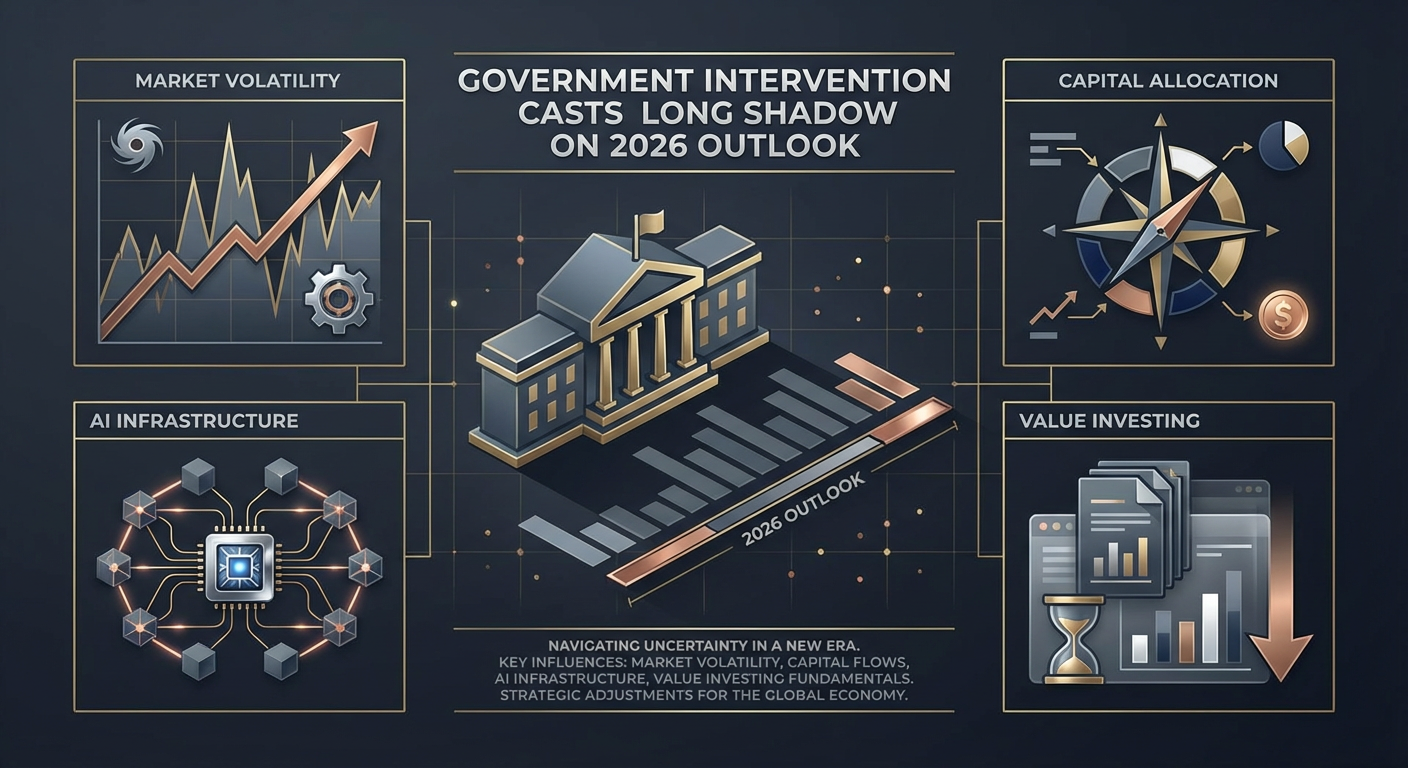
The soft landing narrative is cracking under the weight of an aggressive Fed and escalating government intervention, pushing investors to re-evaluate capital allocation for 2026.
The Intake
9 episodes across 5 podcasts
8 hours, 38 min of market intelligence
The Big Shift
Government Intervention and Policy Errors Threaten Smooth Market Performance in 2026
Despite predictions for an "up year" overall in 2026, a growing chorus of strategists and economists flag increased government intervention and potential policy errors as significant headwinds, disrupting what many hoped would be a smooth recovery. From the executive branch pressuring the Fed to cut rates (Bloomberg Surveillance), to the Treasury's unprecedented bond issuance (Bloomberg Surveillance TV), and even state-level influence on prediction markets (Bankless), political actions are injecting volatility into financial markets. This climate demands a re-evaluation of assumptions about market stability and highlights potential for turbulence in the near to medium term. For executives, this means increased uncertainty in capital markets, potentially affecting refinancing windows and M&A activity. For investors, it signals a need to diversify away from politically sensitive assets and consider regions less exposed to such policy whims.
"Any time that you have government intervention, it typically does put off investors, obviously by varying amounts....this is a moment of pause that maybe 2026 is not going to be as smooth as a lot of people are anticipating."
— Seema Shah, Chief Global Strategist at Principal Asset Management on Bloomberg Surveillance TV
The level: Watch for shifts in inflation data that could be politically co-opted, particularly shelter inflation, and any legislative actions impacting bond markets or financial regulation.
The Rundown
① Federal Reserve's independence under threat. The Department of Justice issued subpoenas to the Federal Reserve in response to executive branch pressure to replace current chair Jay Powell. This move highlights an unprecedented political interference in monetary policy. (Thierry Wizman on Bloomberg Surveillance)
- Why it matters: The long-held premise of Fed independence is eroding, suggesting future monetary policy could be swayed by short-term political agendas, potentially impacting inflation and interest rate stability for business planning.
② The rise of "Cannibal Buy-ups" for shareholder value. Fairfax Financial's Prem Watsa, a deep-value investor, exemplifies a unique strategy where the parent company buys back shares from portfolio companies from other shareholders, significantly increasing ownership and compounding capital. (Kyle Grieve on We Study Billionaires)
- The signal: This "cannibal buy-up" strategy can lead to exceptional capital compounding and long-term shareholder alignment, offering a playbook for private equity managers and operators looking to create durable value in their portfolio.
③ Regulated institutions seek technical guarantees, not social contracts, in blockchain. Canton Network founder Yuval Rooz argues that for real-world assets (RWAs), immutability must be a technical guarantee, not just a social contract, to meet regulatory and institutional needs. (Yuval Rooz on Bankless)
- Why it matters: This distinction signals a growing divergence between crypto-native ideals and the practical requirements for institutional adoption of blockchain, influencing how and where RWAs are tokenized.
"Immutability is a social construct. It's not. Can I just say one thing on that? They prove that some blockchains aren't immutable or some blockchains are much less immutable than others, or some social contracts are much different than other social contracts for blockchains."
— Yuval Rooz, Co-founder of Digital Asset on Bankless
④ Passive investing is creating market inefficiencies. The rise of passive investing, specifically index funds, is widening the gap between price and fundamental value in overlooked market segments, creating significant opportunities for active value investors. (Daniel Gladiš on We Study Billionaires)
- The signal: As active management shrinks, asset allocators with a disciplined value approach can find mispriced opportunities, especially in mid-cap and small-cap segments.
⑤ NVIDIA chips at the center of institutional investment. Apollo Global Management recently engaged in a $5 billion sale-leaseback transaction involving NVIDIA chips, signaling a significant institutional bet on the continued demand and strategic value of advanced computing infrastructure. (Jim Zelter on Bloomberg Surveillance TV)
- Why it matters: This move highlights that critical digital infrastructure, particularly in AI, is becoming a new class of "hard asset" attracting large-scale, structured finance, creating opportunities for those who can deploy capital against these assets.
The Heat Map
🔥 HEATING UP
- Government Intervention in Markets: Political pressure on the Fed and legislative actions are increasingly shaping market dynamics. (Seema Shah on Bloomberg Surveillance TV)
- Credit Bullish Positioning: A "historic degree" of crowded bullish positioning in credit indicates high short-to-medium term correction risk, but a positive long-term resolution. (Darius Dale on Macro Voices)
- Institutional AI Infrastructure Bets: Hyperscalers and large asset managers are making multi-billion dollar, multi-year commitments to AI compute and energy infrastructure. (Jim Zelter on Bloomberg Surveillance TV)
👀 ON WATCH
- 🆕 Mercado Libre (MELI): The "Amazon of LatAm" is delivering over 30% revenue growth for 27 consecutive quarters and trading at its lowest-ever EV/EBIT valuation, suggesting a mispriced opportunity. (Daniel Mahncke on The Intrinsic Value Podcast)
- 🆕 Canton Network: This RWA-focused blockchain is designed for regulated institutions, emphasizing "need-to-know" privacy and federated architecture; it projects settling "trillions" daily by 2030. (Yuval Rooz on Bankless)
- Shift to Small/Mid Caps: Markets are displaying broadening breadth beyond "Magnificent Seven" into mid-cap and small-cap equities, and cyclical sectors. (Alicia Levine on Bloomberg Surveillance)
🧊 COOLING OFF
- Housing Affordability Post-Rate Drop: Despite White House orders to lower mortgage rates, structural issues (income gap, supply) mean limited impact on overall affordability. (Diana Olak on CNBC's "Fast Money")
- Traditional Blockchain Immutability: The notion of blockchain immutability as a purely technical guarantee is being challenged by the needs of regulated finance, framing it as a "social construct." (Yuval Rooz on Bankless)
The Debate
Is the Fed truly independent amidst political pressure?
🐂 The bull case:
"The White House and the executive branch have a different reaction function than the Federal Reserve. In other words, the White House tends to put more emphasis on what the electorate wants to see in the short term, especially in key election years, let's say. And the premise here is that the White House's reaction function, if it's driven by what the electorate want, is going to put more weight on driving growth, on reducing unemployment and on keeping mortgage yields low, more so than it would worry about inflation."
— Thierry Wizman, Global FX & Rates Strategist at Macquarie Group on Bloomberg Surveillance
🐻 The bear case:
"A dovish policy error by the Fed is a near certainty this year. And the reason I say that is President Trump is being extremely heavy handed in terms of just demanding that anybody he allows onto the FOMC board is going to have to vote for a reduction, a continued cutting of policy rates."
— Erik Townsend, Host at Macro Voices
Our read: While the Fed officially maintains independence, the political pressure, including DOJ subpoenas, suggests a growing risk of policy errors driven by short-term electoral cycles. This implies higher volatility in the rate path than current fed dot plots suggest, requiring operators to stress-test capital structures for wider rate swings.
The Bottom Line
The confluence of political interference, structural market shifts, and emerging tech infrastructure demands means operators must plan for a bumpier, but potentially rewarding, 2026 by prioritizing capital structure resilience and agile investment strategies.
🎯 Your Move
- Stress-test your capital structure against political intervention: With rising political pressure on the Fed and growing government involvement, re-evaluate your financing agreements for sensitivity to unpredictable rate shifts and prepare for potential volatility in capital markets.
- Audit your deal sourcing for market inefficiencies: Passive investing is making markets less efficient. Look beyond crowded trades to identify mispriced opportunities in small- to mid-cap segments or overlooked sectors where fundamental value is disconnected from price.
- Explore structured finance for next-gen infrastructure: Follow the smart money deploying capital into critical digital infrastructure like AI compute and power. Consider innovative financing structures, like sale-leasebacks, for high-value tech assets within your portfolio, mirroring institutional bets.
📚 APPENDIX: EPISODE COVERAGE
1. Bloomberg Surveillance: "Powell Vows to Stand Firm as Fed Served With DOJ Subpoenas"
Guests: Tom Keene (Host, Bloomberg), Paul Sweeney (Host, Bloomberg), Thierry Wizman (Global FX & Rates Strategist, Macquarie Group)
Runtime: 32 min | Vibe: Disquieting insights on Fed independence and economic pressures
Key Signals:
- Eroding Fed Independence: The DOJ subpoenas and political pressure on the Fed signal a significant shift in monetary policy’s political insulation, potentially leading to decisions influenced by short-term electoral cycles rather than pure economic data.
- Economic Slowdown Drivers: The current slowdown in hiring isn’t solely due to demand deficiency; other factors like low-income consumer debt burdens and wage stagnation are playing a larger role. This points to a more complex economic landscape than traditional recession indicators suggest.
- Unsustainable S&P 500 Returns: The S&P 500's average annualized return of 12.5% since 2010 is historically high and unlikely to be sustainable in a higher-rate environment, indicating a need for investors to broaden their scope beyond large-cap tech.
"The White House and the executive branch have a different reaction function than the Federal Reserve. In other words, the White House tends to put more emphasis on what the electorate wants to see in the short term, especially in key election years, let's say." — Thierry Wizman, Global FX & Rates Strategist at Macquarie Group
2. We Study Billionaires - The Investor’s Podcast Network: "TIP783: What the Market Missed: Prem Watsa and One of the Greatest Records in Business w/ Kyle Grieve"
Guests: Kyle Grieve (Host, The Investor's Podcast Network), Prem Watsa (CEO, Fairfax Financial), The Investor's Podcast Network (Host, The Investor's Podcast Network)
Runtime: 68 min | Vibe: A masterclass in deep value investing and corporate resilience
Key Signals:
- Long-Term Alpha Generation: Fairfax Financial, under Prem Watsa, achieved over 19% compounded capital growth since 1985 through deep value investing and leveraging insurance float, demonstrating that patient, long-term strategies can still yield exceptional results.
- Resilience Against Short-Sellers: Fairfax’s ability to withstand a multi-year short-seller attack highlights the power of transparency, strong corporate culture, and a 'fortress balance sheet' in navigating market skepticism.
- "Cannibal Buy-up" Strategy: Watsa's unique approach of buying back shares from portfolio companies from other shareholders, as opposed to open market buybacks, significantly increased ownership stakes, showcasing an effective method for capital allocation and value creation in holding companies.
"Since 1985, it has compounded capital at over 19%, placing it firmly in the top 1% of all companies in America. And here's the twist. It isn't even American. It's a Canadian insurance conglomerate called Fairfax Financial led by Prem Watsa." — Kyle Grieve, Host at The Investor's Podcast Network
3. CNBC's "Fast Money": "A Housing Revival As Mortage Rates Drop… And Meta’s Nuclear Deal 1/9/26"
Guests: Melissa Lee (Host, CNBC), Tim Seymour (Partner, Triogem Asset Management), Karen Fireman (Chairman and CEO, Macquarie)
Runtime: 43 min | Vibe: Rapid-fire market takes on housing, big tech, and energy futures
Key Signals:
- Limited Impact on Housing Affordability: Despite government efforts to lower mortgage rates, structural issues like high home prices, income gaps, and supply constraints mean a limited impact on overall housing affordability, dampening expectations for a housing "revival."
- Hyperscalers' Long-Term Energy Strategy: Meta's 20-year power purchase agreements and securing nuclear builds by 2035 illustrate how hyperscalers are thinking a decade ahead for energy independence, a critical factor for the scalability of AI data centers.
- NVIDIA's Data Center Moat: The demand for advanced cooling solutions like water-cooled chillers remains high, with companies like Trane sold out for two years, underscoring NVIDIA's continued dominance in data center infrastructure and the physical demands of AI.
"The average as you said on the 30 year fixed dropping 22 basis points to 5.99% it hasn't been that low since the start of February 2023." — Diana Olak, Reporter at CNBC
4. Bankless: "Is Canton a Real Blockchain? | Canton Founder Yuval Rooz"
Guests: Yuval Rooz (Co-founder, Digital Asset), Ryan (Host, Bankless), David (Host, Bankless)
Runtime: 91 min | Vibe: Deep dive into enterprise blockchain and regulated "real-world assets"
Key Signals:
- Enterprise Blockchain for RWAs: Canton Network offers a federated, "need-to-know" privacy model tailored for regulated financial institutions and real-world assets (RWAs), contrasting with public chains like Ethereum. It projects settling "trillions" daily by 2030, highlighting institutional demand for bespoke blockchain solutions.
- Immutability as a Social Contract: Yuval Rooz challenges the crypto industry's core tenet by asserting that blockchain immutability is a "social construct," not a technical guarantee, especially for regulated institutions. This reframe is crucial for understanding institutional adoption barriers.
- Strategic Tokenomics Deferral: Canton intentionally deferred tokenomics for 7 years to focus on core technology and institutional adoption first, suggesting a pragmatic approach to blockchain development that prioritizes utility over speculative token value for enterprise use.
"to move financial services on chain is going to take time. Only after you prove the underlying mechanics of the architecture can you build decentralized infrastructure. Only then can you start thinking about the coin economics." — Yuval Rooz, Co-founder of Digital Asset
5. Bankless: "ROLLUP: Prediction Market Bill | Solana DEX ATH | ETH Stablecoins ATH | Zcash Implodes | Vitalik “Trilemma Solved”"
Guests: Ryan (Host, Bankless), David (Host, Bankless)
Runtime: 52 min | Vibe: Weekly crypto news, from market regulation to protocol innovation
Key Signals:
- Prediction Markets and Regulation: The controversy around a Polymarket trader and a new legislative bill on insider trading in prediction markets indicates growing regulatory scrutiny and the emergence of these markets as sources of real-time intelligence for policymakers.
- Institutional Crypto Adoption Shifts: Morgan Stanley's unexpected filings for Bitcoin, Solana, and Ethereum ETFs signal a significant acceleration in institutional comfort and a broadening of acceptable crypto assets beyond just Bitcoin.
- Blockchain Trilemma "Solved": Vitalik Buterin claims Ethereum has "solved" the blockchain trilemma through zk-EVMs and data availability sampling, potentially paving the way for truly scalable and secure decentralized applications.
"A prediction market trader placing a large large bet on Maduro's capture four hours ahead of his actual capture. And a bill from a Congressman Richie Torres saying, I don't like this. This looks like insider trading inside the government." — Ryan
6. We Study Billionaires - The Investor’s Podcast Network: "TIP782: The Search for Mispriced Stocks w/ Clay Finck"
Guests: Clay Finck (Host, The Investor's Podcast Network), Daniel Gladiš (Founder and Director, Vitalva Fund), Daniel Gladys
Runtime: 62 min | Vibe: Insights into value investing opportunities created by passive markets
Key Signals:
- Passive Investing Creates Inefficiency: The rise of passive investing, contrary to popular belief, is making markets less efficient by detaching price from fundamental value, thereby creating increasing opportunities for disciplined active value investors.
- Japanese Market Reforms: Corporate governance reforms in Japan, driven by the threat of delisting for companies not prioritizing shareholder value, are leading to increased dividends and buybacks, presenting an overlooked investment opportunity.
- Capital-Light Business Models: NVR's homebuilding model, utilizing land options and pre-sold homes, allowed it to remain profitable during the 2008 crisis, highlighting the resilience and capital efficiency of models that de-risk asset-heavy operations.
"Gladiš argues that as fewer investors focus on the underlying fundamentals, the gap between price and value has widened in many overlooked corners of the market." — Daniel Gladiš, Founder and Director of Vitalva Fund
7. Macro Voices: "MacroVoices #514 Darius Dale: 2026, Fasten Your Seat belts For Take-off"
Guests: Darius Dale (Founder, 42 Macro), Erik Townsend (Host, Macro Voices), Patrick Ceresna (Host, Macro Voices)
Runtime: 75 min | Vibe: Macroeconomic and market outlook with a focus on 2026 predictions
Key Signals:
- Turbulent "Up Year" Prediction: Darius Dale predicts 2026 will be an "up year" for financial markets overall but cautions for significant turbulence in early months due to a 'historic degree of credit bullish positioning' that needs to resolve.
- Misinterpretation of Geopolitical Oil Supply: The widely held belief that Venezuelan oil will soon flood the market and crash prices is severely overblown; meaningful production increases will take at least three years (Erik Townsend).
- Shifting Macro Headwinds to Tailwinds: Four of six key macro cycles (monetary, fiscal, liquidity, positioning) are currently headwinds but are expected to transition into tailwinds in the medium term, ultimately supporting a positive market resolution.
"One year from now in January 2027, we'll probably look back on 2026 as an up year for most financial markets. But put your seatbelt on for the first few months of the year, which he thinks could be quite turbulent." — Darius Dale, Founder of 42 Macro
8. Bloomberg Surveillance TV: "January 8th, 2026"
Guests: Stephen Miran (Governor, Federal Reserve), Seema Shah (Chief Global Strategist, Principal Asset Management), Bloomberg (Host, Bloomberg)
Runtime: 30 min | Vibe: High-level discussion on Fed policy, fiscal deficits, and institutional investment strategy
Key Signals:
- Inflation Calculation Quirks: Fed Governor Stephen Miran asserts that most "excess inflation" above target is due to measurement quirks, particularly lagging shelter inflation, rather than fundamental economic overheating, justifying aggressive rate cuts.
- US Economy Resilience: The US economy is currently less susceptible to traditional recession triggers from rate hikes thanks to diverse funding, healthy banks, and a different housing market structure, distinguishing it from peers like the UK.
- Institutional Bet on AI Infrastructure: Apollo Global Management's $5 billion sale-leaseback of NVIDIA chips highlights the growing trend of large institutions deploying capital into critical digital infrastructure, treating AI compute as a new class of hard asset.
"My view is that almost all of the excess inflation over target is due to quirks of how we calculate inflation. So...shelter inflation really, really lags a lot." — Stephen Miran, Governor of Federal Reserve
9. The Intrinsic Value Podcast - The Investor’s Podcast Network: "TIVP054: Mercado Libre: More than just "the Amazon of Latin America" w/ Daniel Mahncke & Shawn O’Malley"
Guests: Daniel Mahncke (Host, The Investor's Podcast Network), Shawn O’Malley (Host, The Investor's Podcast Network), The Investor's Podcast Network (Host, The Investor's Podcast Network)
Runtime: 92 min | Vibe: Deep dive into Latin America's e-commerce and fintech giant
Key Signals:
- Mercado Libre’s Exceptional Growth and Value: Mercado Libre is the only public company out of 80,000+ to achieve over 30% YOY revenue growth for 27 consecutive quarters yet trades at its lowest-ever EV/EBIT valuation, signaling a potentially mispriced, high-growth opportunity.
- Profitable Marketplace Model: Unlike Amazon, Mercado Libre’s marketplace is more profitable due to its 90%+ third-party product mix and robust fintech arm, Mercado Pago, which comprises 40% of its revenue—a model built for emerging market realities.
- Capital-Light Logistics Moat: Mercado Libre's extensive logistics network efficiently uses third-party partners and branded fleets, creating a defensive moat across Latin America without the asset-heavy burden of competitors like Amazon, crucial for navigating volatile emerging markets.
"Out of over 80,000 companies, it is the only one that managed to grow by more than 30% for 27 consecutive quarters. That's almost seven years. That type of growth is just utterly ridiculous." — Daniel Mahncke, Host at The Investor's Podcast Network