
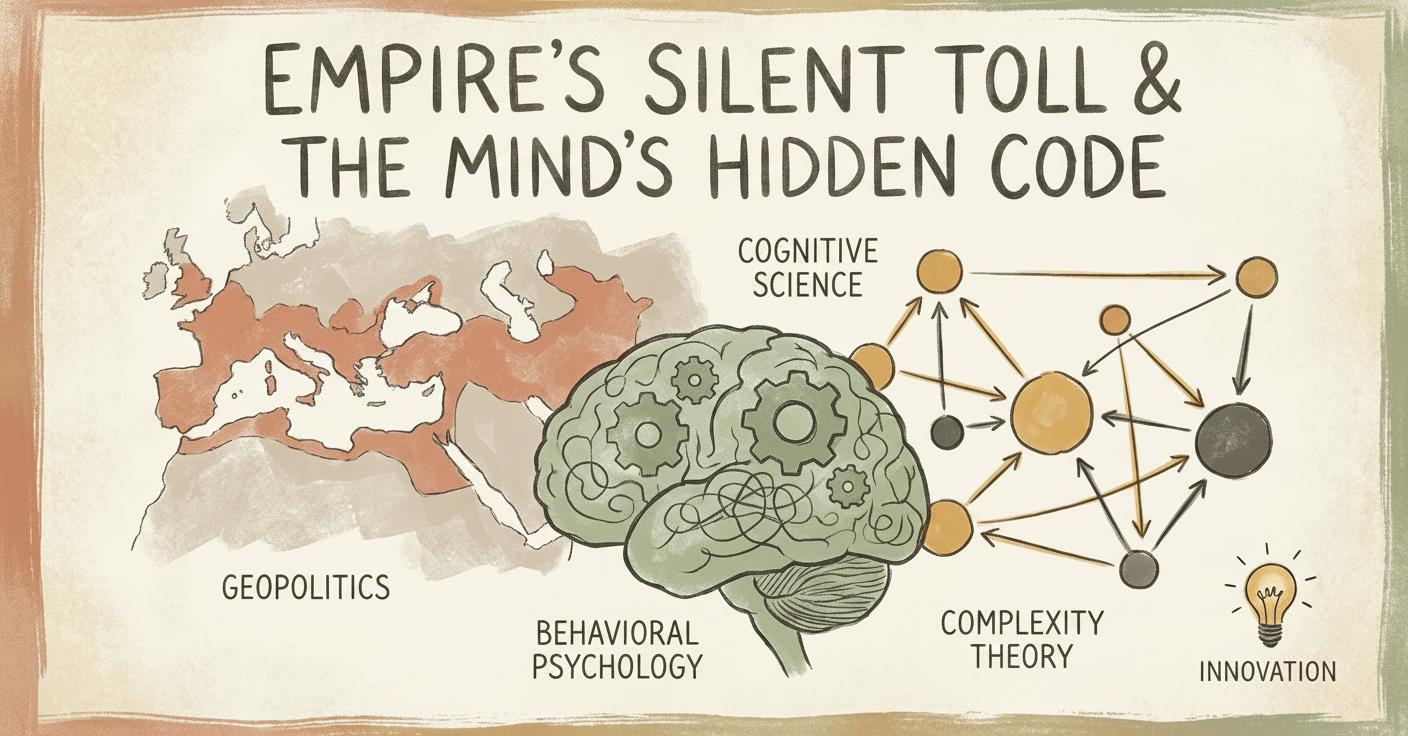
The Unnamed Costs of Empire and the Desire to Want
This week, the urgent questions weren't about what's broken but what's hidden. Hidden costs of geopolitical ambition, hidden mathematical barriers to emergent intelligence, and the hidden truth behind our own desires. What if the most profound limits aren't out there, but within—or in the frameworks we apply to the world?
The Intake
Friday thinking. The frameworks, tensions, and questions worth pondering going into the weekend.
📊 10 conversations across 10 podcasts
⏱️ 637 minutes of long-form intellectual exploration
🎙️ The thinkers: Stuart Kauffman, Curt Jaimungal, Sam Harris, Judea Pearl, Joe Hudson, Morgan Housel, David Bessis, Jonathan Swanson, Sarah Schnitker, Adam Aleksic
💡 20 reframes that might change how you see something
The Big Idea
The Stealth Costs of Empire: When Tactical Wins Mask Strategic Decay
The U.S. foreign policy establishment often celebrates tactical military achievements, but Daniel Bessner (on The Glenn Show) forcefully argues these can be distractions from deeper, strategic failures. His point is that policies framed as advancing U.S. interests, particularly interventions in other nations, have perverse domestic effects. From the militarization of American society to the inflationary pressures of defense spending and the financialization of the economy, the pursuit of global dominance hollows out the very nation it claims to protect. This isn't just about economic models; it suggests a subtle, long-term degradation of American democracy itself, reducing it to procedural voting while executive power expands unchecked in foreign policy.
"To my mind, it's very difficult to have the quote, unquote, good parts of empire without the bad. And I would say it's very difficult to say that Gaza wasn't bad, however one defines that." — Daniel Bessner, Host of American Prestige on The Glenn Show
Why it matters for leaders: Bessner's argument implies that leaders often optimize for visible, short-term wins rather than understanding the cascading, often hidden, negative externalities of their strategies. For a CEO, this might mean celebrating quarterly gains while ignoring the erosion of culture, employee trust, or market health—the hidden costs that ultimately undermine long-term viability. It challenges us to look beyond immediate metrics and consider the full ecosystem implications of our actions, even if those implications are subtle and slow-burning.
The tension: This perspective clashes with a pragmatic view that defends interventions based on immediate U.S. interests, particularly in its traditional sphere of influence. Is it possible to pursue national interests proactively without succumbing to the 'bad parts of empire'? Or is the pursuit of influence inherently a Faustian bargain?
Ideas in Brief
① The Universe Isn't a Solvable Puzzle: Why a "Theory of Everything" May Be a Category Error
Stuart Kauffman (Theories of Everything with Curt Jaimungal) makes a profound claim: there can be no "theory of everything" because biological evolution fundamentally creates new, non-deducible possibilities. He posits that the universe isn't ergodic above a certain level of complexity, meaning that highly complex structures like a human heart cannot spontaneously form within the universe's lifetime. Their existence is driven by utility and natural selection, not just fundamental physics. This suggests that reality is not merely unfolding according to fixed, pre-existing laws, but is genuinely open-ended.
• The implication: For leaders in innovation, this reframe suggests that true novelty isn't always a deduction from existing principles, but sometimes an emergent, unpredictable phenomenon. It means that while understanding underlying rules is crucial, we must also be open to radical shifts and emergent properties in complex systems—whether those are markets, technologies, or organizations—that cannot be mathematically predetermined.
② The Deception of Desire: How Resisting Our Wants Creates Suffering, Not Peace
Many spiritual traditions suggest that desire is the root of suffering. Joe Hudson and Alexa Kistler (The Art of Accomplishment) offer a powerful counternarrative: it's not desire itself, but our resistance to or dishonest engagement with our desires that causes pain. They argue that "wanting is aliveness" and that cleanly expressing our wants is essential for personal well-being and healthy relationships. Suppressing wants, or expressing them "sideways" through codependency, leads to resentment and self-sabotage, even for highly successful individuals.
"When you own your want, you're far less manipulatable." — Joe Hudson, Host of The Art of Accomplishment
• The implication: This framework reframes motivation and conflict. For leaders, understanding this distinction can unlock cleaner communication, more authentic team dynamics, and stronger decision-making. When individuals are encouraged to own and articulate their true wants, they become less susceptible to manipulation and more empowered to align their actions with their deepest aspirations, fostering a more robust and resilient organization.
③ The Illusion of Genetic Determinism: Rethinking Twin Studies and the "Perfect Experiment"
David Bessis (EconTalk) challenges the widespread belief in strong genetic determinism, particularly regarding IQ, by dissecting the methodological flaws in famous identical twin studies. He argues that the revered "perfect natural experiment" of separated twins is often compromised by tiny, non-random sample sizes, questionable data practices, and the absence of crucial control groups (like fraternal twins). He asserts that much of human variability comes from neither genes nor family, but from unique life experiences, echoing Eric Turkheimer's third law of behavioral genetics.
• The implication: For leaders making decisions about talent, team composition, or organizational design, this suggests caution against overly simplistic biological or inherent trait-based explanations for performance and behavior. It emphasizes the profound and often underappreciated role of individual lived experience, environment, and ongoing development, encouraging investment in adaptive approaches rather than fixed "talent" identification.
The Question
If true novelty and existential risk can both arise from emergent properties of complex systems—be it biological evolution or artificial intelligence—how do we cultivate the patience to nurture the former while exercising the vigilance to mitigate the latter, especially when both operate on scales beyond our intuitive grasp? In a world of increasing complexity and unpredictable outcomes, what does responsible innovation really look like?
📚 The Bookshelf
- The Psychology of Money by Morgan Housel — Housel's exploration of money, happiness, and independence was the foundation of this week's discussion on wealth as a tool for resilience and contentment rather than just acquisition.
- The Selfish Gene by Richard Dawkins — Critiqued by Stuart Kauffman for its focus on genes as the primary unit of selection, prompting a reevaluation of selection acting on the whole organism.
- The Book of Why: The New Science of Cause and Effect by Judea Pearl — Relevant to the discussion on mathematical limitations of LLMs and their inability to derive causation from correlation, as explored by Pearl.
- Eric Turkheimer's Three Laws of Behavioral Genetics — A key conceptual framework for critically re-evaluating genetic determinism, as discussed by David Bessis and highlighting the outsized role of unique life experiences.
The Bottom Line
This week's conversations reveal a common thread: the world, and our place in it, is far more complex than our prevailing frameworks often suggest. Whether it's the hidden costs of empire, the emergent novelty of evolution, or the subtle architecture of our own desires, true understanding often begins by questioning the "obvious." The most valuable action for leaders might be to seek out these hidden complexities and challenge assumptions, rather than simply optimizing within existing paradigms.
What We Listened To
1. Daniel Bessner – Making Sense of the Donroe Doctrine
Guests: Daniel Bessner (Host, American Prestige), Glenn Loury (Host, The Glenn Show), Robert Patton Spruill (Confederate/Partner, Housing Provider, The Glenn Show) Runtime: 58 min | Vibe: Geopolitical reckoning with domestic consequences
This episode offers a probing critique of U.S. foreign policy, arguing that tactical military successes often mask strategic failures that erode American democracy and economy. It challenges conventional notions of realism and international relations, drawing parallels between historical and contemporary imperial overreach.
"To my mind, it's very difficult to have the quote, unquote, good parts of empire without the bad. And I would say it's very difficult to say that Gaza wasn't bad, however one defines that." — Daniel Bessner, Host of American Prestige
Connects to: The broader implications of national strategy beyond immediate objectives.
2. Stuart Kauffman: There Is No Theory of Everything
Guests: Stuart Kauffman (Founder of Complexity Theory, Santa Fe Institute), Curt Jaimungal (Host, Theories of Everything) Runtime: 88 min | Vibe: Grand unified theory deconstruction
Stuart Kauffman argues against the possibility of a "theory of everything," positing that biological evolution creates genuinely new, unpredictable phenomena irreconcilable with purely physical laws. He introduces concepts like "Kantian wholes" and Darwinian exaptation, challenging the ergodic assumption of the universe for complex systems.
"Biological open ended biological evolution is real. And it's real because parts come to have and have used different non deducible functions. So that underlying open ended evolution, it's not deducible." — Stuart Kauffman, Founder of Complexity Theory at Santa Fe Institute
Connects to: The limits of reductionist thinking and the nature of emergent complexity.
3. #453 — AI and the New Face of Antisemitism
Guests: Sam Harris (Host, Making Sense with Sam Harris), Judea Pearl (Professor of Computer Science, University of California, Los Angeles) Runtime: 22 min | Vibe: AI's fundamental limitations and societal challenges
Sam Harris and Judea Pearl delve into the fundamental mathematical barriers preventing current LLMs from achieving AGI, highlighting their inability to derive causation or truly understand world models. The discussion also touches upon Pearl's experiences confronting deep-seated antisemitism.
"There are certain limitations, mathematical limitations that are not crossable by scaling up." — Judea Pearl, Professor of Computer Science at University of California, Los Angeles
Connects to: The ongoing debate about AI capabilities and the nature of intelligence.
4. Why You Feel Guilty For Wanting Things
Guests: Joe Hudson (Host, The Art of Accomplishment), Alexa Kistler (Facilitator and Brett's wife, The Art of Accomplishment) Runtime: 38 min | Vibe: Psychological liberation through desire
This conversation explores the pervasive struggle with desire, arguing that resistance to wants, rather than wanting itself, causes suffering. Joe Hudson and Alexa Kistler highlight the importance of owning one's desires for personal growth, healthy relationships, and resilience against manipulation.
"To really be able to understand and feel and speak your wants cleanly can absolutely change lives." — Joe Hudson, Host of The Art of Accomplishment
Connects to: Behavioral psychology and its impact on personal and interpersonal dynamics.
5. The Real Reasons Greenland Matters
Guests: Heather A. Conley (Senior Fellow, American Enterprise Institute), null (Host, The Free Press), Heather (null, null) Runtime: 40 min | Vibe: Geopolitical chess game in the Arctic
Heather Conley discusses the geopolitical significance of Greenland, its crucial role in North Atlantic security, and the complex reactions to past U.S. acquisition attempts. The conversation highlights how clumsy diplomacy can inadvertently strengthen alliances or provoke unforeseen backlashes.
"But right now, our position on acquiring Greenland is now antagonizing those very important allies. In fact, those allies now are preparing themselves to defend against the United States." — Heather A. Conley, Senior Fellow at American Enterprise Institute
Connects to: The intricacies of international relations and the unintended consequences of national policy.
6. Morgan Housel: Wealth is What You Have Minus What You Want
Guests: Morgan Housel (Partner and Author, Collaborative Fund), Shane Parrish (Host, The Knowledge Project) Runtime: 118 min | Vibe: Financial psychology for enduring success
Morgan Housel explores the nuanced relationship between money, happiness, and independence, proposing that money is more like a "vaccine" preventing misery than a direct source of joy. He emphasizes that true financial goal is "survival" and the psychological endurance of market volatility.
"I think what people actually want to get to, what they aspire to, whether they know it or not, is contentment, which is not happiness. It's a different emotion. You'd want to get to a point where you're just like, I'm good." — Morgan Housel, Partner at Collaborative Fund
Connects to: The intersection of behavioral economics and personal finance.
7. Nature, Nurture, and Identical Twins (with David Bessis)
Guests: Russ Roberts (Host, Shalem College and Stanford University's Hoover Institution), David Bessis (Mathematician and Author) Runtime: 65 min | Vibe: Scientific skepticism on foundational studies
David Bessis and Russ Roberts critically examine identical twin studies, revealing methodological flaws, small sample sizes, and non-random placements that undermine their claims of strong genetic determinism. They highlight the vast individual variability unexplained by either genes or family environment.
"If this is true, if you really perform that experiment and it really yields that result, that there is no measurable difference between people that are raised completely separately, then of course it means something very deep about genetic determination." — David Bessis
Connects to: The importance of statistical rigor and critical thinking in scientific inquiry.
8. #1047 - Jonathan Swanson - The Obvious Strategy to Take Back Your Time
Guests: Jonathan Swanson (Co-founder, Thumbtack), Chris Williamson (Host, Modern Wisdom) Runtime: 72 min | Vibe: Strategic delegation for time sovereignty
Jonathan Swanson advocates for strategic delegation as a core strategy for achieving time abundance and increasing overall output. He discusses various delegation hierarchies, the potential for AI in proactive delegation, and argues that successful people "buy time, not things."
"The most successful people I know are not buying things, they're buying time." — Jonathan Swanson, Co-founder of Thumbtack
Connects to: Productivity hacks and their impact on work-life balance and strategic focus.
9. You 2.0: The Practice of Patience
Guests: Hidden Brain, Shankar Vedantam (Host, Hidden Brain), Sarah Schnitker (Psychologist, Baylor University), Jennifer Tosti Karra (Researcher, Babson College), Jennifer Tosti-Karas (Professor, Babson College), Jennifer Tosti Karas (Psychologist, Author, Babson College) Runtime: 101 min | Vibe: The science and art of strategic waiting
Shankar Vedantam and Sarah Schnitker explore the science of patience, discussing how impatience affects decision-making from sports to politics and business. They highlight methods for cultivating patience, such as reflection and purpose-driven activities, while also balancing it with "virtuous impatience."
"And so to truly be doing patience well, we had to find that real sweet spot, that golden mean between recklessness and passivity." — Sarah Schnitker, Psychologist at Baylor University
Connects to: Cognitive science applications for decision-making and personal development.
10. ReThinking: Demystifying Gen Alpha slang with Adam Aleksic
Guests: Adam Grant (Host, TED), Adam Aleksic (Linguist and Author, etymologynerd.com) Runtime: 35 min | Vibe: Decoding algorithmic language and internet culture
Adam Aleksic explains "brain rot" language and internet slang, detailing its origins in algorithmic trends and cultural niches like African American English and 4chan. He suggests seemingly frivolous online content like "Skibidi Toilet" can offer deep commentary on surveillance and hyper-mediated reality, advocating for media literacy.
"Brain rot can be something that is perceived to be mentally deleterious online, or it can be this meme aesthetic associated with things that are bad with your brain." — Adam Aleksic
Connects to: Cultural anthropology meets digital communication and the impact of algorithms.