
The Opener
What if the universe isn't governed by fundamental laws we can ever fully grasp, but rather by emergent patterns? And what if the most powerful people are often the most socially inept?
The Intake
Friday thinking. The frameworks, tensions, and questions worth pondering going into the weekend.
This week's exploration:
- 📊 12 conversations across 11 podcasts
- ⏱️ 1068 minutes of long-form intellectual exploration
- 🎙️ The thinkers: Curt Jaimungal, Erik Verlinde, Adam Grant, Sara Seager, Rick Glassman, Dr. Lauren Colenso-Semple, James Sexton, Aled Maclean-Jones, Scott Barry Kaufman, Rutger Bregman, Nicolai Tangen, Logan Ury, Anand Giridharadas
The Big Idea
The Universe Isn't Foundational—It's Emergent
For centuries, the quest in physics has been to uncover the fundamental laws governing the universe. It's an ambition rooted in the belief that beneath all observed phenomena lies an ultimate, knowable truth. Yet, Erik Verlinde, a theoretical physicist at the University of Amsterdam, presents a profoundly contrarian view: the idea of uncovering "final laws" is hubris. Instead, he argues that what we perceive as laws, including gravity, are merely emergent properties arising from quantifiable unknown information, or entropy, at a deeper level. Our macroscopic laws are condensations of microscopic information, much like temperature and pressure emerge from the chaos of individual molecules.
"I don't believe that we'll ever get to what would be the fundamental laws, because I think there's always more than that we can understand as humans."
— Erik Verlinde, Professor at University of Amsterdam on Theories of Everything with Curt Jaimungal
Why it matters for leaders: This isn't just about physics. If the universe's order is emergent, not foundational, it challenges the very notion of 'first principles' in problem-solving. Leaders often seek to distill problems down to fundamental truths, but perhaps the most potent leverage lies in understanding the emergent properties and informational flows within complex systems (organizations, markets, cultures). It suggests that sometimes, the 'rules' we operate under are simply approximations, and true innovation comes from recognizing the deeper, underlying informational dynamics rather than fixating on the observable symptoms.
The tension: This view challenges the traditional scientific pursuit of a unified theory of everything, suggesting instead an infinitely complex, approximations-based reality. How do we build scalable models or strategies if the "laws" are always provisional and context-dependent?
Ideas in Brief
① IQ Tests Were Originally a Tool for Support, Not a Measure of Innate Worth
Scott Barry Kaufman, a cognitive scientist, reveals that Alfred Binet, the creator of the first IQ test, intended it as a diagnostic tool to identify children needing extra academic help. He explicitly stated it was not a measure of intelligence. In the US, it was misapplied to label and sort individuals, tragically limiting the potential of many. This historical misuse underscores how a tool's original intent can be distorted, hindering rather than helping human flourishing. (Scott Barry Kaufman on Hidden Brain)
- The implication: Leaders should critically examine the origins and true purpose of metrics they use—be it performance reviews, market segmentation, or hiring assessments. Are these tools genuinely serving to unlock potential or inadvertently categorizing and limiting it? The 'betrayal' of Binet's original intent is a powerful lesson in unintended consequences.
② Societal Progress Hinges on 'Moral Ambition,' Not Just Passion, and Often Requires Pragmatism Over Purity
Rutger Bregman, author of "Moral Ambition," argues that dedicating one's time, talent, and resources to making the world "wildly better" is more impactful than simply "following your passion." He highlights the British abolitionist movement's success, attributing it to pragmatic, laser-focused efforts like Thomas Clarkson's, who prioritized tangible results (ending the slave trade) over moral absolutism (ending all slavery at once). This contrasts with American abolitionism's perceived ineffectiveness due to its focus on moral purity. (Rutger Bregman on Conversations With Coleman)
- The implication: For leaders aiming for transformative impact, the lesson is clear: moral ambition requires strategic pragmatism and a focus on measurable outcomes. "Follow your passion" can be self-indulgent; "pursue moral ambition" with strategic foresight drives real change. It challenges the conventional wisdom that pure, uncompromising ideals always yield the best results.
③ The Swiss Watch Industry's Survival Teaches How to Reposition Value in the Face of Disruption
When Japanese quartz watches decimated the Swiss industry by offering superior accuracy at a lower cost, Swiss entrepreneurs, led by figures like Nicolas Hayek (founder of Swatch Group), didn't compete on price or technology. Instead, they shrewdly repositioned mechanical watches as luxury artifacts—tributes to human craftsmanship, storytelling, and heritage—effectively turning a technological weakness into a market strength. By doing so, they moved from being a low-cost producer to a luxury market leader. (Aled Maclean-Jones on EconTalk)
- The implication: In any industry facing radical disruption, this case study offers a blueprint: don't necessarily fight on the disruptor's terms. Instead, rethink your core value proposition. What aspects of your offering are irreplaceable, emotional, or tied to a deeper narrative that machines or cheaper alternatives can't replicate? This is about finding new forms of differentiation and competing on value, not just utility.
④ The 'Panopticon Effect' of Over-Parenting Parallels Over-Management in Organizations
Drawing on the free-range parenting movement, Amanda Slavin discusses how constant parental surveillance (the "Panopticon effect") hinders children's growth and prevents parents from witnessing their independent development. This over-involvement creates children who lack self-sufficiency and prevents the organic joy of discovery. (Amanda Slavin on From The Culture)
- The implication: This is a powerful metaphor for leadership. Just as children need space to grow, employees need autonomy to develop leadership and problem-solving skills. Overly controlling or micro-managing environments, driven by a 'data-driven surveillance culture,' might lead to short-term productivity boosts, but they inadvertently stifle innovation, self-reliance, and long-term employee potential. Trust, not constant information, is the key to thriving teams.
The Tension
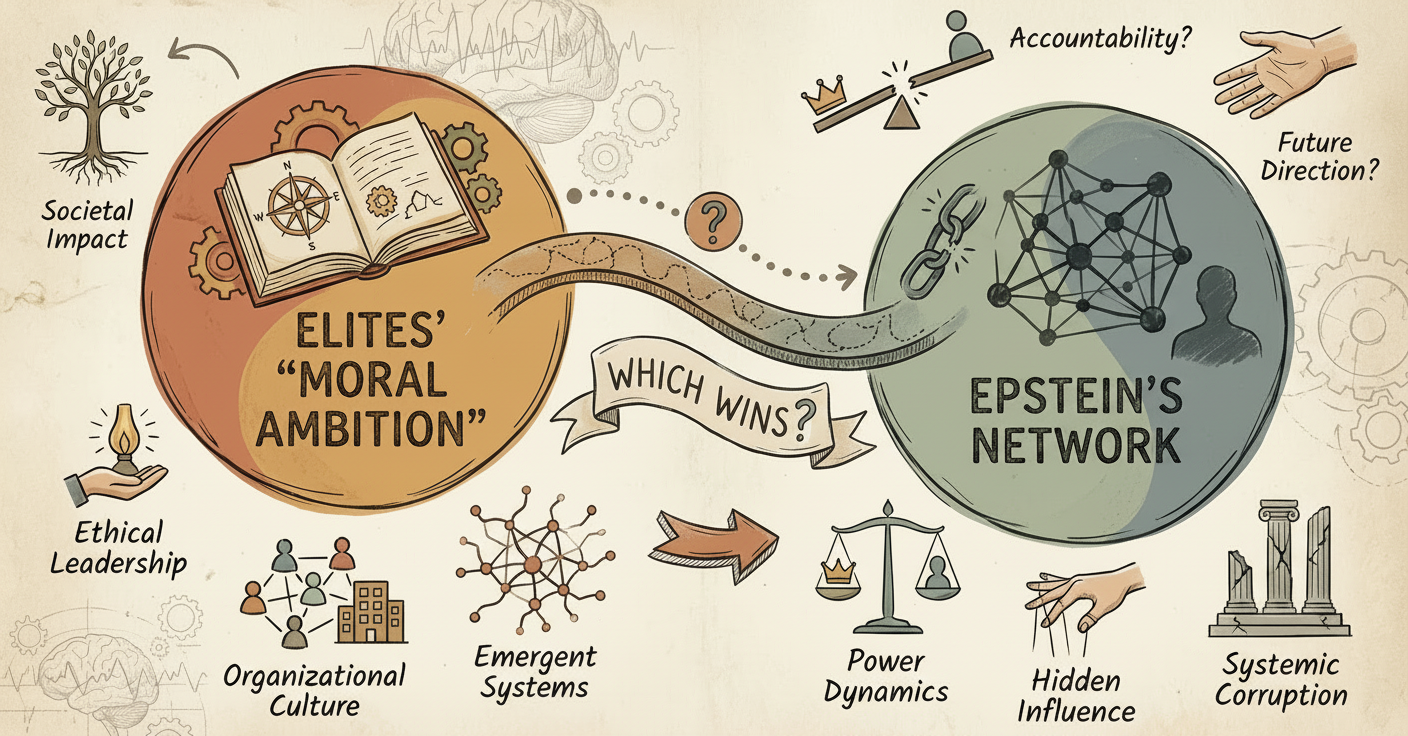
Is the pursuit of wealth and power inherently corrupting, or does it simply amplify existing flaws?
🔵 One view:
"His network is the proof that he is worth dealing with and not beyond the pale. Because if he was, well, then how would he still have this network? He is revealing how these elites make decisions about trust that I think are really different from the way folks at home go through the world."
— Anand Giridharadas, Journalist / Author on The Ezra Klein Show
- The argument: The Jeffrey Epstein saga, as dissected by Anand Giridharadas, reveals a chilling truth: for elites, networking and perceived access often trump character. The sheer breadth of Epstein's connections, spanning political, industrial, and professional divides, paradoxically served as proof of his 'worthiness.' This suggests that the pursuit of power and access within elite circles can create a system where moral judgment is distorted, fostering a transactional environment where superficial connections outweigh ethical considerations.
🔴 The counter:
"We are increasing productivity probably by 20% just by utilizing it more and we're just stuffing it in wherever we can and it's making a huge impact."
— Nicolai Tangen, CEO of Norges Bank Investment Management on The Knowledge Project
- The argument: Nicolai Tangen, CEO of the world's largest sovereign wealth fund, embodies a different perspective. His drive to inject AI everywhere for productivity and to manage a multi-trillion-dollar fund ethically, suggests that immense wealth and power can be wielded with a strong moral compass and a focus on long-term, positive societal impact. He emphasizes objective truth and the importance of diverse opinions to reduce blind spots, implying that power doesn't necessarily corrupt if actively managed with integrity and a commitment to broad well-being.
What's at stake: This tension forces leaders to confront the dual nature of ambition and power. Does it inevitably lead to moral compromises, or can it be a force for good? Understanding this helps leaders make decisions about who to trust, what networks to build, and how to safeguard against the subtle erosion of ethical judgment in high-stakes environments.
The Question
If society's most powerful individuals are often the most effective at navigating social dynamics, how do we reconcile the observation that many high-achieving elites (as exemplified by figures drawn into the Epstein narrative) exhibit profound social awkwardness or a desire to avoid 'resistance' in personal relationships? What are the unrecognized social vulnerabilities of the powerful, and what does this mean for how we select and support leaders?
📚 The Bookshelf
- Moral Ambition by Rutger Bregman — This book expands on the idea that true impact comes from pragmatic, not just passionate, effort to improve the world, exemplified by historical movements.
- The Innovator's Dilemma by Clayton M. Christensen — The classic work explaining how even good companies can fail by focusing on existing customers and technologies, a phenomenon mirrored in the Swiss watch industry's disruption.
- Rake's Digress (Substack) by Aled Maclean-Jones — The platform where Aled Maclean-Jones shares insights, including those on economic history and industry disruption, such as the Swiss watch industry.
- Take Your Shoes Off (podcast) hosted by Rick Glassman — For a deeper dive into the unconventional communication styles and boundary-setting discussions touched upon in Modern Wisdom.
The Bottom Line
This week's conversations point to a central theme: the true nature of 'fundamental' isn't always what it seems. Whether it's gravity as an emergent phenomenon, IQ as a misapplied tool, or leadership as an exercise in navigating emergent social dynamics, leaders must constantly question the foundational assumptions underpinning their decisions. The most effective strategies may not come from rigid adherence to established rules, but from understanding the deeper, often hidden, informational and emergent forces at play.
📚 APPENDIX: EPISODE COVERAGE
1. Theories of Everything with Curt Jaimungal: "Erik Verlinde: This Physicist (Unexpectedly) Derived Gravity from Information"
Guests: Curt Jaimungal (Host, Theories of Everything with Curt Jaimungal), Erik Verlinde (Professor, University of Amsterdam)
Runtime: 119 min | Vibe: Mind-bending theoretical physics challenging foundational beliefs
Key Signals:
- Emergent Reality in Physics: Erik Verlinde proposes that fundamental laws of physics are inaccessible to humans and are instead emergent approximations. This challenges reductionist views, suggesting gravity arises from quantifiable unknown information (entropy), impacting how we understand the universe's basic rules.
- Spacetime from Entanglement: Verlinde argues that spacetime's connectivity originates from quantum entanglement, similar to how molecular bonds create physical objects. This perspective draws parallels to black hole horizons and redefines our understanding of spacetime, moving beyond pre-existing assumptions.
- Critique of Foundationalism: Verlinde directly criticizes the idea that we can ever find "final laws" of physics, dismissing it as hubris. His work emphasizes that observed laws are condensations of microscopic information, pushing the boundaries of quantum gravity and its connection to cosmological observations.
"I don't believe that we'll ever get to what would be the fundamental laws, because I think there's always more than that we can understand as humans."
— Erik Verlinde, Professor at University of Amsterdam
2. Modern Wisdom: "#1060 - Rick Glassman - The Case Against Condoms & Fake Friendship"
Guests: Rick Glassman (Guest Comedian, Actor, Podcaster, Host of Take Your Shoes Off, Modern Wisdom), Chris Williamson (Host, Modern Wisdom)
Runtime: 148 min | Vibe: Candid and often humorous exploration of relational dynamics
Key Signals:
- "Condomless Friendships": Rick Glassman uses the metaphor of "condomless friendships" to advocate for relationships where individuals feel safe to express their true selves and boundaries without fear of judgment. This challenges typical societal expectations of polite, superficial social interactions, promoting deeper authenticity.
- Proactive Boundary Setting: The discussion highlights the value of proactive boundary setting, suggesting that clear communication about personal quirks and needs should be established early in relationships, potentially through an 'induction day.' This offers a structured approach to fostering psychological safety and honest feedback, moving beyond implicit expectations.
- Embracing "Non-Fungible" Traits: Glassman and Williamson argue for embracing unique, "non-fungible" characteristics rather than striving for conformity. They reveal how often social interactions, like small talk, are learned behaviors rather than innate skills, underscoring the importance of tailored communication in relationships.
"I just think it's important to... in friendships, be able to have friendships where you don't have to wear a condom."
— Rick Glassman, Comedian, Actor, Podcaster, Host of Take Your Shoes Off
3. Worklife with Adam Grant: "ReThinking: Searching for life on other planets with astrophysicist Sara Seager"
Guests: Adam Grant (Host, Worklife with Adam Grant), Sara Seager (Astrophysicist and Planetary Scientist, MIT)
Runtime: 30 min | Vibe: Inspirational and insightful exploration of extraterrestrial life
Key Signals:
- Low Probability of Intelligent Life: Despite trillions of exoplanets, Sara Seager argues the probability of finding intelligent life nearby is low due to strict evolutionary and communicative conditions. This challenges popular perceptions and emphasizes humility in contemplating humanity's place in the cosmos.
- Accidental Scientific Discoveries: Adam Grant reveals that approximately half of all patents are accidental or spontaneous discoveries, not driven by planned searches. This highlights the role of serendipity and "crazy ideas" in scientific advancement, underscoring the importance of openness and challenging authority.
- Life in Extreme Environments: Seager's controversial hypothesis suggests microbial life might exist in Venus's concentrated sulfuric acid clouds. This broadens the definition of habitable environments beyond water-based assumptions, revolutionizing astrobiological search parameters.
"To solve practical problems on Earth, we need a lot of people trained in technological sciences, like in physics and engineering and math and other topics. And one of the big things we do in astronomy is we communicate to the public the wonders of science."
— Sara Seager, Astrophysicist and Planetary Scientist at MIT
4. From The Culture: "S1, E7 - Fun, Meaning and The Cultures That Work"
Guests: Marcus Collins (Host), Amanda Slavin (Host), Lenore Skenazy (Speaker, Syndicated Columnist, Author, Free-Range Parenting Movement), Marcus (Host, From The Culture), Amanda (Host, From The Culture)
Runtime: 62 min | Vibe: Thought-provoking discussion on work, meaning, and cultural influence
Key Signals:
- Culture Shapes Meaning and Behavior: Marcus Collins and Amanda Slavin emphasize how organizational culture profoundly shapes perception and behavior, contrasting it with a transactional view of work. This highlights that growth, for both individuals and organizations, is driven by meaning, not just productivity.
- The Cost of Productivity: Amanda Slavin shares her burnout experience from an overly productive work culture, revealing the personal toll. This challenges the myth that relentless efficiency invariably leads to success, advocating for a re-evaluation of how work impacts well-being and sense of purpose.
- Trust Over Information for Peace of Mind: The discussion on "free-range parenting" argues that true peace of mind comes from trust, not constant surveillance. This extends to organizational contexts, suggesting that relinquishing control and fostering autonomy (for children and employees) encourages growth and self-reliance more effectively than micromanagement.
"Culture is a realized signifying system. It is the system by which we translate the world and make meaning of it."
— Marcus Collins, Host
5. Huberman Lab: "The Most Effective Weight Training, Cardio & Nutrition for Women | Dr. Lauren Colenso-Semple"
Guests: Lauren Colenso-Semple (PhD in Integrative Physiology and Certified Strength and Conditioning Specialist, Scicomm Media), Scicomm Media (Host, Scicomm Media), Dr. Lauren Colenso-Semple (Guest), Andrew Huberman (Host, Scicomm Media)
Runtime: 152 min | Vibe: Science-backed deep dive into women's fitness and debunking myths
Key Signals:
- Similar Physiological Responses in Men and Women: Dr. Lauren Colenso-Semple debunks the myth that women respond fundamentally differently to exercise than men. She asserts that at the cellular level, both genders respond very similarly to training, with baseline muscle mass differences primarily due to testosterone.
- "Bulking Up" Myth Debunked: The widespread fear among women of "bulking up" from resistance training is largely unsubstantiated. Colenso-Semple states that achieving extreme muscularity without pharmacological assistance is highly improbable, requiring exceptional effort, thereby encouraging women to embrace weight training without this concern.
- Redefining Acute Hormonal Response: Previous theories suggesting that acute post-exercise hormonal surges (like testosterone) drive muscle growth are now understood not to predict long-term adaptation. This shifts focus from chasing momentary hormonal spikes to consistent progressive overload as the primary driver of sustained fitness benefits.
"The data says men and women respond to exercise very similarly."
— Lauren Colenso-Semple, PhD in Integrative Physiology and Certified Strength and Conditioning Specialist at Scicomm Media
6. Modern Wisdom: "#1059 - James Sexton - Divorce Lawyer: “Give her a prenup on the 3rd date”"
Guests: James Sexton (Divorce Attorney and Author, Law Office of James Sexton), Chris Williamson (Host, Modern Wisdom Podcast)
Runtime: 119 min | Vibe: Pragmatic, sometimes cynical, insights into relationships and legal realities
Key Signals:
- Everyone Has a "Prenup": James Sexton argues that every married couple implicitly has a prenup, either one they've created or a default one dictated by government laws. This highlights the legal and financial ramifications of marriage, urging intentional conversations about expectations early in a relationship.
- Early Prenup Discussions for Safety: Sexton controversially suggests discussing prenups as early as the third date. His rationale is that it normalizes the conversation, establishes clear rules, and fosters a sense of safety and vulnerability before potential disputes arise, potentially reducing divorce rates.
- High Divorce Rates in Professional Athletes: Professional athletes face significantly higher divorce rates (close to 70%), with fifty percent occurring within a year of retirement. This is attributed to an identity crisis post-career, underscoring the importance of purpose beyond profession for relationship stability.
"Everyone, every person who's married has a prenup. It's either one that was written by the government and can be changed by the government at any time without your notice... or it's a contract written by the two people that claim to love each other."
— James Sexton, Divorce Attorney and Author
7. EconTalk: "Seiko, Swatch, and the Swiss Watch Industry (with Aled Maclean-Jones)"
Guests: Russ Roberts (Host, Shalem College and Stanford University's Hoover Institution), Aled Maclean-Jones (Writer, Rake's Digress (Substack))
Runtime: 61 min | Vibe: Engaging economic history lesson on industry disruption and reinvention
Key Signals:
- Repositioning Value Post-Disruption: The Swiss watch industry, devastated by Japanese quartz technology, didn't compete on price or accuracy. Instead, it pivoted to reposition mechanical watches as luxury items, emphasizing craftsmanship and storytelling. This demonstrates how industries can thrive by redefining their value proposition in the face of technological obsolescence.
- Marketing as Core Strategy: Figures like Jacques Piguet and Jean Claude Beaver launched luxury brands with minimal product, relying heavily on marketing and perceived allure. This highlights that effective branding and narrative can create demand and market share, even when competing against superior technology.
- Optimistic View of Creative Destruction: The Swiss watch industry's resurrection offers a counter-narrative to typical creative destruction scenarios. It illustrates that industries can adapt and reinvent themselves, showcasing resilience and innovation beyond purely technological competition.
"The problem was they didn't really have any cash, so they basically had a, I think a borrowed Volkswagen Westphalia, which is an excellent campervan by all sounds, but. And they were there for the Basel Fair..."
— Aled Maclean-Jones, Writer at Rake's Digress
8. Hidden Brain: "Why You're Smarter Than You Think"
Guests: Shankar Vedantam (Host, Hidden Brain), Scott Barry Kaufman (Cognitive Scientist, Columbia University), Nick McIntosh (Psychometrician, Author of The Science of IQ), James Cordova (Psychologist, Clark University)
Runtime: 94 min | Vibe: Comforting and intellectually rigorous re-evaluation of intelligence
Key Signals:
- IQ Tests' Misapplication: Scott Barry Kaufman explains that Alfred Binet intended the IQ test as a diagnostic tool for educational support, not a measure of innate intelligence. Its misuse in the US for categorization distorted its purpose, demonstrating how context and interpretation can profoundly alter a scientific instrument's impact.
- Creativity and IQ's Inverse Relationship: Insights suggest an inverse relationship between certain high IQ scores and creativity. This implies that traditional intelligence measures often overlook crucial aspects of human potential, particularly in artistic and innovative domains.
- Implicit Learning Ignored by IQ: Implicit learning, the ability to grasp probabilistic rule structures unconsciously, is virtually uncorrelated with IQ scores. This highlights a significant cognitive ability missed by standard intelligence tests, suggesting a broader definition of 'smartness' is needed.
"This is not an intelligence test that I'm creating. This is a test that I've been given the task of differentiating those who would need more remediation and those who don't. We say only about the child's current needs, not his future potential."
— Scott Barry Kaufman, Cognitive Scientist at Columbia University
9. Conversations With Coleman: "Is Your Life Morally Ambitious Enough?"
Guests: Rutger Bregman (Dutch Historian and Author, N/A), The Free Press (Host, N/A)
Runtime: 71 min | Vibe: Challenging and thought-provoking analysis of ethics and impact
Key Signals:
- Pragmatism in Moral Ambition: Rutger Bregman argues that effective moral ambition often requires pragmatic, incremental goals rather than moral absolutism. The British abolitionist movement's success in ending the slave trade (before full abolition) serves as a case study, showing that tangible results can be prioritized over idealized purity.
- "Follow Your Passion" Critiqued: Bregman criticizes the popular advice to "follow your passion," contending it often limits impact. He suggests passions can narrow focus, whereas moral ambition, when strategically applied, can yield far greater contributions to societal improvement.
- Historical Costs of Moral Endeavors: The British spent up to 2% of their GDP for decades to abolish the slave trade, making it one of the most expensive moral efforts in history. This highlights the significant economic commitment sometimes required for profound ethical change, defying purely cost-benefit analyses.
"It is the desire to make this world a wildly better place and to use what you have. Your scarce resources, most importantly your time, but also your talent, your capital, your access to certain cultural networks, your podcast, anything you have to make the biggest possible impact for as many people as possible. That's, that's moral ambition."
— Rutger Bregman, Dutch Historian and Author
10. The Knowledge Project: "Nicolai Tangen: The $2 Trillion Mind"
Guests: Nicolai Tangen (CEO, Norges Bank Investment Management), Shane Parrish (Host, The Knowledge Project)
Runtime: 63 min | Vibe: Pragmatic and contrarian insights from a leading global investor
Key Signals:
- Contrarian Investment Strategy: Nicolai Tangen, CEO of the world's largest sovereign wealth fund, champions a contrarian approach, suggesting that in an AI-hyped market, a move towards less AI-related and more real estate investments could be strategic. This challenges herd mentality in major capital allocation.
- AI for Universal Productivity: Tangen posits that if he were Prime Minister, he would inject AI "everywhere" to boost ambition and productivity by 20%. This highlights a belief in AI as a core infrastructure for national economic growth, not just a sector-specific tool.
- Cultural Change as a Decade-Long Project: Changing organizational culture effectively requires a 10-year commitment, slow action, and unified leadership to avoid triggering the organization's "immune system." This underscores the deep inertia and resistance inherent in large-scale change efforts.
"If I were like Prime Minister for day, I would inject AI everywhere."
— Nicolai Tangen, CEO of Norges Bank Investment Management
11. The Mel Robbins Podcast: "What it Takes to Find & Keep True Love: The Best Advice No One Ever Told You"
Guests: Mel Robbins (Host, The Mel Robbins Podcast), Logan Ury (Director of Relationship Science, Behavioral Scientist, Dating Coach, Bestselling Author, Hinge), Logan Urie (Director of Relationship Science, Hinge)
Runtime: 63 min | Vibe: Actionable and empathetic advice for modern dating challenges
Key Signals:
- "Dating Like a Scientist": Logan Ury advocates for applying the scientific method—forming hypotheses, running experiments, and testing assumptions—to dating. This approach combats dating app burnout and fear of rejection by reframing failed dates as valuable data points for growth.
- "Prom Date vs. Life Partner Mentality": The segment stresses shifting from superficial criteria to prioritizing qualities like emotional stability, kindness, loyalty, and growth mindset for long-term relationships. This challenges the common focus on immediate "sparks" or potential, emphasizing realistic assessment of current compatibility.
- Toxic Anxious-Avoidant Loop: The dating pool disproportionately consists of anxiously and avoidantly attached individuals, creating a "toxic loop" as securely attached individuals are often already in relationships. This sheds light on persistent dating challenges and offers insights into common relationship patterns.
"If you're in your 20s or 30s, I know you've had it with dating. ...all of their friends, regardless of gender, are saying how toxic the dating scene is. The endless swiping, the ghosting, the fact that everyone is dating a million people at the same time..."
— Mel Robbins, Host of The Mel Robbins Podcast
12. The Ezra Klein Show: "The Infrastructure of Jeffrey Epstein’s Power"
Guests: Ezra Klein (Host, New York Times Opinion), Anand Giridharadas (Journalist / Author, The.Ink / New York Times)
Runtime: 86 min | Vibe: Disturbing and incisive analysis of elite complicity
Key Signals:
- Elite Social Dynamics Over Character: Anand Giridharadas highlights how Epstein leveraged his vast network for credibility, revealing that for many elites, transactional relationships and perceived access outweighed character judgments. This exposes a systemic vulnerability in powerful circles where connections can validate morally compromised individuals.
- Epstein's "Proof of Worthiness": Epstein's network itself became proof he was "worth dealing with," despite clear red flags. This demonstrates a perverse logic where continued association by powerful figures signaled acceptance, blinding many to his illicit activities.
- Social Insecurity of the Powerful: Many successful, elite individuals, despite their professional intelligence, exhibited social awkwardness and a desire to avoid 'resistance' in personal relationships, making them susceptible to Epstein's manipulation and offerings of 'easy' social access. This reveals unexpected social vulnerabilities among high-status individuals.
"His network is the proof that he is worth dealing with and not beyond the pale. Because if he was, well, then how would he still have this network? He is revealing how these elites make decisions about trust that I think are really different from the way folks at home go through the world."
— Anand Giridharadas, Journalist / Author on The Ezra Klein Show