
The soft landing narrative is giving way to a more complex reality: geopolitical shifts and massive capital allocation to AI are reshaping the global economic order, forcing a re-evaluation of long-held investment theses.
The Intake
Midweek macro. The patterns, levels, and positioning calls that the market is talking about.
This week's signal:
📊 10 episodes across 9 podcasts
⏱️ 596 minutes of market intelligence
🎙️ On the record: Daniel Mahncke, Shawn O’Malley, Mikkel Rosenvold, Andreas Steno Larsen, Michael Every, Richard Clarida
📈 20 non-consensus calls surfaced
The Big Shift
The ‘Reverse Gorbachev’: How Trump's Economic Vision Could Redefine Capital Allocation
The post-Cold War liberal world order is breaking down, and with it, the traditional investment playbook. Michael Every (Global Strategist, Rabobank) posits a "reverse Gorbachev" thesis to describe Donald Trump's economic strategy. Far from a conservative adherence to traditional free-market principles, Trump's approach aims to shift the US from an economy weighted heavily towards consumption and financialization to one focused on national security and industrial strength. This could entail significant short-term economic pain and higher inflation, fundamentally altering the landscape for capital deployment.
Why it matters: If this vision materializes, it implies a dramatic re-onshoring and re-industrialization effort, potentially leading to differentiated interest rates for national security sectors and a new "Warsaw Pact" of economically aligned nations. This is not merely a policy shift but a fundamental regime change that will dictate where capital flows, how supply chains are structured, and which industries receive strategic government support.
"I think you can actually draw a real comparison between Trump and former Soviet President Gorbachev... Gorbachev tried to do and obviously failed badly and the system collapsed. Trump is trying to take a system which many people are very happy with and would say, why are you changing it? Which is overly weighted towards consumption and financialization..."
— Michael Every, Global Strategist on The Grant Williams Podcast
The level: Watch for explicit policy proposals around industrial subsidies, targeted tariffs, and increased defense spending that favor domestic production over globalization, indicating the acceleration of this national security-driven economic build-out.
The Rundown
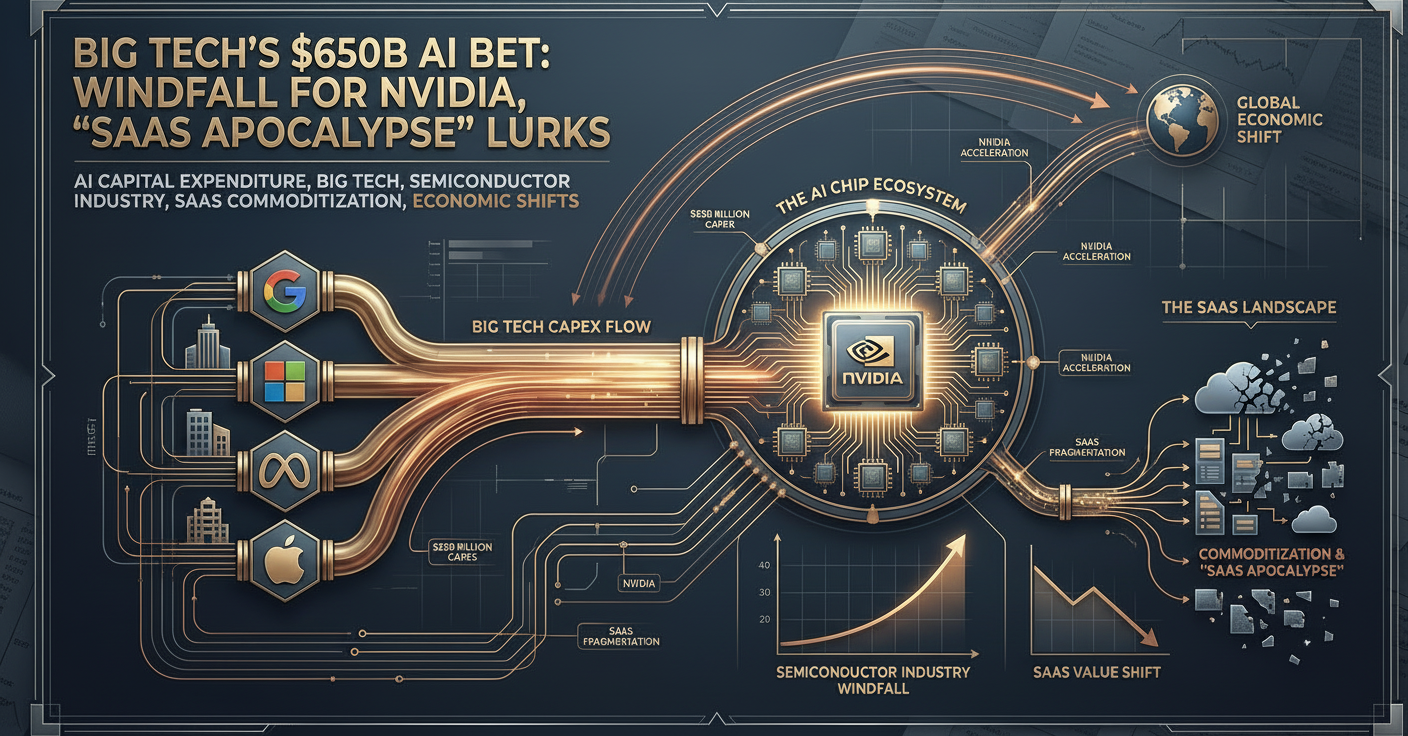
① Big Tech's AI Capital Expenditure Hits Unprecedented Levels. Meta, Microsoft, Alphabet, and Amazon are collectively projected to spend $650 billion by 2026 on AI development, an investment so vast it shocked even bullish AI investors. (Travis Hoium on Motley Fool Money)
• Why it matters: This massive capex is a windfall for semiconductor companies like NVIDIA and infrastructure providers like Dell, but it also raises significant questions about market commoditization and the "SaaS apocalypse" as AI threatens to replace traditional software functions.
② Hermès Defies Conventional Luxury Economics. Hermès maintains its ultra-luxury status by intentionally limiting supply, practicing strict local manufacturing, and implementing rigorous artisan training. This strategy creates unparalleled scarcity and prestige, allowing it to cultivate exclusive demand rather than cater to aspirational buyers. (Shawn O’Malley on The Intrinsic Value Podcast - The Investor’s Podcast Network)
• The signal: The success of Hermès underscores that in certain luxury segments, scarcity and strategic inaccessibility can be more powerful drivers of value and profit than volume or broad market reach, especially in markets like China where luxury demand is immense.
③ Biotech Investing Requires a Redefined Toolkit. Traditional factor models (value, quality, momentum) fail in biotech due to the prevalence of unprofitable companies. New metrics, such as market cap to spend for value and specialist ownership for quality, are emerging as more effective valuation tools. (Dan Rasmussen on The Meb Faber Show - Better Investing)
"Most biotechs lose money. I think the caricatures that biotech companies especially, and we folks hear this paper's on unprofitable biotech, so it doesn't include Merck or something. But what you see in unprofitable biotech is that 70% of these companies, the public equities, lose money."
— Dan Rasmussen, Founder of Verdad Advisers on The Meb Faber Show - Better Investing
• The level: Operators and investors in biotech should shift their focus from traditional P/E ratios to metrics that reflect R&D expenditure and ownership by sector specialists to accurately assess early-stage company potential and risk.
④ The 'Shadow Hiring Market' Distorts Labor Data. Beneath headline unemployment figures, a significant 'shadow hiring market' exists, where mass retirements (2 million+ Americans annually) are replaced by younger workers. These replacement hires don't register as new job creation in non-farm payrolls, masking underlying labor market fragmentation. (Frances Donald on Bloomberg Surveillance)
• Why it matters: This suggests labor market tightness might be greater than official statistics indicate, potentially contributing to persistent inflation even amidst what appears to be moderating job growth, challenging the Fed's narrative on rate hikes and economic cooling.
⑤ Systematic Investing Outperforms Discretionary in Volatile Markets. The dramatic volatility in silver markets, dubbed 'Freaky Friday', underscored how systematic investors employing dynamic position sizing and robust risk management were able to navigate severe one-day drops and even outperform, contrasting sharply with those relying solely on discretionary calls. (Rob Carver on Top Traders Unplugged)
• The signal: This highlights the increasing importance of quantitative approaches to risk management and active portfolio adjustments in environments characterized by rapid, unpredictable market swings, reinforcing the value of rules-based strategies over human judgment during extreme events.
The Heat Map
🔥 HEATING UP
- Big Tech AI Capex: Unprecedented spending shifts focus to infrastructure and chip suppliers. (Travis Hoium on Motley Fool Money)
- China's Biotech Investment: Government-backed expansion makes it a major source for Big Pharma acquisitions. (D.A. Wallach on The Meb Faber Show - Better Investing)
- Geopolitical Realignment: The shift to national security-focused economies is driving new industrial policies. (Michael Every on The Grant Williams Podcast)
👀 ON WATCH
- 🆕 Autonomous Driving Future for Uber: Uber pivots to a partnership model for AVs, balancing network aggregation with strategic balance sheet investment. (Andrew Macdonald on The Compound and Friends)
- Japan's Economic Revitalization: New leadership and policy reforms could lead to higher growth and lower yields. (Paul Sweeney on Bloomberg Surveillance)
- Kevin Warsh Fed Chair Nomination: A potential nominee whose views are highly correlated with the sitting president, impacting monetary policy. (Andreas Steno Larsen on Real Vision: Finance & Investing)
🧊 COOLING OFF
- Traditional Biotech Valuation Models: Factor models for value, quality, and momentum prove ineffective in the sector. (Dan Rasmussen on The Meb Faber Show - Better Investing)
- Broad Market Bubble Narrative: Significant software stock sell-off is not dragging down the broader market, signaling a healthy rotation not a systemic crash. (Michael Batnick on The Compound and Friends)
The Debate
Is the soft landing thesis still viable, or is a macro regime shift ushering in sustained high inflation?
🐂 The bull case:
"The big game changer now is that we see cyclical growth returning. This cyclical backdrop arrives at the same time as probably the softest inflation reports in years over the next couple of months."
— Andreas Steno Larsen, Founder and CEO of Steno Research on Real Vision: Finance & Investing
🐻 The bear case:
"The issue is based on our outlook, we're going to stay in the high twos and around 3% through the end of this year. So it wouldn't surprise me if you had me back a year from now that we're celebrating the six year anniversary of inflation above the 2% target."
— Frances Donald, Chief Economist at RBC on Bloomberg Surveillance
Our read: The market is caught between near-term disinflationary pressures and long-term structural shifts. While a soft landing remains possible for now, the underlying currents—driven by de-globalization, re-industrialization, and massive AI capex—suggest a higher baseline inflation environment going forward. Operators should prepare for a world where 3% inflation is the new 2%, impacting everything from input costs to discount rates.
The Bottom Line
The geopolitical and technological shifts driving capital allocation are too profound to ignore; successful operators and investors need to adapt their strategies to a world where national security and AI dominance increasingly outweigh traditional drivers of efficiency and globalization.
🎯 Your Move
- Audit your supply chain for national security exposure: If the "reverse Gorbachev" thesis plays out, expect government incentives and disincentives that will favor domestic or allied production in key sectors; position accordingly.
- Re-evaluate your software spend in light of AI's commoditization threat: Big Tech's massive AI investments suggest a future where many standard software functions are replaced or dramatically undermined; identify areas of high vulnerability in your tech stack.
- Stress-test your unit economics for a sustained 3% inflation environment: The "shadow hiring market" and persistent inflation signals mean that even if the Fed softens, higher costs are here to stay; ensure your pricing power and cost structures can absorb this new reality.
What We Listened To
1. The Intrinsic Value Podcast - The Investor’s Podcast Network: "TIVP058: Hermes: The Most Prestigious Luxury Brand in the World w/ Daniel Mahncke & Shawn O’Malley"
Guests: Daniel Mahncke (Host, The Investor's Podcast Network), Shawn O’Malley (Host, The Investor's Podcast Network) Runtime: 87 min | Vibe: An in-depth dive into the counter-intuitive strategies of ultra-luxury brand Hermès.
Key Signals:
- Scarcity as a Mote: Hermès intentionally undersupplies its most coveted items, creating immense demand and maintaining prestige by making products difficult to acquire.
- Unparalleled Craftsmanship: The brand's commitment to strict local manufacturing, rigorous artisan training over years, and multi-decade family control ensures quality and exclusivity that defies modern mass-production.
- Dominance in Asia: Hermès enjoys significantly higher profit margins in markets like China (near 50%) due to overwhelming demand relative to supply, underscoring the power of exclusivity in high-growth economies.
"If a brand could start from scratch and choose which customers they want to serve, I'm actually quite sure most would go with the top 0.1%. And even if you look at the numbers, that's the fastest growing cohort of luxury shoppers in the world with a CAGR of about 9% in the last decade."
— Shawn O’Malley, Host on The Intrinsic Value Podcast - The Investor’s Podcast Network
2. Motley Fool Money: "Big Tech’s $650 Billion Bet on AI"
Guests: Travis Hoium (Host, Motley Fool Money), Lou Whiteman, Jon Quast, John Quast (Analyst, Motley Fool Money), Dan Boyd (Producer, Motley Fool Money) Runtime: 42 min | Vibe: A lively discussion on the monumental capital being poured into AI by tech giants.
Key Signals:
- Unprecedented AI Capex: Big Tech (Meta, Microsoft, Alphabet, Amazon) is committing $650 billion to AI by 2026, signaling an all-in bet on the technology that surprises even bullish investors.
- Beneficiaries and Commoditization: This massive spending primarily benefits semiconductor giants like Nvidia and server providers like Dell, but also raises concerns about AI commoditizing existing software services, potentially leading to a "SaaS apocalypse."
- Overlooked Opportunities: Companies like Dell, trading at 10x forward earnings, are quietly benefiting from massive server demand driven by this AI capex, often overlooked by investors chasing high-growth AI names.
"Between Meta, Microsoft, Alphabet and Amazon, we got guidance for about 650 billion in capex for 2026. Even the most bullish AI investors were shocked at how much money these companies are spending."
— Travis Hoium, Host on Motley Fool Money
3. Real Vision: Finance & Investing: "Is Macro Regime Shift Underway? ft. Andreas Steno & Mikkel Rosenvold"
Guests: Mikkel Rosenvold (Partner and Head of Geopolitics, Real Vision), Andreas Steno Larsen (Founder and CEO, Steno Research) Runtime: 34 min | Vibe: A deep dive into the underlying forces driving major shifts in the global economic landscape.
Key Signals:
- Cyclical Growth & Soft Inflation: A macro regime shift is underway with cyclical growth returning alongside surprisingly soft inflation reports, partly due to incentivized corporate CAPEX spending.
- Kevin Warsh's Shifting Stance: The consensus view of Kevin Warsh as an inherently hawkish Fed chairman is debated, with observations that his views correlate with the sitting president, implying a more cooperative monetary and fiscal policy if he were to lead the Fed.
- Geopolitical Risks: Increased likelihood of an Iran strike by the US or Israel could significantly impact oil markets, presenting a clear tail risk for global energy prices.
"The big game changer now is that we see cyclical growth returning. This cyclical backdrop arrives at the same time as probably the softest inflation reports in years over the next couple of months."
— Andreas Steno Larsen, Founder and CEO of Steno Research on Real Vision: Finance & Investing
4. The Grant Williams Podcast: "The Grant Williams Podcast Ep. 115 - Michael Every FULL EPISODE"
Guests: Grant Williams (Host, The Grant Williams Podcast), Michael Every (Global Strategist, Rabobank), Michael Wolraich (Commentator, Independent) Runtime: 81 min | Vibe: A provocative and candid discussion on the unraveling of the liberal world order.
Key Signals:
- "Reverse Gorbachev" Thesis: Donald Trump's strategy aims to reorient the US economy from consumption/financialization towards national security and industrial strength, even at the cost of short-term pain, contrasting with Gorbachev's failed reforms.
- Europe as Geopolitical Price-Takers: Europe is likened to Egypt during the 1956 Suez crisis, becoming geopolitical "price-takers" rather than "price-setters" due to diminished financial and military influence, facing pressure to align with US interests.
- Financialization's Impact: The pre-Trump US economic system, focused on financialization and lacking long-term planning, led to atrophied capital stock and reliance on a Fed-centric system with soft budget constraints.
"The liberal world order we had built, if you really stripped it down to its moving parts, was for various reasons undermining American military industrial strength... American muscle relatively had atrophied far enough it itself as a country would walk away from the liberal world order to try and build up some muscle again."
— Michael Every, Global Strategist at Rabobank on The Grant Williams Podcast
5. Odd Lots: "How a Former Fed Vice-Chair Is thinking About the Next Fed Chair"
Guests: Richard Clarida (Global Economic Advisor and Former Vice-Chair of the Federal Reserve Board, Pimco), Tracy Alloway (Host, Bloomberg), Joe Weisenthal (Host, Bloomberg) Runtime: 51 min | Vibe: An insightful look into Fed dynamics ahead of a potential leadership change, from an insider's perspective.
Key Signals:
- Warsh's Evolving Views: Kevin Warsh, often perceived as a hawk, has shown a recent tendency to advocate for lower rates, suggesting his stance is more nuanced or adaptable depending on the political landscape.
- QE as Maturity Transformation: Modern Quantitative Easing primarily alters the maturity composition of government debt from fixed to floating through interest paid on bank reserves, rather than simply "printing money."
- AI's Short-Term Inflationary Push: While AI may offer long-term disinflationary potential, its short-term impact is primarily demand-side, potentially contributing to inflationary pressures before any productivity gains materialize.
"Kevin has been publicly and consistently critical of every expansion in the Fed's balance sheet since the first QE1 program."
— Richard Clarida, Global Economic Advisor and Former Vice-Chair of the Federal Reserve Board on Odd Lots
6. The Compound and Friends: "Momentum Stock Slaughterhouse"
Guests: Michael Batnick (Host, Ritholtz Wealth Management), Downtown Josh Brown (Host, Ritholtz Wealth Management), John Mowry (Chief Investment Officer, Portfolio Manager and Equity Strategist, NFJ Investment Group), John Lynch (Guest, NFJ Investment Group (a Virtus affiliate)) Runtime: 85 min | Vibe: A candid and engaging discussion on market divergences and the shifting landscape for investors.
Key Signals:
- Software's "Anti-Bubble": A severe downturn in a massive segment of software stocks (down 25%) is occurring while the broader S&P 500 remains near all-time highs; this divergence is historically unprecedented and suggests a healthy market rotation, not a pervasive bubble.
- Factor Decay in Value Investing: The efficacy of traditional value factors has diminished post-2008, partly due to the commoditization of alpha by ETFs and passive money, necessitating new approaches to value identification.
- Cyclical Shift: Market leadership is rotating from perceived "AI winners" towards sectors like energy, materials, and regional banks, which are demonstrating strong fundamentals and undisrupted value.
"I'm seeing liquidations in some of the most popular stocks of the last three years. Look, physically you can tell it's margin related selling, it's people being called out of stocks at any price."
— Michael Batnick, Host at Ritholtz Wealth Management on The Compound and Friends
7. Bloomberg Surveillance: "Traders Brace for Economic Data Flood"
Guests: Jean Boivin (Global Head of Research, BlackRock Investment Institute), Frances Donald (Chief Economist, RBC), Tom Keene (Host, Bloomberg), Paul Sweeney (Host, Bloomberg), Ian Bremmer (President, Eurasia Group) Runtime: 39 min | Vibe: A fast-paced exploration of market drivers, from AI to geopolitics.
Key Signals:
- AI's Unfulfilled Productivity Promise: Despite the hype, AI has yet to significantly boost productivity or break the 150-year 2% US growth ceiling, suggesting its true economic impact is still prospective.
- Persistent Inflation: The US is likely to remain in a high-twos to 3% inflation range, potentially marking a six-year anniversary of above-2% inflation, hinting at a longer-term shift in inflationary expectations.
- Emerging Markets Opportunity: BlackRock maintains a positive outlook for emerging markets by 2026, driven by a weaker dollar and the pervasive, long-term impact of AI, with tactical opportunities noted in China due to shifting regulatory stances.
"I don't think we've seen the productivity yet. I do think that this is the potential is real. I mean, and I think it's going to take some time to see it. But like we, for, we think for the first time it's conceivable that AI could be powerful enough to finally break us out of a 2% growth world which we haven't broke in the US for 150 years."
— Jean Boivin, Global Head of Research at BlackRock Investment Institute on Bloomberg Surveillance
8. The Meb Faber Show - Better Investing: "Dan Rasmussen & D.A. Wallach on Biotech’s Surge, China, IPOs, US Valuations & Japan | #617"
Guests: Meb Faber (Co-Founder and Chief Investment Officer, Cambria Investment Management), Dan Rasmussen (Founder, Verdad Advisers), D.A. Wallach (Venture Capital Investor, Time BioVentures) Runtime: 75 min | Vibe: A deep dive into the complex world of biotech investment and global market divergences.
Key Signals:
- Biotech's Unique Valuation: Traditional factor models fail in biotech due to many unprofitable companies; new metrics like market cap to spend (value) and specialist ownership (quality) are necessary to capture true potential.
- China's Biotech Ascendancy: Government investment and lower costs for early-stage clinical trials have made China a major player, with 30-40% of Big Pharma's early-stage acquisitions now sourced from Chinese companies.
- US Valuation Divergence: High US equity valuations (Schiller CAPE ratio) are attributed to continuous innovation in cloud computing and AI, while traditional value investing still thrives outside the US, particularly in Japan following corporate governance reforms.
"It's become much, much cheaper to do early stage clinical drug Development work... in China, than it is to do that work outside of China."
— D.A. Wallach, Venture Capital Investor for Time BioVentures on The Meb Faber Show - Better Investing
9. Top Traders Unplugged: "SI386: When Position Sizing Saves You ft. Rob Carver"
Guests: Niels Kaastrup-Larsen (Host, Top Traders Unplugged), Rob Carver (Quantitative Trading Author and Educator, Rob Carver) Runtime: 69 min | Vibe: An insightful discussion on quantitative trading's role in managing extreme market volatility.
Key Signals:
- Systematic Risk Management: The importance of dynamic position sizing and robust diversification was highlighted during extreme volatility (e.g., 'Freaky Friday' in silver markets), where systematic trading proved more resilient than discretionary.
- Liquidity Myths: New traders often overestimate commodity market liquidity, leading to magnified losses during adverse price moves, a 'cinema with only one fire door' effect.
- CTA Portfolio Optimization: For crisis tail protection, optimal CTA portfolios should increase allocation to traditional liquid futures markets to 50% (from a generic 30%), even if it means foregoing some standalone Sharpe ratio.
"The main lesson here is for risk management. And the two key things about risk management are position sizing and diversification. So on Friday, I lost 3% of my total account value because I have a reasonably diversified portfolio."
— Rob Carver, Quantitative Trading Author and Educator on Top Traders Unplugged
10. The Compound and Friends: "Autonomous Driving Is a Trillion Dollar Opportunity With Uber President Andrew Macdonald"
Guests: Downtown Josh Brown (Host, The Compound and Friends), Andrew Macdonald (President and Chief Operating Officer, Uber) Runtime: 33 min | Vibe: A forward-looking conversation on how Uber approaches the future of mobility, particularly autonomous vehicles.
Key Signals:
- Uber's AV Partnership Model: Uber is not trying to build all AV tech in-house but instead partners with multiple developers (e.g., Lucid, Nuro) to aggregate supply, focusing on utilization and consumer experience.
- Strategic Balance Sheet Use: While Uber is typically asset-light, it's strategically using its balance sheet to invest in AV fleets to foster ecosystem growth, ensuring it leads in the autonomous future rather than being at the mercy of AV providers.
- Autonomous Delivery's Unit Economics: In certain markets like Los Angeles, autonomous delivery robots already boast better unit economics than human couriers, offering benefits to both Uber and consumers.
"I want to have them on our network. I don't want to have them on our balance sheet. But there's a difference between what we think the end state model looks like and what we think we need to do in the next couple of years to make sure that we lead in that end state model."
— Andrew Macdonald, President and Chief Operating Officer at Uber on The Compound and Friends