
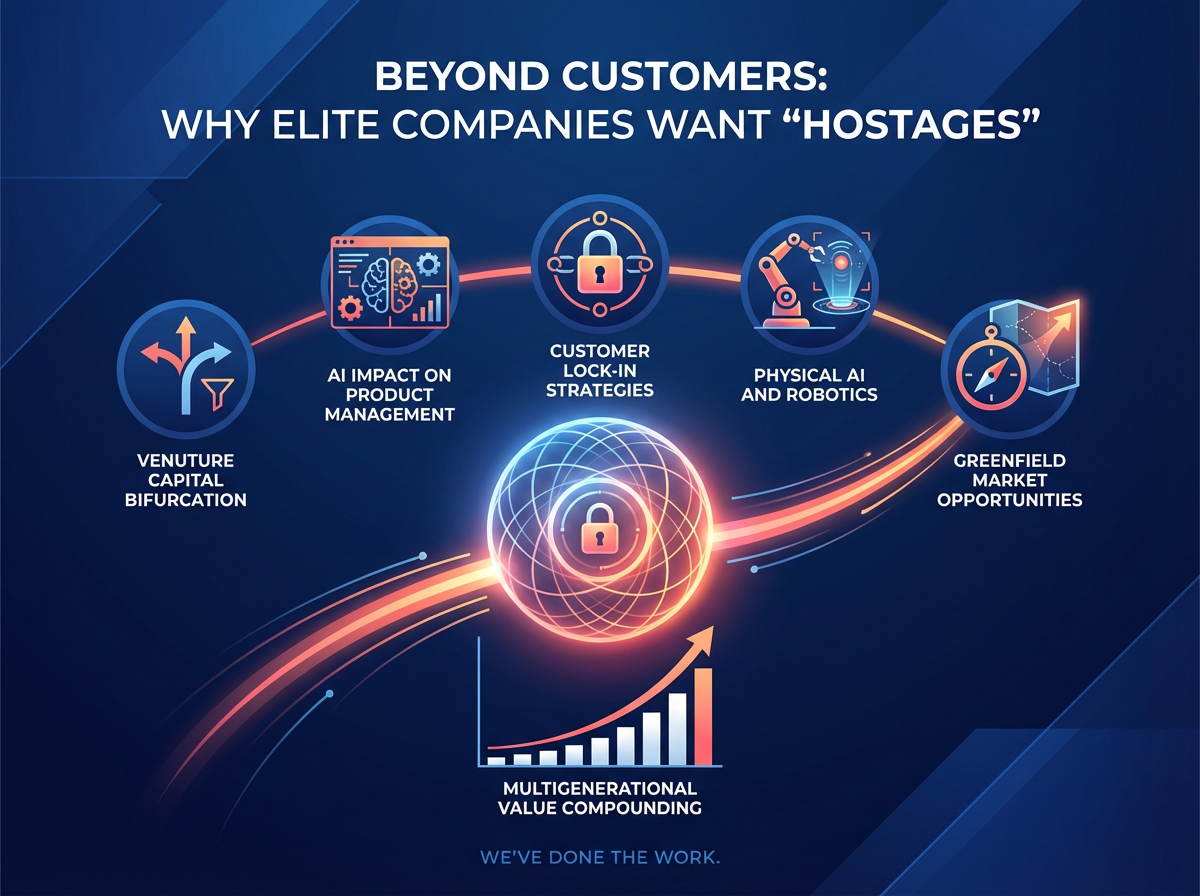
The Series A market has become "Greenfield Bingo," with valuations for AI moonshots and established SaaS platforms diverging wildly. Understanding whether your next capital injection is a gamble or a guaranteed win depends on accurately assessing your "hostage" count, not just your customer base.
The Intake
11 episodes across 7 podcasts
12 hours 4 min of conversation with GPs, founders, and LPs
The Big Shift
The VC "Middle" is Dead: Large Funds and Specialists Dominate as AI Accelerates Bifurcation
The venture capital landscape is increasingly bifurcated: either be a massive generalist fund or a focused specialist. The "death of the middle" means mid-sized generalist funds will struggle, as they lack the scale of the giants and the deep expertise of niche players. This trend is exacerbated by AI's accelerating impact, where the ability to deploy significant capital into highly competitive, rapidly evolving sectors (like AI infrastructure) or to deeply understand emerging, specialized markets becomes paramount. This shift directly impacts LPs, who are concentrating capital in top performers, and founders, who face a more extreme funding environment.
Why it matters: If you're a mid-sized fund, your strategy needs an urgent re-evaluation. For founders, understanding whether your target investors are deploying at scale (and what valuation expectations come with that) or are true specialists (who can add deep value beyond capital) is critical to framing your raise.
"My view is most asset classes you either have to be a large generalist or a small specialist. And the hard thing is to be like a mid sized generalist because then you're largely going to lose to like the big generalists or the small specialists."
— Alex Rampell, General Partner at Andreessen Horowitz on The Twenty Minute VC (20VC)
The move: Re-evaluate your capital strategy—whether as an LP, GP, or founder—against this "large or specialist" paradigm. How does your fund size or company stage position you?
The Rundown
① Unveiling government fraud is a viable, billion-dollar business model. The False Claims Act allows private entities to act as whistleblowers, earning up to 30% of recovered fraud dollars, effectively turning investigative journalism into a highly profitable venture (Alex Shieh on This Week in Startups).
- Why it matters: This creates a unique category of "bounty hunter" businesses addressing government efficiency, attracting entrepreneurial interest for impact-driven, high-return opportunities, albeit with long settlement times.
② AI is rewriting the product management playbook, eliminating PM roles in some companies. ElevenLabs operates without Product Managers, believing engineers should own the product roadmap and user feedback, with ex-PMs shifting to growth or product engineering roles (Luke Harries on The Twenty Minute VC (20VC)).
- The signal: This points to a deeper integration of technical execution and market strategy, potentially indicating a future where AI-native companies prioritize direct engineering ownership over traditional product management functions, merging product strategy directly into development and growth.
③ The "hostage" model: best companies lock in customers so tightly they can't leave. Top-tier VCs are prioritizing companies that effectively create high switching costs and deep integration, where customers are more like "hostages" than easily swayed patrons (Alex Rampell on The a16z Show).
"The best companies have hostages, not customers."
— Alex Rampell, General Partner at Andreessen Horowitz on The a16z Show
- What to watch: How founders are articulating lock-in during pitches—is it real system-of-record integration or just strong customer service? Investors will be looking for the former.
④ CES 2026 underscored the rise of "physical AI" and humanoid robots. The event highlighted a significant shift towards AI applications in the physical world, extending beyond software to robots for industrial and consumer use, despite some skepticism about their current utility (Sean O’Kane on Equity).
- The signal: This indicates a broadening of the AI investment thesis beyond pure software and compute, suggesting a new wave of capital allocation towards embodied AI, robotics, and integrated hardware/software solutions, creating potential greenfield opportunities for deeply technical founders.
⑤ The "Greenfield Bingo" strategy thrives in new markets. This approach involves building best-in-class products for burgeoning markets with high new company creation rates, effectively outcompeting incumbents without direct customer poaching (Alex Rampell on The Twenty Minute VC (20VC)).
- Why it matters: For founders, identifying and dominating these greenfield segments is a powerful strategy, reducing direct competition with entrenched players and allowing for faster market penetration by targeting unmet demand. For investors, it means looking beyond direct competitive displacement and into new market formation.
Capital Signals
🔥 HOT
- Physical AI & Humanoid Robotics: CES 2026 showcased a massive push into embodied AI, with major players and new startups entering the space. (Sean O’Kane on Equity)
- AI Infrastructure & Full-Stack Solutions: NVIDIA and AMD are expanding beyond chips, aiming to own the full AI stack with software and integrated solutions, indicating fierce competition for foundational AI components. (Kirsten Korosec on Equity)
👀 EMERGING
- 🆕 "Greenfield Bingo" Investment Thesis: Targeting new markets with high rates of company creation to build category-defining products, rather than directly unseating incumbents. (Alex Rampell on The a16z Show)
- 🆕 Investigative Journalism as a For-Profit Venture: Leveraging the False Claims Act to uncover government fraud can yield significant financial returns for private companies. (Alex Shieh on This Week in Startups)
🧊 COOLING
- Mid-sized Generalist VC Funds: The market is moving towards either very large generalists or small specialists, squeezing out the middle. (Alex Rampell on The Twenty Minute VC (20VC))
⚠️ CROWDED
- AI Application Layer: While critical, product development velocity in this layer is so fast (weeks vs. years), it creates extreme competitive pressure and rapid commoditization. (Alex Rampell on The a16z Show)
- Legacy SaaS Businesses: Companies not aggressively transforming into AI-native platforms will be left behind, as AI products are now generating more revenue than core SaaS for some first movers. (Ryan Anderson on The Official SaaStr Podcast: SaaS | Founders | Investors)
The Debate
Is the current AI valuation environment justified by demand, or is it a bubble reminiscent of past tech booms?
🐂 The bull case:
"if you look at what's going on underneath in terms of the customer adoption, the revenue growth rates, et cetera, like, we've never seen demand like this and so we've never seen valuations rise like this, but we've never seen demand rise like this either."
— Ben Horowitz, Co-founder and General Partner at Andreessen Horowitz on The a16z Show
🐻 The bear case:
"I don't think this means that there's going to be 20 more semiconductor grade outcomes. To be clear, it's a little like in networking... you look at it and you go, oh, someone made 20 billion in a one off, good luck to them."
— Rory O'Driscoll, Partner at Scale Venture Partners on The Twenty Minute VC (20VC)
Our read: While unprecedented demand supports high valuations for market leaders, the "one-off" nature of mega-exits like Groq or Manus suggests that not every AI company will achieve outsized outcomes. The market is highly selective, rewarding defensible infrastructure and unique application layers, while the "rest of the pack" faces significant churn and valuation pressure.
The Bottom Line
The venture market is hyper-efficient at pricing in extreme outcomes, both positive and negative—if you're not in the top decile of innovation or market share, prepare for a harsh re-evaluation of your capital strategy.
🎯 Your Move
- Audit your customer lock-in: Are your customers "hostages" deeply integrated, or just customers who can easily switch? Investors are increasingly prioritizing the former in a competitive AI landscape.
- Re-evaluate your PM function: If you're building an AI product, consider a more engineering-led product development model, shifting ex-PMs to growth or product engineering as ElevenLabs has done.
- Scan for "Greenfield Bingo" opportunities: Look for new markets with high rates of company creation where you can build a best-in-class product to dominate, rather than directly challenging entrenched incumbents.
What We Listened To
1. This Week in Startups: "How to Make Billions from Exposing Fraud | E2234"
Guests: Alex Shieh (Founder, The Antifraud Company), Blake Scholl (Founder and CEO, Boom), Jason Calacanis (Host, This Week in Startups)
Runtime: 65 min | Vibe: Investigative & Ambitious
Key Signals:
- Fraud as a Business Model: Private companies are leveraging the False Claims Act to uncover government fraud, creating a legitimate, profitable business with significant financial incentives for whistleblowers.
- Supersonic Comeback: New advancements in aerodynamics, materials, and software are making supersonic travel economically viable, with modern designs achieving 30% better fuel efficiency than Concorde.
- Startup Execution for Hard Problems: Applying lean startup principles to complex engineering challenges like supersonic flight or large-scale fraud detection shows how agility can tackle seemingly intractable problems.
"You can do a supersonic seat for the same fuel that a lay flat bed in business class would take. Ah, that's the key. That's what makes this feasible."
— Blake Scholl, Founder and CEO of Boom
2. The a16z Show: "Alex Rampell on Venture at Scale and Founder Incentives"
Guests: Harry Stebbings (Host, The a16z Show), Alex Rampell (General Partner, Andreessen Horowitz)
Runtime: 71 min | Vibe: Strategic & Provocative
Key Signals:
- Founder Materialization Framework: The best founders "materialize labor, capital, and customers," demonstrating deep agency and persistent drive, often fueled by "revenge or redemption."
- "Hostages, Not Customers": Truly great companies have such strong lock-in that their customers are effectively "hostages," making switching incredibly difficult and ensuring sticky revenue.
- AI's Application vs. Infrastructure: While infrastructure is critical, the application layer holds stickier customer relationships, especially in systems of record, making it a focus for long-term value creation.
"The best companies have hostages, not customers."
— Alex Rampell, General Partner at Andreessen Horowitz
3. The Twenty Minute VC (20VC): Venture Capital | Startup Funding | The Pitch: "20Growth: The $6.6B Growth Engine Behind ElevenLabs | Why ElevenLabs Do Not Have PMs | The 7 Part Launch Playbook to Crush All Launches with Luke Harries, Head of Growth @ ElevenLabs"
Guests: Luke Harries (Head of Growth, ElevenLabs), Harry Stebbings (Host, The Twenty Minute VC (20VC))
Runtime: 74 min | Vibe: Tactical & Disruptive
Key Signals:
- No Product Managers: ElevenLabs operates without PMs, instead empowering engineers to directly own the product roadmap, fostering a deeply technical and user-feedback driven development cycle.
- Sharded Growth Teams: Rather than a single unified team, ElevenLabs employs specialized "sharded" growth teams, each with dedicated resources for consumer, creator, and developer marketing.
- Strategic Launch Playbook: An effective launch requires "shameless" outreach, non-scalable personal DMs, and high-quality video content to grab attention and convert initial interest.
"Unless you have the editing skills of Mr. Beast, you're just not going to keep people for the launch video. So make it short, get the key message across in the first 30 seconds."
— Luke Harries, Head of Growth at ElevenLabs
4. The Official SaaStr Podcast: SaaS | Founders | Investors: "SaaStr 837: 10 Things To Do Right Now to Become AI Native with Filevine's CEO & Founder"
Guests: Ryan Anderson (Co-Founder and CEO, Filevine), SaaStr (Host, SaaStr)
Runtime: 29 min | Vibe: Transformative & Actionable
Key Signals:
- AI-Native Revenue Growth: Filevine generates more new revenue from AI products than its traditional SaaS platform, highlighting the urgency and potential of AI transformation.
- Rearchitecting for AI: Becoming AI-native requires tearing down legacy systems and fundamental architectural changes, rather than simply layering AI capabilities onto existing platforms.
- Blended Gross Margin Pricing: SaaS companies can offer AI products at competitive prices by leveraging their higher blended gross margins, outperforming AI-only competitors who lack this traditional SaaS revenue base.
"We are now doing far more revenue on a new quarter by quarter basis in AI products than in our SaaS product."
— Ryan Anderson
5. All-In with Chamath, Jason, Sacks & Friedberg: "Howard Lutnick: How America Can Hit 6% GDP Growth in 2026"
Guests: Howard Lutnick (Secretary of Commerce, US Department of Commerce), Chamath (Host, All-In Podcast, LLC), Jason (Host, All-In Podcast, LLC)
Runtime: 87 min | Vibe: Economic & Political
Key Signals:
- Trade Deal "Staircase" Strategy: Trump's trade negotiation strategy rewards early movers with the best terms, pressuring other nations to engage quickly or face less favorable deals.
- Reshoring and GDP Growth: Significant US GDP growth (projected 5-6%) is anticipated from reshoring manufacturing, infrastructure projects, and strategic trade deals prioritizing domestic production.
- Government Fraud as Economic Drag: A focus on combating an estimated trillion dollars in government fraud could significantly impact national economic health and resource allocation.
"President Trump does deals like a staircase. First stair gets the best deal. You can't get the best deal after the first guy win. Everyone says, I want the UK deal, I want the UK deal. The answer is no. They were first."
— Howard Lutnick, Chairman and CEO of Cantor Fitzgerald
6. The a16z Show: "Ben Horowitz on Investing in AI: AI Bubbles, Economic Impact, and VC Acceleration"
Guests: Ben Horowitz (Co-founder and General Partner, Andreessen Horowitz), Erik Torenberg (Host, The a16z Show)
Runtime: 34 min | Vibe: Incisive & Forward-Looking
Key Signals:
- AI Valuations Justified by Demand: Current high AI valuations are rooted in unprecedented customer adoption and revenue growth, indicating a genuine market shift rather than merely a bubble.
- VC Firm Verticalization: Andreessen Horowitz's verticalization strategy minimizes internal politics and allows for focused investing teams, adapting to the rapid pace of the AI cycle.
- AI as M&A Driver: AI's disruptive nature forces incumbents to acquire future-forward DNA, leading to a resurgence in M&A activity as traditional companies seek to integrate AI capabilities.
"if you look at what's going on underneath in terms of the customer adoption, the revenue growth rates, et cetera, like, we've never seen demand like this and so we've never seen valuations rise like this, but we've never seen demand rise like this either."
— Ben Horowitz, Co-founder and General Partner at Andreessen Horowitz
7. Equity: "CES 2026 was all about “physical AI” and robots, robots, robots"
Guests: Kirsten Korosec (Transportation Editor and Host, TechCrunch), Anthony Ha (Weekend Editor and Host, TechCrunch), Sean O’Kane (Senior Transportation Reporter and Host, TechCrunch)
Runtime: 34 min | Vibe: On-the-Ground Reporting
Key Signals:
- Physical AI Dominance at CES: CES 2026 prominently featured "physical AI" and humanoid robots, signaling a major industry shift towards integrating AI into tangible products and environments.
- Screenless AI Experiences: The trend towards ambient computing and screenless AI devices (e.g., smart rings) raises questions about utility but offers companies like Amazon greater control over user purchasing decisions.
- Full-Stack AI Pursuit: NVIDIA and AMD are aggressively pursuing full-stack AI solutions, moving beyond chip manufacturing to encompass software and entire AI infrastructure, intensifying the battle for AI dominance.
"The humanoids were everywhere. So that was the big thing."
— Sean O’Kane, Senior Transportation Reporter at TechCrunch
8. Lenny's Podcast: Product | Career | Growth: "What OpenAI and Google engineers learned deploying 50+ AI products in production"
Guests: Aishwarya Naresh Reganti (AI Product Builder/Researcher, OpenAI (formerly), Google (formerly)), Kiriti Badam (AI/ML Infrastructure Engineer, OpenAI, Google (formerly))
Runtime: 86 min | Vibe: Technical & Insightful
Key Signals:
- AI's Non-Deterministic Nature: AI products inherently deal with non-deterministic user input and model output, requiring a continuous calibration and development approach.
- Agency Control Trade-off: Developing AI involves a critical trade-off between giving AI agents autonomy and maintaining human control, necessitating a gradual increase in agency as trust is built.
- Leaders Relearning Intuition: Successful AI product deployment requires leaders to actively engage and 'relearn' their intuitions about technology, as traditional leadership experience may not apply to AI's unique challenges.
"Every time you hand over decision making capabilities or autonomy to agentic systems, you're kind of relinquishing some amount of control on your end. Right. And when you do that, you want to make sure that your agent has gained your trust or it is reliable enough that you can allow it to make decisions."
— Aishwarya Naresh Reganti, AI Product Builder/Researcher at OpenAI (formerly)
9. This Week in Startups: "Jason’s Top CES Products and Takeaways | E2232"
Guests: Jason Calacanis (Host, This Week in Startups), Alex (Host, This Week in Startups)
Runtime: 69 min | Vibe: Curated & Observational
Key Signals:
- M&A and IPO Resurgence: After a period of dormancy, M&A and IPO activities are picking up, with companies like Discord and Strava pursuing public offerings, signaling a more active liquidity environment.
- Data as a Moat: For consumer apps, user data embedded within the product creates a powerful "lock-in" effect, making it very difficult for users to switch, which is highly valued by investors.
- Accelerated AI Adoption: Despite market froth, there is massive, demonstrable adoption of AI technology across various sectors, underlining the genuine, demand-driven growth of the AI market.
"When people have their data in your product, you know it's very hard for them to unsubscribe. That's the best moat, the best lock in."
— Jason Calacanis, Host at This Week in Startups
10. The Twenty Minute VC (20VC): Venture Capital | Startup Funding | The Pitch: "20VC: Groq's $20BN NVIDIA Acquisition | Manus Acquired by Meta for $2BN | Why Sam Altman Does Not Care About Dilution | Navan Trading at 4x ARR & Why Going Public Does Not Make Sense Anymore | The Rise of Invisible Unemployment and Labour Markets in 2026"
Guests: Harry Stebbings (Host, The Twenty Minute VC (20VC)), Jason Lemkin (Founder, SaaStr), Rory O'Driscoll (Partner, Scale Venture Partners)
Runtime: 84 min | Vibe: Analytical & Speculative
Key Signals:
- Strategic Acquisition for Market Dominance: NVIDIA's $20 billion acquisition of Groq was primarily a strategic move to eliminate a potential competitor in the inference space and secure market share, emphasizing competitive elimination over pure valuation.
- "Local Maximum" Exits: Founders sometimes opt for significant exits at a "local maximum" to de-risk and gain life-changing wealth, even if VCs might prefer a longer hold for potentially higher, but riskier, returns.
- "Spite Startups" Drive AI Innovation: Competitive motivations—or "spite"—are fueling the creation of high-impact AI companies like Anthropic and xAI, demonstrating an unconventional but powerful driver of entrepreneurial ambition.
"Inference is all of the growth. And if Grok is even part of the answer, right, part of the existential answer for Nvidia, it's worth it."
— Jason Lemkin, Founder of SaaStr
11. The Twenty Minute VC (20VC): Venture Capital | Startup Funding | The Pitch: "20VC: a16z's $15BN Fundraise with Alex Rampell | The Best Companies Have Hostages Not Customers | The Best Founders Materialise Capital, Customers and Labour | Mid-Sized Funds with Die and The Future of Venture Capital"
Guests: Alex Rampell (General Partner, Andreessen Horowitz), Harry Stebbings (Host, 20VC)
Runtime: 77 min | Vibe: Foundational & Visionary
Key Signals:
- Death of the VC Middle: Venture capital is bifurcating into massive generalist funds and specialized niche funds, with mid-sized generalists struggling to compete on either scale or expertise.
- "Greenfield Bingo" Strategy: In markets with high new company creation, the strategy of building a clearly superior product for a new category can lead to dominance without directly "stealing" customers from incumbents.
- Accelerated Software Development: The ability to build software products in weeks, not years, creates intense pressure on application-layer companies, demanding extreme agility and rapid iteration to stay competitive.
"You want to invest in people that can materialize labor, capital and customers. If you quit your job to start a company and you can snap your fingers and five people follow you tomorrow for a 50% pay cut, that's pretty magical."
— Alex Rampell, General Partner at Andreessen Horowitz