THIS WEEK'S INQUIRY 📚 8 conversations with 7 thinkers ⏱️ 8 hours of long-form intellectual exploration 🎙️ Featuring: Sam Harris, Michael Levin, Andy McCarthy, Bari Weiss, Mel Robbins, Gabby Reece, Robert Breedlove 📅 Coverage: Mid-May 2024
The ideas worth your attention. Here's what we're thinking about.
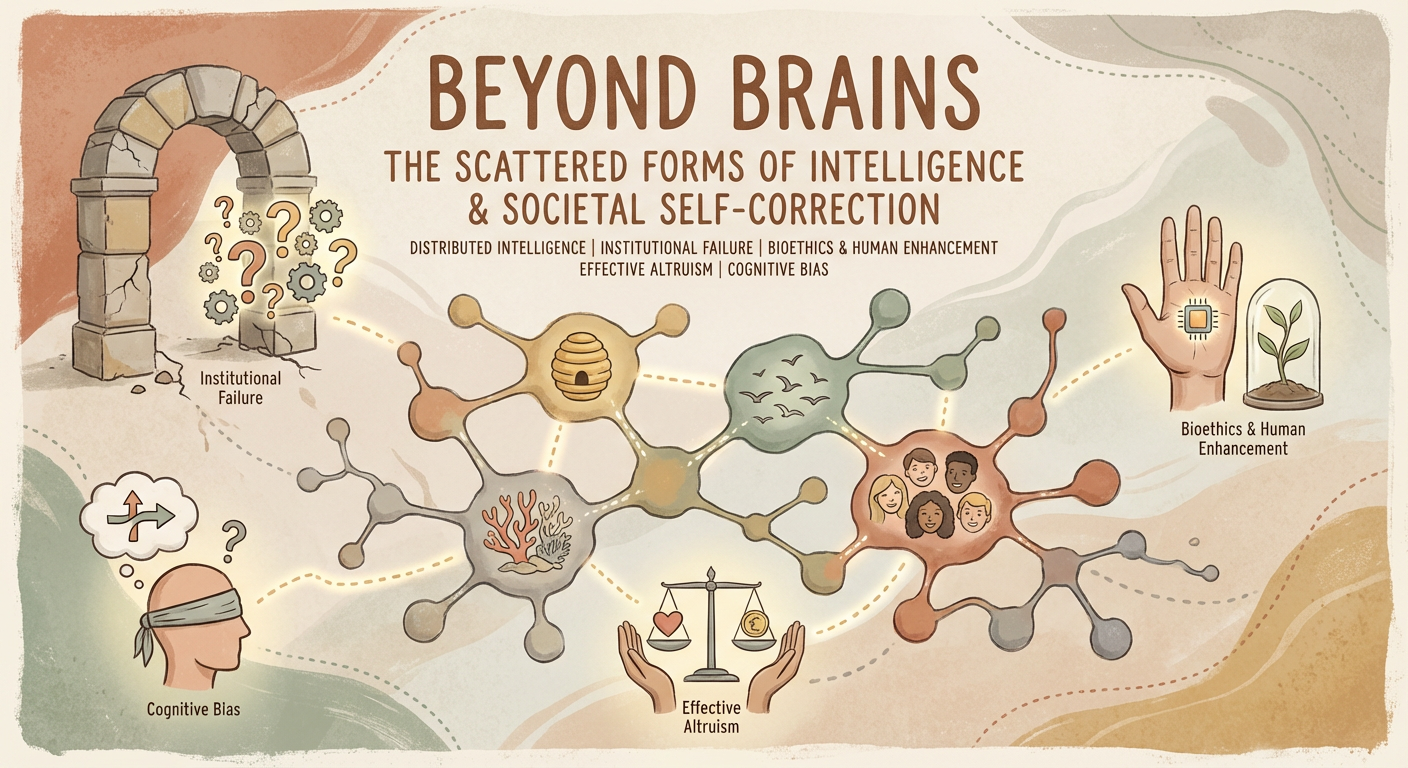
THE CASE FOR INTELLIGENCE — AND ITS SCATTERED FORMS
We often define intelligence by human-centric measures: problem-solving, language, abstract thought. But what if we're missing the forest for the trees? What if intelligence isn't just a point on a spectrum, but a distributed phenomenon, operating at scales we barely perceive? This week, conversations across fields challenged our narrow definitions, hinting at forms of intelligence embedded in everything from biological systems to corporate structures, and even the very fabric of the cosmos. The underlying tension? Our cognitive bias to see intelligence only where it mirrors our own.
Michael Levin, a developmental biologist, blew open the doors on this idea on the Lex Fridman Podcast, arguing that even single cells exhibit a form of "basal cognition"—a capacity for problem-solving, decision-making, and memory that predates neurons. Our bodies, he suggests, aren't just collections of automatons; they are federations of intelligences, collaborating to maintain homeostasis and achieve complex goals. This isn't just philosophical musing; it has profound implications for how we understand health, disease, and the very nature of consciousness. If tissues and organs possess a "mind" of their own, however rudimentary, it changes the entire paradigm of medicine and evolutionary biology.
This perspective resonates with insights from other domains. The Knowledge Project’s deep dive into Mary Kay Ash, for example, highlighted a different kind of intelligence: the strategic, empathic, and motivational genius that built an empire out of relationships. Ash's "Golden Rule" wasn't just a moral platitude; it was an organizational intelligence, a highly effective algorithm for motivating a distributed workforce and fostering collective success. It reveals that intelligence, in its organizational form, isn't always about brute computational power, but about understanding incentives, crafting culture, and leveraging social dynamics.
The thread here is that intelligence, far from being confined to brains, is a property of systems that can store information, adapt, and pursue goals. From cellular networks performing complex biological "computations" to business models that maximize human potential, intelligence manifests as a dynamic capacity for self-organization and problem-solving, often without a central processing unit. The question shifts from "what can a brain do?" to "what can a system do to achieve its ends?"
WHEN INSTITUTIONS FAIL: THE SYMPTOMS AND THE DEBATE OVER A CURE
It's clear that trust in institutions, from government to media to corporations, is at an all-time low. But why are they failing? And what does "failure" even mean? This week, two distinct perspectives emerged on institutional decay, each offering a different diagnosis and, implicitly, a different prescription.
Andy McCarthy, a former prosecutor, offered a legal lens on institutional failure during his conversation with Coleman Hughes. For McCarthy, the issue isn't so much institutional decay as it is active corruption or, at best, a purposeful misapplication of institutional power. He argues that once-sacred institutional norms—like the impartiality of the justice system—are being deliberately undermined by political actors. The problem isn't that the system is breaking down, but that it's being bent to serve partisan ends. The cure, in this view, is a return to fundamental principles, a re-establishment of ethical boundaries, and a forceful rejection of politicization. This diagnosis implies agency: institutions fail because people with power choose to make them fail.
"The whole trick of the American system is to try to make sure that the people who have power are also operating under the constraint that they know they could lose their power." — Andy McCarthy, Conversations With Coleman
A more structural, less agent-centric view emerges from other discussions. The underlying narrative of institutional failure in many public conversations points to a more diffuse problem: a loss of competence, a focus on performativity over substance, or perhaps simply an inability to adapt to new, complex challenges. For example, Ezra Klein's interview with Julie K. Brown, the journalist who exposed Jeffrey Epstein, implicitly highlighted institutional failures on multiple levels: law enforcement neglecting victims, media outlets shying away from difficult stories, and elite networks protecting their own. Here, the failure isn't always malicious; it's often a failure of imagination, courage, or simply a system too sluggish to respond to clear and present dangers.
The tension between these views is crucial. Is institutional failure a matter of deliberate subversion (McCarthy's view), requiring accountability and a recommitment to ideals? Or is it a more systemic, emergent property of complex organizations, perhaps requiring a fundamental redesign or a new kind of leadership? Most likely, it's both. But our choice of diagnosis dictates our chosen remedy. If we only look for malice, we might miss the slow erosion of competence. If we only look for structural problems, we might overlook the deliberate misuse of power.
THE ETHICS OF IMPROVEMENT: GENE EDITING, IMPOSTER SYNDROME, AND “DOING GOOD”
At what point does improving ourselves—or our species—cross an ethical line? This question, once confined to science fiction, is now a live debate, fueled by advances in biotechnology and a relentless cultural push for optimization. Yet, paradoxically, many individuals struggle with the perception of their own competence, feeling like frauds despite their achievements. This week we explored the boundaries of human aspiration, from genetic enhancement to psychological self-improvement, and even the philosophical underpinnings of "doing good."
Bari Weiss's discussion on designing babies directly confronted the ethical thicket of human genetic engineering. The debate is often framed as a conflict between avoiding future suffering (e.g., eliminating genetic diseases) and preserving human dignity (e.g., avoiding designer babies that create new forms of inequality). But a different, more provocative argument emerged: if we can eliminate suffering and enhance human capabilities, do we have a moral imperative to do so? This shifts the ethical dilemma from a conservative "should we meddle?" to a progressive "how can we not?" The consequences of inaction—allowing preventable suffering to continue—become the new ethical burden. The core question becomes: what do we owe future generations, and where does our responsibility end?
"The burden of proof needs to be shifted...if we could prevent the genetic diseases that lead to so much suffering, is it a moral imperative to use that science?" — [Implicit argument from guest in Honestly]
Meanwhile, on a more personal level, Mel Robbins tackled imposter syndrome (in two separate podcast appearances—a testament to its pervasive nature). Imposter syndrome, the feeling of being a fraud despite evidence of success, highlights a different kind of "improvement" challenge. It's not about what capabilities we lack, but about our internal perception of those we possess. Robbins's advice—focusing on small, actionable habits and reframing self-talk—suggests that even profound psychological blocks can be overcome with consistent, deliberate effort. This reflects a growing understanding that psychological well-being is not just about therapy but also about practical, behavioral interventions.
Sam Harris, in his exploration of effective altruism, brought a philosophical rigor to the idea of "doing good," asking how we can use our resources to maximize positive impact. This is improvement on a societal scale, a rationalist's approach to philanthropy. The common thread here is the pursuit of optimization: whether it's optimizing human genetics, human psychology, or human charitable efforts. Each domain struggles with similar questions: What are the true costs? Who benefits most? And where do our aspirations for a better future meet our limitations and ethical constraints? It reveals that "good" is not always self-evident, and that improving means constantly grappling with unforeseen consequences and complex moral trade-offs.
THE QUESTION WORTH ASKING
If intelligence is a distributed, emergent property, active across various scales from cellular networks to human organizations, and if institutions are failing due to a complex interplay of deliberate subversion and systemic inertia, then what kind of "intelligent system" is capable of self-correction and ethical evolution at the societal level?
We have individual intelligence, collective intelligence, and even biological intelligence. But as we enhance human capabilities (genetically, psychologically) and our institutions falter, what framework or meta-intelligence can guide us towards a future that optimizes for well-being without succumbing to unintended consequences or the tyranny of the well-intentioned? Is it a new form of digital governance, a re-imagined democratic process, or perhaps a more profound understanding of the "collective cognition" of humanity itself? We know how cells self-correct; we know how markets adapt. But how do we design for societal-scale intelligent self-correction, especially when the goalposts of "good" are constantly shifting?
THE READING LIST
📖 The Body Keeps the Score by Bessel van der Kolk — Explores the deep, embodied intelligence (or trauma) stored within our biological systems, echoing Levin’s ideas about cellular cognition operating below conscious awareness.
📖 Thinking, Fast and Slow by Daniel Kahneman — Essential for understanding the heuristics and biases that can lead to individual and collective irrationality, and thus contribute to institutional failures.
🎧 The Jordan Harbinger Show: "Ep. 504: Michael Levin | Is the Universe Conscious?" — Another fascinating conversation with Michael Levin, expanding on the ideas of basal cognition and distributed intelligence.
📖 Inspired, Not Retired: Leadership Lessons from Mary Kay Ash by Michael Ash — A direct resource for understanding the principles and leadership style behind Mary Kay Ash's organizational intelligence.
THE CONTRARIAN CORNER
While many conversations are about fixing broken institutions or improving individual cognition, a lingering question from these discussions is whether "fixing" is even the right frame. What if the current institutional structures are simply obsolete for the kind of complex, rapidly changing world we inhabit? The contrarian view here isn't just that institutions are failing, but that they are doing precisely what they were designed to do for a past era, and that attempting to patch them up is a waste of effort. Instead, perhaps we should be focusing less on repair and more on entirely new forms of organization, governance, and collective action that are natively designed for distributed intelligence and rapid adaptation. This would mean embracing a more radical approach than reform, one that dares to imagine post-institutional solutions rather than just better institutions.
THE BOTTOM LINE
We've explored intelligence at its most fundamental and most ambitious; we've wrestled with the decay of our most vital societal structures; and we've questioned the very nature of human improvement. The throughline? The urgent need for better frameworks—for understanding what intelligence is, for diagnosing institutional sickness, and for guiding our aspirations for a better future. The biggest challenge isn't a lack of smart people, but a lack of shared, robust mental models for navigating the complexity before us. What ideas are you betting on to bridge that gap?
📚 APPENDIX: EPISODE COVERAGE
1. Modern Wisdom: "#1027 - Mel Robbins - The Secret to Overcoming Imposter Syndrome"
Guests: Mel Robbins (New York Times Bestselling Author, Motivational Speaker)
Runtime: 1 hr 25 min | Vibe: Empowering, practical, self-improvement focused
Key Signals:
- The "High 5" Habit for Self-Belief: Imposter syndrome isn't about lack of competence, but a self-doubt loop. Robbins introduces the "High 5" habit—physically high-fiving yourself in the mirror daily—as a fast-track to self-encouragement, neurochemically proven to boost confidence and prime the brain for belief in oneself, rather than relying on external validation.
- Identifying Imposter Syndrome Triggers: The episode dissects the common triggers for imposter syndrome, linking it to feelings of inadequacy, fear of failure, or comparison. Robbins suggests that awareness of these internal narratives is the first step, allowing individuals to mentally "tag" and detach from these thoughts rather than internalize them as truth.
- The Power of Small, Consistent Actions: Overcoming deep-seated imposter syndrome isn't about one grand revelation, but about cumulative small wins. Robbins advocates for starting with tiny, achievable actions that build momentum and internal proof of capability, systematically dismantling the fraud narrative through consistent accomplishment.
"The moment you start doing small things, your brain gets to see you as the person who is capable of doing big things."
2. The Mel Robbins Podcast: "Get Back on Track: 3 Small Habits That Change Your Body, Energy, and Life"
Guests: Mel Robbins (New York Times Bestselling Author, Motivational Speaker), Gabby Reece (Former Pro Volleyball Player, Entrepreneur)
Runtime: 47 min | Vibe: Action-oriented, holistic, habit-forming
Key Signals:
- The Power of Micro-Habits for Macro Change: The conversation emphasizes that significant life changes don't require drastic overhauls but rather the consistent implementation of tiny, manageable habits. The episode details a "three-habit reset" focused on hydration, movement, and intentional breathwork, demonstrating how these small actions compound to improve overall well-being.
- Understanding the "Spiral Up" Mechanism: The discussion highlights how positive habits create an upward spiral effect, where improvements in one area (e.g., energy from hydration) naturally fuel motivation and capacity for improvements in others (e.g., more consistent exercise). This principle suggests that initiating even one positive change can cascade into broader life enhancements.
- Shifting from Overwhelm to Action: A key takeaway is the importance of simplifying and breaking down goals to overcome overwhelm, which often paralyzes individuals. By focusing on minimal, non-negotiable daily actions, the framework helps individuals bypass decision fatigue and perceived difficulty, thereby fostering consistency and long-term adherence.
"When you simplify your intention, and you simplify one step that you can take, consistently, over time, it generates this giant wave of self-confidence."
3. Making Sense with Sam Harris: "#446 — How to Do the Most Good"
Guests: Sam Harris (Neuroscientist, Author, Host)
Runtime: 1 hr 18 min | Vibe: Philosophical, introspective, ethically rigorous
Key Signals:
- The Rationality of Effective Altruism: Harris delves into the foundational premise of effective altruism, arguing that if one genuinely cares about reducing suffering and promoting well-being, it is morally incoherent not to apply reason and evidence to maximize impact. He positions effective altruism not as a niche movement, but as the logical conclusion of a compassionate worldview.
- Beyond Personal Feelings: The Data-Driven Approach to Ethics: The conversation emphasizes moving beyond intuitive, emotional responses to charity and instead adopting a dispassionate, data-driven approach to determine how resources can effect the most good. This implies a critique of traditional charitable giving that might prioritize personal connection over measurable benefit.
- The Challenge of Moral Trade-offs: Harris explores the difficult moral calculations inherent in effective altruism, such as prioritizing existential risks at a global scale versus immediate, local needs. He acknowledges the psychological discomfort of these trade-offs but insists that rationality demands confronting them directly to achieve the greatest possible positive outcome.
"If you truly care about reducing suffering, then the most ethical stance is to do the most amount of good that you can, given your resources."
4. The Knowledge Project: "Mary Kay Ash: The Greatest Saleswoman In History [Outliers]"
Guests: Robert Breedlove (Host), John David Mann (Author of "The Go-Giver")
Runtime: 1 hr 32 min | Vibe: Inspirational, business history, leadership principles
Key Signals:
- The "Golden Rule" as a Business Strategy: The episode highlights how Mary Kay Ash built her colossal empire not through aggressive sales tactics, but by genuinely prioritizing the success and well-being of her consultants, embodying the "Golden Rule" (treat others as you want to be treated). This philosophy fostered loyalty, motivation, and a highly effective distributed sales force, demonstrating empathy as a core business driver.
- Empowerment Through Opportunity: Mary Kay Cosmetics provided an unprecedented opportunity for women to achieve financial independence and leadership roles at a time when such opportunities were scarce. Ash's genius lay in designing a system that incentivized mentorship and lifting others up, where a consultant's success was tied to the success of those they recruited and trained.
- Culture as Competitive Advantage: The discussion underscores that Mary Kay's enduring success was rooted in a distinct, positive company culture centered on recognition, encouragement, and a strong sense of community. This culture, often dismissed as "soft," proved to be a formidable competitive barrier and a powerful engine for growth, illustrating the strategic value of an intentionally cultivated internal environment.
"Mary Kay understood that if you want to motivate people, you don't motivate them with money alone; you motivate them with respect, recognition, and the opportunity to become more."
5. Lex Fridman Podcast: "#486 – Michael Levin: Hidden Reality of Alien Intelligence & Biological Life"
Guests: Michael Levin (Developmental Biologist, Tufts University)
Runtime: 3 hr 15 min | Vibe: Mind-bending, scientific, philosophical
Key Signals:
- Basal Cognition: Intelligence Beyond Brains: Levin introduces the concept of basal cognition, arguing that intelligence and problem-solving are not exclusive to organisms with brains or nervous systems. He provides compelling evidence that single cells, tissues, and even entire organisms without a central nervous system exhibit complex decision-making, memory, and goal-directed behavior, challenging our anthropocentric view of intelligence.
- The Biocomputer of the Body: The episode posits that the body itself functions as a decentralized biocomputer, where cells and tissues communicate and process information to achieve complex morphological goals (e.g., forming a limb, regenerating an organ). This shifts the paradigm from individual cells as automatons to a collective intelligence collaborating for physiological outcomes.
- Implications for AI and Consciousness: Levin's work has profound implications not only for biology but also for artificial intelligence and our understanding of consciousness. If intelligence is a scalable property of matter capable of information processing and adaptation, then the search for alien intelligence, and the definition of consciousness itself, must broaden considerably beyond carbon-based brains.
"The brain isn't the only 'mind' in the biological universe. Your cells, your tissues, your organs are doing a lot of problem-solving. This is basal cognition."
6. Honestly with Bari Weiss: "Is Designing Babies Unethical—or a Moral Imperative?"
Guests: Bari Weiss (Journalist, Host)
Runtime: 55 min | Vibe: Provocative, ethical debate, future-oriented
Key Signals:
- The Shifting Moral Landscape of Gene Editing: The episode explores how advances in gene editing technologies (like CRISPR) are forcing a re-evaluation of deeply held ethical priors. It moves the discussion beyond just preventing disease to the proactive enhancement of human traits, positing that a future with "designer babies" is not just theoretically possible, but increasingly within our grasp.
- From Averting Suffering to Moral Imperative: A central tension is whether, given the ability to eliminate genetically linked diseases and potentially enhance beneficial traits, there emerges a moral obligation to pursue such interventions. This flips the traditional ethical cautiousness on its head, suggesting that inaction when capability exists could be seen as irresponsible.
- Equity and Access: The New Ethical Frontier: The conversation highlights the inevitable socioeconomic disparities that would arise from accessible but expensive gene-editing technologies. While the science promises to eradicate suffering, its unequal distribution could exacerbate existing inequalities, creating a genetic divide between the "haves" and "have-nots," sparking fresh ethical and societal challenges.
"Is it ethical to intervene? Or, given what we know we can prevent, is it actually a moral imperative now to intervene?"
7. Conversations With Coleman: "Justice in the Age of Retribution with Andy McCarthy"
Guests: Andy McCarthy (Former Federal Prosecutor, Author), Coleman Hughes (Host)
Runtime: 1 hr 29 min | Vibe: Incisive, legal, politically analytical
Key Signals:
- The Politicization of Justice: McCarthy argues vehemently that the impartiality of the American justice system is being eroded by partisan politics, with prosecutors and agencies increasingly driven by ideological agendas rather than strict adherence to the rule of law. He posits that this politicization undermines public trust and corrupts the foundational principles of justice.
- The Distinction Between Justice and Retribution: The episode carefully unpacks the difference between seeking justice (fair application of law, proportional consequence) and pursuing retribution or vengeance (punishment driven by emotion or political animosity). McCarthy highlights the dangers when the latter masquerades as the former, leading to weaponization of legal processes.
- Erosion of Institutional Norms: A recurring theme is the decay of unwritten rules and norms that historically safeguarded the integrity of legal and governmental institutions. McCarthy contends that once these norms are breached, it sets a dangerous precedent, making it progressively easier for subsequent actors to further deviate from ethical conduct without facing significant pushback.
"The whole trick of the American system is to try to make sure that the people who have power are also operating under the constraint that they know they could lose their power."
8. Making Sense with Sam Harris: "#446 — How to Do the Most Good"
Guests: Sam Harris (Neuroscientist, Author, Host)
Runtime: 1 hr 18 min | Vibe: Philosophical, introspective, ethically rigorous
Key Signals:
- The Rationality of Effective Altruism: Harris delves into the foundational premise of effective altruism, arguing that if one genuinely cares about reducing suffering and promoting well-being, it is morally incoherent not to apply reason and evidence to maximize impact. He positions effective altruism not as a niche movement, but as the logical conclusion of a compassionate worldview.
- Beyond Personal Feelings: The Data-Driven Approach to Ethics: The conversation emphasizes moving beyond intuitive, emotional responses to charity and instead adopting a dispassionate, data-driven approach to determine how resources can effect the most good. This implies a critique of traditional charitable giving that might prioritize personal connection over measurable benefit.
- The Challenge of Moral Trade-offs: Harris explores the difficult moral calculations inherent in effective altruism, such as prioritizing existential risks at a global scale versus immediate, local needs. He acknowledges the psychological discomfort of these trade-offs but insists that rationality demands confronting them directly to achieve the greatest possible positive outcome.
"If you truly care about reducing suffering, then the most ethical stance is to do the most amount of good that you can, given your resources."